That evening, Nadya laughed so much that her cheeks began to hurt. Nikolai came home carrying a bouquet the size of a small bush and solemnly announced that they were celebrating their “two-week anniversary of having the stamp in our passports.” The light in their rented one-room apartment was warm and yellow, making it seem as though life was somehow settling into place all by itself. 🌿
“Two weeks of marriage,” Nadya said, “and you’re already bringing me flowers. Suspicious.”
“It’s a strategy.” Nikolai arranged the bouquet in a three-liter glass jar. “I’m getting you accustomed to the good stuff early, so later you’ll have something to compare things with.”
“Smart. Like giving me an advance before taking out a lifelong mortgage on my patience.”
“I thought that was called love.”
“Love is when you wash the inside of the jar, not just the outside,” Nadya said, pointing at the streaks. “The philosophy of domestic life, darling.”
Two days later, she went to visit her Uncle Viktor.
She had been visiting him almost every day since he came home after that terrible industrial accident—a steel beam, a fractured spine, six months in hospitals, and a limp that had changed his walk forever.
He never complained. In general, he was a man stingy with complaints but generous with jokes. 💙
“Oh, look who it is—my niece,” Viktor said as he opened the door. “A married woman now. How’s the husband? Are you feeding him?”
“He feeds himself, Uncle Vitya. I merely inspire him.”
“Inspiration is very high in calories.” He lowered himself heavily into an armchair. “Sit down. Tell me something stupid and cheerful. I’m tired of intelligent things.”
So Nadya talked.
She told him about the jar with the bouquet, about the neighbor who rehearsed speeches in front of the mirror every morning, and about how she and Nikolai had argued over what to name the cat they might have someday.
Viktor listened and smiled with half his face—the half that still obeyed him.
“Has Artyom called?” she asked once.
Only once.
And regretted it immediately.
“No,” her uncle answered shortly.
Then he changed the subject back to cats.
She remembered Artyom as a boy. She remembered how they used to jump from the shed at the summer house into a pile of sand, how he had generously shared his broken scooter with her, and how he used to call her “Nadyoga.”
And then there had been that argument with his father—loud, bitter, vicious.
Artyom had slammed the door behind him.
And he never came back, not even when his father was lying in the hospital attached to IV drips and asking to see him. 😔
Nadya’s mother, Olga, had called her nephew perhaps twenty times.
“Artyom, please come. He’s your father,” she would say into the phone. “He’s having a very hard time.”
“Aunt Olya, I have my own life. He said everything he wanted to say back then. Let him live with what he said.”
“You won’t forgive yourself later.”
“I will. I forgive myself for everything.”
Nadya never raised the subject again.
She simply kept visiting.
She brought newspapers because her uncle refused to accept news from a screen, repaired his lamp, and listened to his stories about how, back in 1979, he had accidentally sunk someone else’s motorcycle in a river.
Then her mother called.
“Nadya. Uncle Vitya died.”
“What?”
Nadya stood in the middle of the hallway wearing only one boot.
“We talked yesterday. He was laughing. He was telling me about the motorcycle.”
“He didn’t wake up this morning. His heart.”
“That can’t happen.”
“It can, sweetheart. That’s always how it happens.”
There weren’t many people at the funeral.
His son didn’t come.
No flowers. No phone call. Not even a message.
Nadya stood beside the grave holding her mother by the elbow, while one meaningless phrase kept circling through her head:
“Nadyoga, jump! The sand’s soft here.” 🕯️
Six months passed uneventfully: the rented one-room apartment, both of them working, evening arguments over whose turn it was to go out and buy bread.
Nikolai joked that Nadya was “building her career as if someone were chasing her.”
Nadya replied that the only thing chasing her was the rent.
“Nadya,” Olga said one day on the phone, “you need to go to a notary.”
“Where?”
“To a notary. About Uncle Vitya.”
“Mom, what does this have to do with me?”
“You’ll find out when you get there.”
She found out.
The three-room apartment in the old district—the same apartment her uncle had inherited from his father—and a plot of land with a summer house had been left to her.
To Nadezhda.
His niece.
Nadya read the document three times, as though a typo might suddenly reveal itself. 😳
The phone rang that same evening.
Artyom didn’t bother saying hello.
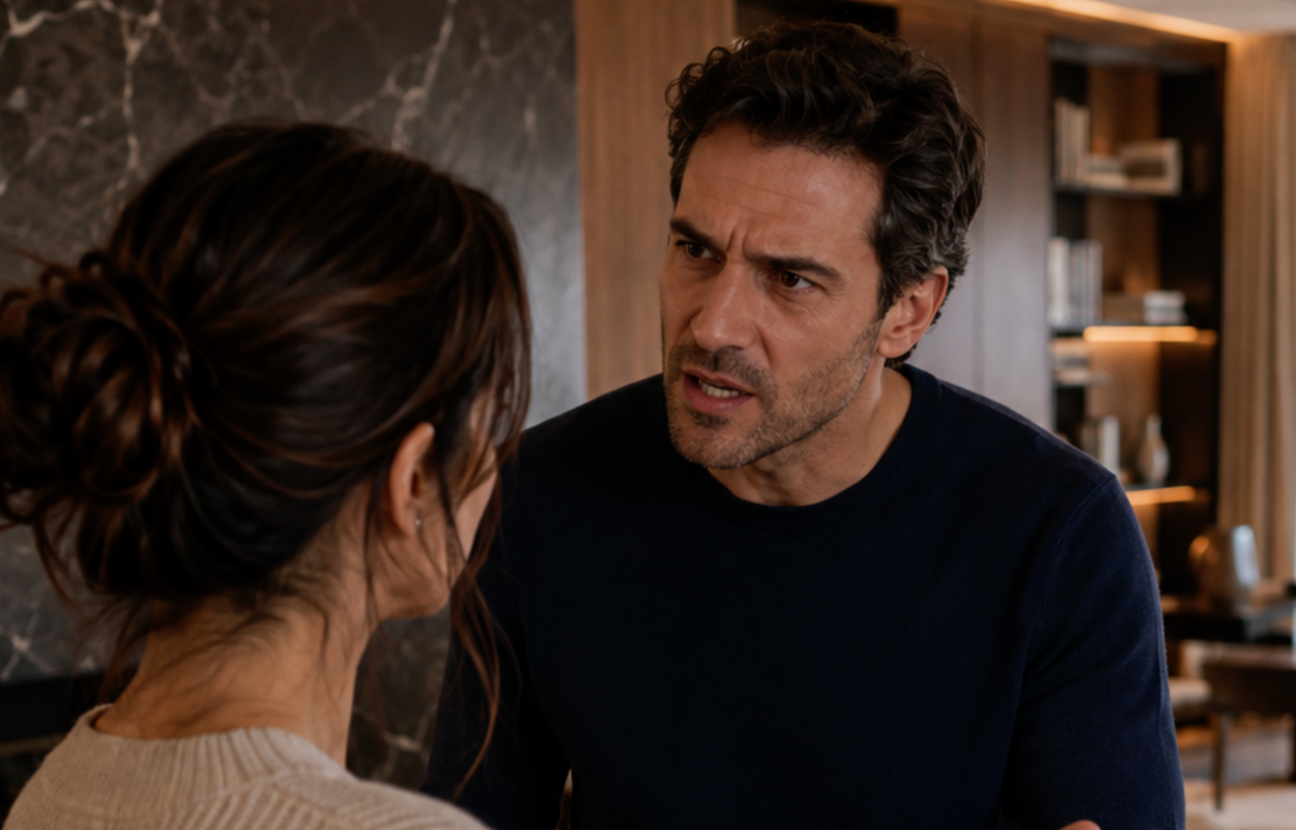
“Do you have any conscience at all?” he shouted into the phone. “How did you pull this off? You kept visiting him so you could beg him for his property, didn’t you?”
“Hello, Artyom. We haven’t spoken for eight years, and you’ve gone straight for the trump card.”
“Don’t play innocent! That’s my father’s apartment! It’s mine!”
“Actually, your father was yours,” Nadya said evenly. “An apartment is just walls. You didn’t lose the walls. You lost a person and didn’t even notice.”
“You’re going to lecture me about morality now?!”
“No. Morality isn’t a popular commodity, so I don’t waste money on it. I’m simply answering your questions.”
Olga took the phone.
“Artyom,” she said without anger, “I’m not going to scold you. I’ll only remind you. Your father asked you to visit him in the hospital. Twice he asked me to tell you. You said, ‘I have my own life.’ You didn’t come to the funeral. You made all your choices yourself, dear. The will is simply a piece of paper where those choices were written down.”
“To hell with you and your precious square meters! I hope neither of you ever finds happiness inside those walls!” His voice cracked.
“Noted,” Nadya said calmly. “Curse accepted. You’re number thirty-eight in the queue.”
He hung up.
He never challenged the will in court—either lawyers explained that the case was hopeless, or his pride prevented him from showing up somewhere when he hadn’t even shown up for his father. 🚪
“Mom, I don’t understand,” Nadya said that night. “Why me?”
“Because that’s how it should be,” Olga replied. “This is how he explained it to me: ‘The one who came to see me while I was alive can live there after I’m gone.’ That’s all. Don’t ask anymore.”
When Nikolai heard the news, he picked his wife up right there in the hallway.
“Nadyusha, you’re a woman with real estate now!”
“I’m a woman with renovations now. Those are two completely different genres.”
“I’ll support you. Morally and physically.”
“Morally means holding the stepladder, not giving advice.”
He was happy.
Genuinely happy for her—and somewhere in a separate, quiet corner of his mind, happy for himself too.
The apartment, which her uncle had inherited from his own father, had three rooms, high ceilings, creaking parquet floors, and enough structural strength to last another hundred years.
A week later, Nikolai called his mother, Larisa, and couldn’t resist telling her.
“Mom, can you believe it? Nadya has a three-room apartment in the old district now, plus a summer house! The apartment has been in her family forever—it goes back to her great-grandfather.”
“Oh, Kolya,” his mother drawled. “Now that’s luck. Fell straight out of the sky.”
“Not out of the sky. From her uncle.”
“You know what I mean. Listen, don’t forget about Veronika. Three kids, renting a place, struggling all the time. You’re her brother.”
“Yeah, Mom.”
Nikolai let the remark pass through one ear and out the other, like a station announcement.
His mother hung up and immediately called her daughter.
“Veronika, Kolya’s wife has a three-room apartment and a summer house now.”
“What?” Veronika actually sat down. “Just like that?”
“She inherited it. Her uncle left it to her.”
“Mom, that’s so unfair! Denis and I are crammed into a rental with three children, and an apartment just drops into her lap! What did she do to deserve that?”
“Good behavior, apparently,” Larisa said dryly. “Don’t be jealous. Think.”
“Think about what? We have that one-room apartment we rent out. Denis wants to sell it and take out a mortgage. But we can only afford a two-room place, and there are five of us. Five, Mom!”
“Exactly. Think,” her mother repeated.
Nadya and Nikolai moved into the inherited apartment.
Olga came over three days in a row, washing windows, sorting through books, and putting Uncle Viktor’s belongings into boxes—some things to keep, others to give away.
Nadya claimed one room for herself and installed bookshelves all the way up to the ceiling. 📚
“Nadyusha,” Nikolai said one evening, looking around at the parquet floor. “What about me?”
“What do you mean?”
“Well… we’re married. Maybe we should make everything official properly. Give me a share of the apartment or something.”
Nadya put down the screwdriver.
“Kolya. The apartment is mine. And it will remain mine.”
“I was only asking.”
“And I was only answering. My answers are fast, like express delivery.”
He said nothing.
He shrugged and went off to install a curtain rod.
The subject was closed—or so Nadya thought.
Veronika arrived on Saturday with her three children, a box of marshmallows, and eyes that scanned every square inch of the apartment.
“Oh, Nadyusha, this is gorgeous!” she exclaimed, walking down the hallway and touching the walls. “Look at these ceilings! Three meters high! Separate rooms too. Absolutely luxurious. Some people are lucky, while others work their whole lives.”
“Some people work their whole lives and get lucky too,” Nadya said with a smile. “Nature isn’t always fair, but at least it’s consistent.”
“It’s easy for you to joke. You got everything handed to you.” 😤
“I got eight years of conversations with a man who was dying piece by piece. Would you like to trade places retroactively?”
Veronika stopped short and immediately changed her tone.
“All right, all right. I didn’t mean anything bad. Listen, we have news. Denis sold the one-room apartment!”
“He sold it?” Nadya brightened. “So you got the mortgage? Congratulations!”
“No.” Veronika waved a hand. “We bought a car. A big seven-seater. We have to drive the kids around—to activities, doctors, everywhere.”
“And where are you going to live?”
“We’re renting for now. Like everyone else.”
“Nika, you sold something that generated income and bought something that consumes income. That’s like selling a cow and buying a very comfortable bucket.”
“You don’t understand! You don’t have children!”
“I don’t have children, but I do have a calculator. It doesn’t give birth, but it knows how to count.”
Veronika sulked but finished the marshmallows anyway.
The children raced through the hallway. The oldest peeked into the room full of books and gasped admiringly.
“It looks like a movie in here!”
The following day, without calling ahead, Nikolai’s aunt Inna appeared.
She was a loud, good-natured woman with a talent for dropping remarks as though they had simply fallen out of the sky on their own.
“Oh, kids, you have so much space!” she exclaimed, sitting down and opening a bag of gingerbread. “Listen, why don’t you take Larisa in? She must get lonely living by herself.”
“Aunt Inna,” Nadya said, raising an eyebrow, “was that a joke, or are you conducting reconnaissance?”
“Oh, I’m only saying it because we’re family!”
“Family is when you bring gingerbread. This is logistics.”
Everyone laughed.
Inna left, waving from the elevator.
“Nadyusha,” Nikolai said as he closed the door, “maybe we really should think about it. She is alone.”
“Kolya. Your mother and I have excellent neutral relations. She has never interfered in our lives, and I am genuinely grateful to her for that. Do you know why it works? Because distance is the best preservative for family affection.”
“So that means no?”
“It means don’t bring it up again. The apartment is mine, and it will remain mine.”
Nikolai clenched his jaw.
“The apartment is yours. How long are you going to keep throwing that in my face?” her husband asked, hurt in his voice. 🏠
Nadya exhaled.
She walked over and placed a hand on his shoulder.
“I’m not throwing anything in your face. I’m marking a boundary so nobody trips over it in the dark. That’s it. Peace. Come on, let’s hang that shelf. It won’t hang itself.”
He nodded.
The rough edges smoothed over—for two weeks.
Larisa came on Thursday.
From the moment she stepped inside, she wasted no time taking off her shoes or asking how they were doing.
“That’s it, kids. It happened.”
“What happened?” Nikolai tensed.
“Denis sold the one-room apartment. The one they were renting out. Now they have no income from it, and they can’t afford their rent. Veronika, her husband and the children are moving in with me. All five of them. Into my two-room apartment.”
Larisa sat down and surveyed the room.
“So I’ll move in with you. You have enough space here for an army company.”
Nikolai went pale.
“Mom, that apartment was their only safety net! Where did the money go? Into the car?! They turned their apartment into wheels?”
“Don’t shout at your mother!”
“I’m not shouting, I’m in shock! That’s like setting your house on fire to keep warm!”
“What’s done is done.” Larisa waved her hand as though swatting away a fly. “It’s settled. I’m moving in here. I’ll take the room with the books. Nadya, you can move your books to the summer house.”
Nadya remained silent.
She had understood everything back when Aunt Inna had dropped those innocent little gingerbread-flavored hints at the door.
The scheme was as clear as a blueprint: first reconnaissance, then admiration of the square footage, then “but we’re family,” and finally suitcases in the hallway.
“Nikolai,” Nadya said without looking at his mother. “Come with me. I want to show you something.”
“Why aren’t you talking to me?!” Larisa snapped. “I’m sitting right here!”
Nadya didn’t answer.
She led her husband through the apartment, speaking evenly and calmly, like a tour guide.
“Look. Here’s the bedroom—ours. Here’s the room with the books—my workspace, the place where I can breathe. Here’s the guest room. You and I already discussed it. It’ll become a nursery when we have children.”
“Nadya…”
“And now the important part.”
She opened the hallway closet and rolled out a gray suitcase.
She placed it in the middle of the hallway.
Beside the front door.
Without saying a word.
Nikolai stared at the suitcase.
Then at the door.
Then at the threshold.
And understood everything without a single word. 🧳
Nadya returned to the room, sat in the armchair opposite her mother-in-law, and said:
“The apartment is mine.”
And this time Nikolai didn’t say a single word about her throwing it in his face.
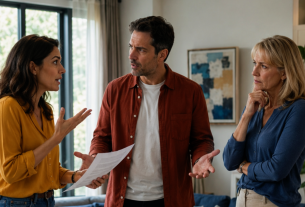
“Oh, so that’s how it is!” her mother-in-law sprang to her feet. “You’ve already packed his things?! Who do you think you are here?! You got all of this for free, never lifted a finger for it, and now you’re throwing your own family out into the street?! You don’t have a shred of conscience!” 😡
“Don’t shout,” Nadya said. “My hearing is excellent. Better than your planning skills, at least.”
“Kolya! Do you hear how she’s talking to me?!”
“Mom.”
Nikolai stood up.
His voice was unusually firm.
“Sit down, please. And listen.”
“What?!”
“I’m not blaming you. You want to help your daughter. I understand that. But let’s stick to the facts. The apartment belongs to Nadya. Not me. Not you. Not Veronika.”
“You listen to your wife more than your own mother?!”
“Veronika and Denis are adults. They chose to sell their one-room apartment. They chose to spend the money on a car instead of housing. Nobody forced them. Veronika has a husband. Her husband has parents too. And, incidentally, they have walls as well.”
“They were busy having children instead of sitting around staring at the ceiling!”
“They had three children without stopping to think about where those three children would sleep. That was their choice, Mom. I respect their choice. But my wife is not going to pay for it.”
Larisa opened her mouth but couldn’t immediately find the words.
Veronika, who had quietly arrived after her mother and was now standing in the doorway, froze too.
She had been certain her brother would give in.
In her mind, she had already arranged the furniture. 😶
“Kolenka,” Larisa tried from another direction, her voice quieter and trembling. “I’m old. I’m alone. I need help.”
“Mom, I love you. And I will help you. With money, with physical work, with medicine, repairs—whatever you need. But you have your own two-room apartment. Yours. And you are not obligated to give it to anyone—not to me and not to Veronika. You don’t have to move into somebody else’s home just to free up your own.”
“But they…”
“They can solve their own problems. You can remain a loving mother and a loving grandmother. You don’t have to become a dormitory.”
“You’re cruel!”
“I’m an adult.”
Nikolai exhaled.
“And one more thing. Nadya and I want children. Here. In this apartment. And I don’t want my wife living in her own home as though she has no rights. Six months ago, she lost a man who helped raise her almost as much as her own family did. She visited him every day when he was sick. And now people are telling her she ‘never lifted a finger’ to deserve this place. Mom, that is beyond unacceptable.”
His mother turned toward Nadya—her last hope.
“Nadyusha, you’re a kind person. Say something to him.”
“I will,” Nadya nodded. “Listen to your son. He’s in the best form I’ve ever observed.”
Larisa stood up.
She adjusted her sleeve.
She looked at Veronika, then at the suitcase beside the door—and understood everything.
“Well, enjoy your life,” she said, no longer shouting.
“And I sincerely wish you the same,” Nadya replied.
Nikolai went to see them out.
Veronika left first without saying a word.
Nadya remained alone in the apartment, where the parquet floor creaked and her uncle’s books still stood on the shelves.
She sat in the armchair and began unraveling the entire chain, link by link. 🧩
It hadn’t started with money.
It had started with envy.
Her mother-in-law had seen the three-room apartment and immediately constructed a convenient plan in her mind: her son had lots of space, therefore there was room.
She told Veronika, and Veronika began believing that their mother’s two-room apartment would soon become available.
Veronika convinced Denis that housing was “taken care of,” and Denis, losing his head completely, sold their only real safety net and bought a car.
The chain became long:
a word—hope—certainty—a sale—a dead end.
And the entire structure rested on someone else’s apartment without anyone ever asking the owner.
The person who broke the chain was Nikolai.
Not Nadya with her suitcase.
Him.
The same man who, only two weeks earlier, had taken offense every time she said the word “mine.”
He returned an hour later.
He took off his shoes, hung up his jacket, and walked into the room.
He said nothing about his mother or his sister.
Nadya walked over and hugged him tightly with both arms.
“Do you know what finally got through to me?” he said into the top of her head… no, into her shoulder, because she was almost as tall as he was. “The suitcase.”
“I suspected as much.”
“I stood there looking at it and started counting. Soon there’ll be six people in Mom’s two-room apartment. And if I hadn’t stopped, I would’ve become number seven. With a suitcase.”
“You’re quick with numbers. I love a man who can do mental arithmetic.”
“Nadya. Forgive me. For saying, ‘How long are you going to keep throwing it in my face?’ You weren’t throwing anything in my face. You were simply telling the truth, and I heard it as an accusation because the truth made me uncomfortable.”
“It happens. The truth often rubs like a new pair of shoes.”
“The apartment is yours. And it will remain yours. I’m your husband, and I’ll protect both you and the apartment. In that order—you first, the walls second.”
Nadya hugged him even tighter.
Outside the window, the old courtyard rustled with life. Somewhere children were laughing, and the parquet floor creaked beneath them—the same floor that remembered her great-grandfather. 💙
“Uncle Vitya,” she whispered, “turns out you knew exactly what you were doing.”