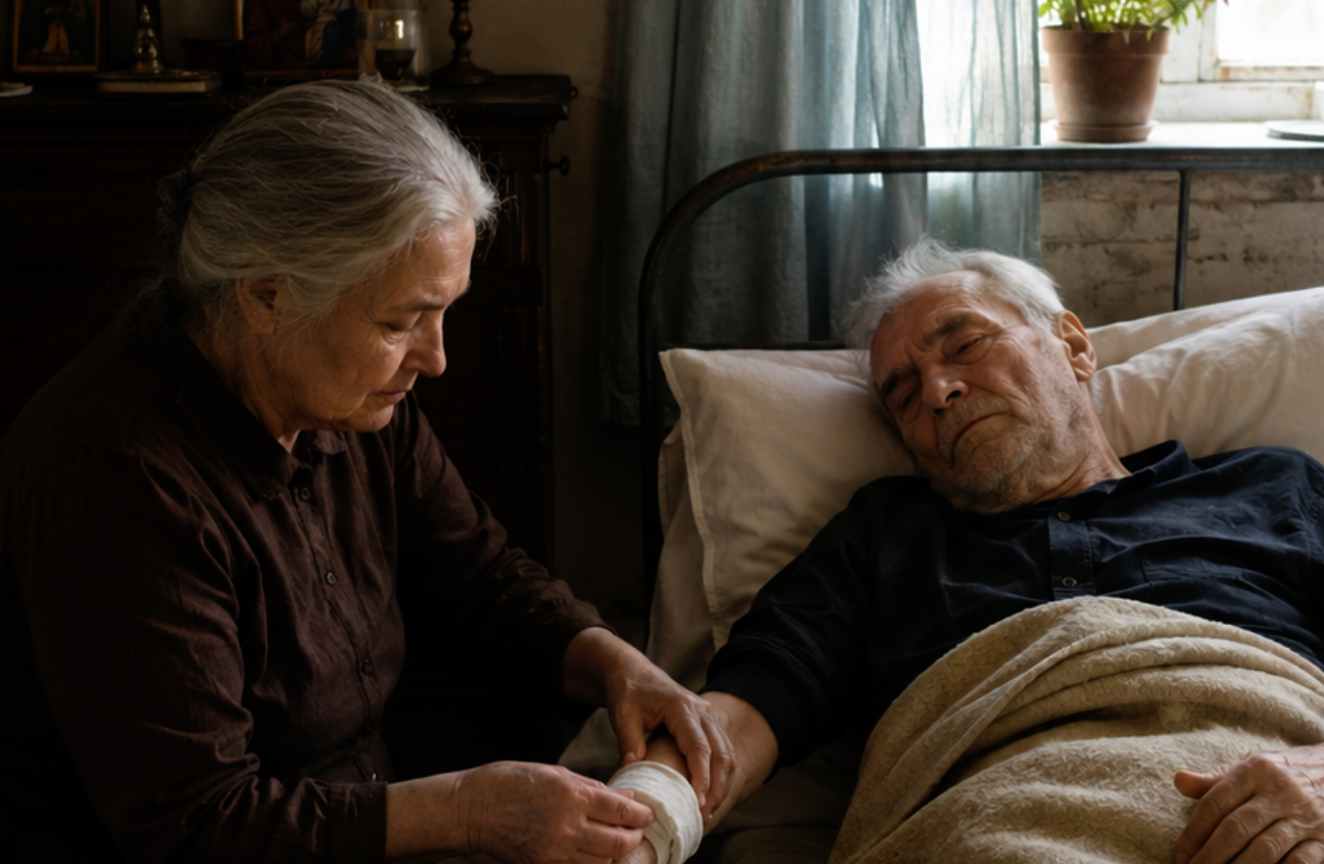
Zinaida entered the room exactly as she did every morning at the same time—seven o’clock sharp. In her hands she carried a basin of warm water, and over her shoulder hung a clean towel. She placed the basin on the stool beside the bed, adjusted the curtain, and let the daylight in.
Nikolai lay on his back, staring at the ceiling. After the stroke, he could no longer speak. He only groaned when he was in pain and followed Zinaida’s movements around the room with his eyes. His eyes were clear, alive, fully aware. That was the most frightening part: his body had failed him, but his mind remained intact. He saw everything, heard everything, understood everything—and could do nothing.
“Come on, let’s wash you,” Zinaida said calmly, without warmth or anger. “Let’s turn you onto your side.”
With the practiced skill she had developed over time, she rolled him over, tucked a pillow beneath him, and wiped his face, neck, and hands. Everything was done quickly and precisely, like an experienced nurse. Then she changed the bedding, fed him pureed porridge by the spoonful, and held a drinking cup of water to his lips.
And throughout it all, there was not a single unnecessary touch. Not one second of physical contact beyond what was required.
Everyone said she cared for him perfectly—the neighbors, the local doctor, even their children when they came to visit. Perfectly. Better than any professional caregiver. Everything was clean, everything was done on time, and she never complained.
But no one noticed one small detail.
In a year and a half, she had never once taken his hand.
She had never stroked his hair.
Never kissed his forehead.
Never spoken a single affectionate word to him.
She was like a machine.
A flawless, tireless, emotionless machine caring for a helpless human being.
Nikolai saw it.
And he understood why.
He had cheated on her all his life.
He had not even tried particularly hard to hide it. He did it with a kind of shameless, provincial openness.
The first time happened two years after their wedding, with a saleswoman from the local store. Zinaida found out immediately. The village was small; nothing stayed secret for long.
She ran to him crying, pounding her fists against his chest.
He simply stood there, looking at her calmly.
“Why are you carrying on like this, Zin? I’m a man, aren’t I? It doesn’t mean anything. It’s just… for my health. You’re the only one I have. You’re my wife.”
And she believed him.
Because what else could she do? She was twenty-two years old, with a baby in her arms, a house, a household to manage.
And because she loved him.
Foolishly, faithfully, with that old-fashioned village kind of love that expected to last a lifetime.
Then there was a second woman.
A third.
A tenth.
Eventually, he stopped making excuses altogether.
He would come home before dawn smelling of another woman’s perfume, lie down beside her, and begin snoring.
And Zinaida would lie awake staring at the ceiling, swallowing her tears so she wouldn’t wake the children.
In the morning, she would get up and go to work.
Zinaida worked all her life.
First as a milkmaid on a farm, then as a bookkeeper, and later in the local administration, sorting paperwork.
She worked, kept the household going, and raised their two children—Seryozha and Galya.
She raised them, educated them, and helped them make something of themselves.
Both eventually moved to the city.
Both were financially comfortable.
Both called on holidays.
Nikolai, on the other hand, worked little and poorly.
But he loved living well: freshly ironed shirts, polished leather boots, drinking parties with the men.
And women.
There were always women.
Sometimes he had one in the district town, sometimes in a neighboring village, sometimes practically under Zinaida’s nose at the farm.
Once, when Galya was twelve, the girl asked:
“Mom, why do people say Dad is running around with other women?”
For the first time, Zinaida slammed her palm down on the table—not at her daughter, but against the wood.
“That’s none of your business! He’s your father. That’s all you need to know. Don’t say another word.”
That night, Zinaida sobbed into her pillow.
Not even because of the betrayal anymore, but because of her helplessness.
Because her daughter already understood everything, and Zinaida, her mother, could do nothing to protect her from it.
Because she had nowhere to go.
And because, no matter what Nikolai did, she could not stop loving him.
The children grew up.
They moved away.
The house became empty.
Zinaida thought perhaps Nikolai would finally settle down in old age.
Not a chance.
At fifty and even at sixty, Nikolai was still running after women—the widow across the road, the divorced cook from the cafeteria.
He was not ashamed of himself.
Quite the opposite.
“I’m still a man in my prime,” he liked to say while admiring his heavier but still solid figure in the mirror.
By then, Zinaida had stopped crying.
She simply lived beside him.
She cooked.
She washed clothes.
She worked in the vegetable garden.
And she remained silent.
It was the silence of someone who had already understood everything and made her decision.
One day, when their daughter Galya came to visit, she could no longer stand it.
“Mom, how much longer are you going to put up with this? You’re not living with him—you’re just existing beside him. Divorce him! You don’t owe him anything. He’s ruined your entire life.”
Zinaida looked at her daughter for a long moment before answering calmly:
“Who told you I’m not living with him? I am living with him, Galya. Just in my own way. And don’t try to teach me how to live. I’m my own mistress.”
Galya did not understand what her mother meant.
She understood much later—after her father became bedridden.
The stroke happened one February evening.
Nikolai had gone outside to clear the snow.
He raised the shovel, suddenly swayed to one side, dropped it, and collapsed face-first into a snowbank.
Fortunately, a neighbor saw him, shouted for help, and called an ambulance.
They took Nikolai to the district hospital.
The diagnosis was a massive stroke.
His left side was paralyzed.
He had lost the ability to speak.
The doctor spread his hands helplessly.
“At his age, and considering the way he lived… it’s a miracle he survived. But he probably won’t walk or speak again. He’ll need constant care.”
Zinaida listened and nodded.
Then she traveled to the district center and bought everything they would need: diapers, absorbent pads, a special adjustable bed, a wheelchair.
She converted the large room of the house for his care.
Then she brought Nikolai home.
“Why are you taking him home, Mom?” the children cried in horror. “That’s going to be torture for you! Let’s put him in a care facility, or hire a nurse. We’ll all contribute money.”
“No,” she said firmly. “I’ll do it myself. He is my husband. I’ve been his wife for forty years. Where else would I send him?”
And so she began caring for him.
Alone.
She would not let anyone else do it.
Her days became an endless, exhausting cycle.
Up at six.
Washing him.
Feeding him.
Changing the bedding.
Massaging him to prevent bedsores.
Feeding him again.
Changing him again.
In a year and a half, she never complained once.
Never lost her temper.
She simply grew thinner, her face became gaunt, and her body seemed to shrink into something dry, wiry, and unbreakable.
And still—not one warm word.
Not one touch beyond what was necessary.
She washed him, fed him, turned him over, wiped saliva from his mouth—all with the same stony, unreadable expression.
Nikolai lay there watching her.
And in his clear, understanding eyes was a question she refused to answer.
Perhaps there was fear in them too.
Fear of this quiet, flawless, icy woman who was his wife.
One day, while she was adjusting his blanket, Nikolai tried to reach for her with his right hand, the healthy one that still obeyed him a little.
His fingers trembled as they stretched toward her.
Zinaida looked at his hand.
At those trembling fingers.
Then calmly moved her own hand away.
“Lie still,” she said. “Don’t move around.”
And she turned away.
Tears appeared in his eyes.
The first tears he had shed in forty years.
But she did not see them.
She was already leaving the room.
The second year of his illness began.
Autumn was dry and golden, with cold, clear mornings.
One day, after examining Nikolai, the doctor took Zinaida aside.
“Prepare yourself, Zinaida Andreyevna. His heart is weak. He doesn’t have much time left. Maybe a week. Maybe two. No more.”
She nodded.
Her expression did not change.
“Tell the children,” the doctor added.
“I will,” she replied.
The children arrived the next day—Sergey with his wife, Galya with her husband.
They sat beside their father’s bed, held his hand, and cried.
Nikolai stared at them, trying to make sounds, while tears ran down his sagging cheeks.
Zinaida stood in the doorway with her arms crossed over her chest and watched.
There was a weariness on her face that her children had never seen before.
“Mom, come sit with him,” Galya called. “He keeps looking for you.”
“There will be time,” Zinaida said quietly. “Don’t rush me.”
His final night was peaceful.
The children had gone home, thinking their father would last a little longer.
The house became empty again.
Outside, the wind rustled and scattered yellow leaves against the window.
The last logs were burning down in the stove.
Zinaida sat beside Nikolai’s bed.
Alone.
A small nightlight cast long shadows across the walls.
She knew this was his final night.
She could feel it.
Not because of what the doctor had said, nor because of any particular symptom, but through some ancient, instinctive awareness possessed by a woman who has spent most of her life beside the same man.
Nikolai lay looking at her.
His eyes were wide open and clear.
For the first time in a year and a half, there was no fear in them.
Only expectation.
And something else.
Perhaps guilt.
Perhaps farewell.
Zinaida remained silent for a long time.
Then she leaned over, adjusted his blanket, and tucked it carefully around him.
And suddenly, of her own accord, for the first time since his illness began, she took his hand.
His hand was dry and cold, the veins swollen beneath the skin.
She held it between both of her palms, carefully, as though she were holding a small bird.
“Well, Kolya,” she said quietly. “Here we are. We’ve reached the end.”
He stared at her without looking away.
“I knew everything,” she said. “All those years. Everything, right down to the last detail. The saleswoman. The cook. The widow across the road. All of them. Did you think I was blind? No, Kolya. I saw everything. Every shirt that smelled of another woman’s perfume. Every night you didn’t come home. I knew it all.”
She spoke calmly.
There were no tears and no tremor in her voice.
It sounded as though she were reciting something she had memorized long ago.
“And I forgave you. Do you hear me? I forgave you. Just not in the way you might have imagined. Not the kind of forgiveness where you forget everything. I forgave you in my own way. Every morning I got up and continued living. Every day I fed your children. Every day I cleaned your house. Every day I stayed. That was my forgiveness, Kolya. I stayed.”
She fell silent.
Outside, the wind died down.
“But I wouldn’t give you my hand. Not once in a year and a half. Do you know why?”
She looked directly into his eyes.
“Because you never truly gave me yours all your life. You always came back to me—but those hands of yours had been touching other women. I wanted to let you touch me, but I couldn’t. I was disgusted, Kolya. Not by you. By those hands.”
Tears trembled in Nikolai’s eyes.
He tried to say something, but only a hoarse sound escaped his throat.
“Hush, hush,” she said, stroking his hair. “You don’t need to say anything. I’m not telling you this to blame you. I’m telling you because… you shouldn’t torment yourself. Don’t punish yourself anymore. I lived with you, which means I loved you. And I didn’t abandon you now. That means I forgave you. Truly forgave you.”
She sighed.
“As for not letting you hold my hand… maybe I was wrong. Maybe I should have forgiven that too. But I couldn’t, Kolya. I just couldn’t. Forgive me for that as well.”
She leaned closer to his face.
And for the first time in forty years—perhaps for the first time in their entire lives together—she kissed him on the forehead.
Slowly.
Tenderly.
The way one kisses someone who is leaving forever.
“I’m letting you go,” she whispered. “Go. I’m not holding you here. And I bear you no ill will. We had everything together—the bad and the good. But I don’t count the bad anymore. The bad has passed. All that remains is the life we had. Our life, Kolya. One life shared between the two of us.”
He looked at her.
Tears streamed down his cheeks, but suddenly his eyes became peaceful, clear, serene.
He weakly squeezed her fingers one last time.
Barely at all.
As much as he could.
And Zinaida squeezed his hand in return.
Nikolai died shortly before dawn.
Quietly.
In his sleep.
Zinaida remained sitting beside him, still holding his hand, watching the sky outside the window slowly brighten.
The wall clock ticked.
The embers in the stove grew cold.
Somewhere in the distance, a rooster crowed.
She did not cry.
There were no tears left.
She had cried them all away over forty years.
She simply sat there holding his hand—for the first and final time—and watched the sun rise over the river.
When daylight finally filled the room, she stood up, straightened his blanket, and closed his eyes.
Then she walked to the window and opened it wide.
Fresh autumn air rushed into the room, carrying the smell of fallen leaves and the river.
“Well,” she said quietly, speaking to no one. “That’s it. Forty years. Gone like a single day.”
Then she sat down on a chair, folded her hands in her lap, and remained motionless for a long time, staring ahead.
There was something new in her dry, exhausted face.
Not grief.
Not relief.
But a deep, hard-earned peace.
The peace of someone who had done everything she believed was right.
Someone who had walked her path all the way to the end.
Someone who had managed both to forgive and to remain unbroken.
Two days later, at the memorial gathering, Galya asked her mother tiredly, her tears already spent:
“Mom… did you forgive him?”
Zinaida remained silent for a moment, looking at the guests gathered around the table.
“I forgave him,” she said. “A long time ago. I forgave him when I chose to stay. He only understood it now.”
Then she added more quietly, almost to herself:
“I only regret that I wouldn’t give him my hand. I was always afraid I wouldn’t be able to. But it turned out I could. On the very last night, I could.”
Galya began to cry and buried her face against her mother’s shoulder.
Zinaida sat upright and calm, gently stroking her daughter’s hair as she had when Galya was a little girl.
Only now, it seemed, she finally had the strength for that too.