Marina inserted the key into the lock and froze. The sound of the television came from behind the door—the news, as always. She closed her eyes and took a deep breath. Another shift at the cafeteria was over, and ahead of her was home, where cleaning, cooking, and Andrei with his permanently sour expression were waiting.
Six months ago, he had lost his job. At first, he said it was temporary, that in a week or two he would find something better. Then he started sending out résumés to every vacancy he could find. And now he simply sat at home watching television, occasionally glancing at his phone and sighing irritably.
image
“Hi,” Marina said quietly as she took off her shoes in the hallway. They were old, worn-out heels she had been wearing for three years. The soles had become so thin in places that her feet got wet whenever it rained.
“How much did you spend today?” Andrei asked without turning around.
“Only on transportation. I ate lunch at work.”
“Good. Yesterday you wasted money on some nonsense again.”
Marina clenched her teeth. The “nonsense” he was referring to was a toilet air freshener she had bought on sale. Fifty rubles—and even that had caused a scandal.
There was almost nothing in the refrigerator. Marina took out some eggs, potatoes, and an onion. Fried potatoes with eggs would have to do. Again. Andrei didn’t like such simple food, but they had to save money. Her waitress salary barely covered the essentials.
While she cooked, Andrei flipped through the channels and grumbled.
“They’re showing nothing but crap again… Hey, didn’t you buy butter? We’re out.”
“I forgot,” Marina lied. Butter cost one hundred and fifty rubles, and she had almost no money left in her wallet.
“How could you forget? I told you this morning! Do you even listen to anything I say?”
Marina silently fried the potatoes using the last bit of old butter.
She listened to everything. Every word he said, every reproach, every dissatisfied complaint. She listened as he went on about how all employers were idiots, how unfair the world was, and how everyone else was to blame for the fact that he couldn’t find a job.
“I’ll go to the store tomorrow,” she said quietly.
“With what money? Are we going to put it on the credit card again?”
Marina placed a plate in front of him and sat across from him with her own portion. She had no appetite. Exhaustion and constant tension had killed it.
“I was thinking… maybe I could find another job. On weekends, for example.”
Andrei looked up at her.
“Another one? You’re already on your feet all day. I’d better keep looking for something…”
You’ll keep looking, Marina thought, but said nothing aloud.
He had been “looking” for six months, mostly while lying on the couch.
The next day, she actually found a second job—cleaning an office in the evenings. She would have to work from seven until ten after her main shift at the cafeteria. She wouldn’t get home until around half past ten.
“You’ve lost your mind,” Andrei said when she told him. “When are you going to cook? Clean? Am I supposed to do everything myself?”
“Could you help a little?” Marina suggested cautiously.
“I spend all day sending out résumés and going to interviews! I don’t have time for housework!”
Marina looked at him.
He was sitting on the couch in his underwear and undershirt, surrounded by cookie crumbs. Three dirty cups stood on the table. He refused to wash dishes on principle—it was “women’s work.”
“All right,” she said. “I’ll cook in the mornings. Enough for the whole day.”
That was how her new life began.
She got up at six in the morning, prepared breakfast and lunch for the whole day, worked at the cafeteria from nine until six, and then cleaned offices until ten at night. At home, there was only enough time for a quick shower and sleep. On weekends, she did the laundry, cleaned the apartment, and cooked food for the entire week.
Andrei became even more irritable.
It annoyed him that Marina came home exhausted and had no energy left to talk to him. It annoyed him that the food had become simpler because she no longer had time to cook elaborate meals. Everything annoyed him.
“You don’t pay any attention to me,” he complained. “You come home, collapse into bed, and that’s it. What am I, furniture?”
“Andryusha, I’m just really tired…”
“And I’m not tired? You think it’s easy for me? Going to interviews and hearing rejection after rejection?”
Marina knew that he went to interviews at most once a week. The rest of the time, he stayed at home, and every time she returned, he greeted her with a new complaint or criticism.
Money slowly began to appear.
Not much, but enough to buy decent food and stop borrowing from the neighbor until payday. Marina even started putting a little aside for emergencies.
Three months passed.
Marina lost two kilograms—not because of a diet, but because of exhaustion and stress. In the mornings, she looked at herself in the mirror and saw a stranger’s face—thin, worn out, with dark circles under her eyes.
That day, she was coming home from her cleaning job particularly exhausted. A pipe had burst at the office, and she had spent extra time mopping water off the floor. Her shoes were soaked through, and her feet were freezing.
On the way home, she passed a shoe store.
A sign in the window read:
“SALE! 70% OFF!”
And on one of the shelves stood a beautiful pair of black shoes with comfortable heels—exactly her size.
Marina stopped.
How many months had she dreamed of buying new shoes?
Her old pair was completely falling apart. The soles were coming unstuck, the heel was wobbling. In the rain, her feet got wet; in winter, they froze.
She went inside.
“This is the last pair,” the saleswoman said. “Size thirty-seven. Very comfortable, Italian. They used to cost twelve thousand. Now they’re three and a half.”
Marina tried them on.
They fit perfectly—soft, comfortable, beautiful.
For the first time in months, she felt something close to happiness.
“I’ll take them,” she said, pulling money from her emergency savings.
At home, Andrei was sitting in the kitchen with a grim expression.
“Where have you been? Do you know what time it is?”
“A pipe burst at work. I had to stay longer to clean it up.”
Marina placed the shopping bag with the shoes in the hallway behind the wardrobe.
She didn’t want to tell him about the purchase. Andrei would only start arguing again.
But the next morning, he found the box.
“What’s this?” he asked, pulling it out from behind the wardrobe.
Marina, who was making porridge for breakfast, turned around.
Her heart dropped.
“Shoes,” she said quietly.
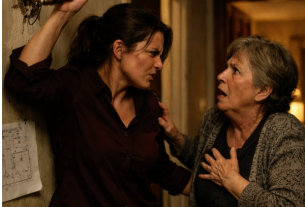
Andrei opened the box, looked at the price tag, and exploded.
“Why did you buy yourself shoes without asking me?” he shouted. “Three and a half thousand! Have you lost your mind?”
“Andrei, my old ones are completely falling apart…”
“And you couldn’t ask me first? Am I not the head of this family? Don’t I have the right to know what our money is being spent on?”
“But it’s my money!” Marina blurted out.
“Yours?!”
Andrei’s face turned red with rage.
“And who renovated this apartment for you? Who fed you all these years? Money in a family is shared!”
“When you were working—yes, it was shared! But now I’m the only one earning anything!”
“Oh, so that’s how it is!”
Andrei threw the box onto the floor.
“So now you’re in charge! You earn a little money and suddenly think you’re better than me!”
Marina stared at the shoes that had fallen out of the box onto the dirty hallway floor.
Beautiful, brand-new shoes she had wanted so badly.
The only thing that had brought her joy in months.
“I work fourteen hours a day,” she said quietly. “I come home and cook and clean. I don’t have a single free minute, not one day of rest. And you lie on the couch and demand that I ask your permission before buying myself a pair of shoes.”
“Don’t you dare speak to me like that!” Andrei yelled. “I’m looking for work! These are temporary difficulties!”
“Six months of temporary difficulties!” Marina shouted back, surprising even herself with the sound of her own voice. “You’ve been sitting at home doing nothing for six months while I work for both of us! And I’m not even allowed to spend three thousand rubles on shoes!”
“Take them back to the store! Immediately!”
“I’m not taking them back.”
“What do you mean, you’re not? I told you to take them back!”
“You told me?”
Marina felt something inside her finally snap.
“You’re ordering me around? An unemployed man who has been living off me for six months is ordering me what to do with the money I earn?”
“Shut up!”
Andrei raised his hand.
“Don’t you dare!”
Marina stepped back.
“Don’t even think about it!”
They stood facing each other, breathing heavily.
Marina saw anger in his eyes—and something else.
Confusion.
He was used to her silently putting up with everything.
“You know what, Andrei,” she said slowly. “I’m tired of this. I’m tired of working like a horse and listening to your complaints. I’m tired of cooking, cleaning, doing laundry, and then having to justify every kopeck I spend. I’m tired of waiting on someone who does absolutely nothing and still finds something to complain about.”
“Marina…”
“Don’t interrupt me!”
For the first time in her life, she raised her voice at him.
“I’ve been feeding you for six months. You live on my money, you sit around in my apartment, and I’m supposed to ask your permission before I buy myself a pair of shoes? Why on earth should I?”
Andrei opened his mouth but said nothing.
“The money I earn through my own hard work is mine to spend however I want,” Marina continued. “And if you don’t like it, there’s the door.”
“What, are you throwing me out?”
“What am I supposed to do? Put up with your tantrums every time I spend a ruble on something other than food? Listen to you tell me what a terrible wife I am because I’m exhausted from working two jobs?”
Marina walked into the bedroom and pulled a large suitcase from the wardrobe.
She threw it onto the bed.
“Pack your things.”
“Marina, come on… We’re a family…”
“What family?”
She turned toward him.
“A family is when people support each other. What do we have? I work enough for two people, while you lie on the couch and still complain. That isn’t a family. That’s me supporting a freeloader in my own home.”
“But I’m looking for work!”
“You’ve been looking for six months! You would have found something by now if you were actually looking instead of waiting for someone to bring you the perfect job on a silver platter.”
Andrei sat down on the edge of the bed.
He looked completely lost.
“Marina, please… Don’t do this. Let’s talk calmly…”
“Talk about what? About how I’m supposed to save every kopeck while you keep sitting at home telling me what to do?”
Marina opened the suitcase.
“Pack. Go to your parents, go to your friends—I don’t care. But you’re not living here anymore.”
“Because of what? Some stupid shoes?”
“It’s not because of the shoes.”
Marina sank wearily into a chair.
“It’s because I’m twenty-eight years old and I feel fifty. Because I can’t remember the last time I laughed. Because buying a pair of shoes became a celebration for me, and you couldn’t even let me have that.”
She looked at him—disheveled, wearing an old undershirt, staring at her in disbelief.
“I don’t want to live like this, Andrei. I don’t want to be a slave in my own home. I don’t want to ask permission to spend money I earned myself. I don’t want to listen to criticism from someone who has done nothing for six months.”
“But where am I supposed to go?”
“That’s your problem. I already have enough of my own.”
Andrei remained silent for several minutes.
Then he slowly stood up and began putting his clothes into the suitcase.
Marina watched him and felt a strange sense of relief.
As though a huge weight had been lifted from her shoulders.
“Maybe you’ll reconsider?” he asked while closing the suitcase.
“I already have. I’ve been thinking about it for six months.”
He walked into the hallway, put on his shoes, and picked up his jacket.
“Marina…”
“Leave the keys on the table.”
Andrei put the keys down, stood by the door for a moment, and then walked out.
The door closed with a quiet click.
Marina was alone.
The apartment was silent.
For the first time in months, nobody was grumbling, demanding things, or criticizing her.
She picked her new shoes up from the floor and carefully placed them back into the box.
Then she turned on the kettle and took out the good tea leaves she had been saving for a special occasion.
She brewed a cup of strong, fragrant tea.
Then she sat at the kitchen table with a beautiful cup—not the ordinary one she used every day, but the good one she saved for celebrations.
Outside the window, the spring sun was shining.
Marina took a sip of tea and smiled.
For the first time in six months, she truly smiled.
Tomorrow would be a difficult day—her shift at the cafeteria, followed by office cleaning.
But this morning, she had one hour of silence, a cup of good tea, and a beautiful new pair of shoes.
That was enough to make her happy.
Marina took the shoes out of the box and placed them on the chair beside her.
She admired them.
Beautiful.
And most importantly—they were hers.
Bought with her money, for her happiness.
And she didn’t need anyone’s permission.
She finished her tea, got ready for work, and for the first time in months, left the apartment with a light heart.
Wearing her new shoes.