She called on Wednesday, around noon. I was just filing away the budget for a new project—a private property in the Moscow region, where the client wanted a Japanese garden. For three weeks now, Andrey and I had been working through materials and water features. My phone was lying face up, and when her name popped up on the screen, I just stared at it for a few seconds. Alina. Ten years—and suddenly, Alina.
I picked up the phone.
Let me start by telling you what happened before. Not because I want to—just because none of this will make sense otherwise.
I was twenty-four when it all happened. Denis had been by my side for three years—we met when I turned twenty-one. I can’t say it was some storybook romance, but it was real. He knew how I drank my tea—no sugar, just a slice of ginger. I knew he was afraid of dentists, even if he’d never admit it. Three years isn’t just dating anymore; it’s real life together, even if, officially, we still had separate apartments.
Alina is three years older than me. She’s vibrant, loud, the kind of person who walks into a room and everyone turns to look. I’ve always been different—quiet, with a pencil behind my ear and a notebook where I’d been sketching out property layouts since I was fifteen. We were never that close, but I always thought: a sister is a sister. That has to mean something.
Turns out—it doesn’t.
I didn’t hear it from her. Mom called, her voice strange, and from the third word I knew she was scared to tell me. Denis and Alina. For a while, apparently. A few months already. All the while, I thought Denis and I were doing fine, while I was making plans to move to his side of the city.
I didn’t yell. I didn’t cry in front of my mom. I hung up, stood by the window for five minutes or so, then reached for my notebook and started drawing. I don’t know what—just lines, shapes, something like a hedge. My hands kept busy while my mind tried to process what had just happened.
Denis called that evening. He explained. I listened—calmly, all the way through. Then I replied: got it. And that was it.
Alina called a week later. Her voice had that sound—slightly guilty, but already with a hint of something else. Finality. She told me she and Denis would be together, hoped I would understand, and—I still remember the pause before this—they’re planning to marry and she’d really like me to attend. Because we’re sisters, after all.
I hung up right away. Not rudely—just pressed end and set the phone on the table. Then I went to the kitchen, put the kettle on, and waited for it to boil. I drank my tea without sugar, with ginger. And I started thinking about what comes next.
I didn’t go to the wedding. I explained to Mom once, briefly. She didn’t accept it—she talked for a long time about family being family, about how I’d regret it, about how Alina didn’t do it out of malice, it just happened. I listened to all of it. I said: Mom, I hear you. And I never brought it up again.
A few months later, I met Andrey. I wasn’t looking for anyone—our paths just crossed at a project, he handled the electrical work and I was designing the layout. He looked at my sketches and said, «This is serious.» It wasn’t a compliment—it was his assessment. I remembered that.
* * *
A year after Alina’s wedding, her mom still called me and spoke as if I was somehow at fault. Never directly—she never did that. But every call carried that vibe: you’re too proud, too stubborn, you put yourself above the family. By the way, Alina’s doing just fine. Denis has a good job, they bought a car, and they’re even thinking about getting a summer house.
I listened, but my mind was elsewhere. That year, I took on my very first independent project—a small front garden in Serpukhov. The owner wanted something “simple, but impressive enough to make the neighbors envious.” I made it happen. Later, the owner sent photos and said that, yes, the neighbors were asking about it. I printed those photos and put them in a folder—my first portfolio of completed work.
Mom would say: so how long will you keep up with this hobby of yours? Alina thought the same—I knew because Mom would sometimes repeat what others said without realizing it. Temporary, they figured. Not serious. I should have chosen a real career, not spent my days with a shovel in someone’s garden.
I never argued. I just kept working.
Then Mom came up with an idea she thought was brilliant. Alina and Denis had bought a plot for a summer house. Not big—just six hundred square meters—but they wanted to make it nice. And Mom suggested: Marinotchka, you know how to do this, make them a project. For the family, as a favor.
Back then, I didn’t know how to say no to Mom. That lesson would come later with experience.
So I took on Alina and Denis’s plot. That was seven years ago—I was twenty-seven, already knew what I was doing, but didn’t realize how much my work was worth. Four months of effort: measurements, sketches, three layout options, material discussions with Denis, visits to the site, overseeing the construction of the paths. I did it all. Didn’t take a cent—Mom said “for the family,” and I nodded.
Alina accepted the work without much excitement. It wasn’t as if she didn’t say thanks—she did, briefly, through Mom. Something like “tell her it turned out okay.” Okay. Four months—and it was just okay.
A year later, she asked for the second stage. A gazebo, lighting for the paths, and another gardening area. Again, through Mom—like, Marinotchka, you do this anyway, it’s no big deal for you.
That’s when I did the math. I grabbed my calculator, checked the rates at the time, and calculated how much the work I’d already done would have cost. It came out to almost two hundred eighty thousand rubles. At market rates, no markup, just for the work and site visits.
I called Mom and said: I’m willing to do the second stage. With a contract, at market price. Just like for any other client.
Mom was disappointed. Alina—I heard through Mom again—decided I’d grown conceited and greedy. That I used to be normal and that something had changed in me. Money must have spoiled me, she guessed.
After that conversation, a silence stretched for six years—that made it nine since the wedding I hadn’t attended. All that time, we were like strangers, connected only through Mom.
I didn’t suffer. I married Andrei—we registered quietly, no big celebration, just invited about ten people who were nearby. I registered my own business—that was six years ago, right after breaking up with Alina, as if one door closed and I immediately pushed another open. I took on orders—small at first, then bigger ones. Three years ago, we landed our first serious commercial project. Last year, we finished three—two of them even got published in an industry magazine. The folders with those projects are on the office shelf, lined up by year, spines out. I don’t hide them. Work is work.
Every now and then, Mom would call. She’d talk about her own things, and I’d listen. In recent years, she barely ever brought up Alina. Once, she mentioned that things with Denis were ‘not going so smoothly.’ I didn’t ask for details.
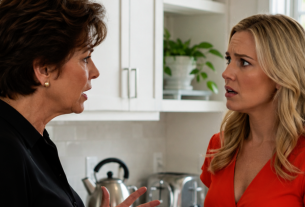
‘Marina, it’s me,’ Alina said.
Her voice was the same—low, a little husky. But now, there was something new. A tension, maybe. Like someone who prepared for this conversation and still wasn’t ready.
‘I hear you,’ I replied.
She paused. Clearly, she was expecting something else—an exclamation, a question, surprise. I stayed silent.
‘Aren’t you going to ask how I am?’
‘You called—so I figure you’ll tell me.’
Another pause. Then:
‘Can we meet? I need to talk. In person.’
I looked at my desk. Three folders, an estimate, pencils, a sketch of a Japanese garden with Andrei’s notes in the margins. It was a workday, and I had enough to do through the evening.
‘Tonight,’ I said. ‘After six.’
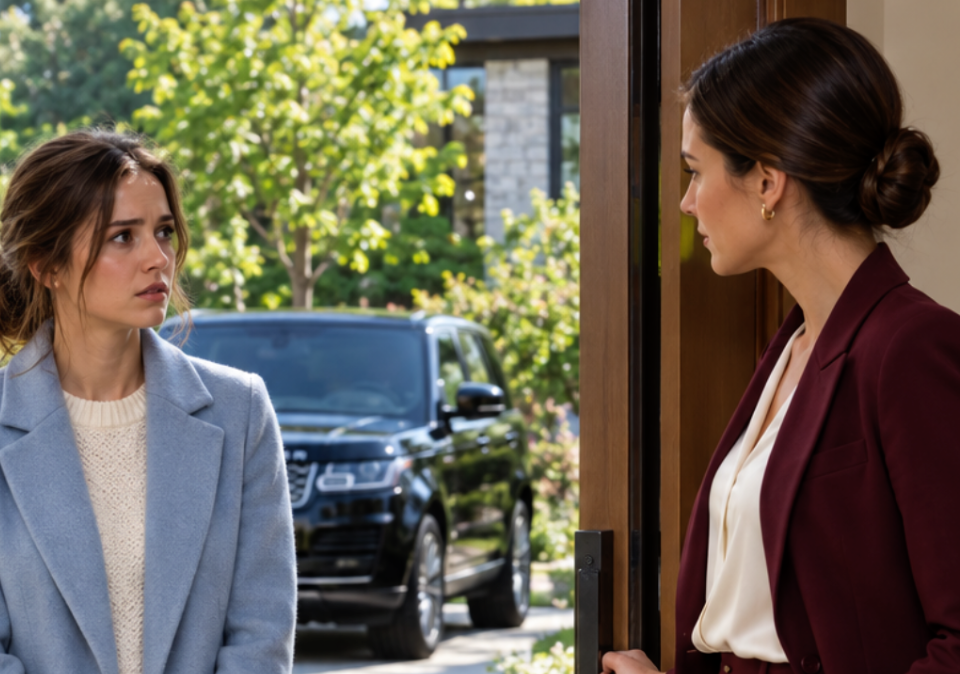
Alina showed up a little before seven. I opened the door, and the first thing she did was look around the hallway. Not quickly, not sneakily—openly, the way you’d look at someone else’s place, sizing things up. New tiles. Custom shelves for shoes. The coat rack Andrei brought back from a work trip.
‘Not bad,’ she said.
Not ‘hello.’ Not ‘long time no see.’ Just ‘not bad.’
‘Come in,’ I answered.
I took her to the office—Andrei and I use one of the rooms as a workspace. Desk, two monitors, shelves with folders organized by year and project, several printed photos of finished projects on the wall. Alina stopped in the middle and looked at the shelves slowly, from left to right. Three folders from last year. Two magazines with bookmarks. A stack of sketches. Then her gaze shifted to the photos—projects, land, greenery, stone, water. That ‘unlucky hobby’ had turned into all this.
‘You’re really serious about this,’ Alina said. There was surprise in her voice—real and unfeigned.
‘Have a seat,’ I offered.
Alina sat down. Right away, I noticed how she held her bag—with both hands, on her lap. Only someone here to ask for something holds their things like that.
We chatted a bit—about mom, the weather, how long it had been since we last met. Alina spoke promptly, almost cheerfully, but the tension was still there. I waited.
About ten minutes later, she got to the point:
‘Marina, we’re in a tough spot. Denis is having problems at work, we’re deep in debt, the summer house is mortgaged.’ She paused a moment. ‘We need five hundred thousand. Just for six months, then we’ll pay you back. You must understand—I wouldn’t have come if it wasn’t absolutely desperate.’
I looked at her. Alina looked back at me—waiting.
“I understand,” I said.
Alina relaxed a little. Too soon.
I stayed quiet for about ten seconds. Then I stood up, opened the bottom drawer of my desk, and pulled out a folder. Not the one for current projects—a much older one, with worn edges and a faded spine. I never throw out old budget documents: you never know when you might need them. This one had been in that drawer for seven years. I opened it to the right page and set it in front of Alina on the table. I remember that sheet by heart—back when everything happened, I reread it many times, checking over and over whether I’d made the right call.
“This is the budget for your property,” I said. “Seven years ago. Four months of work. Measurements, three layout options, author oversight, six site visits.” I pointed to the final line. “Two hundred seventy-eight thousand rubles at market rates back then. I did all this for free. For family, after all.”
Alina stared at the sheet in silence.
“You came here to talk about money,” I continued. “So let’s be honest about money. Here’s one figure. You have another. You just remember yours and, apparently, forgot about mine.”
“Are you serious?” Her voice went cold. “That was ages ago. That was to help the family. Are you really bringing that up now?”
“I’m just naming numbers,” I replied. “And you’re naming numbers too. Five hundred thousand is a number. Two hundred seventy-eight is also a number. I’m suggesting we count everything together, since we’re counting anyway.”
Alina stood up, still clutching her bag with both hands.
“You haven’t changed,” she shot back.
I didn’t say anything. I just looked at her.
Alina walked through the hallway, opened the door. She turned at the threshold—I thought she might say something else. But she just looked at me for a few seconds and left.
I closed the door. I stood in the hallway—it was quiet, for about thirty seconds. Then I went back to the office, put the folder back in the bottom drawer, and sat down at the desk. I picked up my pencil and looked at the sketch of the Japanese garden.
Stones, water, clean lines. Everything in its place.
Two weeks went by. Alina didn’t call. Mom reached out on the third day—her voice told me everything: Alina had told her. Mom talked for a long time, and I listened. About how a sister is still a sister. About how money isn’t the most important thing. About how maybe I could have done more.
I said: Mom, I love you. Goodbye.
That evening, after Alina left, Andrey asked me just one thing: how are you? I said I’m fine. He nodded and set the kettle to boil. We drank tea and looked out the window at our yard—the thuja we planted together three years ago is growing there, and, by the way, it’s doing just fine.
The folder with the budget is still in the bottom drawer. I didn’t throw it out—a document is a document.
I sleep peacefully. For the first time in a long while—truly peacefully, without that nagging feeling that something’s been left unfinished.
Did I go too far back then—or was I right? Let me know.