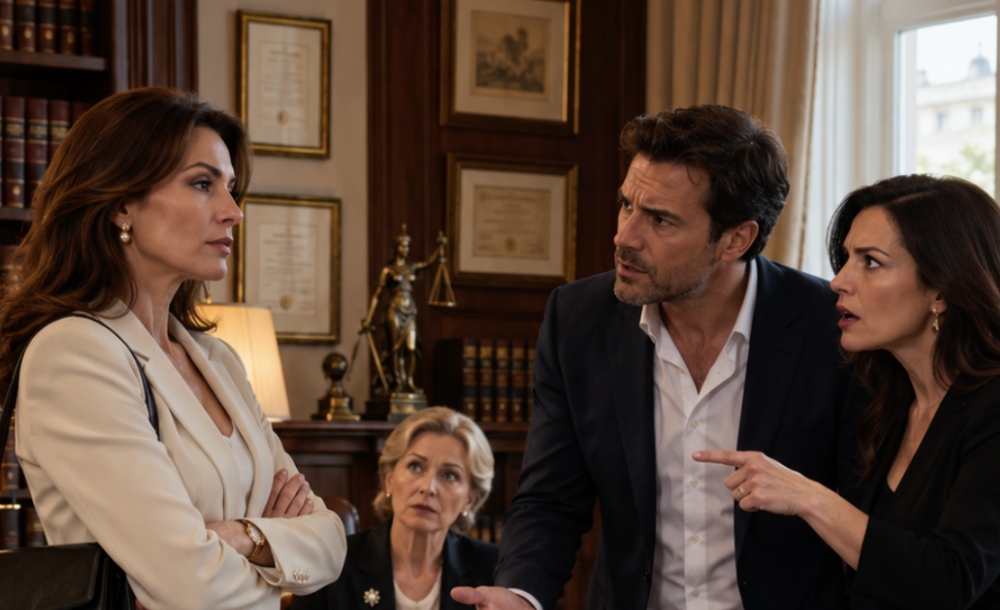
“You have absolutely no say here, so just sit quietly and stay out of the way while the notary and I complete all the necessary paperwork.” Vadim dropped a heavy leather folder onto the polished table with a dull thud without even turning toward his stepmother.
Vera quietly caught her breath and adjusted the collar of her gray wool jacket. The corridor of the notary’s office smelled of institutional dampness, old paper, and cheap coffee from the vending machine in the corner. A fine October rain drizzled beyond the wide window, smearing the gray city twilight across the glass. Alina sat on the nearby faux-leather sofa with an openly disdainful expression.
Her husband’s daughter made a show of examining her flawless manicure, occasionally straightening the hem of her expensive beige coat. Vera remembered perfectly well that Alina had bought it on credit—a debt that their father had ultimately paid almost half of himself.
“Vadim is absolutely right,” Alina said without looking up from her smartphone. “We didn’t come here to listen to your advice or ask your permission for every step we take. Dad isn’t in a condition to assess the situation rationally, and we are his biological children. We have the primary right to protect our family property from an outsider’s claims.”
“Your father is entirely sound of mind,” Vera replied calmly, without raising her voice. She stared straight ahead at the closed door bearing a golden plaque. “And he knows perfectly well why I’m here today. You would be better off calling him to ask how he is instead of staging this circus in front of strangers.”
Vadim gave a nervous chuckle, unbuttoned his jacket, and stepped closer to his stepmother. He towered over her with the condescending, almost contemptuous confidence of someone who imagined himself in control of another person’s fate.
“You’re nobody to Dad. Do you finally understand that? You’re just some woman he took pity on and allowed to stay in his three-room apartment after your divorce left you with nothing. For twelve years, you lived comfortably at his expense and never went without anything while my sister and I had to make our own way. And now that Dad has fallen ill, you’ve decided to sell his apartment behind our backs and cover your tracks? That’s not going to happen, sweetheart. We’ll revoke any power of attorney you have in five minutes.”
Vera remained silent. She merely tightened her fingers around the strap of her modest handbag. There was no point in arguing in that stuffy corridor. This blind, smug conviction had been growing in her stepchildren’s minds for far too long. They believed too firmly in their own infallibility and in the myth of their father’s wealth, to which they supposedly had a blood-given right whenever it suited them.
Their blindness had been cultivated over many years. When Vera married Viktor twelve years earlier, his children were already adults—and fully formed egoists. Vadim had just turned twenty. He had recently graduated from university and dreamed of building a business empire. Nineteen-year-old Alina was looking for a wealthy husband and refused even to consider getting a job.
They barely remembered their mother. She had moved abroad with a new boyfriend while they were still in elementary school, leaving them entirely in their father’s care.
Burdened by constant guilt toward his son and daughter over the collapse of their family, Viktor had spent years sacrificing everything for them. He carried them on his shoulders, paid off Vadim’s endless debts from one failed “startup” after another, and covered Alina’s luxury apartment rent, foreign vacations, and designer clothes.
His children nevertheless treated him with cold, entitled condescension. They regarded Vera’s appearance in his life as an irritating inconvenience.
In their eyes, Vera had always been a silent dependent and convenient servant who cooked delicious borscht, ironed their father’s shirts, and quietly worked as a senior accountant at a construction company. During all the years of their marriage, Vera never asked her husband for a single kopeck for her personal needs. Her stepchildren attributed this to natural timidity and an awareness of her supposedly inferior position.
Then came the terrible year that turned all their lives upside down.
Viktor’s small transportation company had long been teetering on the brink of profitability because he constantly withdrew money to satisfy his children’s whims. Then the company was hit with severe penalties and a tax audit. Creditors demanded immediate repayment of their loans, bailiffs froze the company’s accounts, and the enormous stress and fear of falling into a bottomless pit of debt caused Viktor to suffer a severe hypertensive crisis.
Vera clearly remembered calling both Vadim and Alina during those dreadful autumn days, begging them to visit their father in the hospital or at least help her find good specialists.
“I’m launching a new project right now, and I absolutely cannot afford any distractions, or I’ll lose millions in investments,” Vadim had rattled off over the phone, without even asking what the doctors had said. “Dad’s a grown man. He’ll pull through. You’re there, so you can take care of him. That’s what you’ve been given a place to live for.”
Alina had answered irritably from the airport, saying that her vacation tickets had been purchased long ago and that canceling the trip would cause her severe psychological trauma.
During that month, all Viktor’s supposed friends and business partners abandoned him. Debt collectors hounded them at home, and the debt from his commercial guarantees exceeded four million rubles. Vera was the only person who remained at the bedside of the man who had been paralyzed by fear and illness.
She did not make a scene, cry, or reproach her husband because everything he had earned over the years had disappeared into the bottomless pockets of his ungrateful children.
Vera simply took decisive action. She sold the two-bedroom apartment in the city’s quiet historic center that she had inherited from her late grandmother and had previously rented out with great care. She used the proceeds to settle every lawsuit and commercial debt her husband faced, saving him from a humiliating bankruptcy and potential criminal prosecution.
With the remaining money and her own long-term savings, she bought the spacious three-bedroom apartment in a new, leafy neighborhood—the very apartment they were discussing now. She registered the property solely in her own name.
Once Viktor had fully recovered and realized who the people around him truly were, he personally insisted on signing a notarized prenuptial agreement. He formally relinquished any claim to the property, painfully aware of how blind he had been regarding his children. They had not even thought of him while bailiffs were threatening to descend upon his home.
As soon as the crisis passed and Viktor’s health began to improve, Vadim and Alina reappeared on the doorstep. They sincerely believed that their father had somehow resolved all his financial problems by himself and that the new apartment had been purchased with the profits from another successful business deal he had simply chosen not to discuss.
Now Viktor’s doctors had strongly advised him to change climates and move to the countryside, away from the city’s dust and commotion. The couple therefore put the spacious apartment up for sale so they could buy a cozy, single-story cottage near a pine forest.
When the children learned about the impending sale through mutual acquaintances in real estate, they immediately sounded the alarm. To them, it was the height of arrogance for an “outsider” to dispose of an apartment they had already divided between themselves in their minds.
The heavy oak door to the office finally swung open. A stern female notary wearing severe horn-rimmed glasses invited everyone inside with a gesture.
“Please come in. Who is here regarding the verification of authority and the transfer of the property on Akademika Koroleva Street?” she asked as she settled behind a broad desk covered with registries and folders.
Vadim pushed forward first. He pulled out a leather chair and sat across from the notary, placing his palms on the desk as though he were presiding over an important board meeting.
Alina gracefully lowered herself into the neighboring chair and cast Vera a triumphant look. Vera remained standing near the door, her shoulder resting lightly against the smooth wall.
“We have come to lodge a formal objection to the proposed transaction,” Vadim began immediately in a practiced, confident voice. “This woman, Vera Nikolaevna, is taking advantage of our father’s helpless condition and attempting to sell an expensive three-bedroom apartment illegally. As his direct and lawful first-priority heirs, we demand that you block all transactions involving this property. Furthermore, we insist that a power of attorney be issued in our names so that we can manage our father’s assets in his best interests.”
The notary looked over her glasses at the young man, shifted her gaze to the silent Vera, and sighed with the mild weariness of someone who encountered such family dramas almost daily.
“Young man, let us begin with the most important point,” the notary said dryly as she opened the electronic database and pulled a printed extract from the state registry toward her. “First, under Russian law, there is no such thing as a ‘first-priority heir’ while the person concerned is still alive. Your father is alive, legally competent, and free to manage his life and affairs as he sees fit.”
“But he’s ill!” Alina protested, leaning forward and throwing up her hands. “He suffered an extremely serious medical crisis. Someone has manipulated him! He spent his entire life saving for this apartment, building his business, and supporting us. And now some strange woman is going to sell the property and leave us with nothing! We have a right to our lawful share of our father’s estate!”
The notary tapped the tip of her pen against the desk, signaling for the young woman to compose herself.
“Please refrain from unnecessary emotional outbursts. Since you came to me for legal advice and verification of ownership rights, let us examine the official documents.”
She removed a thick sheet bearing an official seal from a slim folder and unfolded it in front of Vadim.
“The apartment on Akademika Koroleva Street was purchased five years ago. Vera Nikolaevna, who is present here, is its sole and exclusive owner. The money used to purchase it came from the sale of her personal premarital property, as confirmed by bank statements from a secured letter-of-credit account.”
Vadim frowned. His self-assured smile faltered slightly, but he immediately shook his head, refusing to believe what he had heard.
“You’re mistaken. They were legally married when the apartment was purchased! Everything acquired during a marriage is divided equally, regardless of whose name appears on the paperwork. That means half of the apartment unquestionably belongs to our father, and we are here to represent his lawful interests!”
“Young man, please do not attempt to interpret the Family Code selectively,” the notary interrupted with cold politeness. “Your father and Vera Nikolaevna signed a notarized prenuptial agreement that remains fully legally binding. Under that agreement, the joint-property regime does not apply to this apartment. Furthermore, the contract explicitly states that your father fully acknowledges the origin of the funds and makes no claim to any share of this property under any circumstances.”
A heavy, ringing silence fell over the office. The only sounds were the traffic splashing through puddles outside the window and the steady ticking of the wall clock in its bulky plastic case.
Alina looked at her brother in confusion. Irregular red blotches spread across her cheeks.
“Vadim, this is nonsense. Dad couldn’t have done that. He couldn’t have left us without a share of the apartment. He always said that everything he achieved was for us.”
“Exactly!” Vadim sprang to his feet and jabbed a nervous finger toward Vera. “She forced him! She drugged him with pills, intimidated him, and made him sign this worthless piece of paper! We’ll take this to court! We’ll have the agreement declared invalid, and we’ll have you prosecuted for fraud! You’ll be left without a penny and end up on the streets!”
Vera calmly took two steps forward and placed her phone on the edge of the notary’s desk.
“I knew you would put on this performance,” she said quietly, but with astonishing firmness in her voice. “For five years, you never once asked what your father was living on, who paid for his expensive medication, or why he closed his vehicle fleet. You sincerely believed that unlimited amounts of money simply fell from the sky into his hands.”
She unlocked her smartphone and activated the speakerphone. The call rang for only a few seconds before a deep, slightly hoarse but entirely resolute male voice came through the speaker.
“Yes, Vera dear, I’m listening. Are you already at the notary’s office? Are the documents in order?”
Vadim practically lunged toward the phone, talking over his sister.
“Dad! Dad, can you hear me? We’re at the office! Your precious wife used some suspicious prenuptial agreement to put the entire apartment in her name, and now she’s trying to sell it! She’s leaving our family without a roof over our heads! Tell the notary you weren’t in your right mind when you signed it!”
A long, painful silence followed on the other end of the line. Viktor sighed heavily, and in the stillness of the office, that sigh seemed louder than thunder.
“Hello, Vadim,” his father said slowly. “Hello to you too, Alina. I know you’re there. It is a great pity that during the past six months, you found time to speak to me only when you decided that someone was taking away property that never belonged to you.”
“Dad, what are you talking about?” Alina cried as she hurried toward the desk. “We care about you! We don’t want anyone to deceive you!”
“Only one person has cared for me during the past five years,” Viktor snapped. His voice now carried a hard, steely edge his children had never heard from their usually gentle father. “When I was dragged through the courts because of your fraudulent investment loans, Vadim—the loans I had guaranteed—neither you nor your sister was anywhere to be found. You turned off your phones and went away to relax at resorts. Vera sold her apartment to keep your father from being sent to prison and ruined by debt-enforcement orders. She pulled me back from the brink and paid every last kopeck of my debts.”
Vadim’s face turned ashen. He swallowed convulsively and stared helplessly at the phone lying on the desk.
“Dad, we didn’t know all the details. You never really explained anything to us.”
“Because you didn’t care,” his father replied mercilessly. “All you cared about were bank transfers and expensive presents. Throughout all these years, Vera supported our household, cared for me after my hospital stays, and never took a single ruble from my pocket. The apartment was purchased entirely with her own money. I personally begged the notary to prepare the prenuptial agreement so I could protect her good name from your endless greed. We’re selling the apartment because we’re buying a house in the country, which will also be registered in Vera’s name. And there will not be a single inch of that house for either of you.”
“Dad, we’re your own children!” Alina exclaimed desperately, feeling the ground disappearing from beneath her feet. “You can’t simply reject your own flesh and blood for the sake of an outsider!”
“Real family members behave like family during times of trouble. They don’t descend like vultures to divide the property of a father who is still alive,” Viktor concluded evenly. “Vera, complete all the necessary paperwork. I’ll be waiting for you at home for dinner.”
The line went dead.
The notary deliberately removed her glasses, carefully placed the verified documents in a plastic folder bearing the state emblem, and handed it to Vera.
“All your papers are in perfect order, Vera Nikolaevna. There are no legal obstacles to completing the sale. Your ownership rights are absolute and unconditional.”
Vadim slowly lowered his hands. His brazen self-confidence burst like a soap bubble, leaving behind only the bewilderment of a grown man who had never truly grown up and whose familiar source of support had suddenly been taken away.
Alina nervously buttoned her coat, avoided looking at either the notary or her stepmother, and was the first to hurry out of the office into the darkening corridor.
Vadim lingered by the door. He glanced back at Vera and finally spoke in a quiet, strained voice.
“You could have explained everything properly earlier instead of humiliating us in front of strangers. Why did you have to put on this whole show?”
Vera calmly picked up the folder of documents, placed it carefully in her handbag, and looked her stepson directly in the eyes.
“Would you have listened to me if I had tried to tell you at home? No, Vadim. You and your sister have grown accustomed to hearing only the rustle of other people’s money. Now you’ll have to learn how to live on your own.”
She left the office with a light, confident step, never looking back and feeling not the slightest trace of guilt.
Ahead of her lay a new and peaceful life in a wooden house beside a pine forest, where firewood crackled in the stove in the evenings and where she would be accompanied by the man for whom it had been worth enduring every hardship.