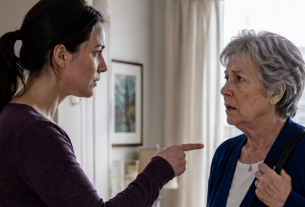
Valeria bought her apartment three years before she got married. She had saved up for it herself, without help from her parents. It was a two-room apartment on the fifth floor of a prefabricated building, but inside, everything was exactly as Valeria wanted it: light walls in the living room, a dark floor, and a wall-length bookcase filled with books and a few potted plants. The kitchen was small but practical. Everything had its place, and she could reach every drawer without getting up from her stool. She had done the renovations with a friend, spent ages choosing the bathroom tiles, and repainted the bedroom wall three times before she got the shade right. It might not have been perfect by anyone else’s standards, but it was perfect for her.
Vladimir moved in after the wedding. He gave up his room in his parents’ apartment without much regret. Living there together would have been cramped, while Valeria’s place was already furnished, comfortable, and warm. During the first few months, he often said how much he liked the apartment, the neighborhood, and the way Valeria made a home feel cozy. He meant it. But over time, that began to change.
Galina Borisovna started visiting about once every two weeks. At first, they were proper visits: she would bring a pie or a jar of jam, talk about the weather and Vladimir’s work, and ask how the newlyweds were settling in. Valeria welcomed her mother-in-law. Tea, conversation, an hour or two, and then she went home. Those visits were easy enough to get used to.
But Galina Borisovna was a woman with opinions. Her opinions were neither cruel nor meant to hurt anyone. They were simply firm. She had one about everything, and she shared it.
“The wallpaper is light,” her mother-in-law said during one of her first visits, looking around the living room. “It’ll get dirty.”
“I like light walls,” Valeria replied.
“It’s your choice,” Galina Borisovna said with a shrug. “You’ll regret it later, though.”
It was nothing serious. Valeria didn’t take it to heart. Everyone liked different things.
Then Galina Borisovna looked at the bookcase.
“That’s a lot of books. They collect dust.”
“I love books.”
“Well, if you love them, you’ll have to clean more often.”
Vladimir was drinking tea and looking at his phone. He glanced up.
“Mom, everything’s fine here. Want some more tea?”
The conversation moved on. Valeria decided that this was simply Galina Borisovna’s way of talking. She didn’t mean any harm; she was just used to noticing things and commenting on them.
Valeria was wrong.
By autumn, the remarks had become more frequent. Galina Borisovna now came once a week, sometimes more. She would bring something for the table, settle into a chair in the kitchen, and begin. The light wallpaper was no longer her main concern. Next came the sofa: too soft, impractical, uncomfortable for guests. Then the curtains: too thin, letting in too much light to get any proper rest. Then the arrangement of the kitchen drawers: inconvenient, with everything in the wrong place.
“Galina Borisovna,” Valeria finally said one day, trying to stay calm, “I renovated this apartment to suit myself. It works for me.”
“Well, when two people live together, you need to think about the other person too,” her mother-in-law replied.
“Vladimir likes it.”
“Vladimir can get used to anything. He’s easygoing.”
Vladimir looked up from his plate, then looked down again.
After the visit, Valeria went to her husband in the other room.
“Listen, could you say something once in a while when your mother criticizes the apartment?”
“She isn’t criticizing it. She’s just sharing her opinion.”
“Her opinion that my walls will get dirty and my curtains are bad is criticism.”
“Valeria, don’t take it so personally.”
Valeria stared at her husband for three seconds, then left the room.
November brought a new subject: food. Galina Borisovna came on a Saturday, just as Valeria was finishing lunch: chicken soup, meat patties, and potatoes. She set the table and called everyone in.
Her mother-in-law tasted the soup and put down her spoon.
“Not enough salt.”
“I don’t like salty food,” Valeria said.
“The chicken is tough. How long did you cook it?”
“About forty minutes.”
“It needs an hour. Then it’ll be tender.”
“I like it this way.”
“Well, if you like it.” Galina Borisovna took a bite of a meat patty. “These are all right, but there isn’t enough onion. You should chop it, not grate it.”
Vladimir ate in silence. Valeria said nothing either, though she clenched her hands beneath the table.
After lunch, her mother-in-law went into the kitchen, stacked the dishes, and began moving the pans around on the stove.
“This makes more sense,” Galina Borisovna announced, shifting the heavy cast-iron pan from the left burner to the right.
“It made sense to me where it was,” Valeria said, moving it back.
Galina Borisovna looked at her daughter-in-law, then at her son.
“Strong-willed,” she said. She wasn’t being rude, merely stating what she thought was a fact.
Vladimir pretended not to hear.
That evening, Valeria approached her husband again.
“Vladimir, I need you to speak to your mother. Explain that it isn’t all right to come into our apartment and criticize how I run the household.”
“Val, what am I supposed to say? She doesn’t mean any harm.”
“Whether she means harm isn’t the point. It’s unpleasant.”
“You’re taking it too hard.”
“Maybe.” Valeria looked at him. “But can you talk to her? Just explain that some things are better left unsaid.”
“I’ll talk to her,” Vladimir said.
He didn’t.
Valeria realized that the following week, when Galina Borisovna appeared again—this time on a Wednesday, without warning, at around five in the afternoon. She rang the bell holding a bag of groceries.
“I was passing by and thought I’d stop in,” her mother-in-law explained as she took off her coat.
Valeria worked from home and was in the middle of a video meeting. She muted herself and stepped out of the room.
“Galina Borisovna, I’m working right now.”
“Oh, come on, it’ll only take five minutes. I brought apples.”
“All right, thank you. I’ll be free in half an hour.”
“That’s fine. I’ll sit and wait.” Her mother-in-law went into the kitchen and began unpacking the bag.
Valeria returned to her laptop. Through the wall, she could hear Galina Borisovna moving things around the kitchen, opening cupboards, and clinking dishes. Then she heard her voice:
“Valera, this pan isn’t in the right place. It’s better over here.”
Valeria didn’t answer. She finished the meeting, closed her laptop, and went out.
Things in the kitchen had been rearranged. Not much—just enough to notice. The mugs had moved to another shelf, the bread knife was in a different drawer, and the pan was back on the right burner.
“I moved a few things. This arrangement is more logical,” Galina Borisovna said as she put the apples in a bowl.
“Please don’t rearrange my things,” Valeria said.
“I was just—”
“I heard you. Please don’t move them.”
Galina Borisovna fell silent. She drank her tea and left twenty minutes later, more coolly than usual.
When Vladimir came home, Valeria told him about the rearranged kitchenware. He listened.
“Well, she was trying to help.”
“No one asked her to help. And no one asked her to turn up without calling while I was working.”
“Valeria, she’s getting older. She’s used to doing things her own way.”
“Vladimir, she came to my apartment without warning and moved my things. And she did it again after I’d already put everything back once. That isn’t an old habit. It’s disrespect.”
“You’re making too much of it.”
“No.” Valeria shook her head. “I’m asking you to talk to your mother. Explain a few simple things to her. Is this the first time I’ve asked?”
“No.”
“Will you talk to her?”
“Yes, I will.”
Once again, he didn’t.
December came. Galina Borisovna arrived for Sunday lunch. This time she had called an hour ahead, giving Valeria time to prepare baked fish, salad, and bread. She set the table.
Her mother-in-law took off her coat and surveyed the entryway. Vladimir’s boots stood slightly to one side of the mat.
“So that’s where people take off their shoes,” Galina Borisovna murmured to no one in particular.
Then she went into the kitchen and sniffed the air.
“Fish?”
“Yes,” Valeria said.
“I’m not fond of fish. Did you know I don’t eat it?”
Valeria hadn’t known. In six months, Galina Borisovna had never mentioned fish.
“I can make something else,” Valeria offered.
“No, don’t trouble yourself. I’ll just sit and talk.”
They sat down. Galina Borisovna picked up a piece of bread and examined it.
“Whole wheat?”
“Yes.”
“White bread is better for our stomachs. Vladimir’s too, by the way.”
“Mom, my stomach is fine,” Vladimir said.
“For now.” Galina Borisovna put the bread back. “Valera, there’s dust in that corner. See? Under the bookcase.”
Valeria looked at the corner. There was no dust. Or rather, there was the amount of dust any lived-in home might have three or four days after cleaning. No clumps, no thick layer—just a faint trace visible only if you bent down and looked for it.
“I’ll clean it,” Valeria replied.
“Well, I understand you’re working and don’t have much time.” Galina Borisovna spread her hands. “But you shouldn’t let things go.”
Vladimir ate his fish in silence.
After lunch, when his mother had left and he was washing the dishes, Valeria stood in the kitchen doorway.
“Vladimir,” she said, “did you hear what she said at the table?”
“I did,” he answered without turning around.
“And?”
“Well, she goes a bit too far. I know.”
“You know, and you say nothing.”
“What was I supposed to do right there at the table?”
“Say, ‘Mom, Valeria keeps the place clean.’ Say, ‘Mom, you could have told us in advance about the fish.’ Say something. Anything to stand up for what happens in this home.” Valeria kept her voice even, though she folded her arms. “You live here too. This is your home.”
“I’m not going to start a fight with my mother over a little dust under a bookcase.”
“It isn’t about the dust. It’s about her coming here and systematically criticizing everything I do. Every time. And every time, you stay quiet.”
“Valeria, you’re exaggerating.”
It was the third or fourth time she had heard it. You’re exaggerating. You’re too sensitive. She doesn’t mean any harm. Valeria looked at her husband, nodded, and walked away.
For the next few days, they lived peacefully. They talked, ate dinner together, and watched films in the evening. But something had changed between them. Valeria could feel it, even if she couldn’t quite name it.
Galina Borisovna came again on Thursday evening, without calling, carrying a bag of mandarins. Vladimir had just returned from work. He met his mother in the entryway and hugged her.
“Come in, Mom.”
Galina Borisovna took off her shoes, walked through the living room, and looked around. Then she went into the kitchen.
Valeria was at the stove, cooking pasta. She turned.
“Good evening, Galina Borisovna.”
“Good evening.” Her mother-in-law set the mandarins on the table and glanced around. “The light in here is dim. You ought to change the bulb. And here”—Galina Borisovna stepped toward the sink and pointed at the seam between the tiles and the countertop—“mold is starting to grow. You aren’t wiping it properly.”
Valeria set her spoon on its rest. Slowly. Then she turned to her husband.
Vladimir stood in the kitchen doorway, having followed his mother in. He held his phone and was looking toward the window.
“Vova,” Valeria said.
He looked up.
“Did you hear that?”
“Well, she’s only saying—”
“I heard what she said. I’m asking you: did you hear it?”
Vladimir shifted his weight.
“Mom, enough about the tiles,” he said quietly, more to the room than to her.
“What do you mean, enough?” Galina Borisovna turned to her son. “I’m telling you something useful. If you don’t clean it in time, the mold will spread, and no cleaner will get rid of it. I’m trying to help you, and you two…”
“Galina Borisovna,” Valeria said clearly, without raising her voice. “You came here uninvited. For the second time this month. And the moment you walked in, you started telling us what’s wrong with our home.”
“I was passing by, so I came to see my son. What’s wrong with that?”
“I live here. And this is my apartment.”
“It’s Vova’s too.”
“No.” Valeria shook her head. “It isn’t Vova’s. The apartment is in my name. Vladimir lives here, but it’s my property.”
Galina Borisovna exchanged a brief glance with her son—the kind of glance people share when they’re sure they’re right.
“So what? Are you saying I can’t come and see my own son?”
“I’m saying that when you come here, you criticize the renovations, the food, and the cleaning. Every single time. I’m tired of it.”
“I’m entitled to my opinion!”
“In someone else’s home, you can keep that opinion to yourself.” Valeria’s voice stayed level, but something in it made the kitchen fall quiet. “I did these renovations myself. I cook food the way I like it. I clean on my own schedule. None of that is anyone else’s business.”
“Vova,” Galina Borisovna called, “do you hear the way she’s speaking to me?”
Vladimir looked at his wife, then at his mother, then back at his wife.
“Valeria, you don’t have to be so harsh,” he finally said.
Something inside Valeria gave way then. There was no shouting, no dramatic outburst—just a quiet, final break.
“Harsh?” She looked at her husband. “Vladimir, this is the fourth time I’ve asked you to talk to your mother. The fourth. Every time, you promise, and every time, you do nothing. Now she’s standing in my kitchen pointing at my tiles, and you’re telling me not to be harsh. So tell me plainly: are you going to talk to her or not?”
Her husband said nothing.
“So the answer is no,” Valeria said. “Then I’ll say it myself.”
She turned to her mother-in-law.
“Galina Borisovna, I’m asking you to leave.”
Her mother-in-law raised her eyebrows.
“What?”
“Leave the apartment. Right now.”
“How dare you…” Galina Borisovna faltered. “Vova! She’s throwing me out!”
“Yes,” Valeria confirmed. “That’s exactly what’s happening.”
“He’s my son! I have the right to come and see him!”
“You have the right to visit. You don’t have the right to turn up without calling, rearrange things, and criticize the person whose home this is.”
“What do you mean, whose home? This is—”
“My home,” Valeria said. “I bought it with my own money before we were married. And I decide how things are done here.”
Galina Borisovna stared at her daughter-in-law as though she were seeing her clearly for the first time.
“Vova,” she said. “Say something to her.”
Vladimir stepped forward.
“Valeria, this is too much. Mom brought us mandarins, and you’re—”
“Your mother came without calling, just like she did three weeks ago. And once again, she started inspecting someone else’s home.”
“She just notices things. She wants to help!”
“She isn’t helping. She’s criticizing. There’s a difference.” Valeria picked up the bag the mandarins had come in and held it out to Galina Borisovna. “Please.”
Her mother-in-law didn’t take it.
“I’m not going anywhere. Vova, am I not allowed to sit peacefully in your home?”
“Valeria, apologize to Mom,” Vladimir said.
Valeria looked at him.
“You’re asking me to apologize?”
“You’re throwing her out. That’s rude.”
“No, Vova. Coming over without warning and pointing at someone else’s tiles is rude.” Valeria put the bag back on the table. “I’m not apologizing.”
“You see?” Galina Borisovna turned to her son. “That’s the kind of person she is. I realized it ages ago, but I kept quiet.”
“Galina Borisovna,” Valeria said evenly, “you are in my apartment. I’m asking you to leave. This is not up for discussion.”
Galina Borisovna straightened and picked up her handbag from the chair.
“Vova, are you seeing this? Your wife is throwing your mother out.”
“Mom, wait,” Vladimir said, raising a hand.
“I will not wait!” Galina Borisovna’s voice cracked. “I came with good intentions. I brought fruit, and she’s driving me away! Ordering people around in an apartment that isn’t even yours!”
“It is mine,” Valeria corrected her. “Galina Borisovna, the entryway is over there.”
Her mother-in-law stared at her, then looked at her son for a long moment, waiting.
Vladimir said nothing.
Galina Borisovna turned and left. From the kitchen, they could hear her putting on her coat in sharp, irritated movements. Then the front door slammed.
The kitchen fell silent. The pasta had overcooked.
Vladimir stood in the middle of the room, staring at his wife.
“Do you understand what you’ve done?” he finally asked.
“Yes. I asked someone to leave my apartment.”
“She’s my mother.”
“I know.”
“You threw her out like… like a stranger!”
“Vladimir,” Valeria said, walking over to the stove and turning off the burner beneath the pot, “I’ve spent six months listening to comments about the wallpaper, curtains, sofa, soup, meat patties, dishes, dust, and now the tiles. Six months. I asked you four times to speak to her. You promised, and you didn’t. Today, I dealt with it myself.”
“Not like that!”
“How, then?” Valeria turned around. “How should I have done it?”
“You shouldn’t have thrown her out! You should have talked to her, explained it properly!”
“I did explain it. You said you would too. Nothing changed.” Valeria spoke without anger, just with tired precision. “Nothing changed until there was a direct conversation with a real consequence. Now something has changed.”
“She’s upset.”
“Probably.”
“You need to call her and apologize.”
Valeria looked at her husband.
“No.”
“Valeria…”
“No, Vova. I’m not going to apologize for setting a boundary in my own home.”
Her husband gripped the edge of the countertop.
“So you think you did the right thing.”
“Yes.”
“And you don’t care that Mom is upset?”
“I do care. That doesn’t mean I was wrong.”
Vladimir was silent for about ten seconds. Then he said:
“She won’t come back here after this. Do you understand?”
“Good,” Valeria said.
He looked at her as though he had expected another answer.
“Good?”
“Yes. If she comes when she’s invited, behaves like a guest, and doesn’t criticize my home, I’ll be happy to see her. Otherwise, it’s better if she doesn’t come.”
“That’s disrespectful to family.”
“This is my home.” Valeria began draining the pasta. “If you want to talk, I’m here. But let me finish making dinner first.”
Vladimir left the kitchen.
They ate in silence. Afterward, Vladimir went to the other room. Valeria cleared the dishes and watered the flowers on the windowsill—something she had been putting off for ages. Then she looked outside at the streetlights, the frost on the branches, and the occasional passing car.
For the next two days, her husband said very little. He answered questions but never started a conversation. Several times he stepped out onto the balcony, apparently to call his mother. Once he came back looking as though she had said something unpleasant to him, and he spent the rest of the evening frowning.
On the third evening, Vladimir sat down across from Valeria.
“Mom says she won’t come here until you apologize.”
“All right.”
“You still won’t apologize?”
“No.”
“Then she won’t come.”
“I heard you.”
“Valeria,” Vladimir said, leaning forward, “do you understand that this isn’t normal? A wife and a mother who don’t speak to each other?”
“They can speak. If they treat each other with respect.”
“Mom thinks you insulted her.”
“Your mother criticized my home for six months. I consider that insulting.”
“She sees things differently. She’s older than you!”
“Being older doesn’t give her the right to behave however she wants in someone else’s home.”
Vladimir stood and paced the room.
“You know what? You’re right about one thing: it’s your apartment. But that means I don’t feel comfortable here. I’m living on someone else’s territory, where my mother can be thrown out.”
“You’re uncomfortable because your mother wouldn’t respect any boundaries, and I finally made mine clear.”
“That isn’t how I see it.”
“I know,” Valeria said. “I see it differently. And the fact that we see it so differently is an important question in itself.”
“What question?”
Valeria paused.
“Whether we can live together in a way that works for both of us.”
Vladimir stopped pacing.
“Are you talking about divorce?”
“I’m talking about how you watched your mother hurt me time after time and stayed silent. And now you’re asking me to apologize to her. I can’t live like that.”
“So you mean divorce.”
“If you aren’t willing to stand up for me even once, then yes.”
The silence lasted a long time. Then Vladimir said:
“I can’t choose between my mother and you.”
“I’m not asking you to give up your mother. I’m asking you to stand up for me in my own home.”
“It’s the same thing.”
“No,” Valeria said. “It isn’t. But if you think it is, you’d be better off going to live with her.”
Four days later, Vladimir packed his things. He didn’t take everything at once; he came back twice with boxes. On the first visit, he said nothing. On the second, he turned around in the entryway.
“Are you sure you won’t change your mind?”
“No.”
The door closed behind him.
Their divorce was finalized in February. There was nothing to divide—the apartment had been hers before the marriage, and Vladimir didn’t have many belongings. He didn’t argue and signed everything without objection.
Galina Borisovna never called.
Valeria didn’t call her either.
In March, Valeria finally bought a new lightbulb for the kitchen: a bright, two-thousand-lumen bulb. The light changed, becoming white and clear. She scrubbed the tiles by the sink with a special brush. Not because there had been mold—there never had been—but simply because she felt like it.
She put the pan on the left burner, where it had always belonged.
A flower bloomed on the living room windowsill. Valeria noticed it one Saturday morning, when she had nowhere to rush. She poured herself a coffee and sat by the window.
It was quiet. No one was telling her what to do. She was at home, and the home was hers.