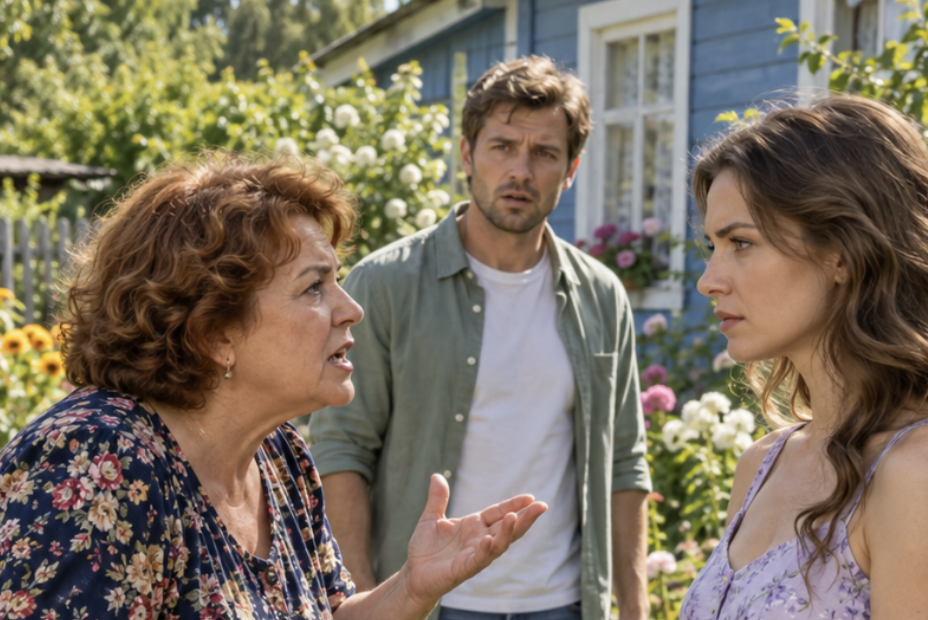
They came across the country house by chance. Andrei saw an advertisement in the newspaper and immediately fell in love with the photograph of an overgrown plot with a crooked little house. Elena was skeptical about the idea at first, but when they went to see it, she also felt there was something special about the place.
“Just imagine, we’ll build a terrace here,” Andrei said dreamily as he cleared the weeds. “And over there, we’ll hang a hammock between the birch trees.”
Elena nodded, imagining the two of them sitting outside in the evenings with a glass of wine, listening to the rustling leaves. No vegetable beds, no gardening—just relaxation and beauty.
They spent most of the first season clearing the property and making minor repairs. By autumn, the house already looked livable, and the grounds felt settled and welcoming. They were proud of their purchase and eagerly waited for the following summer.
Galina Petrovna arrived in May, just after the May holidays. Andrei’s mother had recently retired and, as she liked to say, “wasn’t used to sitting around doing nothing.”
“I’ll stay for a week, get some fresh air,” she said as she unloaded two large suitcases from her son’s car.
Elena tensed inwardly, but Andrei was delighted. He had wanted his mother to see their country house for a long time.
By the second day, Galina Petrovna had already thrown herself into work. She washed the windows with such determination that it looked as if she were preparing for a government inspection, washed every curtain, and scrubbed every corner of the house. Elena tried to help, but her mother-in-law only waved her away.
“Oh, don’t worry, sweetheart. You rest. I’m used to this.”
By the end of the week, the country house had been transformed. Everything shone and smelled clean, and even the flowers in the flowerbed seemed to stand in perfectly straight rows like soldiers on parade.
“Mom, you’re a magician,” Andrei said admiringly.
Galina Petrovna glowed with satisfaction.
“Oh, come on, son. My hands just itch when I see a mess.”
Her one-week visit quietly stretched into a month. Every day, Galina Petrovna found some new task. One day the porch needed painting, the next day the fence needed repairs. Elena and Andrei came on weekends and barely recognized their own property—something had been changed, improved, or rearranged every time.
“It’s so good that Mom took charge,” Andrei said, admiring the freshly painted shutters.
Elena agreed, but something bothered her. The country house was becoming too perfect, too orderly. The romantic carelessness they had loved about the place was disappearing.
In June, Galina Petrovna announced a new project.
“There’s empty land behind the house. It would be a sin not to plant some potatoes there. I’ll plant cucumbers too, and tomatoes.”
“Mom,” Andrei began cautiously, “maybe we shouldn’t? We weren’t really planning to have a vegetable garden.”
“What do you mean, you weren’t planning one?” Galina Petrovna asked in surprise. “There’s land, there are hands to work it. Why should it sit there empty?”
“We wanted to make a lawn,” Elena said quietly.
Galina Petrovna looked at her as though Elena had suggested paving the yard with banknotes.
“A lawn? These days? Come on, sweetheart. Better to grow your own cucumbers than buy them in a store. Do you know how many chemicals they put in those things?”
Elena wanted to object, but she noticed her husband’s warning glance and remained silent.
By July, a model vegetable garden stretched behind the house. Perfectly straight beds, tidy furrows, carefully tied tomato plants. Galina Petrovna worked from sunrise to sunset, and the results were impressive.
“Look at these cucumbers!” she proudly showed them the fruits of her labor. “And look at the tomatoes! You’ll never buy anything like this in a store.”
Andrei praised her. Elena forced herself to smile. Their dream of a country house for relaxation was turning into some kind of labor camp.
“Lena,” Andrei said in the car on their way home, “don’t make that face. Mom is doing all this for us.”
“For us?” Elena finally snapped. “We never asked for a vegetable garden!”
“But it saves money. Now we don’t have to buy vegetables.”
“And who’s going to water them, weed them, and harvest everything? We wanted to relax!”
Andrei sighed.
“Just look at how much Mom has done for the place. Could we really have managed all those improvements ourselves?”
Elena fell silent. He was right, but that didn’t make her feel any happier.
By August, Galina Petrovna felt like the full-fledged owner of the country house. Without asking anyone, she decided to replace all the old cookware with new aluminum pots she had bought at the market. She put away Elena’s “unnecessary” books somewhere and left only useful books about gardening. She rearranged the furniture according to her own taste.
“Mom,” Andrei tried to protest, “couldn’t you have asked us first?”
“What’s there to ask, son? We’re family. The country house belongs to all of us. I’m simply putting things in order. You yourselves said you come here to relax. So relax and don’t interfere with the work.”
“Don’t interfere with the work” became her favorite phrase. Galina Petrovna used it every time the younger couple tried to express an opinion about the changes taking place.
“And do you remember what this place looked like when you bought it?” she would add. “It was practically falling apart. And look at it now! People envy you when they walk past.”
Elena increasingly caught herself thinking that she no longer wanted to go to the country house. What had once been their refuge had turned into an extension of Galina Petrovna’s apartment. Her taste, her order, and her rules were everywhere.
“Sweetheart,” her mother-in-law said sternly when Elena tried to put flowers somewhere she didn’t approve of, “they don’t belong there. They’ll dry out. Put them over here, in the shade.”
“But I like them in the sun,” Elena protested weakly.
“It doesn’t matter what you like. Plants know where they’re better off. I have experience.”
Arguing was useless. Galina Petrovna always had experience, was always right, and always had the final word.
By September, the country house was filled with things that, in Galina Petrovna’s opinion, “might come in handy.” Old jars, boxes, rags, scraps of wood, bottles—everything had been carefully sorted and placed in different corners.
“What is all this for?” Elena asked after stumbling over a box filled with rusty pieces of metal.
“What do you mean, what for? We might need it. Why throw away perfectly good things? You young people don’t understand the value of anything.”
The country house began to resemble a recycling warehouse. Every empty corner was crammed with “useful” objects. Galina Petrovna called it practicality.
“Cheap and practical,” she said proudly. “Why buy something new when the old one can still be used?”
The first serious conflict happened in autumn. Elena discovered that Galina Petrovna had thrown away their hammock.
“It was almost new!” Elena exclaimed angrily.
“It was old and torn,” her mother-in-law replied calmly. “It was just taking up space. And anyway, why should grown adults lie around in a hammock? There are more important things to do.”
“That was our hammock, and this is our country house!” Elena finally snapped.
“So what if it’s yours? Am I not part of the family? Haven’t I worked hard here?”
As always, Andrei sided with his mother.
“Lena, why are you making a scandal over a hammock? Mom has done so much for the place, and you’re picking on little things.”
Elena understood that she had lost the argument. The following weekend, they went to the country house with very little enthusiasm.
During the winter, Galina Petrovna regularly called them and reported on the condition of the house. She went there even in cold weather to make sure the pipes hadn’t burst and that no thieves had broken in. At the same time, she planned new improvements.
“I’ll definitely put up a gazebo in the spring,” she told them. “I found one in an advertisement. They’re selling it cheaply. It’s dismantled, but the man promised to help put it together.”
“Mom, maybe you shouldn’t?” Andrei said uncertainly.
“What do you mean, I shouldn’t? A gazebo is beautiful and cozy. You’ll drink tea there and entertain guests.”
In the spring, the gazebo really did appear. It was old, with peeling paint, but sturdy. Galina Petrovna put some old chairs inside and added a table she had acquired from who knew where.
“See how nicely it turned out!” she said proudly. “And you didn’t want it.”
Elena silently stared at the structure and thought that their country house had finally turned into a museum of Soviet household life.
By summer, the situation had become absurd. Andrei and Elena had started saying they were going “to Mom’s country house.” Galina Petrovna greeted them like the owner, showed them the latest improvements, and gave them reports on what she had accomplished.
“I covered the paths with gravel,” she explained as she showed them around. “I hilled the potatoes, tied up the cucumbers, and repainted the southern side of the fence.”
They listened and nodded.
Like guests.
“And you should see the tomatoes!” Galina Petrovna continued. “They’re gorgeous! I’ve already made tomato juice and canned salads. Everything’s in the cellar waiting for winter.”
The cellar had also become her territory. It was filled with jars of preserves, sacks of potatoes, and boxes of apples. There was plenty of everything, all carefully arranged and labeled.
In August, something happened that Elena would later call the point of no return. They arrived for the weekend, and Galina Petrovna solemnly announced:
“Children, I need to talk to you.”
She sat them down in the gazebo, poured tea from a samovar—no one bothered asking where the samovar had come from—and began her speech.
“You come here to relax, so you need to pay me!”
Andrei choked on his tea.
“What?”
“Well, of course, son,” Galina Petrovna continued calmly. “My pension is tiny, and there are lots of expenses. Seeds, fertilizer, paint, nails—everything costs money. Besides, I work here as a gardener, cleaner, cook, and security guard all at once. Do you know how much people charge for those services in the city? But here it’s all within the family, so I’m giving you a discount.”
Elena was stunned.
“Galina Petrovna, but this is our country house. We bought it…”
“So what?” her mother-in-law replied without blinking. “Don’t I contribute my labor? Wasn’t I the one who turned this wreck into something beautiful? You admit yourselves that you wouldn’t have managed without me.”
Andrei sat there in confused silence. Elena could feel anger boiling inside her.
“How much do you want?” she asked quietly.
“Not much,” Galina Petrovna said generously, waving her hand. “Ten thousand a month during the season. It’s practically a symbolic fee. A health resort charges that much per day.”
“Mom,” Andrei finally said, “you’re not an employee. You’re family.”
“Exactly. That’s why I’m asking for so little,” Galina Petrovna smiled. “Otherwise, you’d have to hire a gardener for thirty thousand, a cleaner for twenty, and a security guard for fifteen. Just calculate how much you’re saving.”
Elena stood up from the table.
“I need to think.”
She went inside and locked herself in the bedroom. Through the window, she could see the perfectly straight garden beds, the tidy paths, and the freshly painted fence. Everything was correct, practical, and reasonable.
And completely alien.
That evening, she and Andrei drove home in silence. Only when they were approaching the city did Andrei finally speak.
“You know, maybe she has a point. She really has done a lot…”
Elena looked at him for a long moment.
“You’re willing to pay your own mother for permission to come to your own country house?”
“Well… not exactly…”
“Then what exactly?”
Andrei had no answer.
They thought about the situation all week. Galina Petrovna called regularly and asked whether they had made a decision. Her voice was businesslike and confident.
By Friday, Elena had made up her mind.
“We’re going there on Saturday,” she told Andrei. “We need to talk to your mother.”
Judging by his wife’s expression, Andrei understood that the conversation would not be easy.
They arrived in the morning. Galina Petrovna greeted them as usual, immediately telling them about the work she had done and her plans for the future.
“I’ve already picked a place for a greenhouse,” she said while leading them around the property. “Right here, behind the bathhouse. We’ll buy one made of polycarbonate. They’re inexpensive these days. You’ll have fresh cucumbers.”
Elena listened and thought about how everything had begun. How they had dreamed of a terrace, a hammock, and peaceful silence. How they had simply wanted to relax on their own land.
“Galina Petrovna,” Elena interrupted her mother-in-law’s monologue, “we need to talk.”
“Of course, sweetheart. About what?”
“About the country house. About what’s happening here.”
Galina Petrovna became wary.
“What’s happening? Everything is fine. Everything is under control.”
“This isn’t what we wanted,” Elena said quietly. “We bought this place to relax, not to work. We never planned a vegetable garden. We never asked for all these changes.”
“What do you mean, you didn’t ask?” Galina Petrovna exclaimed. “Who wanted this wreck cleaned up? Who wanted it made suitable for living?”
“We’re grateful for your help,” Andrei intervened. “But Mom, you’ve changed too much. It doesn’t feel like our country house anymore.”
“Then whose is it?” Galina Petrovna’s voice became sharp. “Who broke their back working here? Who put their heart and strength into this place? Who turned a garbage dump into paradise?”
“We never asked for paradise,” Elena said. “We just wanted somewhere to relax.”
Galina Petrovna straightened herself to her full height.
“Relax! That’s all you know how to do! Who’s supposed to work? Who’s supposed to take care of everything?”
“We are,” Elena replied firmly. “This is our country house. We bought it for ourselves. And we want you to leave.”
Silence fell.
Galina Petrovna turned pale, then red.
“Leave? You’re throwing me out?”
“Mom,” Andrei said gently, “we just want to live our own lives. Thank you for everything you’ve done, but from now on we’ll manage by ourselves.”
“Manage?” Galina Petrovna laughed bitterly. “You two can’t even change a light bulb without me! What about the vegetable garden? What about all the preserves?”
“We’ll figure it out,” Elena said. “Or we’ll redo everything the way we want.”
“Redo everything?” her mother-in-law’s voice became icy. “You want to destroy everything I’ve spent years creating?”
“We want to create what we originally dreamed about,” Elena replied.
Galina Petrovna silently walked into the house. An hour later, she emerged carrying her suitcases.
“Take your country house,” she said without looking at them. “Just don’t expect me to help when everything falls apart.”
Andrei and Elena were left alone on the property, which suddenly seemed strangely unfamiliar.
“Well,” Elena said, looking around at the vegetable garden, the gazebo, and the piles of “useful” things, “we have a lot of work ahead of us.”
Andrei nodded.
“We’ll have to redo everything.”
“Yes,” Elena agreed, smiling for the first time in a long while. “But at least we’ll be doing what we actually want.”
They stood in the middle of the property and began planning the future.
A lawn instead of the vegetable garden.
A terrace instead of the gazebo.
Open space instead of a warehouse full of old things.
There would be plenty of work to do, but this time it would be their work, their choice, and their dream.
That evening, they sat on the porch and looked up at the stars.
For the first time in two years, the country house truly felt like theirs.