The dress fit as though it had been tailored not to Yaroslava’s measurements, but to her personality. She turned in front of the mirror, caught the hem, and lifted it two fingers’ width above the floor. The lighting in the fitting room was perfect: not a single unnecessary shadow.
“Stay like that,” Alisa ordered, raising her phone. “Don’t breathe. Don’t blink. Don’t get clever.”
“Three impossible conditions in a row,” Yaroslava replied. “You just want a photograph of a marble statue.”
“I want a photograph of a bride who doesn’t exist.”
“Brides exist. A flattering angle before noon doesn’t.”
Alisa kept snapping pictures, crouching down, stepping back, rising onto her toes. The consultant brought in a veil and froze respectfully in the doorway as though carrying in a ceremonial banner. Yaroslava thought that happiness was a technical matter: the right person, the right florist, the right lighting.
“Admit it,” Alisa said. “You planned everything. You even ordered good weather for Saturday.”
“You don’t order weather. You accept it with dignity. But everything else—yes, calculated.”
“And Mark was calculated too?”
“Mark isn’t a calculation. Mark is a pleasant accident that behaves like one.”
And he really did behave impeccably. He remembered that she couldn’t stand the smell of lilies, brought her medicine whenever her throat felt scratchy, and gave her flowers on Tuesdays—not on holidays, but specifically on Tuesdays, because Tuesday, as he put it, was the most defenseless day of the week. Yaroslava considered it charming nonsense, yet every Tuesday she still caught herself waiting.
“By the way,” Alisa said, lowering her phone, “is your father really signing the papers on the wedding day?”
“He is. He likes symbolic gestures. Though personally, I think simply showing up sober would be more symbolic.”
“Yaroslava!”
“What? I’m his daughter. I’m allowed.”
They left the bridal salon, and on the steps an elderly woman in a dark coat stopped Yaroslava. Her lips were trembling, as were her hands, and she carried herself like someone who had traveled a very long way while repeating a carefully prepared sentence the entire time.
“Take this,” the woman said, thrusting a sheet of paper folded into quarters into her hand. “Read it alone. Not in front of your friends.”
“We’re not deaf, you know,” Alisa remarked.
“Exactly.”
The woman turned and disappeared around the corner so quickly that the question “Who are you?” was left hanging in the air with no one to answer it.
Yaroslava unfolded the note once they were in the car.
In uneven handwriting, it read:
“Your fiancé is not who he claims to be.”
Below it was the address of some village three hours away.
“What a cheap melodrama,” Alisa said. “Throw it away.”
“Absolutely,” Yaroslava agreed, slipping the note into her handbag.
That night, Mark went out with his friends to bid farewell to bachelorhood—as he solemnly put it, with ceremony and appetizers. Yaroslava sat on the sofa, turning the piece of paper between her fingers and talking aloud to herself because it was easier that way to catch herself doing something stupid.
“A grown woman,” she told the ceiling. “Driving three hours down the highway because of an anonymous note. Wonderful.”
The ceiling remained silent.
She picked up her keys.
The village greeted her with silence, crooked fences, and a house with peeling paint on the porch. The woman opened the door immediately, as though she had been standing there all night waiting.
The kitchen table was covered with floral oilcloth, and a second plate had already been set out—as though for a guest who had been expected for a very long time.
“My name is Nina Zakharovna,” the woman said. “I’m Mark’s mother.”
“Interesting.” Yaroslava sat down without taking off her coat. “I was told his mother died eight years ago. He told me himself. With pauses in all the right places.”
“He buried me in words. It makes for a more convenient biography.”
“What’s it like being dead?”
“Quiet.”
Yaroslava placed the note on the table and smoothed it with her palm.
“All right. I came. Convince me.”
“I’m not going to convince you. I’ll tell you what happened, and you decide.”
“A promising start. Usually people begin with, ‘Don’t think I’m interfering.’”
“I am interfering,” Nina Zakharovna said calmly. “And I know the price of doing it.”
She spoke evenly, without tears, like someone who had already spent all her tears where they were needed.
Her son’s charm, she explained, had never been a quality of his soul. It was a tool, and he kept it polished the way a good craftsman maintains a blade.
He was good at remembering little things because little things were the cheapest way to buy trust.
“Flowers on Tuesdays,” Yaroslava said.
“It used to be Thursdays.”
“Oh.”
“There was a girl before you. Polina. The daughter of a man whose business was doing well. Mark entered her life so he could enter her father’s business. And he left when the business was finished.”
“What do you mean, finished?”
“I mean six months later, the family had nothing left, and Polina left the city and changed her phone number. I tried to interfere back then too. I wrote to her father. Since then, I’ve been crossed off Mark’s list of living relatives.”
Yaroslava was silent for a minute.
She hated this feeling—the moment when beautiful arithmetic suddenly stopped adding up.
“Go on,” she said. “Ask your question. You didn’t bring me here just to confess. You wanted to ask something.”
Nina Zakharovna looked closely at her.
“Is it true that your father is Viktor Lvovich? The man who owns the hotel chain?”
“Yes.”
“And is it true that he’s signing over property to you on your wedding day?”
“Yes.”
Yaroslava nodded and felt her cinematic love story turning into a dull spreadsheet filled with percentages.
“Do you know what’s most humiliating? It isn’t that I was chosen. It’s that I was calculated.”
“He calculates everyone.”
“Did he calculate you too?”
“He wrote me off. It was cheaper.”
Yaroslava stood up, buttoned her coat, and turned at the doorway.
“Thank you. I won’t say you ruined my life. You simply presented the bill in advance, and that’s a rare courtesy.”
She remained silent throughout the entire drive home, going over all the coincidences.
There were indecently many of them.
The fact that Mark already knew the full composition of the board of directors at her father’s company. The fact that he skillfully avoided appearing in group photographs. The fact that in a year and a half, she had never met a single friend of his over forty.
By dawn, she had dug up an old article in an archive about a strange leak of documents from a company that later collapsed.
Mark’s surname wasn’t mentioned.
But the pattern matched.
The morning of the wedding began with a call from Alisa, who announced that the florist was a genius and the wedding arch looked “like something out of a movie.”
Yaroslava listened while staring at the wedding dress hanging nearby and thinking that “movie” was exactly the right word.
“Why are you so quiet?” Alisa asked suspiciously.
“I’m getting ready.”
“For what?”
“To go to the airport.”
“To WHERE?”
“Alisa, I adore you, but I have three hours before boarding and one short note to leave behind.”
She turned off her phone, left a folded sheet of paper on the table, and walked out.
The note began with a line Viktor Lvovich later read aloud to everyone in the wedding hall, without any expression:
“Wedding—stop. Rings back in the box, Mendelssohn’s march into the archives, and we’ll save the explanations for later.”
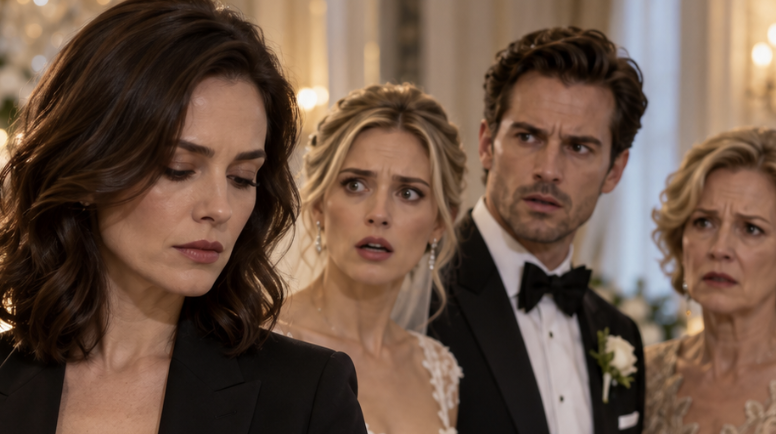
The room went completely silent.
The musicians started the introduction for the third time and stopped halfway through the measure.
Inga leaned toward her husband and whispered that their daughter had left alone. Then she repeated it twice, as though saying it again might somehow make the event disappear.
“What does ‘stop’ mean?” Mark stepped forward, his voice higher than usual. “Viktor Lvovich, what does this mean? The guests are sitting here! People came from three different cities!”
“They’ll go home,” Viktor Lvovich said.
“What about the gifts? The documents? We discussed the wording yesterday! Yesterday!”
“Exactly,” Yaroslava’s father replied, pushing the stack of documents away from himself. “Yesterday we discussed the wording. Today there’s nothing left to discuss.”
“She has no right to do this!”
“As it turns out, she does.”
Viktor Lvovich stood, buttoned his jacket, and politely informed the room that there would be no wedding. The tables had already been paid for and the food was ready, however, so no one would be forced to leave hungry.
Mark kept talking for a long time—about investments, his reputation, and how “you just don’t do something like this.”
He never said a single word about Yaroslava.
And that was the only sincere statement he made all morning.
Two months later, Yaroslava was living in a rented apartment overlooking a tram line and cataloguing a collection of old theatrical posters for an arts foundation.
That was where she met Saveliy, a man who brought her hot coffee whenever she got a headache and recited poetry while mercilessly mangling the original lines.
“You just rhymed ‘October’ with ‘ship,’” she said.
“I expanded the poet’s possibilities.”
“The poet is dead.”
“All the more reason he won’t object.”
Mark found her outside her apartment building at the end of November.
He had lost weight. His coat was still expensive, but his shoulders no longer carried the confidence they once had.
“Well, hello,” he said. “Satisfied?”
“Hello. Moderately.”
“You knew. You already knew everything a week before the wedding, and you stayed silent. You accepted my flowers, my words, my ring—and said nothing!”
“I did,” Yaroslava agreed. “That’s called gathering evidence under comfortable conditions. You spent a year and a half taking things too, by the way. Just not flowers. Information.”
“Do you even understand what you did to me? I took out a loan for that wedding! I sold the rest of my shares! I owe the bank money, do you hear me? I owe them!”
“I hear you. Your diction becomes impressively clear whenever money is involved.”
“This is all because of her! That woman! Some mother she is! She came along and destroyed everything! I curse the day she ever decided she had anything to do with me!”
“Interesting,” Yaroslava said. “For eight years you insisted she was dead, and now you’ve decided she’s responsible for everything. Make up your mind. Either you don’t have a mother, or you have a mother you can blame. Combining the two is sloppy.”
“Don’t you dare lecture me!”
“I’m not lecturing you. I’m summarizing. Different genres.”
Mark stepped closer, and his voice broke into a high, ringing pitch.
“Do you have any idea what I looked like in that hall? Two hundred people! Everyone was staring! Your father crushed me with a single sentence!”
“My father said twelve words and paid for the dinner for his guests. At today’s prices, that’s practically an act of mercy.”
“I would have loved you! I would have done anything!”
“You would have done anything,” she nodded. “The only question was what exactly you wanted to do it with. The hotels, I assume.”
“You didn’t even give me a chance to explain! Not once! You just disappeared!”
“Mark, I listened to you for a year and a half. In all that time, you never once asked what I thought about anything except your plans. But you knew the board of directors by heart. You have to admit, that’s a strange kind of selective memory for a man in love.”
“Do you understand that I have nothing now?!”
“I do. And do you know what’s funny? You’re standing here listing your losses. You haven’t said ‘I miss you’ even once. Not once. It’s all assets, interest rates, and deadlines. You’ve even stopped lying economically.”
He gasped, searching for words, and chose the cheapest ones.
“You’re cold. You’re just cold and calculating…”
“I’m warm,” Yaroslava said calmly. “Just not twenty-four hours a day and not for everyone who asks. Heating is seasonal too.”
“Polina at least cried!”
“There. You remembered her yourself. I didn’t even have to ask.”
Mark stopped short.
He realized he had said too much, and his voice became even thinner.
“I’ll come back,” he said. “I’ll recover. I’ll get everything back.”
“Start by recovering your ability to talk to people without a calculator. It’s cheaper and more useful.”
“You’ll regret getting involved with the wrong person!”
“Actually, I managed not to get involved with the wrong person just in time. Goodbye, Mark. Debt to a bank is very educational. They say it works better than any mentor.”
He left without looking back.
Yaroslava realized she felt no triumph.
Nina Zakharovna appeared outside her building in December carrying a plastic bag and standing very straight.
She waited near the wall, visibly rehearsing her opening sentence.
“I didn’t come to ask for anything,” she said immediately. “I only came to find out if you’re all right.”
“I’m all right,” Yaroslava replied. “Come with me.”
“That’s not why I came.”
“And that’s not what I meant. Come on. It’s cold out here, and I argue badly in freezing weather.”
A week later, Yaroslava rented a small apartment for her two tram stops away.
Nina Zakharovna refused four times.
All four times she received exactly the same answer.
“This isn’t charity,” Yaroslava said. “It’s settlement of an old debt. You saved me a life, and I’m paying you back in square meters. The exchange rate is terrible, but there are no other offers.”
“He’s still my son.”
“He is your son. And you still went to a complete stranger with a piece of paper. That counts for something.”
“They curse me now.”
“Let them.” Yaroslava shrugged. “Curses have depreciated worse than the ruble these days.”
Nina Zakharovna lowered her head and suddenly said very quietly:
“Thank you. Just… let this stay between us.”
“Then it’ll be our shared secret. Every respectable woman should have one.”
Saveliy proposed in the park in the middle of January, without fireworks, an orchestra, or a drone hovering overhead.
He simply took her hand, remained silent for a moment, and said:
“Listen, I don’t have hotels, shares, or a beautiful speech. I have coffee, terrible poetry, and very serious intentions.”
“Terrible poetry is a plus,” Yaroslava said. “I couldn’t tolerate proper poetry.”
“Is that a yes?”
“That’s a yes.”
She agreed immediately, without consulting a plan or calculating anyone else’s benefit, and afterward she spent a long time marveling at how simple it had been.
Sometimes she remembered the wedding that never happened—the arch, the musicians, the interrupted measure—and felt a strange tenderness toward the woman she had been then.
That foolish girl in the white dress who had nevertheless managed to ask one correct question.
At their housewarming, Nina Zakharovna brought them a floral tablecloth exactly like the one that had covered the table in the village.
Yaroslava spread it out, smoothed it with her palm, and thought that love, as it turned out, was cheaper than a limousine and more valuable than a block of shares.
“Beautiful,” Saveliy said.
“Practical,” she corrected him. “Beautiful is when nobody is calculating anybody else. And thank God, in our case, there’s nothing to calculate.”