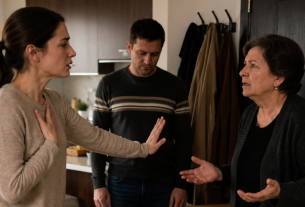
“This is my dacha, got it? Mine! I pulled it out of the dirt, and you’re out here grilling kebabs. Now get off my property!”
“Have you completely lost your conscience, Rita, or have you finally decided to live just to spite other people?” Elizaveta Borisovna snapped, pursing her lips as if she had just tasted sour borscht. “We’re celebrating an anniversary. Strangers are not needed on the property.”
“A stranger?” Margarita did not even let go of her bag; she just froze there by the gate. “On my own dacha, I’m the stranger?”
“Don’t start,” her former mother-in-law waved her off, adjusting her glittering shawl. “Lenya said you never come here. The house was standing empty; you could say we brought it back to life. People came, the tables are set, the shashlik is marinating. And then you burst in like a tax inspector.”
“I’m not an inspector,” Margarita said quietly, slowly looking around the yard. “I’m the owner.”
There really was a celebration going on in the yard. Cheap golden garlands hung from her apple trees, yes, her trees. On the veranda stood salads in disposable bowls, boxes of pastries, bottles, plastic cups. Under the old pear tree, the one her grandmother used to call “the bow-legged beauty,” sat some random aunties in dressy blouses, already wearing those expressions people get when they come by “just for an hour” and end up gossiping about the neighbors until nightfall.
At the far table loomed Leonid. Beside him stood a long-haired girl in a red dress, far too revealing for a dacha and far too self-assured for someone on чужой territory. She looked as if she were already trying on the role of the new mistress of the house. Margarita even smirked to herself: of course. The script was as old as an enamel basin in every Soviet kitchen.
But there had been a lot before this scene.
Thirteen months earlier, Margarita had stood in front of this same house, only back then there were no balloons, just waist-high weeds, a crooked gate, and a roof that looked as if one more rainstorm would make it slide right down onto the garden beds.
“Well, hello there, Grandma’s inheritance,” Margarita had muttered then, nudging the gate open with her hip. “You look, of course, like an official after a prosecutor’s inspection.”
The house answered with the creak of the door.
Inside, it smelled of old wood, dust, and dampness. On the windowsill lay a faded oilcloth printed with lemons; on the veranda there was an overturned stool; and in the corner hung a string bag with some dried-up clothespins inside. Everything was old, crooked, pitiful in places — and painfully familiar.
“So what am I supposed to do with you?” Margarita asked aloud, running her palm along the peeling doorframe.
And almost immediately answered herself:
“Live. Or at least not let you fall apart completely.”
That evening she told her husband about it.
“I’ve decided to restore the dacha,” Margarita said, setting the kettle on the table. “I’ll fix the roof, replace the windows, tidy up the inside. It’s a good place. The garden is still alive. The soil is good.”
“Are you serious right now?” Leonid did not look up from his phone. “Voluntarily throwing yourself into that shed? Rita, you’re not on some DIY makeover show.”
“It’s not a shed. It’s my grandmother’s house.”
“My grandmother’s house,” he mimicked, not maliciously, but with that lazy irritation that hurts more than shouting. “Sell it while someone still wants to buy it. Take the money. Let’s go on vacation. Buy a newer car. That’s what normal people do.”
“Normal people,” Margarita sat down across from him, “sometimes want something other than a five-day vacation with poolside photos. Sometimes they want a place of their own. Their own. Do you understand?”
“No,” Leonid answered honestly. “And most importantly, I don’t want to understand. I get enough advertising during the workweek — I’m not going to kill myself at some dacha on weekends too. Count me out.”
“I’m not asking you to kill yourself. I’m just asking you to at least come, look at it, support me.”
“I support you,” he said without lifting his eyes. “Mentally. From a distance. Very convenient.”
Back then Margarita had still smiled. She decided he was tired, in a bad mood, that he would get used to it later. Back then she still interpreted a lot in his favor. Women are amazingly talented that way: they can turn indifference into “he’s just overworked,” rudeness into “he’s stressed,” betrayal into “it’s just a crisis.” Two days later Elizaveta Borisovna came over.
“Lenya, sweetheart, I brought you some pike-perch,” she sang from the doorway, sweeping into the apartment as if it were her branch office. “Baked it like a tsar’s feast. Not like those store-bought convenience foods.”
“Thanks, Mom,” Leonid perked up.
“And you, Margarita, I hear you’ve decided on a rustic life?” her mother-in-law asked, looking at her daughter-in-law over perfectly lined eyes. “What is this, some new fashion? Is it no longer enough for city women to break a manicure — now they also have to throw out their backs?”
“I’m not planning a rustic life. I want to restore the house.”
“Good Lord, why?” Elizaveta Borisovna threw up her hands. “At your age people think about quality of life, not about hammering nails. You might as well get chickens too. Very romantic. Especially with your office job and Lenya’s constant runny nose.”
“Lenya doesn’t have a constant runny nose. He just has a habit of not closing the car window,” Margarita answered calmly.
“Really? I thought he was allergic to domestic fanaticism,” her mother-in-law said dryly. “And besides, what kind of value is an old dacha anyway? No proper renovation, no amenities, out in the suburbs where even the pharmacy closes at six.”
“It has value to me.”
“To you, maybe even a Soviet china cabinet counts as an antique. But not everything old needs saving.”
All the while Leonid silently ate his pike-perch. He did not even choke. That was the first time Margarita thought that silence is sometimes louder than any words. Especially a man’s silence. Especially when he makes a point of not defending you.
She started going to the dacha alone.
“Going there again?” Leonid would ask on Saturdays when she pulled on old jeans and tied her hair back in a ponytail.
“There again.”
“Don’t you have anything better to do?”
“As a matter of fact, I do.”
“Sure, sure,” he would snort. “Just don’t complain afterward that you’re tired.”
“And who exactly am I supposed to complain to?” Margarita finally snapped one day. “To you? You’ve already chosen the position of decorative sympathy.”
“Don’t start first thing in the morning,” he cut her off. “It’s my day off.”
“Lenya, it seems to me like you’re on a day off in this marriage too.”
That time he looked at her coldly, unkindly, but said nothing. And once again buried himself in his screen.
The dacha changed slowly. First Margarita called in a roofer, then she painted the walls herself, cleared out the junk, scraped off the old paint, hauled broken picture frames and some hideous suitcases with cracked clasps out of the attic…
To be continued just below in the first comment.
“Have you completely lost your conscience, Rita, or have you finally decided to live just to spite people?” Elizaveta Borisovna snapped sharply, pursing her lips as if she had just tasted sour borscht. “We’re celebrating an anniversary. We don’t need outsiders on the property.”
“An outsider?” Margarita didn’t even let go of her bag, freezing there by the gate. “So on my own dacha, I’m the outsider?”
“Oh, don’t start,” her former mother-in-law waved her off, adjusting her glittering shawl. “Lenya said you never come here. The house was standing empty — you could say we brought it back to life. People arrived, the tables are set, the шашлык is marinating. And then you come barging in like some tax inspector.”
“I’m not an inspector,” Margarita said quietly, slowly looking around the yard. “I’m the owner.”
There really was a celebration going on in the yard. Cheap golden garlands hung from her apple trees — her trees. On the veranda stood salads in disposable bowls, boxes of pastries, bottles, plastic cups. Under the old pear tree, the one her grandmother used to call the “bow-legged beauty,” sat a few aunties in dressy sweaters, already wearing the expression people get when they only came for an hour but end up gossiping about the neighbors until nightfall.
At the far table, Leonid loomed in view. Beside him stood a long-haired girl in a red dress — far too revealing for a dacha and far too self-assured for someone on чужой property. She looked as if she were already trying on the role of the new mistress of the house. Margarita even smirked to herself: of course. A storyline as old as an enamel basin in every Soviet kitchen.
But there had been a lot before this scene.
Thirteen months earlier, Margarita had stood in front of this same house, only back then there were no balloons here — just waist-high weeds, a sagging gate, and a roof that looked like one more rainfall would make it slide right onto the garden beds.
“Well, hello there, Grandma’s inheritance,” Margarita had muttered then, nudging the gate open with her hip. “You look like a government official after a prosecutor’s inspection.”
The house answered with the creak of its door.
Inside, it smelled of old wood, dust, and dampness. On the windowsill lay a faded oilcloth patterned with lemons, on the veranda an overturned stool was lying there, and in the corner hung a string bag filled with dried-out clothespins. Everything was old, crooked, pitiful in places — and painfully familiar.
“So what am I supposed to do with you?” Margarita asked out loud, running her palm along the peeling doorframe.
And almost immediately she answered herself:
“Live here. Or at least not let you fall apart completely.”
That evening she told her husband about it.
“I’ve decided to restore the dacha,” Margarita said, setting the kettle on the table. “I’ll fix the roof, replace the windows, tidy up the inside. It’s a good place. The garden is alive. The soil is good.”
“Are you serious right now?” Leonid didn’t look up from his phone. “Voluntarily throwing yourself into that shack? Rita, you’re not on some DIY TV show.”
“It’s not a shack. It’s my grandmother’s house.”
“Grandmother’s house,” he mimicked, not maliciously, but with that lazy irritation that hurts more than shouting. “Sell it while someone still wants to buy it. Take the money. Let’s go on vacation. Buy a newer car. That’s what normal people do.”
“Normal people,” Margarita sat down across from him, “sometimes want more than a five-day vacation with photos by the pool. Sometimes they want a place of their own. Their own. Do you understand?”
“No,” Leonid answered honestly. “And most importantly, I don’t want to understand. I get enough ads during the workweek, and now I’m supposed to kill myself at the dacha on weekends too? Count me out.”
“I’m not asking you to kill yourself. I’m just asking you to at least come, take a look, support me.”
“I support you,” he said without raising his eyes. “Mentally. From a distance. Very convenient.”
Margarita had even smiled then. She decided he was tired, not in the mood, that he’d get used to it later. Back then she made a lot of decisions in his favor. Women are remarkably talented that way: they can turn indifference into “he’s just overwhelmed,” rudeness into “he’s stressed,” betrayal into “it’s a crisis.” Two days later Elizaveta Borisovna came over.
“Lenya, sweetheart, I brought you pike-perch,” she sang from the doorway, walking into the apartment as if it were her satellite territory. “I baked it like royalty. Not like those store-bought convenience foods.”
“Thanks, Mom,” Leonid perked up.
“And you, Margarita, I hear you’ve decided to embrace country life?” her mother-in-law asked, looking at her daughter-in-law over perfectly lined eyes. “What is this, a new trend? Is it not enough for city women to break a manicure now — they also have to throw out their backs?”
“I’m not embracing country life. I want to restore the house.”
“Good Lord, why?” Elizaveta Borisovna threw up her hands. “At your age people think about quality of life, not about hammering nails. You might as well get chickens too. Very romantic. Especially with your office job and Lenya’s constant sniffles.”
“Lenya doesn’t have constant sniffles. He just has a habit of not closing the car window,” Margarita replied calmly.
“Really? I thought he had an allergy to domestic fanaticism,” her mother-in-law said dryly. “And anyway, what kind of value is there in an old dacha? No proper renovation, no amenities, in a suburb where even the pharmacy closes at six.”
“It has value to me.”
“To you, maybe even a Soviet china cabinet is an antique. But not everything old needs to be saved.”
Meanwhile Leonid silently ate his pike-perch. He didn’t even choke. That was the first time Margarita thought that sometimes silence is louder than any words. Especially a husband’s silence. Especially when he makes a show of not defending you.
She started going to the dacha alone.
“Going there again?” Leonid would ask on Saturdays, when she pulled on old jeans and tied her hair into a ponytail.
“Yes. There.”
“Don’t you have anything better to do?”
“As a matter of fact, I do.”
“Well, well,” he would snort. “Just don’t complain afterward that you’re tired.”
“And who am I supposed to complain to?” Margarita finally snapped one day. “You? You already took up the position of decorative sympathy.”
“Don’t start first thing in the morning,” he cut in. “It’s my day off.”
“With you, Lenya, I think even marriage is a day off.”
Then he looked at her coldly, unpleasantly, but said nothing. And buried himself in the screen again.
The dacha changed slowly. First Margarita called a roofer, then she painted the walls herself, cleaned out the junk, scraped off old paint, dragged broken picture frames and terrifying suitcases with cracked clasps out of the attic.
Every time, the neighbor, Aunt Zina, would stick her head out over the fence.
“Girl, where’s your husband?” she would ask loudly, as if checking whether men still had any shame within a two-street radius.
“In the city,” Margarita would answer.
“Ahhh. A city one, then. They’re all like that now. The only thing they know how to hold in their hands is a remote control.”
“Mine can hold a mug too,” Margarita would laugh. “Sometimes.”
“Well, then he’s not disabled yet,” Aunt Zina would nod philosophically.
The house was coming back to life, while the marriage was doing the opposite.
Leonid stayed late more and more often. Said “work” more and more often, and looked Margarita in the face less and less. He ate dinner in silence. Answered questions as though someone were handing him a bill.
“You’re late,” Margarita said one evening when the clock showed almost eleven.
“I had a meeting.”
“Until eleven?”
“Adults, Rita, sometimes have jobs. Not everyone spends their time talking to flowers in the flowerbeds.”
“And you, then, are some kind of hero of capitalist labor?”
“At least I bring money into the house, not boards from the hardware store.”
“Actually, I work too.”
“Do you? Because it feels like all you do is wage war against wallpaper.”
That time Margarita stayed silent. Not because she had nothing to say. Because suddenly she was scared. When someone starts speaking to you like you’re an irritating neighbor rather than a loved one, that isn’t a crack anymore. That’s a draft coming through a door that is almost shut.
A year later the dacha had become completely different. Bright. Warm. With new white window frames, a painted veranda, geraniums in pots, neat garden beds, apple trees, and a bench by the old currant bush. Margarita brought blankets there, books, her grandmother’s old tea set with the blue trim. And for the first time in a long while she felt that at least somewhere in her life, things yielded to her hands.
She texted Leonid: Come on Saturday. We’ll just sit together. I’ll bake a pie.
The reply came forty minutes later: Can’t. Things to do.
And that evening, when she came home, Leonid’s phone lit up with a message. It was lying in the kitchen. The screen shone like a spotlight on a stage.
Kitty, where are you? I already bought the wine. Waiting for you.
Margarita stared at the line of text and for some reason her first thought was something stupid: funny how the word kitty always looks equally ridiculous after thirty.
Then she opened the chat.
Everything was there. Messages, photos, plans, little jokes he used to say to her. Even the tone was the same. As if he had simply copied his old self and handed it over to another woman.
When Leonid came in, Margarita was sitting in the kitchen with his phone.
“Have you completely lost it?” he snapped. “Why did you go through it?”
“Who is she?” Margarita asked so calmly that she hardly recognized herself.
“Don’t change the subject. That’s my phone.”
“Who is she, Lenya?”
He fell silent for a second. Then shrugged.
“Veronika.”
“And who is Veronika to you?”
“A person.”
“How informative. And what am I, then? A shared utility expense?”
“Rita, don’t make a scene.”
“The scene is in your messages. With a bad script and cheap sentimentality. I’m asking you one last time: who is she?”
“My woman,” he said, looking away. “I was going to tell you.”
“When? After your wedding to her? Or when she got pregnant and you urgently needed a wardrobe from our apartment?”
“Don’t hysterics.”
“I haven’t even started yet.”
He sat down across from her and rubbed his forehead tiredly.
“It’s all been broken between us for a long time. You know that too.”
“Between us?” Margarita let out a short laugh. “How convenient. You lied for six months, and we broke. So you were the one making the mess, but apparently the smell comes from both of us?”
“You’re always at the dacha. You’re never around.”
“I invited you. Dozens of times. You didn’t want to come.”
“Because I’m not interested in living among paint cans and old stools!”
“But living between two women interests you?”
“I’m tired, Rita!” Leonid snapped. “Tired of all this constant correctness. Of your complaints. Of the way home always feels like a homeowners’ association meeting: who didn’t do what, who owes whom, why someone is late.”
“Of course. Much more fun to be greeted by a girl in a red dress with wine.”
“I love her.”
“Oh, really. So now it’s love. And how long have we had this love story? On schedule, or did it happen spontaneously?”
“Don’t mock me.”
“And don’t make an idiot out of me.”
He fell silent. Then said dully:
“I want a divorce.”
For a few seconds Margarita looked at him, then nodded.
“All right.”
He even looked confused.
“All right?”
“Yes. But tonight you pack your things and leave.”
“This is my apartment too.”
“It’s a rental apartment. The furniture can be split. You don’t even have to take the dishes, I’m not greedy. But you won’t be spending the night here tonight.”
“You’re kicking me out?”
“No, Lenya. I’m helping you speed up your new life.”
The next morning Elizaveta Borisovna called.
“Lenya told me what you pulled last night,” she said in an icy tone. “You behaved like a market woman.”
“And how did your son behave?” Margarita asked tiredly.
“Don’t you dare speak to me in that tone. A man doesn’t leave for no reason. It means things were bad for him at home.”
“He didn’t leave home. He left for his mistress.”
“And why did your man feel the need to look elsewhere in the first place? A proper wife senses such things in advance.”
“Amazing,” Margarita smirked. “So if the husband cheats, it’s the wife’s fault for not doing the technical inspection?”
“Don’t be sarcastic. You were always too prickly. You have no feminine softness.”
“And you have enough of it to can in jars.”
“There! That’s exactly what I mean! Nothing but sarcasm. No warmth, no respect for family.”
“What family, Elizaveta Borisovna? The one where I was constantly compared to this Tanya in sable and that Marina with her perfect cutlets? Thanks, I’ve had my fill.”
“If you were smarter, all of this could still be saved.”
“With the mistress?”
“Men make mistakes sometimes.”
“And women are supposed to pretend it was just a passing shower afterward?”
“You dramatize everything.”
“And you whitewash everything. A very convenient family tradition.”
They divorced quickly. There were no children. There wasn’t much property to divide. The dacha, which Margarita had inherited from her grandmother, legally remained hers alone — even Leonid didn’t argue with that. Apparently, some residual practicality still lived in him: he didn’t want to get tangled up in documents.
For a while Margarita moved in with her friend Oksana.
“Don’t keep silent,” Oksana said one evening, setting a mug of tea in front of her. “If you stay silent about things like this, they rot inside you.”
“I’m not silent. I’m just thinking.”
“About what?”
“About how I managed to live with a man for five years and only truly see him at the moment when he had almost finished packing his suitcase.”
“You managed just fine,” Oksana snorted. “That’s a national women’s sport. We don’t love people — we love our hopes for them.”
“Thanks. Very encouraging.”
“But honest. And anyway, be glad. At least you still have the dacha. After my divorce, all I had left was a blender and a cat that moved in with my ex a week later.”
Margarita laughed despite herself.
“Traitor.”
“The worst kind. Men, cats — all the same. They go where the food is better.”
That summer Margarita decided to live at the dacha for a while. To breathe. To be alone. Without other people’s intonations, without reproaches, without those sticky conversations where somehow you always end up being blamed for the fact that someone else turned out to be vile.
She bought groceries, packed her things, drove to the property — and saw strange cars by the fence.
At first she thought the neighbors were celebrating something. Then she heard music coming from her own yard.
And then the gate opened — and her former mother-in-law stood before her. And now silence hung over the yard.
“Elizaveta Borisovna,” Margarita said clearly, “are you in your right mind?”
“Are you?” the other woman flared up immediately. “People came to congratulate me, and here you are with a face like a district police officer about to conduct a raid.”
“That’s because I walked onto my own property and found you running the place.”
“Don’t dramatize it. We didn’t steal anything.”
“Really? And where exactly did you get permission to use my house — from the district executive committee of 1982?”
Leonid finally came over.
“Rita, let’s stay calm.”
“Calm?” Margarita turned to him. “You brought your mother, guests, and your mistress. To my dacha. And you want calm?”
“Mom just wanted to celebrate somewhere nice. A restaurant is expensive.”
“So I’m your free venue, then?”
“Don’t get worked up.”
“I’m not a car, Lenya. I’m already worked up.”
Veronika, who had been silent until then, suddenly stepped forward.
“Actually, you could have acted like a human being. Not made a scene in front of everyone.”
Margarita looked at her with the interest one might give a talking iron.
“Like a human being? You’re explaining to me how to act like a human being? You — who stepped into someone else’s marriage, and then came to someone else’s dacha to celebrate someone else’s former mother-in-law’s anniversary?”
“Don’t attack me,” Veronika flared. “It was already over between you two.”
“How convenient. The moment a mistress gets official status, she starts speaking with the voice of a notary.”
“Rita!” Leonid snapped at her.
“What, ‘Rita’? You’re going to lecture me now? Too late. You should have practiced earlier, when you were lying.”
Elizaveta Borisovna slapped her palm on the table.
“That’s enough! This is my celebration!”
“No,” Margarita said firmly. “This is my property. And your celebration is over.”
“And who do you think you are, throwing guests out?”
“The owner. Want me to go get the documents from the car? Or maybe I should just call the police right now? That really livens up an event. Especially after mayonnaise salad.”
Several guests shifted nervously. Someone started whispering. One woman in a lilac blazer clearly already regretted coming.
“Boris!” Elizaveta Borisovna called sharply. “Tell her!”
Her father-in-law stood up slowly, as if he understood that any word he said now would go down in the family archives.
“Liza, she’s right,” he said quietly. “It’s her house. We shouldn’t have come without asking.”
“What do you mean we shouldn’t have?” she burst out. “That’s your position? On my anniversary?”
“My position,” he answered tiredly, “is that you don’t take what belongs to someone else. Even if the roses are pretty and the veranda is comfortable.”
“Wonderful!” Elizaveta Borisovna shrieked. “So now I’m a thief too?”
“Don’t twist my words,” Margarita cut in. “But if we really want to go by the letter of the law, you entered private property without permission. Do you want to continue this discussion in the presence of the police?”
“You wouldn’t dare.”
“Shall we find out?”
Leonid stepped closer.
“You’ve lost your mind. Causing this kind of disgrace over a couple of hours of celebration?”
“The disgrace, Lenya, was the day I found out about your messages. Today is just sanitation. I’m clearing the territory.”
“You’re taking revenge.”
“No. I’m finally defending what’s mine.”
He twisted his face.
“You always were greedy when it came to grievances.”
“And you’re generous when it comes to betrayal.”
“Rita…”
“No, now you listen,” Margarita’s voice grew harder. “For a year I rebuilt this house with my own hands. You never came here once. You didn’t bring a single board. You didn’t hammer in a single nail. But now that it’s clean, beautiful, and suitable for seating guests under the apple trees, suddenly all of you found the road here. Very family-like. Very touching. Almost enough to make me cry.”
“We didn’t think you’d come,” Leonid muttered.
“And that,” Margarita replied quietly, “is the whole essence of your kind. You always count on the fact that the person you humiliated, deceived, and pushed aside won’t come. Won’t speak. Won’t say anything. Will just wipe it off and swallow it. But I’m not swallowing anything anymore.”
She pulled out her phone.
“You have ten minutes. Then I call.”
And that worked better than any shouting.
The guests began gathering their things immediately. The men cleared away the grill, the aunties packed up the salads, someone hurriedly untied the balloons as if they were now material evidence. Veronika huffed nervously, but started collecting plates too. Leonid, with a dark expression, carried boxes to the car.
Elizaveta Borisovna still tried to resist.
“This is inhuman!” she said, frantically zipping up her bag. “A person’s anniversary, and you…”
“And a person should have a brain,” Margarita cut her off. “Especially at sixty. By then you should know the difference between your house and someone else’s.”
“You are such a cruel woman…”
“No. I’m just no longer convenient. And you’re not used to that.”
When most of the guests had driven off, only the core family remained in the yard.
“You’ll regret this,” Leonid hissed, stuffing bags into the trunk.
“I already regretted it,” Margarita nodded. “Five years ago. But now it’s passing.”
“You destroyed everything yourself with your character.”
“Of course. And you’re just a delicate flower, blown away by the winds of circumstance.”
“You know what…”
“I know. Which is exactly why I’m saying: leave.”
Boris Arturovich, already opening the car door, suddenly turned back.
“Margarita,” he said awkwardly, “you did well. The house turned out beautiful. Your grandmother would have been pleased.”
Elizaveta Borisovna gasped as though her husband had publicly transferred property to a stranger.
“Borya!”
“And what about Borya?” he shot back unexpectedly harshly for the first time. “Enough. I’m sick of it. The woman is right. We behaved like owners where nobody invited us. And you raised your son the same way: everyone owes him something, everything should be handed to him on a plate. This is where we ended up.”
Leonid flushed dark red.
“Dad, are you serious right now?”
“Absolutely. And by the way, I suggested a restaurant from the beginning. But no, we had to save money. Using someone else’s property is cheaper.”
Elizaveta Borisovna got into the car in silence. Apparently that was her highest possible degree of inner earthquake.
They drove away.
Margarita was left alone in the middle of the yard. A forgotten plastic fork lay on the table. A napkin rustled under her feet. One golden balloon still swayed on the apple tree — absurd, like a bad idea.
Margarita climbed onto the veranda, sat down on the step, and exhaled.
Then suddenly she laughed. Quietly, tiredly, but genuinely.
“Grandma,” she said into the emptiness, “if you saw that, I hope you weren’t bored.”
Aunt Zina’s head appeared from behind the fence.
“Ritka!” she called in a whisper, though loudly, as only village women can. “I heard everything. Well, you sure gave it to them! That ex of yours is a full-on armored train with no brakes.”
“Thanks, Aunt Zina.”
“Don’t say thanks — you did the right thing. I thought you were going to swallow it again. But look at you, baring your teeth.”
“They came in late.”
“Better late than with false teeth,” the neighbor observed philosophically. “Put the kettle on. I’m coming over. We’ll discuss.”
Margarita stood up and looked around the house, the yard, the garden. Everything was still there. A little rumpled after the invasion, but alive. Hers.
And suddenly she understood the most important thing: it had never really been about the dacha. Not about her ex-husband. Not about her mother-in-law with that permanent expression of I’m the one in charge here. It was about the fact that for too long she had been asking permission to live the way she needed to. To be convenient, patient, understanding, mature, wise — that whole female package they stuff us with until it makes us sick. And then it turns out that convenient women aren’t loved. Or respected. They’re just moved around like an extra chair in the kitchen.
Margarita took the last balloon down from the apple tree, crushed it in her hand, and threw it into the trash bag.
Then she put the kettle on, took out her grandmother’s tea set, and opened the window on the veranda.
Outside, the air smelled of warm earth, currants, and freedom.
And for the first time in a very long while, she didn’t feel abandoned, guilty, or unnecessary.
Only like the owner.