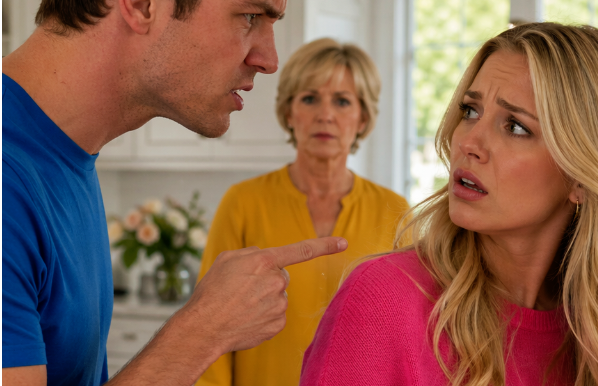
“Ask your mother to forgive you for your money, or you can forget my last name,” her husband ordered, looking right through his mother.
“Do you even hear what you’re saying, or did your conscience go on vacation before you did?” Yevgenia shot back sharply, without taking off her apron and still drying her hands on a kitchen towel. “Should I write down the card number? On what grounds?”
“On the grounds that family helps family,” Inna Fyodorovna said crisply, already settling herself at the kitchen table with such confidence that it felt less like Zhenya’s kitchen and more like one of her branch offices. She clicked open her handbag, pulled out her glasses and a bank card. “Matvey, explain it to her properly, without all this female theater.”
“Zhen, honestly, why do you get worked up right away?” Matvey said tiredly, picking at a piece of omelet with his fork. “Mom isn’t asking for diamonds. It’s for the seaside. For once in her life, a person wants to have a proper vacation.”
“For once in her life?” Yevgenia gave a short laugh and leaned her hip against the counter. “Since April, Inna Fyodorovna has already told me three times how hard it is to live without Turkey. Apparently I was supposed to be moved by that and open a charitable foundation in honor of her suffering.”
“Don’t be sarcastic,” her mother-in-law pressed her lips together. “It doesn’t suit you. You always talk as if everyone around you is an idiot and you alone have a higher moral education.”
“No,” Zhenya replied calmly. “I just talk as if money has an owner. And this time, the owner isn’t you.”
“There!” Inna Fyodorovna flared up triumphantly, turning to her son. “Do you hear that? Do you hear, Matvey? How many times did I tell you—everything that’s yours belongs to your wife, but everything that’s hers is sacred. This isn’t a family, it’s bookkeeping with elements of rudeness.”
Matvey let out a heavy sigh, like a man fate had for some reason appointed chief mediator between two highly flammable warehouses.
“Zhenya, come on, let’s skip the wording. Grandma transferred you the money, fine. But we live together. We have repairs, expenses, plans. And Mom isn’t a stranger.”
“Grandma didn’t ‘transfer’ it,” Yevgenia corrected him sharply. “Grandma sold her old house out in the region and decided to give part of the money to me. Personally to me. While she’s still alive. With a deed of gift. Through a notary. So that later, quote, ‘no outsider would build themselves a sanatorium on my money.’ The woman saw right through it.”
“Oh, please, don’t turn an elderly person into a prophet,” Inna Fyodorovna snorted. “Old people all love to dramatize. They think everyone around them is out hunting for their china cabinets and carpets.”
“Are you seriously saying that right now?” Yevgenia even laughed, but the laugh came out dry, like the crust of yesterday’s loaf. “You’re sitting in my kitchen, holding a card in your hand, and explaining that you’re not after someone else’s money?”
“Not someone else’s—family money!” her mother-in-law raised her voice. “If you’re a wife, then your resources are shared too.”
“No, Inna Fyodorovna,” Zhenya cut in. “By law, a gift officially made to one spouse is that spouse’s personal property. I can even tell you the exact article if you’d like some legal education with your tea.”
“Don’t you dare wave the law at me,” the older woman flared. “We live as a family, not in a courtroom.”
“Strange,” Yevgenia nodded. “Because you talk like a debt collector.”
Matvey set down his fork and rubbed his forehead.
“That’s it, it’s starting. I wanted to eat breakfast in peace for once. Is that impossible? Can’t we get through one day off without a circus?”
“Then don’t bring the circus administration into the house demanding payment for the tour,” Yevgenia said without blinking.
“Did you just call me a clown?” Inna Fyodorovna gasped, pressing a hand to her chest.
“No, of course not. Clowns at least entertain people.”
For a second the kitchen became so quiet that you could hear the smell of fried onions drifting in through the open window from the neighbors, and below the building boys were kicking a ball around and shouting, “Pass it! Where are you blasting it?” The May morning was disgustingly peaceful, as if the world were mocking them on purpose.
Inna Fyodorovna slowly took off her glasses.
“Matvey,” she said almost in a whisper, which somehow made it even more unpleasant. “Are you really going to let her talk to me like that?”
“Mom, well, Zhenya did go too far,” Matvey began.
“Went too far?” Yevgenia flared up. “So I’m the one who went too far? Not the person who came for my money with a ready-made bank card, not you, who spilled everything to your mother the very next day, but me? Wonderful. Truly the theater of the absurd in honor of your family name.”
“What do you mean, ‘spilled’?” Matvey snapped irritably. “I told my mother. I don’t keep secrets from her.”
“You don’t,” Zhenya nodded. “But as it turns out, I have neither a husband nor even the basic right to anything personal.”
“Listen, don’t start acting like a victim,” Inna Fyodorovna hissed. “You live in your own apartment, fine. But what did you hook my son with? The way you look at people with judgment and make soup without salt?”
“The salt is on the table,” Zhenya replied automatically. “Anyone with hands can add their own.”
“See that, Matvey?” her mother-in-law threw up her hands. “Everything she says has a hidden jab. Everything is a little sting. And then she wonders why she’s hard to deal with.”
Yevgenia looked at her husband. He looked away. And that was worse than any shouting. Because a person shouts when they still have energy. But when they avert their eyes, it means everything has already been decided without you.
She slowly sat down across from them and said very evenly:
“Let’s do this once, without the moaning, the manipulation, and the performance. I owe no one anything from that money. Grandma gave it to me because she knew this: if a woman over fifty has no safety cushion of her own, then she isn’t living her life—she’s living at the mercy of other people’s moods. I wanted to replace the windows, set some aside for repairs, maybe take her to a sanatorium in the fall. That’s all. Your vacation was not on that list.”
“And why wasn’t it on that list?” Inna Fyodorovna asked quickly. “Because I’m nobody to you?”
“Because a vacation is not a necessity, it’s your wish. And it shouldn’t be your daughter-in-law paying for it—it should be you.”
“Out of a pension, you mean?” her mother-in-law asked venomously. “With these prices? Well done, children, thank you, way to honor old age.”
“Don’t turn me into the Ministry of Social Protection,” Zhenya said wearily. “I’m not responsible for the size of pensions in this country or for your unrealized Cypruses either.”
Matvey stood up abruptly.
“That’s enough. Zhenya, you’re crossing the line.”
“Me?” She got up too. “Matvey, your mother comes to me for someone else’s money and demands it as if I owe her rent for making use of you. And in your opinion, I’m the one crossing the line?”
“Because you’re humiliating her!”
“And you’re not humiliating me?” Zhenya stepped closer. “The two of you are sitting there discussing how to spend my money as if I’m not even here. What am I, a nightstand? An ATM? An attachment to your mother?”
“Don’t twist it around,” Matvey snapped. “We’re talking about helping.”
“No,” she answered quietly. “We’re talking about nerve.”
Inna Fyodorovna stood up sharply, her chair scraping across the tile.
“I see. So that’s how it is. The moment money appeared, the real face came out. And here I was wondering why you’d been so nice these last few days, smiling all the time, keeping quiet. You were sitting there storing it all up inside.”
“I kept quiet because I hoped you’d have enough shame to stop yourselves,” Yevgenia said. “But as it turns out, you’re a person without extra brakes.”
“Matvey!” her mother-in-law nearly shouted. “Are you going to stand there and watch? Or will you finally remind your wife that she’s in a family, not on a solo protest picket?”
He gave a nervous shrug.
“Zhen, come on, seriously. What, are you really that sorry to part with it? Give Mom at least two hundred. The package is cheap, by bus, all-inclusive. It’s not a million.”
“Two hundred?” Yevgenia slowly turned to him. “So you already discussed the amount too?”
Matvey faltered. Only slightly. But it was enough.
“We just kind of estimated…”
“Estimated,” she repeated. “Without me.”
“What’s the big deal?” he flared up. “I’m the man of the house, I also have a right to discuss family money!”
“Not this money,” Zhenya cut him off. “And not behind my back.”
“Oh, here comes the lecture on property rights,” Inna Fyodorovna rolled her eyes. “Matvey, pretty soon you’ll have to talk to her through a power of attorney.”
“Better through a receipt,” Yevgenia snorted. “More reliable.”
“Are you mocking us?” Matvey stepped toward her.
“And are you trying to surprise me right now?” she leaned forward too. “With what? That you’ll defend your mother again? I already got the picture. You have a strong alliance here: one asks, the other applies moral pressure.”
“Don’t you dare talk about my mother like that!”
“And don’t you dare dispose of my money!”
He grabbed her wrist. Not hard, but sharply, possessively. From the shock, something inside Zhenya clicked—coldly and with absolute clarity…
“Do you even hear what you’re saying, or did your conscience go on vacation before you did?” Evgenia snapped, not even taking off her apron as she kept drying her hands with a kitchen towel. “Write down your card number? Why on earth would I do that?”
“Because family helps family,” Inna Fyodorovna declared crisply, already settling herself at the kitchen table with the confidence of someone acting as though this were not Zhenya’s kitchen, but a branch office of her own. She clicked open her purse, took out her glasses and a bank card. “Matvey, explain it to her properly, without all this female melodrama.”
“Zhenya, come on, why do you get worked up right away?” Matvey said wearily, picking at a piece of omelet with his fork. “Mom’s not asking for diamonds. She wants to go to the sea. For once in her life, the woman wants a decent vacation.”
“For once in her life?” Evgenia gave a short laugh and leaned her hip against the counter. “Since April, Inna Fyodorovna has informed me three times already how hard it is to live without Turkey. Apparently I was supposed to be moved by this and open a charity fund in honor of her suffering.”
“Don’t be sarcastic,” her mother-in-law said, pressing her lips together. “It doesn’t suit you. You always talk as if everyone around you is an idiot and you alone graduated with a degree in moral superiority.”
“No,” Zhenya replied calmly. “I just talk as if money has an owner. And this time, that owner isn’t you.”
“There!” Inna Fyodorovna flared up triumphantly, turning to her son. “Do you hear that? Do you hear, Matvey? How many times have I told you—everything of mine is hers, but everything of hers is sacred. This isn’t a family, it’s bookkeeping with elements of rudeness.”
Matvey let out a heavy sigh, like a man fate had inexplicably appointed chief mediator between two highly flammable warehouses.
“Zhenya, let’s not use those kinds of phrases. Grandma transferred you the money, fine. But we live together. We have renovations, expenses, plans. And Mom isn’t a stranger.”
“Grandma didn’t ‘transfer’ it,” Evgenia corrected him sharply. “Grandma sold her old house in the region and decided to give part of the money to me. Personally to me. While she’s still alive. With a deed of gift. Through a notary. So that later, to quote her, ‘no outsider would build themselves a sanatorium on my money.’ The woman saw straight through it.”
“Oh please, don’t turn an old woman into a prophet,” Inna Fyodorovna snorted. “All old people love to dramatize. They think everyone around them is hunting for their china cabinets and rugs.”
“Are you seriously saying that right now?” Evgenia actually laughed, but it came out dry as yesterday’s bread crust. “You’re sitting in my kitchen, with a bank card in your hand, explaining that you’re not after someone else’s money?”
“Not someone else’s—family money!” her mother-in-law raised her voice. “If you’re a wife, then your resources are shared.”
“No, Inna Fyodorovna,” Zhenya cut in. “Under the law, a gift made to one spouse is that spouse’s personal property. I can even cite the article for you, if you’re in the mood for some legal education with your tea.”
“Wave the law at me, go ahead,” the older woman flared. “Honestly. We live as a family, not in a courtroom.”
“Strange,” Evgenia nodded. “Because you sound like a debt collector.”
Matvey set down his fork and rubbed his forehead.
“There we go. It’s started. I just wanted to eat breakfast in peace for once. Is that too much to ask? Is it impossible to spend one day off without a circus?”
“Then don’t bring circus management into the house demanding someone pay for the tour,” Evgenia said without blinking.
“Did you just call me a clown?” Inna Fyodorovna gasped, pressing a hand to her chest.
“No, not at all. Clowns at least make people laugh.”
For a second the kitchen went so quiet that you could hear the smell of fried onions drifting in through the open window from the neighbors, and the boys down below kicking a ball around the yard and yelling, “Pass it! What are you doing?” The May morning was offensively peaceful, as if the world were mocking them on purpose.
Inna Fyodorovna slowly removed her glasses.
“Matvey,” she said almost in a whisper, which somehow made it even worse. “Are you really going to let her talk to me like this?”
“Mom, well, Zhenya did go too far,” Matvey began.
“Went too far?” Evgenia shot back. “So I’m the one who went too far? Not the person who came for my money with a card already in hand, not you, who told your mother everything the very next day, but me? Wonderful. Truly a family theater of the absurd in honor of your last name.”
“What do you mean, ‘told’?” Matvey snapped irritably. “I told my mother. I don’t keep secrets from her.”
“You don’t,” Zhenya nodded. “But apparently I, as it turns out, have neither a husband nor even the basic right to anything of my own.”
“Listen, don’t start playing the victim,” Inna Fyodorovna hissed. “You live in your own apartment, fine. But what exactly did you use to hook my son? That disapproving stare of yours and soup without salt?”
“The salt is on the table,” Zhenya replied automatically. “Anyone with hands can add their own.”
“You see, Matvey?” her mother-in-law threw up her hands. “Everything she says has a barb in it. Everything comes with a little sting. And then she wonders why she’s so hard to live with.”
Evgenia looked at her husband. He averted his eyes. And that was worse than any shouting. Because people shout when they still have energy left. But when they look away, it means everything has already been decided without you.
She slowly sat down across from them and said very evenly:
“Let’s do this once, without the moaning, manipulation, and full concert program. I do not owe anyone a single thing from that money. Grandma gave it to me because she knew that if a woman over fifty doesn’t have her own safety cushion, then she isn’t living a life—she’s living at the mercy of other people’s moods. I wanted to replace the windows, save some for repairs, maybe take her to a sanatorium in the fall. That’s it. Your vacation was not on that list.”
“And why wasn’t it?” Inna Fyodorovna asked quickly. “Because I’m nobody to you?”
“Because a vacation is not a necessity, it’s your wish. And the person who should pay for it is not your daughter-in-law, but you.”
“On a pension, then?” her mother-in-law asked venomously. “With prices like these? Well done, children, thank you for honoring old age.”
“Please don’t turn me into the Ministry of Social Protection,” Zhenya said tiredly. “I’m not responsible for pension sizes in this country, or for your unrealized dream of Cyprus.”
Matvey rose abruptly.
“That’s enough. Zhenya, you’re crossing the line.”
“Me?” She stood too. “Matvey, your mother comes to me for someone else’s money and demands it as if I owe her rent for the privilege of being married to you. And I’m the one crossing the line?”
“Because you’re humiliating her!”
“And you’re not humiliating me?” Zhenya stepped closer. “Both of you are sitting here discussing how to spend my money as if I’m not even in the room. What am I, a bedside table? An ATM? An add-on to your mother?”
“Don’t twist this,” Matvey snapped. “We’re talking about helping.”
“No,” she replied quietly. “We’re talking about nerve.”
Inna Fyodorovna jumped to her feet, her chair scraping across the tile.
“I see. So that’s how it is. The moment money shows up, a person reveals her true face. And here I was wondering why you’d been so nice these last few days, smiling, staying quiet. You were just sitting there bottling it all up.”
“I kept quiet because I hoped you’d have the decency to be ashamed,” Evgenia said. “But apparently you’re a woman without unnecessary brakes.”
“Matvey!” her mother-in-law nearly shouted. “Are you going to stand there and watch? Or are you going to remind your wife that she’s in a family, not holding a one-woman protest?”
He gave a nervous shrug.
“Zhenya, come on, seriously. What, are you really that stingy? Give Mom at least two hundred. The package isn’t expensive, by bus, all-inclusive. It’s not a million.”
“Two hundred?” Evgenia turned to him slowly. “So you already discussed the amount?”
Matvey faltered. Just slightly. But it was enough.
“Well, we estimated roughly…”
“Estimated,” she repeated. “Without me.”
“What’s the big deal?” he flared up. “I’m the man of the house. I have a right to discuss family money too!”
“Not this money,” Zhenya cut in. “And not behind my back.”
“Oh, here comes the lecture on property rights,” Inna Fyodorovna rolled her eyes. “Matvey, soon you’ll need power of attorney just to speak to her.”
“Better a receipt,” Evgenia smirked. “More reliable.”
“Are you mocking me?” Matvey stepped toward her.
“Are you trying to surprise me right now?” she stepped forward too. “With what? That you’re going to defend your mother again? I already got it. The two of you have a solid alliance: one asks, the other applies moral pressure.”
“Don’t you dare talk about my mother like that!”
“And don’t you dare dispose of my money!”
He grabbed her wrist. Not hard, but suddenly, possessively. From the shock of it, something inside Zhenya clicked—cold and crystal clear.
“Let go,” she said quietly.
“Calm down first.”
“Take. Your. Hand. Off.”
Inna Fyodorovna, instead of pulling her son back, suddenly leaned forward.
“Exactly. Hold her, or she’ll start another performance with that attitude of hers. She allows herself far too much.”
Zhenya jerked her arm free and stepped back.
“That’s it. At this point, both of you get out of my kitchen. Now.”
“What?” Inna Fyodorovna practically choked on air. “You’re throwing me out?”
“Yes.”
“Me? Your husband’s mother?”
“You. The woman who came here to extort money from me. And the husband who decided his wife is temporary, but his mother is forever.”
“You—” Matvey started.
“No, you,” Zhenya cut him off, and suddenly her voice was so firm that he stopped cold. “Now listen carefully. For four years I tried to pretend we were a family. That your endless calls to your mother over every little sneeze were touching. That her advice on how I should fry cutlets, wash curtains, and ‘properly greet a man coming home from work’ was just part of her personality. That her habit of opening my refrigerator, peeking into my pots, and asking why we once again didn’t have ‘proper sausage’ was no big deal. But today, both of you crossed the line past which this is no longer funny to me.”
“And what are you going to do?” Inna Fyodorovna asked with contempt.
“Show you the door,” Evgenia replied. “And if one of you has trouble orienting yourself in space, I’ll help.”
“Zhenya, are you insane?” Matvey burst out.
She smirked.
“How convenient. The moment a woman refuses to let people sit on her neck, she’s instantly ‘crazy,’ ‘hysterical,’ and ‘unstable.’ Classic. Nothing new.”
Inna Fyodorovna lunged for the coat rack, grabbed her purse, but didn’t leave. She spun around in the hallway and, like an actress on stage, declared:
“Matvey, choose. Either you put your wife in her place right now, or you can consider yourself motherless.”
“God,” Zhenya exhaled wearily. “Of course. The final act, complete with ultimatum. Wouldn’t be complete without it.”
Matvey froze. His eyes darted from his mother to his wife and back. But Evgenia was no longer waiting for a miracle. Miracles were fine in movies. In an ordinary two-room apartment on the outskirts of Podolsk, people usually chose not conscience, but habit.
“Mom, let’s go,” he muttered at last. “I’ll walk you home.”
Zhenya looked at him and realized there was nothing left to be surprised by. Everything was perfectly simple and perfectly vile.
“Are you serious?” she asked. “Even now?”
“What did you want?” he shot back. “For me to let my mother go home alone in this state?”
“And my state doesn’t bother you?”
“You wound yourself up.”
“I see.”
She said it so calmly that Matvey suddenly grew even more nervous.
“Zhenya, don’t start. I’ll walk Mom home, come back, and then we’ll talk properly.”
“No,” she shook her head. “We’re not going to talk properly anymore.”
“What do you mean?”
“Exactly what I said. If you walk out that door right now in your role as devoted son and rescuer, then you can only come back for your things.”
Inna Fyodorovna let out a spiteful snort.
“Oh, scary. Who needs you with that kind of character anyway?”
Evgenia turned to her and unexpectedly smiled.
“That,” she said, “is exactly what we’re about to find out.”
Matvey pulled on his jacket.
“Don’t be dramatic. I’ll be back in an hour.”
“Don’t bother,” Zhenya said. “I have plans. I’ll be clearing the apartment of unnecessary clutter.”
He looked at her first with irritation, then disbelief, then waved a dismissive hand at her, as if she were someone with far too high an opinion of herself.
“You’ll cool down.”
The door slammed.
The apartment went quiet. Not beautifully quiet, not cozy quiet—just the kind of silence that comes after a fight: spoons still on the table, the kettle still on, the omelet going cold in the pan, and in the air that stale aftertaste of other people’s audacity, like cheap air freshener.
Evgenia stood there for a minute, then turned off the gas, sat down on a stool, and laughed. Nervously, briefly, almost soundlessly.
“Well, Grandma,” she thought, “you saw that coming.”
She picked up her phone and opened her chat with her grandmother. The last message from yesterday read: “Zhenya, just don’t let anyone sit on your head. You’re not twenty anymore—you don’t have to be a convenient fool.” Grandma never minced words, and she understood people better than any X-ray.
Zhenya typed: “You were right.” Then deleted it. Then simply pressed call.
“Zhenka?” her grandmother answered briskly. “So, have the seagulls already flown in for your money?”
“They have,” Evgenia smirked. “And they came with carry-ons and a Sberbank card.”
“I told you. Well?”
“Well… Matvey left to walk his mother home. After the two of them tried to explain to me that my gift was their family resource.”
“And what did you do?”
“I think, Granny, for the first time in my life, I didn’t bend.”
“Good girl,” Grandma said immediately. “Now don’t get soft. If you decided, go through with it. A man who fears his mother more than he respects his wife is not a husband. He’s a portable problem.”
Evgenia snorted through her tears.
“You’re as gentle as ever.”
“Why would I wrap the truth in lace? I’m seventy-nine. I’ve earned the right to say things plainly.”
“Granny…”
“Don’t cry,” the old woman said harshly. “You can cry later, after you replace the windows and sit on your new sofa. Right now, pull yourself together. Pack his things separately. Check your documents. Double-check your banking apps. And change the lock afterward.”
“You sound like special forces for family matters.”
“That’s because I was married for forty years. I’ve got experience, not fantasies.”
An hour later the hallway was crowded with bags and packages full of her husband’s belongings. Evgenia worked quickly, almost angrily. Socks in one bag. T-shirts in another. Chargers, wires, strange little boxes he’d been keeping “just in case,” in a third. She found the papers for his car in a drawer, his spare keys, even that ridiculous mug with “Best Son” written on it—the one Inna Fyodorovna had given him for his thirtieth birthday. She set it on top. Symbolic.
He came back not in an hour, but nearly three. He opened the door with his key, stepped into the hallway, and froze.
“What’s this?” he asked, staring at the bags.
“That’s you,” Zhenya answered from the room. “In packaged form.”
“Have you lost your mind?”
“No. Quite the opposite. I’ve finally come to my senses.”
Matvey walked into the living room, irritated now, but no longer carrying the battle-ready energy he’d left with. Apparently his mother had vented enough on the way home, and all he had left was ordinary domestic anger.
“Zhenya, stop this circus. I’m tired.”
“I’m not.”
“I’m serious.”
“So am I.”
He sat down on the edge of the couch and ran his hands over his face.
“Let’s just talk normally. What do you want? An apology? Fine. I’m sorry. Mom went too far. But you were out of line too.”
“Don’t give me that ‘we’re both виноваты’ nonsense,” Evgenia cut in. “That’s the favorite trick of people who do something vile and then try to smear the responsibility evenly over the walls. No. Today was very specific: your family decided to use me as a wallet. I refused. You made a scandal.”
“No one was using you!”
“Matvey, right now you’re lying either to yourself or to me. And I honestly don’t care which.”
“Zhenya, just understand—Mom’s been alone all her life. It’s hard for her. She wants attention, a vacation…”
“Then give her your attention and your vacation. Not mine.”
“I don’t have that kind of money.”
“There. Finally, honesty. So you decided it would be easier to climb into mine.”
He flared up.
“Not climb into them—ask!”
“First ask. Then pressure. Then accuse. Then grab my hand. Excellent plan. Very family-oriented.”
Matvey got to his feet.
“You’re deliberately making everything sound worse than it was. You’re turning a fly into an elephant.”
“No,” Zhenya said quietly. “I just stopped pretending the elephant was an interior design choice.”
He laughed nervously, then realized she wasn’t joking.
“So what now? Divorce?” he asked.
“Yes.”
“Over money?”
“No. Over the fact that you sold me out for the idea of a cheap vacation package for your mother.”
He recoiled as if she’d slapped him.
“Big words.”
“Accurate words.”
“And what about four years?” he asked more angrily now. “Just erase all of it? Over one argument?”
“Not over one argument. Over a hundred little humiliations that you always called ‘just ignore it, you know what Mom is like.’ Over the fact that you never once stood between us even though you saw everything. Over the fact that there was never an ‘us’ between you and me. There was ‘me, Mom, and you somewhere off to the side, as long as you stayed convenient.’”
He said nothing.
“Take your things,” Evgenia said. “Leave the keys.”
“And that’s it? Just like that?”
“No,” she smirked. “Not just like that. It’s actually very hard. But it’s honest.”
He kept trying to argue. For twenty minutes he paced around the apartment, first angry, then pleading for sympathy, then promising to “fix everything,” then accusing her of greed, cruelty, and destroying the family. She listened, and with every word became only more convinced that her decision was the right one. Because when a person truly loves you, the first thing they fear is losing you—not earning their mother’s disapproval.
When he finally left, placing the keys on the little table in the hallway, the apartment felt empty. Not frighteningly empty. More like after a deep cleaning: the floor still wet, the windows open, a draft pulling through—but you could breathe again.
Two days later Inna Fyodorovna called her.
“Are you satisfied?” she began without even saying hello. “You pushed my son to this.”
“Don’t start.”
“No, you don’t start! He’s living with me now, like some student with two shopping bags! You threw a man out of the house!”
“The man walked out by himself.”
“Because of your character!”
“No,” Evgenia said calmly. “Because of your parenting.”
A heavy pause hung on the line.
“You’ll regret this yet,” her mother-in-law hissed.
“Maybe. But not because I defended my boundaries.”
“Oh, such clever words. Boundaries. Personal resources. Toxicity. People read their internet nonsense and then can’t keep a family together.”
“A family?” Evgenia smirked. “Inna Fyodorovna, a family is when people don’t try to use you. When they do, it’s not a family anymore. It’s a financial scheme.”
The older woman hung up.
Grandma came to visit a week later. In a headscarf, pulling a little shopping trolley, carrying a container of pies, and wearing the expression of a person who had seen plenty in life and was no longer surprised by much.
“Well then, show me the battlefield,” she said as she entered the apartment.
“What is there to show? A sofa without Matvey. A kitchen without criticism. Silence without commentary.”
“Thank God for that,” Grandma waved it off. “Silence is a terribly underrated luxury.”
They sat in the kitchen until evening, drinking tea, eating cabbage pies, discussing windows, repairs, grocery prices, and the woman from the fifth floor who somehow managed to dry fish on the shared balcony so that the entire building smelled like a seaside market.
“Just don’t waste the money all at once,” Grandma instructed. “Put part of it in savings. Part into the apartment. And definitely leave some for yourself to live on. Not survive on—live on. You understand? For a coat, for a trip, for decent boots, not ‘these will last one more season.’”
“I understand.”
“And one more thing. Don’t you dare start trying to prove to everyone how strong you are now. You’ve already been strong. Now be smart.”
Evgenia smiled.
“Granny, would you maybe like to go somewhere in the fall? Not Turkey, obviously. But maybe Kaliningrad? Or Pyatigorsk? You always said you just wanted a nice city where you could walk around, drink coffee, and watch people instead of staring at garden beds.”
Grandma narrowed her eyes.
“Now that sounds like a conversation worth having. But no pomp. And there’d better be breakfast included. I have no intention of hunting down a boiled egg at seven in the morning on vacation.”
The divorce went through quickly in court. There were no children, and aside from a few joint purchases, there was nothing to divide. Matvey sat there gloomy and distant, slightly rumpled, as if life back at his mother’s had already turned him into a teenager again. When the judge asked whether reconciliation was possible, he muttered:
“No.”
Evgenia said it too:
“No.”
No tragedy. No wringing of hands. Just two people—one of whom had kept silent too long, and the other had gotten too used to having his mother decide everything for him.
After the hearing, he caught up with her outside.
“Are you happy now?” he asked bitterly.
“For now, I’m just at peace.”
“You ruined everything.”
“No, Matvey. I just stopped propping up something that had been cracking for a long time.”
“Mom was right. You always thought only of yourself.”
Zhenya looked at him carefully and, to her own surprise, didn’t even get angry.
“You know what’s funniest?” she said. “For the first time in my life, I actually thought of myself—and that was enough to make your whole structure collapse. Which means it was never built on love. It was built on my endurance.”
He wanted to say something back, but couldn’t find the words. He just jerked a shoulder and headed off toward the bus stop.
By autumn, new windows had been installed in the apartment. Not luxurious ones, just normal ones—warm, quiet, without that constant winter whistle. Zhenya bought a new sofa, changed the curtains, and for the first time in years stopped scrimping on herself as if there were some medal awarded for “Most Convenient Woman in the District.” She joined a swimming pool. Then yoga, where half the group talked less about enlightenment and more about pharmacy discounts, utility bills, and grown children over forty who still called to ask how to cook buckwheat.
For Grandma’s birthday they went to Kaliningrad. They drank coffee on the embankment, argued over where the fish was better, laughed at tourists in identical raincoats.
“You see?” Grandma said, adjusting her scarf. “And someone wanted to send your husband’s mother to the sea with your money. What a terrible loss for domestic tourism.”
“No kidding,” Zhenya snorted. “The country almost lost a unique investor.”
“So how does one-person life suit you?” Grandma asked.
Evgenia thought for a moment and answered honestly:
“Peacefully. At first it was scary. Then strange. And now… it feels like I’ve finally stopped living on tiptoe.”
“That,” Grandma nodded, “is adult freedom. Not when you prove something to someone—but when your home is quiet and your conscience isn’t screaming.”
At the end of September, Zhenya was coming home from work when she spotted Matvey near the supermarket. Beside him, like an accessory, stood Inna Fyodorovna with two heavy shopping bags. She was lecturing him about something, and he nodded, shifting the net bag of potatoes from one hand to the other. The image was so symbolic it deserved a frame.
Matvey looked up and noticed Evgenia. His face twitched.
“Zhenya…”
Inna Fyodorovna turned too. She pressed her lips together and looked her former daughter-in-law up and down—new coat, good boots, calm face.
“Well, well,” she said with a sour smile. “You’re blooming.”
“Got good windows installed,” Evgenia replied politely. “No drafts.”
Matvey shifted awkwardly.
“Listen… maybe we could talk sometime?”
“About what?” she asked.
“Well… just. Like people.”
Inna Fyodorovna immediately cut in:
“What is there left to talk about? Everything’s already been said.”
Zhenya looked at her, then at him, and suddenly realized she truly had nothing to discuss. Everything had already happened. Everything had already shown itself.
“Matvey, the time to talk like people was back then, in the kitchen,” she said calmly. “Now all we have left is ‘hello’ and ‘goodbye.’”
He lowered his eyes.
“I understand.”
“Too late,” she replied, without malice.
And then something happened she hadn’t expected. Inna Fyodorovna gave her son an irritated tug on the sleeve.
“Matvey, stop standing there like a post. The potatoes aren’t going to carry themselves.”
Evgenia couldn’t help it—she laughed. Not meanly. Just at the perfect accuracy of the picture.
“What’s so funny?” her former mother-in-law snapped.
“Nothing,” Zhenya smiled. “It’s just that sometimes life makes better jokes than people do.”
She kept walking, and her heart felt surprisingly light. No revenge. No desire to jab. None of that sticky need to prove to her exes that she had been right. She had been right already. And the nicest part was that she no longer needed to explain it to anyone.
That evening at home she put the kettle on, opened the window, and sat in the kitchen with a cup of tea. Someone out in the yard was arguing over parking. The neighbors upstairs were dragging a stool around. From the balcony across the courtyard came the sound of a television—another discussion about prices, pensions, utilities, and how tomatoes used to taste better back in the day. Ordinary life. Real life. Without beautiful slogans and without unnecessary drama.
Her phone beeped. A message from Grandma: “Bought new slippers. Very comfortable. That’s what it means to live for yourself.”
Evgenia smiled and typed back: “Learning from the best.”
Then she finished her tea, looked at her reflection in the dark window, and for the first time in a long while thought about the future without fear. Not because everything had become perfect. But because everything had become honest.
Sometimes, after fifty, what a person needs is not a new husband, not someone else’s approval, not even the sea. Sometimes all they need is one very simple thing: to stop betraying themselves for people who long ago started treating it as normal.
And when that finally happens, strangely enough, life is only just beginning.