“Polinka, you little bitch!” Yaroslav flung his keys onto the dresser so hard they struck the mirror with a loud clatter. “Where is my white shirt? The one I asked you to iron yesterday!”
Polina froze by the stove, the wooden spoon hanging in the air over the pot of borscht. Something tightened in her stomach — not from fear, but from familiar exhaustion. Here we go again.
“I forgot…” she began, but her husband did not let her finish.
“Forgot!” he mocked her tone. “What haven’t you forgotten? You sit at home all day watching TV, and you can’t even do something basic…”
“Listen, Slava,” Polina interrupted, turning to face him. Something unusual flashed in her eyes — a spark of resistance. “I don’t sit around watching TV all day. I clean, cook, do the laundry…”
“Oh, sure!” Yaroslav laughed, unbuttoning his jacket. “You cook! Then why did I have to fry my own eggs yesterday?”
Polina sighed inwardly. Yesterday she had been lying down with a fever of thirty-eight degrees, but did that matter?
At that moment, the front door slammed so hard the glass in the cabinet rattled. From the hallway came the familiar voice of her mother-in-law:
“Polinochka! We’re here!”
“We” meant Galina Nikolaevna had brought her friends. Again. For the third time that week.
“Mom?” Yaroslav called in surprise.
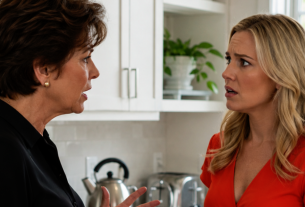
“Sonny!” Galina Nikolaevna burst into the kitchen like a hurricane. Two women around sixty shuffled in behind her. “The girls and I decided to drop by! I wanted to introduce you to Zinaida Petrovna — remember, I told you about her? And Rimma Ivanovna came from Tula!”
Polina looked at the pot of borscht. There would barely be enough for three, and now there were three more guests. In the refrigerator there was a piece of sausage and three eggs. There was pasta, but it would take twenty minutes to cook…
“Polinochka, dear!” Galina Nikolaevna continued without even taking off her coat. “You understand… the girls got hungry on the road. Maybe you could quickly make something?”
Yaroslav looked at his wife expectantly, as if saying, “Come on, show what you’re capable of.”
“Of course,” Polina said quietly. “I’ll just…”
“Wonderful!” Galina Nikolaevna clapped her hands. “We’ll go into the living room, sit down, and chat. Polinochka, you remember that Zinaida Petrovna is diabetic, don’t you? She can’t have anything sweet or starchy.”
And they all went into the living room together, leaving Polina alone in the kitchen with an empty refrigerator and a feeling of complete helplessness.
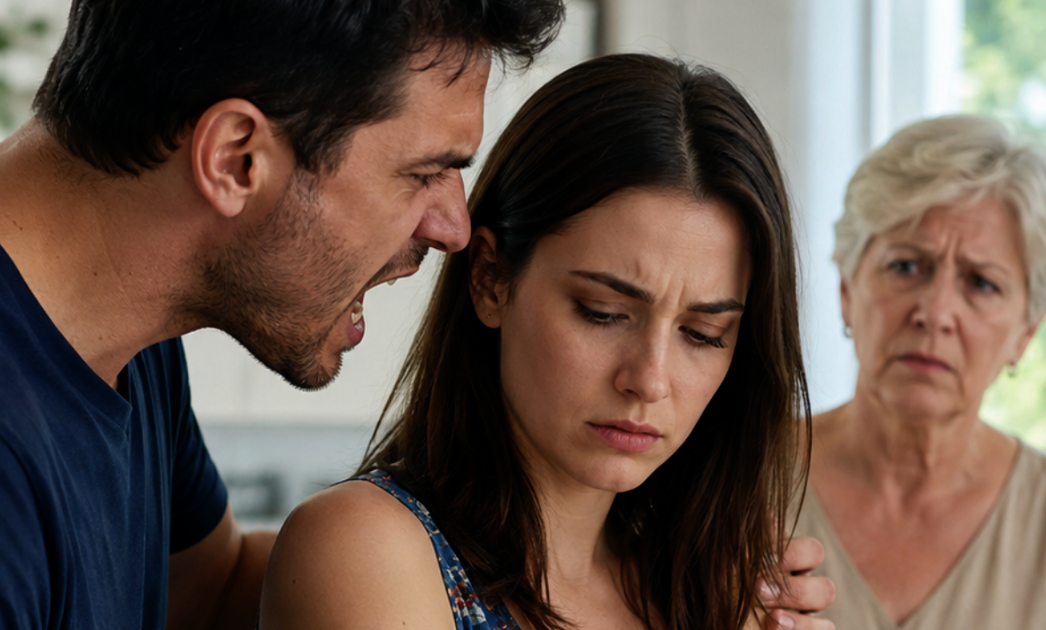
“Go make lunch for my mother’s friends right now!” her husband hissed, leaning toward her ear. “You’re nobody here, and your name means nothing! So get to work!”
The words struck her like a slap. Polina stared at him with wide eyes.
“What did you say?”
“You heard me.” Yaroslav adjusted his tie and walked toward the kitchen exit. “And try not to embarrass yourself. Zinaida Petrovna is a very influential woman.”
Polina was left alone. From the living room came cheerful laughter and the clinking of cups — Galina Nikolaevna was already making herself at home, taking out the best tea set. The very one they had been given for their wedding and that usually sat unused in the sideboard.
She opened the refrigerator and stared at its pathetic contents. Three eggs. A piece of bologna. A jar of pickles. A packet of butter and the remains of yesterday’s mashed potatoes.
“For six people,” she thought, and suddenly laughed. Not happily, but strangely, with hysterical notes in her voice.
“Polinochka!” her mother-in-law’s voice carried from the living room. “How are you doing in there? Managing?”
“I’m managing!” Polina shouted back and laughed again.
She took out the eggs and sausage and turned on the burner. Her hands were trembling — whether from anger or hurt, she did not know. Or perhaps because, for the first time in a long while, she felt something inside her begin to change.
“Nobody, and your name means nothing…” she repeated her husband’s words and set the frying pan on the stove.
More laughter came from the living room. Galina Nikolaevna was telling some story, and her friends gasped and exclaimed. Polina stood in her own kitchen, in her own home, cooking lunch out of nothing for people who had not even greeted her.
Another figure appeared in the doorway — hunched, wearing an old gray headscarf.
“Grandma Lida?” Polina asked in surprise.
The old woman entered the kitchen and sat on a stool by the window.
“The girls brought me,” she muttered. “Said Galinka had invited everyone over. But I’m looking around…” She glanced at the almost empty refrigerator and the meager food on the table. “Something’s not right here.”
“Everything is fine, Grandma Lida,” Polina lied, whisking the eggs in a bowl.
“Fine?” The old woman got up and walked over to the stove. “Dear, you’ve barely got enough food here for two people, let alone six. And what are you planning to serve them? Eggs with sausage?”
Polina nodded without looking up. There was a lump in her throat.
“Do they know?” Grandma Lida asked quietly. “Do they know you’re about to feed them with the last food you have in the house?”
“It doesn’t matter,” Polina whispered.
“What do you mean it doesn’t matter?” Grandma Lida took her hand. “Dear girl, what has happened to you?”
Just then, Zinaida Petrovna’s voice came from the living room:
“Galya, your daughter-in-law is taking rather long. We’re honestly getting hungry.”
“Any minute now!” Galina Nikolaevna called back. “Polinochka, how is it going?”
Polina looked at Grandma Lida, then at the frying pan with the miserable half-made eggs, then toward the living room, where well-fed, satisfied people were sitting and waiting to be served.
And something inside her clicked. Like a switch.
“You know what,” Polina suddenly said loudly enough for everyone in the living room to hear. Her voice sounded calm, almost solemn. “I’m not cooking.”
Grandma Lida raised her eyebrows.
“What, dear?”
“I said I’m not cooking,” Polina repeated, turning off the burner. The eggs remained half-raw. “Let Galina Nikolaevna cook. They are her guests.”
“Polinochka!” her mother-in-law’s alarmed voice came from the living room. “What is going on in there?”
Polina wiped her hands on her apron, took it off, and carefully hung it on the hook.
“Nothing special,” she called back. “I’m just no longer going to cook for people who consider me nobody!”
Silence fell in the living room. Then footsteps sounded, and Galina Nikolaevna burst into the kitchen, followed by Yaroslav, his face twisted with fury.
“What do you think you’re doing?” he hissed. “We have guests!”
“Your guests,” Polina replied calmly. “I didn’t invite them.”
“Polinochka, dear,” Galina Nikolaevna began in a conciliatory tone. “Come now… we’re family…”
“Family?” Polina repeated and suddenly laughed. “Is family when a husband tells his wife in front of outsiders that she is nobody? Is family when a mother-in-law brings guests without warning and demands they be fed with food that doesn’t exist?”
“Polina, stop this hysteria!” Yaroslav barked. “Go and cook immediately!”
“No.”
The word was so quiet that everyone leaned forward.
“What did you say?” her husband asked in a dangerously low voice.
“I said no.” Polina looked him straight in the eye. “I’m not going to cook. I’m not going to keep twisting myself into knots, inventing ways to feed people with food that isn’t there. I’m not going to tolerate rudeness in my own home anymore.”
Grandma Lida suddenly smiled and clapped her hands.
“Well, well!” she said. “Finally! I thought they’d beaten the spirit right out of you.”
“Grandma Lida, don’t interfere!” Galina Nikolaevna snapped.
“I’m not interfering,” the old woman replied calmly. “I’m just saying the girl is right. How long can you keep crushing a person?”
“We are not crushing anyone!” Yaroslav protested. “Polina simply has to fulfill her duties as a wife!”
“Duties?” Polina stepped closer to him. “And where are your duties as a husband? When was the last time you said anything kind to me? When did you thank me for the laundry, the cleaning, the cooking? When did you ask how I was, what I felt?”
“Have you lost your mind?” Yaroslav waved his hand. “What feelings? You’re a housewife. Your job is to run the home!”
“I am not a housewife!” Polina shouted so loudly that something clinked in the living room. “I am a person! A living person with feelings, thoughts, and desires! And I have a name — Polina! Not ‘this one,’ not ‘your wife,’ not ‘the daughter-in-law’!”
A tense silence hung in the kitchen. Muffled voices came from the living room — the guests were apparently discussing what was happening.
“Polina,” Galina Nikolaevna started, but Polina cut her off:
“And one more thing. I will no longer cook from thin air. If you want to eat, go to the store and buy groceries. Or order delivery. I have three eggs and a piece of sausage in the refrigerator. For six people. Miracles don’t happen.”
“You… you are rebelling against your family!” Yaroslav forced out, stammering with indignation.
“No,” Polina replied calmly. “I am simply stopping being convenient. And you know what? I like it.”
She walked past her husband and mother-in-law toward the kitchen exit, but at the door she turned around:
“Oh, yes. One more thing. No one will come into my home without an invitation anymore and demand that I feed them. This is my home too, by the way.”
With those words, she left the kitchen, leaving a deafening silence behind her.
Grandma Lida slowly rose from the stool and followed her.
“Where are you going?” Galina Nikolaevna called after her.
“Home,” the old woman answered without turning around. “The show is over. And you girls should think about how you treat people.”
In the living room, Polina found the guests sitting on the sofa with confused faces. Zinaida Petrovna nervously fidgeted with her purse, while Rimma Ivanovna looked out the window.
“Sorry for the noise,” Polina said politely. “But I won’t be able to feed you. There isn’t enough food in the house for this many people.”
“It’s all right, dear,” Rimma Ivanovna said quickly. “We… we should probably go.”
“Yes, yes,” Zinaida Petrovna agreed. “We really must be going.”
They hurriedly gathered their things and left, muttering something about urgent matters.
Polina remained alone in the living room. A few minutes later, Yaroslav and Galina Nikolaevna appeared. Both looked bewildered.
“So what now?” Yaroslav asked.
Polina looked at him for a long moment.
“Now, dear husband, you are going to the store to buy groceries. If you want dinner at home. And your mother will no longer bring guests without warning.”
“You can’t order me around!” he flared up.
“I can,” Polina replied calmly. “And I will. Because I live in this house too. And I have rights too.”
She walked to the window and looked outside. Grandma Lida was slowly walking along the sidewalk, leaning on her cane. And for some reason, she was smiling.
Polina stood by the window and suddenly understood — she could no longer stay in this house. Not today. Not after what had happened. The air here had become too heavy, Yaroslav’s words were still ringing in her ears, and her mother-in-law’s stare burned into her back.
“I’m leaving,” she said quietly, without turning around.
“Where exactly are you going?” Yaroslav asked mockingly. “Into the street? In your nightgown?”
Polina looked down at herself — indeed, she was wearing a house robe and slippers. But that did not stop her.
“I’ll change,” she answered shortly and went into the bedroom.
“Polina, don’t be stupid!” Galina Nikolaevna shouted after her. “So you had a fight! Families fight!”
But Polina was no longer listening. She opened the wardrobe, took out jeans, a sweater, and a warm jacket. Her hands were trembling, but not from fear — from some strange excitement. When was the last time she had left the house alone? Without permission, without explanations, simply because she wanted to?
“Polina!” Yaroslav burst into the bedroom. “What is this performance? Change back immediately!”
“Leave me alone,” she muttered, pulling on her jeans.
“I said leave me alone!” Yaroslav grabbed her by the arm. “You’re not going anywhere!”
Polina yanked herself free.
“Don’t you dare touch me!”
“Have you lost your mind?” He tried to block her way to the door. “I’m your husband!”
“Husband?” Polina put on her sweater and looked at him with a new expression on her face. “A husband is someone who loves, supports, and respects. And you… you’re just a roommate who thinks I’m a servant.”
“Polinochka, dear,” Galina Nikolaevna peered into the bedroom. “What are you doing? Where will you go in this weather?”
Outside, it had indeed begun to drizzle. A cold, nasty October rain.
“I don’t know,” Polina answered honestly, taking a bag out of the wardrobe. “But I’m definitely not staying here.”
She threw her documents, some money from her emergency stash, her phone, and a charger into the bag. She did not need anything else.
“You can’t just get up and leave!” Yaroslav shouted. “We have plans together, a shared household!”
“What plans?” Polina turned to him. “Have you asked me even once in the past year about my plans? About what I want? Or am I really nobody to you?”
“I didn’t mean it like that…”
“You did. That is exactly what you meant.” She pulled on her jacket. “Now move away from the door.”
“I won’t!”
“Yaroslav,” Polina said very calmly, “if you do not move away right now, I will call the police and tell them you are holding me against my will.”
His face changed.
“You wouldn’t dare…”
“I would.” Polina took out her phone. “I have a witness — your mother saw you grab my arm.”
Galina Nikolaevna looked back and forth between her son and daughter-in-law in confusion.
“Polinochka, why go that far…”
“Move, Yaroslav,” Polina repeated.
He slowly stepped aside. Polina walked past him without looking into his eyes.
In the hallway, she put on her boots and took an umbrella. Her hands were still trembling, but now she understood — it was from the anticipation of freedom.
“Polina, wait!” Yaroslav ran after her. “All right, I was wrong! I’m sorry! But don’t leave!”
She turned around. He stood in the doorway in only his socks, disheveled, with a guilty expression on his face. Like that, one might have pitied him. A month ago, she certainly would have.
“Do you know what the scariest thing is?” she said quietly. “Not that you humiliated me. It’s that for a long time I thought — maybe he’s right. Maybe I really am nobody.”
“You’re not nobody…”
“Now I know.” Polina opened the door. “Goodbye, Yaroslav.”
“When will you come back?”
She did not answer. The door slammed shut.
The stairwell was dark and smelled of paint — there had recently been repairs. Polina slowly went downstairs and stepped outside. The rain grew heavier, but she did not care. She walked along familiar streets and felt like it was the first day of vacation — when you can go anywhere, do anything, and no one asks why.
At the bus stop stood a familiar hunched figure.
“Grandma Lida?” Polina asked in surprise.
The old woman turned around.
“Ah, it’s you, dear!” She looked Polina over — wet hair, eyes shining from the rain, a bag over her shoulder. “Ran away too?”
“I ran away,” Polina admitted honestly.
“You did the right thing.” Grandma Lida nodded. “Otherwise they would have worn you down completely. Will you come to my place? We’ll drink tea and talk. I have a cat, Murzik. He also likes it when people tell him about their problems.”
Polina laughed — sincerely, for the first time all day.
“Thank you, Grandma Lida. Let’s go.”
“The bus will be here any moment,” the old woman said, taking her pension card from her purse. “And at home I’ll make pancakes. With jam. Like in childhood.”
Polina nodded. Suddenly she wanted pancakes with jam very much. And conversations with a wise old woman. And simply to be somewhere where no one would consider her nobody.
The lights were still on in the windows of their home. Yaroslav and Galina Nikolaevna were probably discussing what had happened. Making plans for how to bring back the rebellious wife.
But Polina stood in the rain at the bus stop and, for the first time in many years, knew one thing for certain — she was free. And it was wonderful.
Three months later, Polina opened her eyes in her small studio apartment on the eighth floor and smiled at the sun outside the window. The habit of waking up at five in the morning had remained, but now it was not a punishment. It was a gift to herself — two hours of silence before the workday began.
She got up and turned on the coffee maker — she had bought it with her first paycheck from the small café where she now worked as an administrator. A simple job, a modest salary, but the money was her own. Earned with her own hands, her own smile, her own patience with difficult customers.
“Good morning, beautiful,” she said to her reflection in the mirror and laughed.
A lot had changed in those months. She had cut her hair short — a shoulder-length bob — and dyed it dark red. “A fiery woman,” her colleagues at the café joked. And truly, something fiery had appeared in her. A spark in her eyes that had been going out over the years of marriage.
Polina made coffee and sat by the window with the cup in her hands. Below, the city was waking up — people hurried to work, cars honked, dogs barked. Her new neighborhood was noisy and not very prestigious, but it was hers. Here, no one knew her as “Yaroslav’s wife” or “Galina Nikolaevna’s daughter-in-law.” Here, she was simply Polina.
Her phone vibrated. A message from Kira, her friend from work: “Polinka, you haven’t forgotten, right? Today after the shift we’re going to yoga! And then maybe we can watch a movie.”
Polina quickly typed: “Of course! I can’t wait!”
Yoga… When she had been married, she had not even dared dream of yoga. “Why do you need that nonsense?” Yaroslav used to say. “You’d be better off getting the house in order.” And now she went to yoga twice a week, had signed up for English classes on weekends, and was even thinking about driving school.
In the refrigerator were groceries she bought for herself. Greek yogurt, red fish, avocado, strange blue cheeses she had always wanted to try. Before, Yaroslav would grimace: “What is that garbage? Buy normal food!” Now she could eat whatever she wanted.
Polina quickly had breakfast and got dressed — jeans, a white shirt, a bright scarf. Her makeup was light but noticeable. She had learned how to do it again by watching videos online. It turned out she had beautiful eyes — green with golden sparks. She had not noticed before.
On the way to work, she stopped by a small flower shop.
“Good morning, Polina!” the saleswoman, an elderly woman with kind eyes, greeted her.
“Good morning, Vera Ivanovna! The usual — white roses!”
“Of course, dear.” Vera Ivanovna wrapped three white roses in beautiful paper. “Buying them for yourself?”
“For myself,” Polina smiled. “Just because. Because they’re beautiful.”
This was her new rule — to buy herself flowers every week. Just because. Not for holidays, not for special occasions. Simply because she deserved them.
The café was still quiet — there was half an hour before opening. Polina put the roses in a vase on the bar counter, checked the registers, and wiped the tables. Andrey, a young barista with cheerful eyes, appeared.
“Hi, Polina!” He nodded at the roses. “Treating yourself again?”
“Why not?” she laughed.
“Exactly!” Andrey began preparing the coffee machine for work. “Listen, do you remember that guy who came in a month ago? Asked about you, said he was your husband?”
Polina nodded. Yaroslav had found her a month after she ran away. He had come to the café, demanded a conversation, begged her to come back. She had listened to him calmly and said only, “I’m filing for divorce. Don’t interfere with my life.”
“He hasn’t shown up again,” Andrey continued. “And that’s good. He seemed aggressive.”
“He’s in the past now,” Polina said with a wave of her hand.
She had filed the divorce papers two weeks earlier. Yaroslav resisted, Galina Nikolaevna kept calling, crying into the phone, accusing her of destroying the family. But Polina remained firm. There had not been a family for a long time. There had been habit, convenience, fear of change. And now even that was gone.
The café opened, and the first customers started coming in. Polina smiled, took orders, and chatted with regulars. She liked the job — live communication, movement, variety.
At lunchtime, Grandma Lida came in. Over these months, they had become friends. The old woman often stopped by for a cup of tea and an unhurried conversation.
“How are you, dear?” she asked, settling at a table by the window.
“Wonderful,” Polina answered, bringing her usual tea with lemon. “And you?”
“I have news,” Grandma Lida said, narrowing her eyes slyly. “Yesterday I ran into your former mother-in-law at the store.”
“And?”
“She complains that Yaroslav has completely fallen apart. He doesn’t do laundry, doesn’t clean, has problems at work. Says she now understands how much you did around the house.”
Polina shrugged.
“She understood too late.”
“She also says she deeply regrets that day. And that she is ready to apologize if you come back.”
“I won’t come back,” Polina said calmly. “I have a different life now.”
And that was true. In those three months, she had learned she was capable of a great deal. She had found a job, rented an apartment, learned to live alone and not fear loneliness. More than that — she had learned to enjoy it.
“That’s right, dear,” Grandma Lida nodded. “You only get one life. You have to live it for yourself, not for other people’s expectations.”
That evening, after yoga, Polina and Kira sat in a small movie theater, watching a romantic comedy and eating popcorn. Kira was ten years younger, unmarried, and cheerful. She had become Polina’s first real friend in many years.
“Polina,” Kira whispered in the darkness of the theater, “have you thought about trying relationships again? You know, meeting someone?”
Polina thought for a moment. Had she thought about it? Of course. But she was not ready yet. She liked being alone. She liked getting to know herself again, discovering things she had forgotten over the years of marriage.
“Not yet,” she answered honestly. “I need time. I’ve only just begun to understand who I am.”
“And who are you?” Kira asked curiously.
Polina smiled in the dark.
“I am Polina. Just Polina. And that is enough for me.”
After the movie, they went to a twenty-four-hour coffee shop and talked until midnight about work, plans, and dreams. Polina had dreams now — to go to the seaside in summer, learn English, maybe change jobs to something more interesting.
She came home late, but not tired — full of energy. A desk lamp was glowing in the small studio, white roses stood on the windowsill, and a book she had been reading before bed lay on the table.
Polina took a shower, brewed herbal tea, and sat in the armchair by the window with her book. Below, the lights of the night city shimmered; somewhere music was playing, people were laughing. And she was part of that world. Not someone’s shadow, not an attachment, but an independent person with her own interests, dreams, and right to happiness.
Her phone lay silent on the table. Before, she had always waited for calls — from her husband, her mother-in-law, someone else. Now she liked the silence. She liked that no one demanded a report on where she was, who she was with, or what she was doing.
Outside the window, rain began — just like on that evening when she had left home. But now the rain did not seem sad. It was simply rain.
And she was simply Polina, who had the right to her own life.
And it was wonderful.