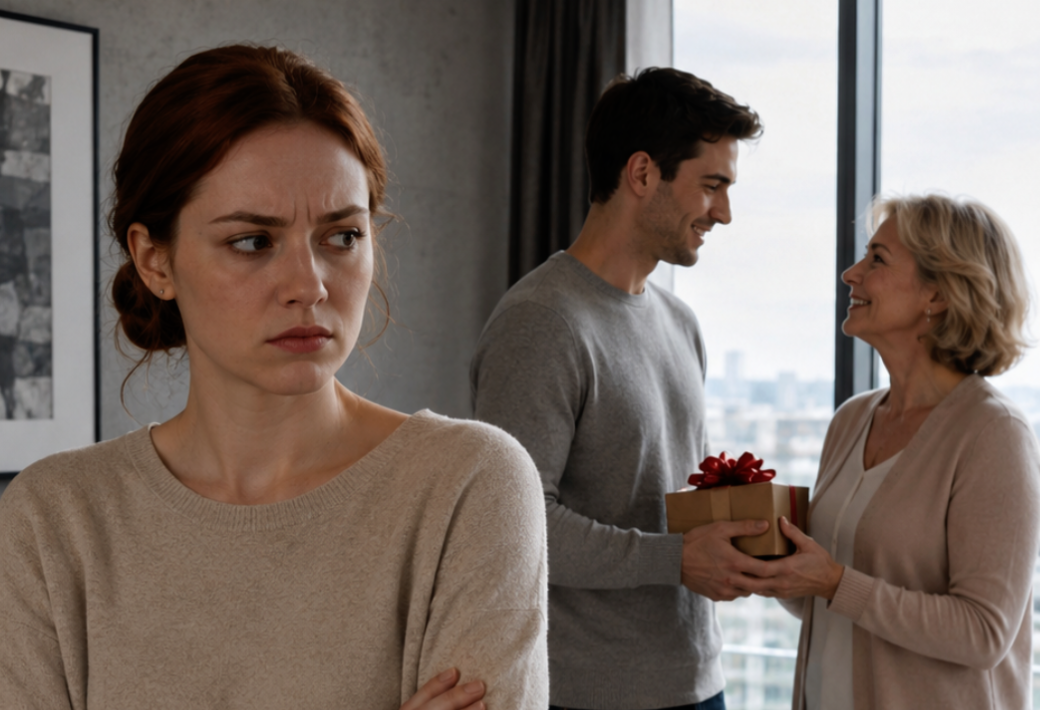
“— We need to sell the car,” Andrey said as if he were talking about an old refrigerator. He put his plate in the sink, turned to Svetlana, and added, “I’ve already promised Mom.”
Svetlana lowered her fork.
“Wait. What did you promise?”
“That we’d help with money. She needs to go to a sanatorium in Kislovodsk. The voucher costs one hundred and twenty thousand. Where else are we going to get that kind of money quickly?”
He spoke calmly. That was the most frightening part — not anger, not apologies, but this calm certainty of a man who had already decided everything.
“Andrey,” Svetlana said slowly, carefully choosing her words, “that is my car. I saved for it for three years. For three years I rode buses and minibuses, remember? In winter, crushed in the crowd, changing near the market.”
“I remember.”
“And now you’re telling me you promised to sell it. You didn’t ask me. You promised.”
Andrey rubbed the back of his head.
“Well, Mom isn’t a stranger. She needs to improve her health.”
“She has a pension. She has savings — you told me yourself she’s been saving for about ten years.”
“She doesn’t want to spend her own.”
Svetlana got up from the table. She didn’t slam the chair, didn’t raise her voice. She simply stood up and left the kitchen. Because if she had stayed, she would have said something she would later regret.
She called Olga at half past ten. Olga answered after the second ring — which meant she wasn’t asleep yet.
“Can you talk right now?”
“I can. What happened?”
Svetlana told her everything briefly, without unnecessary details. Olga listened silently, only sighing from time to time.
“Wait,” she said when Svetlana fell silent. “He already promised?”
“He already promised.”
“Without your consent.”
“Exactly.”
A pause.
“Sveta, you understand this isn’t about the sanatorium at all, right? The sanatorium is an excuse. It’s a test. Who makes the decisions in the house.”
“I understand that,” Svetlana said. “That’s exactly why I feel so awful right now.”
She was sitting on the edge of the bed in the bedroom. Andrey had stayed in the kitchen and hadn’t followed her, which said something too. Through the wall she heard the television click on. He had found something to occupy himself with.
“Listen, how much does a sanatorium voucher to Kislovodsk actually cost?” Svetlana suddenly asked.
“I have no idea. Why?”
“He said one hundred and twenty thousand.”
“Well… it depends on the sanatorium, the season. Do you want me to check tomorrow? A colleague of mine went there last year.”
“Please check.”
When Svetlana returned to the kitchen, Andrey had already turned off the television and was sitting with his phone. He looked up.
“Have you calmed down?”
“I wasn’t not calm,” she replied evenly. “Andrey, I want to ask you one question, and I want an honest answer. Where did the figure one hundred and twenty thousand come from?”
“Mom calculated it.”
“The sanatorium voucher costs one hundred and twenty thousand?”
“Well, there’s also the travel, and then…”
“And then what?”
He fell silent.
“Does she want to put something aside on top of it?” Svetlana asked directly.
Andrey didn’t answer. But from the way he looked away, she knew she had guessed correctly.
Kostya was nineteen, and he had long ago learned how to be invisible in this house when something like this began. He would go to his room, put on his headphones, open his laptop. The adults would sort it out themselves — he had believed that until he was about sixteen.
Then he stopped believing it.
That Friday, he returned from his grandmother’s earlier than expected. He came in, still wearing his jacket, heard voices in the kitchen, and stopped in the hallway — not to eavesdrop on purpose, he simply froze because he heard his name.
No, not his name. He heard his mother’s name.
The voice was his grandmother’s, but somehow different — not the one she used when speaking to him. That one was soft, a little pitying, with her “Kostenka.” This one was firm, almost businesslike.
“…Svetka thinks that if it’s registered in her name, then she’s the owner. Let her finally understand what kind of family she lives in.”
Tamara’s voice — the neighbor who often dropped by for tea — sounded cautious.
“Nina, maybe you shouldn’t…”
“I should. Andryusha is finally listening the way he’s supposed to. Otherwise he’d gotten completely out of hand, always ‘Sveta said,’ ‘Sveta thinks’…”
Tamara muttered something indistinct.
“Kislovodsk comes later,” Nina Vasilyevna continued. “The main thing now is for her to understand.”
Kostya left as quietly as he had entered. He stood in the courtyard by the entrance and lit a cigarette — though he rarely smoked, only when he didn’t know what to do with himself.
One question kept turning in his head: should he tell his mother or not?
The next day at lunchtime, Olga wrote: “I looked at sanatoriums in Kislovodsk. Normal ones, with treatment, are 60 to 80 thousand for three weeks. There are good ones for 70. Where did 120 even come from?”
Svetlana read the message and put her phone into her desk. She sat for a minute. Then she took it out again and wrote: “Thank you.”
That evening she asked Andrey to show her exactly where his mother had found such a sanatorium for one hundred and twenty thousand. He began searching on his phone, then said his mother had sent him the link but he had deleted it. Then he said he needed to check with her.
“All right,” Svetlana said. “Let’s check. Call her now.”
“It’s already late.”
“It’s half past eight.”
“She goes to bed early.”
Svetlana looked at him for a long time. He held her gaze, but his eyes still shifted slightly to the side — that habit of his, which she knew by heart.
“Andrey,” she said, “I’m not going to make a scene. But I want you to understand one thing. I bought this car with money I saved from my salary for three years. Every month, while you were taking money from your mother to ‘add to vacation’ and ‘cover the end of the month.’ I didn’t reproach you. I simply saved.”
He said nothing.
“This is not a family car. It is my car. And I am not going to sell it.”
“Mom will be offended.”
“That is her right,” Svetlana said.
She didn’t sleep until one in the morning. She lay there thinking about how, three years earlier, they had moved into this apartment — the one Nina Vasilyevna had immediately called “a bit small.” About how at the housewarming, her mother-in-law had walked through the rooms and said, not addressing anyone in particular, “Well, one can live here.” About how for the first six months she called Andrey every day at lunchtime — just to talk, just to ask how he was — and Svetlana kept silent, because what could you say? She was his mother.
Then she remembered how, about two years after the wedding, she had asked Andrey — carefully, without accusation — whether he didn’t think his mother was a little too involved in their lives. Back then he had answered, “She’s just worried. She’s used to it.” And after a pause he added, “You know how hard that year was for her when Dad left.”
Svetlana knew. And still, something had tightened inside her back then and had remained tight ever since.
Andrey slept evenly beside her — he could switch off quickly, and that had always irritated her a little. Svetlana stared at the ceiling and thought: what would have happened if she hadn’t kept silent then?
Kostya approached his mother on Sunday morning — he chose a moment when his father was not home, having gone to the market for potatoes.
“Mom, can we talk?”
Svetlana looked up from her laptop.
“Sit down.”
He sat opposite her, kneaded his phone in his hands, and said:
“I heard something at Grandma’s. Last Friday. I came earlier, and she was talking to Tamara. I didn’t do it on purpose.”
“What did you hear?”
He told her. Not word for word, but the essence — accurately. Svetlana listened without interrupting. When he fell silent, she looked toward the window for a while.
“Are you sure about what you’re saying?”
“Yes. I wouldn’t make it up.”
“I know,” she said. “Thank you for telling me.”
“Aren’t you upset?”
Svetlana smiled faintly — not happily, but not bitterly either.
“I’m not upset. I simply understand a little more now than I did before.”
Kostya hesitated.
“Mom, are you going to tell Dad?”
“When the time comes, I will.”
He nodded and got up. At the door, he stopped.
“Listen, are you really not going to sell the car?”
“Really.”
“Good,” he said simply, and went to his room.
On Monday after work, Svetlana drove to her mother-in-law’s.
She didn’t call in advance. She simply went. Nina Vasilyevna opened the door and stared at her for a second with a look as if she had not expected to see her specifically, though who else could one expect when the doorbell rings?
“Sveta? Did something happen?”
“Nothing happened. May I come in?”
They went into the kitchen. Nina Vasilyevna put the kettle on automatically, out of habit. Svetlana sat at the table and placed printouts in front of herself.
“Nina Vasilyevna, I want to speak with you normally. Without Andrey, without extra people.”
Her mother-in-law lowered her eyes to the papers.
“What is this?”
“These are prices for sanatoriums in Kislovodsk. I checked myself, and through acquaintances. Good sanatoriums, with full treatment, for three weeks — from sixty to eighty thousand. There are very decent options for seventy.”
Nina Vasilyevna took one sheet and looked at it.
“Well, there are different sanatoriums…”
“There are. That is why I want to offer you this. I am ready to lend you seventy thousand. Not give it as a gift — lend it, like normal people, with an agreement that it will be returned. That will be enough for a good voucher and the journey.”
Nina Vasilyevna looked at her with an expression as if she had expected something else. A scandal, probably. Tears, perhaps. Not this.
“And the car?” she asked, and that same firmness appeared in her voice — the one Kostya had heard by the entrance.
“I will not sell the car,” Svetlana said calmly. “It is my car. I bought it with my own money. It is registered in my name. If you need help with the sanatorium, I am ready to help exactly as I offered. If not, that is also your choice.”
“Andrey promised…”
“Andrey promised something that was not his to promise,” Svetlana interrupted, her voice still even. “I understand that he is your son and that you are used to him not letting you down. But in this case, he promised someone else’s property. That is something you should discuss with him, not with me.”
The kettle clicked off. Nina Vasilyevna did not move.
“So that’s how it is,” she said at last.
“That is exactly how it is,” Svetlana confirmed. “I am not your enemy, Nina Vasilyevna. I never was. But I will no longer pretend that I don’t notice the obvious.”
She stood up and took the sheets from the table.
“I’ll send Andrey the links to the sanatoriums. If you change your mind about the loan, tell him. The offer is open.”
Her mother-in-law said nothing while Svetlana walked to the door. Only when Svetlana had already taken hold of the handle did she say to her back:
“You think you’re very clever.”
Svetlana stopped. Turned around.
“No,” she said. “I think I’m tired of pretending I don’t see what I see. Those are different things.”
And she left.
Andrey came home shortly after seven and sensed something from the doorway — that special silence that happens not when everyone is quiet, but when everyone knows something he does not yet know.
Svetlana was in the kitchen. Kostya was in his room, the door slightly open.
“You went to Mom’s,” Andrey said. He didn’t ask — he stated it.
“I did.”
“She called me. She’s upset.”
“I understand.”
Andrey sat down at the table. Svetlana placed a plate in front of him — simply because dinner was ready, and it was dinner, not a battlefield.
“What did you say to her?”
“The truth. That I will not sell the car. That I am ready to lend money for the voucher — a real amount, for a real voucher.”
“She said you were rude.”
Svetlana slightly raised an eyebrow.
“Andrey, I went to see her alone, without accusations, put printouts with prices on the table, and offered specific help. If that is rudeness, I have difficulty imagining what your family calls politeness.”
He fell silent. He ate slowly, without raising his eyes.
Then Kostya’s voice came from the hallway:
“Dad, can I have a minute?”
Andrey lifted his head.
“Come here,” he said.
Kostya came in and stood by the doorframe. He looked directly at his father — he had that gaze inherited from Svetlana, straight and a little uncomfortable.
“Dad, I was at Grandma’s on Friday. Earlier than you think. I heard something.”
Andrey slowly lowered his fork.
“What did you hear?”
“How she was talking to Tamara. About Mom. And about how the sanatorium isn’t the main thing.”
The silence in the kitchen changed.
“Kostya,” Andrey began, and his voice took on that special intonation he used when he wanted to stop a conversation, “these are adult matters. You don’t have to…”
“I know I don’t have to,” Kostya interrupted calmly. “That’s why I’m only saying it now. Dad, she said Kislovodsk comes later. That the main thing is for Mom to understand what kind of family she lives in.”
Andrey looked at his son. Then at Svetlana. Then back at his son.
“You definitely heard that?”
“Definitely.”
Andrey stood up. He went to the window and stood with his back to them. Svetlana said nothing — she knew how to stay silent in such moments, and it was one of the few qualities that came to her with difficulty and that she had deliberately taught herself.
“Go to your room,” Andrey said to Kostya. Quietly, without anger.
Kostya nodded and left.
They talked for a long time. Until midnight, probably. They didn’t shout — strangely, this conversation happened without shouting. Andrey was angry, that was clear — from the way he clenched the cup, from his short replies. But he was not angry at Svetlana; he was angry at something inside himself, and that was new.
“I didn’t think it looked like that from the outside,” he said at one point.
“How did you think it looked?”
“I thought I was just helping my mother.”
“You were helping your mother at my expense,” Svetlana said without reproach — she simply stated it. “And not for the first time, Andrey. I simply hadn’t put it so directly before.”
He was silent for a long time.
“When we had just gotten married,” he finally said, “Mom used to say you were proud. That it would be difficult with you.”
“And you believed her?”
“I didn’t know how not to. She is my mother.”
“I know she is your mother,” Svetlana said. “I never asked you to abandon her. I asked only one thing — that sometimes you see the difference between ‘helping Mom’ and ‘giving her what belongs to us.’”
Andrey stared at the table for a long time.
“I need to talk to her.”
“That is your business.”
“No,” he said, and something new appeared in his voice, something Svetlana had not heard in a long time. “It is our business. It’s just that I’m the one who has to talk to her.”
Nina Vasilyevna went to Kislovodsk three weeks later. With her own money. Andrey called her the day after their conversation and spoke for a long time — Svetlana did not listen, she went to her room. Only later did he tell her himself that the conversation had been difficult but necessary. His mother was offended. That was expected.
But she bought the voucher. Herself.
Svetlana drove her to the train station — Andrey asked, and she agreed. They drove in silence, Nina Vasilyevna looking out the window. Just before getting out of the car, her mother-in-law said without turning around:
“You always do everything your own way.”
“I try,” Svetlana replied.
Nina Vasilyevna got out without saying goodbye. Then she came back and opened the door.
“Thank you for driving me.”
And she went toward the train.
Svetlana watched her go and thought that this was probably the maximum for the near future. Not reconciliation. Not friendship. Just “thank you for driving me.” Sometimes that was already a lot.
The car stood by the platform, and it felt strangely good — the fact that it had not gone anywhere, that it was standing where it was supposed to stand.
That evening Kostya asked:
“Is everything all right?”
“Everything is all right,” Svetlana said.
“Dad has started speaking differently somehow,” he observed. “I don’t know how to explain it. Just differently.”
“I noticed.”
Kostya was silent for a while.
“Mom, will she try something like that again?”
Svetlana thought honestly before answering.
“Probably, yes. She won’t change in three weeks. People generally don’t change quickly.”
“And then what?”
“Then we’ll sort it out again,” Svetlana said simply. “But now it will be a little different.”
Nina Vasilyevna returned from Kislovodsk twenty days later. She was tanned and brought back local sweets. She called Andrey — they spoke for almost an hour.
She did not call Svetlana. But the next week, when they accidentally crossed paths at Andrey’s birthday, Nina Vasilyevna looked at her differently. Not more softly — no. Simply differently. The way one looks at a person one has finally truly seen.
It was something. A little. But something.
At the table, Andrey poured tea, lifted his mug, and said — for no particular reason, just like that:
“To us.”
Kostya snorted. Nina Vasilyevna said nothing. Svetlana took her own mug.
“To us,” she agreed.
Nina Vasilyevna left satisfied. But there was something she said to Tamara before she left — and Tamara did not forget.