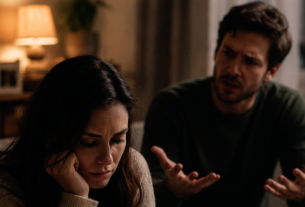
“Are you completely brainless, Anya?” Dmitry’s voice cut through the room as if he were not standing in an apartment, but haggling at a market. “Do you think you’re the only one who needs that two-room place? Tomorrow you’ll hand over the keys, and we’ll finally stop living like beggars. Got it?”
Anna slowly turned around. She had a bag of groceries in her hands, the cold of the metal handle biting into her fingers, and in her head there was only emptiness where, a second ago, there had been an ordinary evening: fatigue, a list of chores, thoughts about work. She had not even had time to take off her coat. His words hit her in the forehead like a wet rag.
“Repeat that,” she said quietly. “Only louder. So your mother can hear it too.”
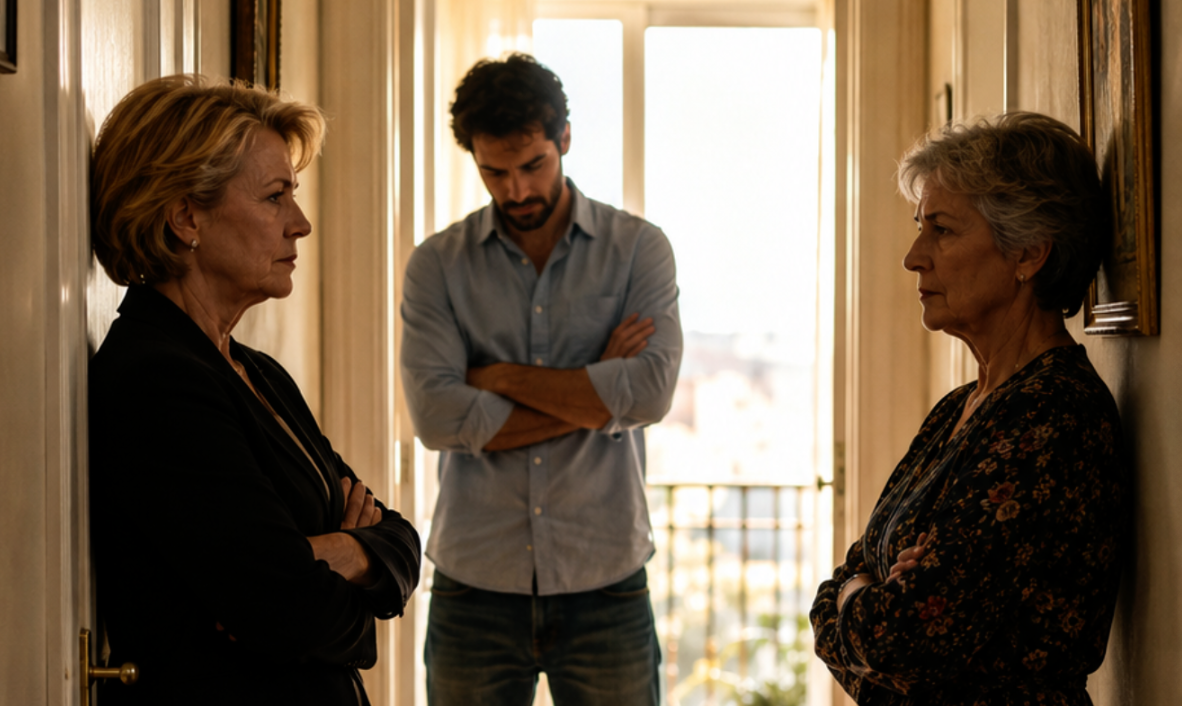
Olga Sergeyevna was sitting at the table — perfect hairstyle, manicure like a morning-show host, a smile measured down to the millimeter. And that smile did not falter. She only raised her eyebrows slightly, as if to say: here we go.
Dmitry came to his senses, looked away, and squeezed a paper napkin so hard that it shredded in his hand.
“You misunderstood,” he muttered, like a schoolboy caught with a cigarette.
“Misunderstood?” Anna gave a short laugh, dry and unfamiliar. “I was standing in the hallway behind the wall. I heard everything. Every one of your ‘she’ll do it herself.’ Every ‘we’ll transfer it later.’ Every ‘she won’t suspect anything.’”
The room became too quiet. Even the refrigerator seemed to fall silent, as if it were listening too. From the kitchen came the smell of something overfried — Olga Sergeyevna had reheated cutlets “quickly” again and, as usual, left the pan unattended. Outside, someone slammed a car door, someone cursed in the courtyard, and that was the only living thing in this glassed-in performance.
Olga Sergeyevna stood up and walked toward Anna softly, almost smoothly, like approaching a patient in a hospital ward.
“My dear…” she began in that same tone people use to explain to children why they must not stick their fingers into sockets. “Let’s not get hysterical. You’re emotional. The wedding is coming up, you’re tired…”
Anna stepped back so the woman’s hand would not land on her shoulder.
“Don’t touch me.” Her voice was still trembling, but inside her something heavy and cold was already rising. “I am not emotional. I am perfectly clear-headed. You were discussing how to leave me without a home.”
“Nobody is leaving you without anything,” Dmitry snapped, then immediately caught himself. “I mean… we wanted… just… for everything to be proper.”
“Proper means not stealing, Dima,” Anna said sharply, setting the grocery bag on the cabinet. Something clinked inside: a jar of pickles hit the milk. “Proper means not making arrangements behind my back. Did you really think I was such a little fool?”
Olga Sergeyevna sighed as if she were being forced to endure someone else’s bad manners.
“Anna, you are a grown woman. You must understand: family means everything is shared. You will become a wife, which means…”
“Which means I’m supposed to quietly gift you my apartment?” Anna felt something tear in her chest, but not toward tears — toward resolve. “And who are you to me? A secretary for registering other people’s square meters?”
Dmitry raised his eyes. There was no love in them, no remorse. Only irritation and exhaustion. As if she were preventing him from living normally.
“I didn’t want it like this,” he said. “Mom said it was right. That you’d agree anyway.”
“Mom said.” Anna nodded, as if she had heard the main confession. “Then marry your mother. Everything is ‘shared’ there.”
Olga Sergeyevna narrowed her eyes.
“You’re going to say something you’ll regret.”
“I’ve already heard something I regret.” Anna raised her hand to stop them both, and she was surprised by how calmly she did it. “There will be no wedding. And you are leaving my apartment. Right now.”
For a second Dmitry sat there as if he had not understood. Then he sprang up, the chair scraping the floor. He took a step toward her, smelling of cheap cologne and wounded pride.
“Are you serious? Because of one conversation?”
“Because you were discussing how to ‘ask’ me to hand over the keys,” Anna looked him straight in the face. “And you aren’t even blushing.”
Olga Sergeyevna quickly stepped in — her habit of keeping the situation under control was as strong as a reflex.
“Anya, listen to me,” she said, stretching out her palms to show peaceful intentions. “It was all just words. Men talk without thinking. We only wanted to help you start your life. Start it properly. Without your… fears and your lonely little ‘I can do it myself.’”
Anna felt the urge to laugh again. “Help.” That word always sounded the same coming from Olga Sergeyevna — as if after hearing it, a person was obliged to wipe their feet and say thank you.
“Helping does not mean preparing powers of attorney and discussing how I ‘hand it over myself,’” Anna said. “And now — the door is over there.”
At that moment, the doorbell rang. Short, insistent, as if someone had pressed it not out of politeness, but to assert authority.
All three of them froze.
Anna went to open it slowly. Aunt Lida stood on the threshold — a thin neighbor with sharp eyes, the kind who never stayed silent in the elevator and noticed everything. She wore an old jacket and held a shopping net in her hand, but her gaze was like a flashlight: point it, and everything became visible.
“Anya, why are you yelling?” she asked without preamble. “I can hear you through the wall. You’re usually quiet.”
Anna swallowed. And suddenly she told the truth so simply, as if she had been rehearsing it all her life.
“Things are bad, Aunt Lida. They were planning to deceive me.”
Aunt Lida stepped inside without taking off her shoes, looked Dmitry and Olga Sergeyevna over, and on her face appeared that expression people have when they have seen more than one person’s misfortune.
“So who are you?” she asked evenly, without shouting. That level tone made even the air grow colder.
“Relatives,” Olga Sergeyevna said hastily, giving her “kind” smile.
“Relatives…” Aunt Lida smirked with one corner of her mouth. “I saw plenty of such ‘relatives’ in the nineties. Whose property are you dividing here?”
Dmitry pretended it had nothing to do with him.
“Aunt Lida, don’t interfere. This is a family matter.”
“Family?” Aunt Lida snapped, turning to him. “What is she to you? Your wife? No. So it isn’t a family matter. It’s someone else’s property.”
Anna felt a strange gratitude toward the neighbor — not sweet gratitude, but the kind that keeps you on your feet. Like a crutch when your leg has seized up.
“They wanted me to ‘voluntarily’ hand over the keys,” Anna said, and her voice no longer trembled.
Aunt Lida gave a low whistle.
“Well done.” Then she turned to Olga Sergeyevna. “Listen, beauty, pack up. And take your son with you. Before I call the district police officer. Ours, you know, is a difficult man. Loves paperwork.”
Olga Sergeyevna went pale, but quickly pulled herself together. Women like her do not throw hysterics — they remember.
“You will regret this,” she said quietly, almost tenderly. “And you, Anna, especially.”
Anna held her gaze.
“Maybe. But not with you.”
Dmitry tried to say something — “Anya, let’s talk,” “You’re destroying everything,” “You don’t understand” — but Aunt Lida was already standing in a way that made getting past her feel like trying to walk through a concrete wall.
They left.
The door closed, and only then did Anna realize her knees were trembling. She slid down the wall right there in the hallway, onto the little rug she had meant to throw out for ages but had never gotten around to.
Aunt Lida sat down beside her too and exhaled.
“Well…” She did not finish, only waved her hand. “They live like rats. Why were you keeping quiet? You should have said it to their faces right away. People like that only understand nerve.”
Anna covered her face with her hands.
“I was so afraid of being alone, Aunt Lida. I… I thought if I endured it, everything would get better.”
“It will get better,” the neighbor grumbled. “Just not with them. Better alone than with such ‘lovers.’ Do you understand that this wasn’t about love? It was about square meters.”
For the first time that evening, Anna began to cry. Not beautifully, not like in a movie — simply like a person who had finally been released. The tears flowed on their own, and beneath that wet, shameful feeling, something else appeared: anger. Sober anger.
The next day, she lived on autopilot. Work, coffee from the machine, colleagues with identical faces. Her phone vibrated — sometimes Sveta wrote, “Hold on,” sometimes her mother called with the familiar, “Well, it’s your own fault, you should have thought ahead.” Anna listened and nodded, though her mother could not see her. Her mother had always believed trouble only happened to people who were not “careful” enough. As if life were a contract, with fine print at the bottom explaining how not to get caught.
That evening, the doorbell rang again. Anna flinched, because by then she expected anything. But on the threshold stood a man of about forty-five — strict, neat, carrying a briefcase. He did not look like Dmitry, or his mother, or any of their acquaintances.
“Anna Petrovna?” he asked.
“Yes.”
“I’m from the notary office. I need to clarify something about documents that you allegedly intended to formalize yesterday.”
The word “allegedly” sounded as if he himself did not believe it.
Anna felt a chill run down her spine.
“What documents?”
He opened his briefcase, took out a folder, then a sheet of paper.
“A power of attorney. For disposing of your housing. According to citizen Dmitry… and his mother, you verbally agreed, and only the final registration remained.” He paused and added, “Your signature is… strange. That is why I decided to confirm it in person.”
Anna took the sheet. The signature looked like hers. Very much like hers. The same “A,” the same flourish. Only as if someone had guided the hand, or copied it from a sample while nervous.
“That isn’t me,” she said, and her voice became unfamiliar. “It’s a forgery.”
The notary nodded, as if he had heard confirmation of what he had suspected.
“That’s what I thought. But you must understand: if they try to push this further, there will be an investigation. Expert analysis, statements…” He looked at her intently. “You need to act quickly.”
Anna stood in the hallway, clutching the sheet, and suddenly understood one simple thing: they had not left. They had simply changed tactics. Yesterday it had been vile whispering in the kitchen; today it was a piece of paper with her “signature.” Tomorrow it would be something else.
“Thank you for coming,” she forced out. “You… you have no idea.”
“I do,” he said dryly. “I’ve seen a lot. And here’s my advice: don’t delay. Go to the police tomorrow. And to Rosreestr. Block any transactions involving the property. This is no joke.”
He left, and Anna remained standing there with the sheet in her hands, as if holding a dirty rag she could not throw out of her mind.
She called Sveta.
“Sveta, they made a document. With my signature. Do you understand?” Anna spoke quickly, almost breathlessly. “They already went to a notary.”
“You’re kidding…” Sveta fell silent for a second. “This isn’t ‘family drama’ anymore, Anya. This is criminal.”
“I understand. But I’m afraid they have… connections. Olga Sergeyevna is like that… She isn’t the type to give up.”
Sveta sighed.
“I know a lawyer. Not free, I’ll say that right away. But he’s tenacious. He likes unraveling people like that. I’ll send you his number.”
Two days later, Anna was sitting in the lawyer’s office. Expensive suit, calm movements, eyes like a man used to being listened to.
He flipped through the copy.
“Forgery,” he said confidently. “We file a statement immediately. Then notifications, prohibitions, documentation of threats. And be ready: they will pressure you. Morally, with calls, with visits. Sometimes with ‘accidents.’ Do you live alone?”
Anna nodded.
“Then change the lock cylinder. Today. And install a camera on the landing if possible. Not for decoration. For evidence.”
Anna listened and thought how strangely everything was arranged: not long ago she had been choosing earrings for the wedding and arguing with Dmitry about what color the curtains would be, and now she was discussing “documenting threats” and “bans on registration actions.” As if someone had pulled the rug out from under her feet, and she did not fall — she simply discovered that she had been standing on air her whole life.
That night, she did not sleep. The apartment was quiet, but the silence did not soothe her — it pressed down. Anna walked from room to room, checking windows and switches, as if something depended on it.
And suddenly — a rustle at the door.
Not loud. Not cinematic. Thin, metallic, the kind that immediately makes it clear: this is not a neighbor taking out the trash, not a child from the apartment opposite. This is someone fiddling with the lock.
Anna froze. Her heart struck so hard it hurt. She approached the door and pressed her ear to it. Another sound — as if someone were trying to insert something thin and turn it.
“Hey! Who’s there?!” she shouted, her voice breaking into a hoarse rasp.
The rustling stopped.
A pause.
Then quick footsteps down the stairs. And the slam of the entrance door, like a final period.
Anna stood there, clutching her phone to her chest. She wanted to call the police, but what would she say? “It seemed like something”? “Someone ran away”? Thoughts raced through her head, each worse than the last: what if next time he did not run? What if he came in while she was in the shower? What if… what if it was not Dmitry at all, but someone Olga Sergeyevna had paid?
In the morning, Anna called Aunt Lida.
“Aunt Lida, someone was picking at the lock last night. I heard it. He ran away.”
The neighbor was silent for a moment, and Anna could almost feel her gathering herself inside.
“I knew it,” Aunt Lida said grimly. “They won’t stop. Listen to me: today you change the lock. And I’ll watch. My window faces the entrance. I don’t sleep anyway.”
“You’re already helping me so much…”
“Don’t give me that ‘already.’” Aunt Lida snorted. “I’m bored in retirement. At least I’ll be useful.”
Anna smiled for a second, but the smile vanished immediately. Her phone vibrated — an unknown number.
She answered.
“Anna,” Dmitry’s voice was quiet, even, without its usual syrupy sweetness. “We need to meet.”
“We don’t,” she said.
“We do.” He paused. “Either we settle everything calmly, or you’ll make your life difficult. Very difficult.”
Anna felt that same cold rising inside her.
“Are you threatening me?”
“I’m warning you,” he replied. “You have a chance to do everything normally.”
“Normally means not forging documents, Dima.”
“You chose this yourself.”
And the call cut off.
Anna held the phone to her ear for another second, then slowly lowered her hand. It was an ordinary morning in the apartment: the kettle, a dirty mug in the sink, crumbs on the table. Ordinary — and that made it especially frightening. Because now trouble had become domestic too. Like bills. Like a broken faucet. Like someone else’s shamelessness that never asks whether it is convenient for you.
She opened her messenger and wrote to the lawyer: “He’s calling and pressuring me. And someone was at the door last night.” Then she looked at the lock. At the old cylinder. At the chain she had never used — “What could happen here?” And suddenly she understood: the darkest part of this story had not even begun yet.
Anna got up, threw on her jacket, and went to change the lock — with the feeling that someone was already watching her, just not showing themselves yet.
Anna closed the door with the new lock. It clicked dully, solidly, but she did not feel calmer. It was like placing a stool under a beam holding up the ceiling: you had done what you could, but you could still hear the cracking.
The finale did not begin with a scream or a blow. It began with silence.
For several days, everything seemed to die out. No calls. No messages. Even the stairwell was unusually empty. Aunt Lida called faithfully in the mornings and evenings, reporting, “No one suspicious. All clear.” Anna nodded, thanked her, but inside lived the vigilance of a person who knows too well: if a predator goes quiet, it means it is preparing.
She kept going to work, sitting in meetings, staring at her monitor and catching herself realizing she did not remember what she had read a minute earlier. Her colleagues glanced at her: she had lost weight, her eyes had changed. Not tearful — sharp.
On the fifth day, a letter arrived. Ordinary, in the mailbox. No return address. Inside was a printout: a photograph of her building entrance, taken from a distance. And a short phrase printed in large letters, without emotion:
“It can be resolved without noise.”
Anna stared at the sheet for a long time. Her hands were not shaking. That was the scariest part.
She photographed the letter and sent it to the lawyer. Then to the police. They already knew her surname there. They accepted the statement without unnecessary questions, dryly and businesslike. That even gave her hope: so it had not been for nothing. So she was not alone.
That evening, Aunt Lida came over herself. She sat in the kitchen and folded her hands on her knees.
“They’ll press until the very end,” she said. “People like that don’t back down until they hit a wall with their forehead. But do you know what their weakness is?”
“What?” Anna stared into her cup of tea, long gone cold.
“They think you’ll be scared. But you’re not scared anymore. You’re angry. That’s different.”
For the first time in days, Anna gave a crooked smile.
“Sometimes I think,” she said, “that if I hadn’t heard that conversation back then… if I had married him…”
“Then you’d be living in a rented room and listening to them explain that it was ‘your own fault,’” Aunt Lida cut her off. “Fate handed you the truth in time. Not everyone is that lucky.”
Two days later, Dmitry was officially summoned for questioning. Not detained — not yet. But summoned. Anna learned about it from the lawyer and, for the first time in a long while, allowed herself to exhale. Briefly.
Because that evening, the doorbell rang.
Not sharply. Calmly. Confidently.
Anna looked through the peephole — and her heart still skipped. Olga Sergeyevna. Alone. No theater. No smile. In a coat simpler than usual. With a face that had neither makeup nor expression — only fatigue and anger.
Anna opened the door. Not because she wanted to. Because she was no longer going to run.
“Shall we talk?” Olga Sergeyevna asked.
“Talk,” Anna said, not stepping aside, remaining in the doorway.
“You destroyed my family,” the woman said at once, without introduction. “You put my son on the hook. Are you satisfied?”
“Your son climbed onto that hook himself,” Anna answered calmly. “I simply didn’t let myself be robbed.”
“Robbed?” Olga Sergeyevna smirked. “What are you, anyway, without this apartment? Ordinary. Gray. Do you think anyone will need you?”
There it was. Finally, the real thing. Without masks.
Anna looked at her carefully. And suddenly she understood: this woman was not frightening. She was empty. All her power lay in pressure. In the habit of taking by force. And when that did not work — there was nothing inside.
“Leave,” Anna said. “While you still can leave on your own.”
“You’ll regret this,” Olga Sergeyevna hissed. “Life is long. I’ll outlive you.”
“Perhaps,” Anna nodded. “But you won’t outlive this apartment.”
Olga Sergeyevna stared at her for another second, then sharply turned and walked away. No curses. No shouting. And that was scarier than hysteria.
A week later, everything finally collapsed.
Dmitry was detained. No longer “for a conversation.” Document forgery, attempted fraud, pressure on the victim. Other episodes were found too — other women, other apartments, similar schemes. Anna read the report and felt something strange: not joy. Relief. As if a period had finally been placed at the end of a word that had long irritated her eyes.
Olga Sergeyevna was summoned too. For now — as a witness. She called once. Anna did not answer.
Then everything quieted down.
It did not become easier right away. At night, Anna still flinched at every rustle. Checked the lock. Listened to the stairwell. But the fear was different now — retreating. Like pain after surgery: unpleasant, but you know the worst is behind you.
In spring, she renovated the apartment. A small renovation. No designers, no showiness. She simply tore off the old wallpaper, repainted the walls, rearranged the furniture. She threw away Dmitry’s things without sorting through them. Not out of anger — out of hygiene.
Sometimes Aunt Lida came over. They drank tea. Talked about life. Without moralizing.
And one evening, returning from work, Anna saw a familiar figure near the entrance. The same young man — Aunt Lida’s grandson. An operative. Tired, with his unchanged attentive gaze.
“How are you?” he asked simply.
“I’m living,” she answered. And understood that it was true.
He nodded.
“It’s over. They won’t come after you again. Stories like this rarely have a second act.”
Anna looked at the windows of her building. Only her light and Aunt Lida’s were on.
“Thank you,” she said. “To all of you.”
“Hang in there,” he replied. “You’re stronger than you think.”
He left, and Anna stood there a little longer, then went upstairs. She closed the door. Checked the lock out of habit. And suddenly realized: inside, it was quiet. Not empty — quiet.
She sat in the kitchen, turned on the light, and poured herself tea. An ordinary evening. An ordinary life.
Only now — it was hers.
Anna was no longer afraid of being alone. She was afraid of something else — of failing to hear a warning whisper in time again. And so she listened to herself carefully.
And that, as it turned out, was the best protection.
The End.