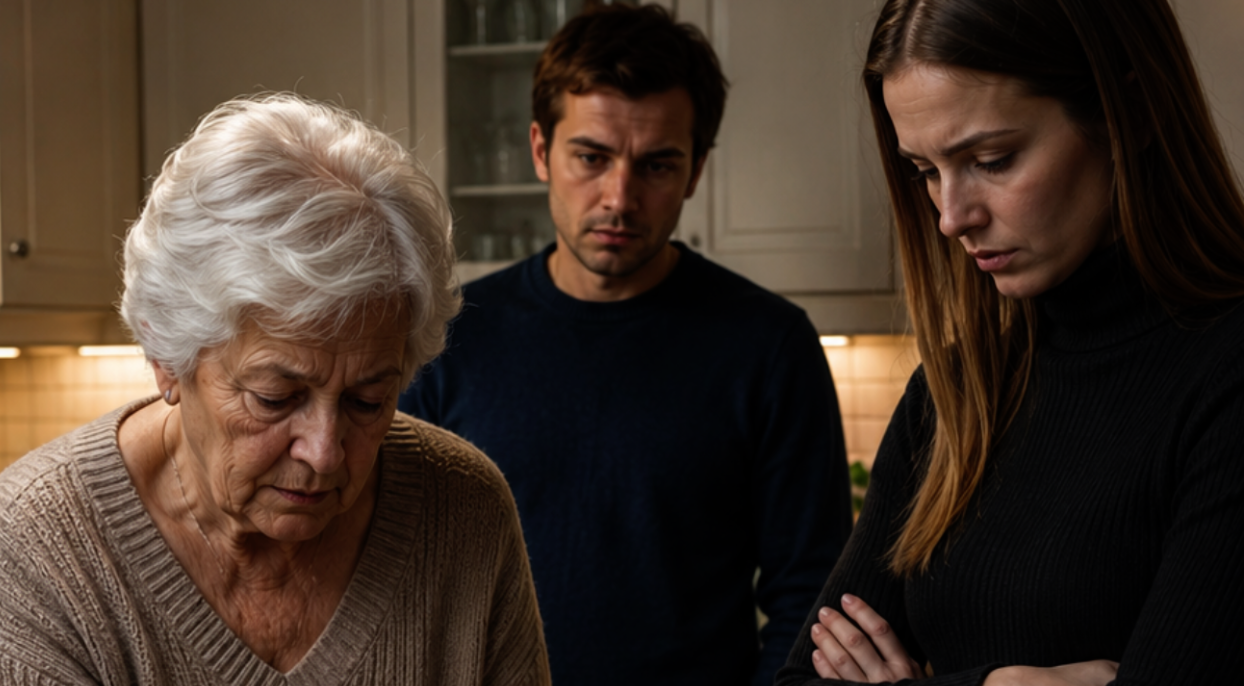
“What were you counting on? That I would give in because I’m alone? I’m not giving you the apartment. Don’t even dream of it.”
Olga said it so calmly that she surprised herself. Her voice did not tremble, her hands did not shake, nothing tried to break out of her—not tears, not hysteria. Just a full stop at the end of the sentence. Like a seal stamped on paper.
Svetlana Petrovna, her mother-in-law, froze by the kitchen table with a cup of tea in her hand. The tea had already gone cold, but she held the mug as if something far more important than tea was boiling inside it—outrage, resentment, and the habit of being in charge.
Alexey was sitting sideways, as if he wanted to quietly slip out of the kitchen through the wall. Men, in general, love disappearing at the exact moment women finally stop smiling out of politeness.
“So, you’ve decided to go against the family?” Svetlana Petrovna stretched the words like rubber. “Against your husband? Against your child? Against… everything?”
Olga stood by the window. Rain tapped against the windowsill, drops sliding down the glass, and for some reason they seemed very proper to her: not showy, not dramatic—just autumn doing its job.
“I’m not against the family,” she said without turning around. “I’m against being pushed out of my own home.”
“‘My own’!” her mother-in-law almost shrieked. “Listen to her! All these new words… ‘personal,’ ‘my rights,’ ‘my property.’ And what is family, then? A rental agreement? A hobby club?”
Alexey lifted his head, and something like panic flashed across his face.
“Mom, come on… don’t start…” he muttered, not looking at either woman. “Let’s talk normally.”
“I am talking normally!” Svetlana Petrovna slapped her palm on the table so hard that the spoon clinked. “I’m talking to her as my son’s wife. And she stands here like a queen. Telling me what she will give and what she won’t!”
Olga turned around.
Calmly. Like a teacher at a staff meeting who has been told for the third hour that “children these days aren’t what they used to be.” There was fatigue in her eyes, irony, and somewhere at the bottom—anger, but adult anger, without screaming. The kind of anger directed not at people, but at the very structure of life.
“Svetlana Petrovna,” she said clearly. “The apartment is registered in my name. I lived in it before the marriage. I have the documents.”
“Documents!” her mother-in-law spat out the word. “You have documents for everything! But where is your heart? Where is your conscience? Where is your… simple womanly understanding that a husband must be helped?”
Olga gave a quiet laugh.
“Helped how? By giving him my apartment? So that later, when something seems wrong to you again, I can be thrown out with my things?”
Alexey finally looked up.
“Olya, no one is going to throw you out…”
“No one?” she looked at him so intently, as if seeing him for the first time. “Lyosha, do you actually believe yourself right now?”
He opened his mouth, wanting to say something confident, masculine, correct… but all that came out was:
“Well… Mom… she’s just… having a hard time…”
“A hard time?” Olga raised an eyebrow. “And I’m having an easy time? It’s been hard for me since day one, listening to how I ‘must,’ how I’m ‘obligated,’ how I’m ‘not behaving like a woman.’”
Svetlana Petrovna stood up, pushing her chair back with a sound as if it had betrayed her.
“You’re ungrateful, Olga. I accepted you. I helped you. I looked after the child while you were sitting there… with all your feelings! And now you’re pretending to be independent!”
“I’m not pretending,” Olga said dryly. “That is exactly what I am. It’s just that before, you thought I was tame.”
Alexey flinched as if struck.
“Olya…”
“What, is it not true?” she turned sharply toward him. “Do you even hear what’s happening here? Your mother is seriously discussing who owns my home. And you’re silent. You’re sitting there waiting for me to swallow it—like always.”
Svetlana Petrovna snorted.
“Because you’re hysterical, that’s all! You always dramatize everything! You create tragedy out of nothing!”
“And this is coming from the person who came into my home with demands,” Olga smiled without warmth. “And let’s be honest: you’re not talking about the apartment. You’re talking about power.”
Her mother-in-law leaned slightly forward.
“Power? Listen to how clever she is! You think I care about power? I couldn’t care less about power! I care about family!”
Olga slowly nodded.
“Of course. Only for some reason, in your version of family, everything begins exactly where I end.”
A thick silence hung in the room. From the next room came Ilya’s voice: he was talking to a toy dinosaur, arguing over who would guard the spaceship. That childish nonsense sounded almost blessed—like a reminder that life was actually simpler than adults made it.
Svetlana Petrovna exhaled sharply.
“Lyosha, tell her. Tell this… mistress of life that this is unacceptable. That a husband is not a tenant.”
Alexey swallowed. His fingers clenched the edge of the tablecloth.
“Mom… Olya and I will decide for ourselves.”
“Decide for yourselves?!” Svetlana Petrovna exploded. “Who is this ‘we’? You and her are ‘we’ now? And what am I?”
Olga raised her hand, as if trying to stop the flow.
“You are his mother. No one disputes that. But you are not the mistress of our family.”
Her mother-in-law looked at her as if Olga had said something indecent, obscene, almost foul.
“Oh… you don’t even understand what you’re saying…” she whispered. “A woman without obedience is trouble. Trouble, Olga. You’ll destroy the family.”
Olga felt something click coldly inside her. Not from hurt—from clarity. As if there it was, the main thing: not the apartment. Not the documents. The fact that she had dared to stop being convenient.
“If the family depends on my obedience,” she said calmly, “then it isn’t a family. It’s a regime.”
And then Svetlana Petrovna, like in bad theater, made a gesture that apparently was meant to finally show who was in charge: she grabbed the cup and hurled it into the sink with all her strength.
The crash was so loud that Ilya fell silent for a second behind the wall.
Shards flew across the tile. Alexey jumped up.
“Mom! What are you doing?!”
“Let her know!” Svetlana Petrovna was almost choking. “Let her know that her little papers don’t decide everything! Not everything!”
Olga looked at the shards. Then she crouched down and began gathering them with her hands—carefully, slowly. There was something humiliating and stubborn at once in that movement: yes, I am cleaning up the consequences of someone else’s scandal, but I am not falling apart.
“Why are you doing that?” Alexey looked at her as if he were seeing for the first time how she could be silent louder than he could speak.
“Cleaning up the consequences of someone else’s anger,” Olga answered shortly. “As usual.”
Svetlana Petrovna grabbed her bag.
“That’s it. I’m leaving. But know this: I won’t back off. You think you’re the only strong one? You think you’re untouchable?”
Olga looked up. Her eyes were calm and heavy.
“I only think one thing: I will no longer live according to your script.”
The door slammed so hard the handle trembled.
In the kitchen, the dripping faucet became audible. Drip… drip… drip… as if counting the seconds until something new.
Alexey stood there, not knowing what to do with his hands.
“Olya… well… maybe you went too far?” he said cautiously.
Olga stood up and wiped her palms on a towel.
“Or maybe, on the contrary… I straightened my back for the first time.”
And she went to her son.
The phone rang at half past six.
Olga was already awake—a nervous habit. She always woke up slightly before the alarm, as if life had long ago made it clear that it was better to meet surprises in advance.
“Yes, Lyosha?” she looked at the screen and sighed.
“Olya… hi,” Alexey’s voice was hoarse. “Can we talk?”
Olga poured coffee into a cup, listened to the water trickle, and suddenly thought: of course… it was always like this. When he felt bad, he “wanted to talk.” When she felt bad, he “didn’t understand why she was being dramatic.”
“Talk.”
Alexey was silent for a moment.
“Mom… is nervous. Her blood pressure is jumping. She’s… upset.”
Olga narrowed her eyes slightly.
“And what do you want from me?”
“I’m going to see her today. Maybe… you could come too?”
Olga gave a dry laugh.
“So she can look at me like I’m a criminal and then say I ruined your life?”
“She’s just… she’s scared that everything is changing.”
Olga took a sip.
“Lyosha, who isn’t scared right now? I’m scared every day. But somehow I don’t allow myself to throw cups around and demand other people’s apartments.”
A pause.
“You’re angry…” he said quietly.
“I’m not angry. I’m… tired,” Olga looked out the window. “I’m tired of being convenient. I’m tired of being guilty. I’m tired of being the ‘wise woman’ who understands everything, swallows everything, and smiles at everyone.”
He exhaled heavily.
“I’ll stop by tonight.”
“Come,” she said, her voice even. “Just without theater.”
That evening, Alexey arrived with a grocery bag. He looked guilty and slightly ceremonious, like a schoolboy who had brought home a report card without any failing grades and hoped it would cancel out a week of horror.
“I won’t stay long,” he said, entering the kitchen. “I brought something.”
He took out a box of pastries.
Olga automatically wanted to say, “You shouldn’t have,” but then remembered—those forbidden words worked like buttons in her mother-in-law’s mind, and she herself had already developed an allergy to compliance.
“Thank you,” she said dryly. “Sit down.”
Alexey pulled out another bag. Inside was an envelope.
“This… Mom asked me to give it to you.”
Olga took the envelope. The handwriting was large and uneven—as if anger had written it, but the hand was trembling from something else.
She opened it. Read it.
Then read it again.
And again.
Alexey was silent. He watched her and waited like ships wait in a harbor: for permission to enter or a final ban.
Olga finally raised her eyes.
“She really wrote this?”
Alexey nodded.
“Herself. This morning. I didn’t interfere.”
Olga leaned back in her chair, silently looking at the envelope.
“You know,” she said quietly, “she doesn’t hate me. She’s just… afraid.”
“Afraid of what?” Alexey frowned.
Olga smiled faintly, but without anger.
“That I’ll live better than she did. That I won’t endure what she endured. To her, that feels like a personal accusation.”
Alexey fell silent. He clearly wanted to justify his mother, but could not find any simple words.
“She says she won’t interfere,” he finally forced out. “And… that she wants us to… well… live normally.”
Olga looked at him closely.
“And do you want that?”
He nodded too quickly.
“I do.”
“Then start with something simple,” she said. “Stop being a little boy between two women. You’re an adult. You’re a husband. You’re a father. Or what are you?”
Alexey lowered his head.
“I… don’t know,” he said honestly. “I’m used to her deciding everything. And you… suddenly stopped being silent.”
Olga smiled.
“And you suddenly noticed I exist at all.”
He wanted to say something, but at that moment Ilya came out of the room—disheveled, sleepy, with a toy in his hand.
“Mom, why did Dad come?” he asked innocently. “Is Dad sleeping here tonight?”
Olga froze. So did Alexey.
The silence after such questions is always the longest. Olga bent down to her son.
“Dad came to talk. You go to sleep, little bunny.”
“I’m not a bunny,” Ilya grumbled. “I’m a dinosaur.”
“All right, dinosaur,” Olga smiled. “Go to your den.”
Ilya left, satisfied.
Alexey looked at Olga, and there was everything in that look: fear, hope, shame, the desire to be saved from his own mistakes.
“Olya… I want to fix everything,” he said quietly. “Without Mom’s advice, without pressure. Just… us.”
Olga was silent for a long time. Then she stood and walked to the window. The rain had ended, and the streetlights reflected in the wet asphalt.
“Starting over doesn’t mean ‘like it was,’” she finally said. “It means differently. And if you want ‘differently,’ you have to choose once and for all. Not me. Not your mother. Yourself. A normal version of yourself.”
Alexey nodded. For once, he did not argue.
“I’ll try.”
“Try,” Olga said. “But not for one week. I’m tired of living in a rough draft.”
Two weeks later, Svetlana Petrovna called herself.
Olga saw her name on the screen and wasn’t even surprised—she simply gathered herself internally, as before an unpleasant conversation with accounting.
“Hello.”
“Olga…” The voice was careful, almost unfamiliar. “Can you… come over? With Ilya, if you want. I… I baked an apple charlotte.”
Olga almost laughed. Svetlana Petrovna’s charlotte had always been a weapon of reconciliation, practically a diplomatic document.
“All right,” Olga said. “We can come. But on one condition.”
A pause.
“What condition?”
“No conversations about the apartment.”
Svetlana Petrovna sighed as if she had been asked to remain silent for the rest of her life.
“Fine. No conversations.”
Olga hung up and looked at Alexey.
“Well? Shall we go visit your diplomacy?”
Alexey smiled nervously.
“Let’s go.”
Svetlana Petrovna’s apartment smelled of apples, cleaning solution, and the habit of living “properly.” Everything was as always: neat napkins, a stack of magazines, a cat on the windowsill looking like the true mistress of the house.
“Olechka, come in,” her mother-in-law said, and for the first time there was no blade in her voice.
Ilya, as usual, took off his shoes and immediately ran into the room where Grandma kept the old toys that were “still better than modern ones.”
Svetlana Petrovna looked at Olga carefully, as if comparing her with some internal picture.
“You’ve lost weight,” she said.
Olga raised an eyebrow.
“So this is how peace begins? With an evaluation of my appearance?”
Svetlana Petrovna grew embarrassed, but quickly pulled herself together.
“No, I just noticed.”
Olga took off her coat, went into the kitchen, and sat down.
“Well?” she asked. “You didn’t invite me here to give compliments.”
Svetlana Petrovna sat across from her. She was silent for a long time. Alexey settled off to the side, like in court: not a participant, but a witness.
“I don’t know how to do things properly,” her mother-in-law suddenly said. “I only know how I’m used to. With pressure. With ‘I know better.’”
Olga gave a quiet laugh.
“That’s noticeable.”
Svetlana Petrovna nodded and did not take offense.
“I thought that if I kept all of you under control… you wouldn’t fall apart.”
“Did you ever think you were suffocating us?” Olga asked calmly.
Her mother-in-law raised her eyes.
“I did. Too late. When I saw that you didn’t bend. At first I was furious… and then I realized I was jealous.”
Olga said nothing. But something inside her trembled—not pity, no. Understanding. The unpleasant kind, because you understand: yes, this person really does live like that. And it truly is hard for her.
“I don’t need your love, Svetlana Petrovna,” Olga said quietly. “I need respect.”
Her mother-in-law nodded.
“I’ll try. But you, too… don’t think I’m the enemy.”
“You’re not the enemy,” Olga looked straight at her. “But you are dangerous. Because you’re used to taking what belongs to others as if it were yours.”
Svetlana Petrovna sighed.
“I… understand.”
And then Alexey suddenly spoke. Not mumbling. Not making excuses. Properly.
“Mom, Olya and I will live the way we want. I love you. But you will no longer decide for us. That’s it.”
Svetlana Petrovna looked at her son as if he had unexpectedly learned to walk at forty.
“Well, finally,” she said. “I was beginning to think you’d live your whole life… like furniture.”
Olga couldn’t help it—she laughed.
And Svetlana Petrovna smiled too. Truly, for the first time.
But at that exact moment, Olga noticed papers on the kitchen table. Gray, boring sheets with stamps. Not recipes. Not utility bills.
Documents.
She slowly stopped smiling.
“What is this?” she asked.
Svetlana Petrovna flinched.
“Oh… nothing.”
Olga stood, walked over, and picked up the top sheet.
And saw the heading: “Spousal Consent for Transaction.”
At the bottom was Alexey’s surname.
And… her personal details. Filled in neatly by hand.
Olga turned toward her husband so sharply that her head even spun.
“Lyosha. What is this?”
Alexey went pale.
“Olya… I…”
“Did you sign this?!” her voice became low, dangerous. “Did you sign papers for my apartment?!”
Svetlana Petrovna jumped up.
“Don’t shout! The child is in the room!”
Olga looked at her with icy eyes.
“Now you remember the child? After deciding to quietly pull off a transaction behind my back?”
Alexey stood up, his hands trembling.
“Olga, I didn’t sign… I… Mom said it was just to ‘be on the safe side,’ that it was a formality…”
Olga gave a bitter laugh.
“A formality? And did you fill in my surname ‘formally’ too?”
Her mother-in-law tried to take the document, but Olga pulled her hand away.
“Don’t touch it.”
Svetlana Petrovna suddenly flared up.
“Why are you screaming as if someone is cutting you open? We wanted to do what was best! Lyosha needs support! He’s a man! He needs to feel that he has…”
“He has plenty,” Olga interrupted. “He has a job. He has hands. He has a brain. He has a child. And my apartment is not his ‘support.’ It is my insurance against your surprises.”
Alexey exhaled.
“Olya, I swear, I didn’t mean to…”
“You meant only one thing—for everything to stay quiet,” Olga looked at him with contempt. “So you wouldn’t offend anyone. And in the end, you betrayed me. Because comfort matters more to you than truth.”
Alexey stepped toward her.
“Don’t say that… please…”
Olga raised her palm.
“Stop. Don’t come closer.”
She turned to Svetlana Petrovna.
“You wanted a family? Congratulations. You just finished it off. Not with a cup. With papers.”
Svetlana Petrovna was trembling.
“I… I didn’t think you would…”
Olga nodded.
“That’s the most frightening part: you never think a person might not forgive you.”
At that moment, Ilya ran out of the room.
“Mom! Dad! What’s going on?” he asked, frightened.
Olga inhaled sharply and forced herself to smile—briefly, tightly.
“Everything is fine,” she said. “We’re just… talking.”
Ilya looked from one person to another.
“Can we go home?” he asked quietly.
Olga walked over and took her son by the hand.
“We can. We’re leaving now.”
She looked at Alexey.
“You’re staying here. Deal with your ‘formalities’ yourselves.”
Alexey stepped after her.
“Olga, please…”
She stopped in the doorway.
“You wanted me to be convenient. Well, I’m not. And you know what’s the funniest part?”
Alexey raised his eyes.
“What?”
Olga smiled bitterly, but evenly.
“You both wanted so badly to take my apartment from me… and only now have I realized that neither of you even has the moral right to my kitchen.”
And she left.
The door closed quietly.
But in Olga’s head, it thundered as if cups were flying all over again.
And the farther she walked down the stairs with her son, the more clearly she understood: now everything was truly beginning.
The end.