Vasily stood in the middle of the living room, clutching a scrap of paper so tightly that his knuckles had turned white. A feverish, almost insane gleam burned in his eyes. This was not just a lottery ticket. It was his pass into a world he had only ever seen through the screen of his smartphone: a world of snow-white yachts, azure coastlines, and women whose smiles cost more than his annual salary as an engineer at the factory.
“Tanya,” his voice sounded dry and sharp, like the crack of a whip. “Stop fussing with those cutlets. Come here.”
Tatiana came out of the kitchen, wiping her hands on a greasy apron. Her face, once fresh and radiant, now bore the traces of endless sleeplessness and small household worries. She looked at her husband with familiar anxiety.
“What happened, Vasya? Another delay at work?”
“A miracle happened, Tanya. More precisely, justice happened. I won. One. Million. Dollars.”
A heavy silence settled over the room. The only sound was the oil sizzling in the frying pan in the kitchen. Tatiana slowly lowered herself onto the edge of the old armchair they had been planning to reupholster for the past three years.
“Vasya… is it true? Are you sure? Show me…”
But Vasily abruptly pulled his hand away, hiding the ticket in the pocket of his jeans.
“Don’t touch it! This is no longer your concern. Do you know what I’ve been thinking about all these ten years while we counted pennies from paycheck to advance? I thought about how cramped I felt. Cramped in this apartment, cramped in this city, and frankly, cramped with you.”
“What are you talking about?” she whispered, and tears began gathering in her eyes.
“Freedom!” Vasily almost shouted, pacing around the room. “I’ve already spoken to a realtor. We’re putting the apartment up for sale tomorrow, at a reduced price so it sells within a week. There’s already a buyer—an acquaintance of mine, a developer, will take it for an office. The money will come immediately. And now, the main thing.”
He pulled several pre-printed papers from a folder on the table. The A4 sheets rustled ominously in his hands.
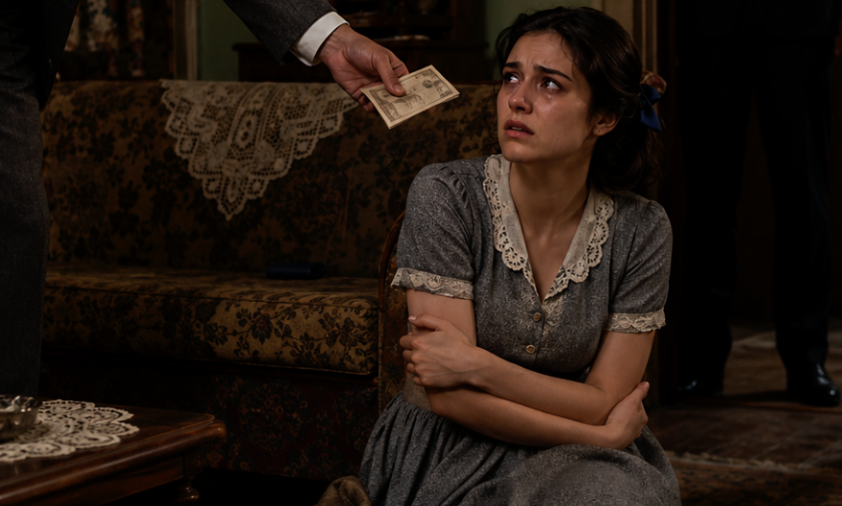
“Tanya, sign the divorce papers. Right here and now. By mutual consent, without dividing the property. I’ll leave you the car, that old Lada, and you can take the television. But everything else is mine. Now I need a model, do you understand? A woman who will decorate the deck of my yacht, not someone who constantly smells of onions and cleaning products. You are a cook. You are my past. And I am leaving for a new life!”
Tatiana looked at him as if she were seeing him for the first time. The man with whom she had shared bread and a bed, whom she had supported when he was laid off, whose mother she had nursed after a stroke, had disappeared. A stranger with a cold heart stood before her.
“Vasya, come to your senses…” Her voice trembled. “Money comes and goes. Don’t do anything foolish. We were planning to have children, we wanted…”
“Shut up, loser!” he cut her off, throwing a pen onto the table. “Your plans are a swamp. And I’m a lion now. Sign, or I’ll simply leave, and you won’t even get that rusty car.”
Broken, unable to believe what was happening, Tatiana took the pen. Her hand wrote a neat signature that crossed out twelve years of marriage. She did not cry out loud. She simply stood up, took off her apron, and went to the bedroom to pack her things into an old suitcase.
Vasily did not even look after her. He had already opened a website on his laptop with listings for motor yachts in Monaco. His finger greedily slid over images of snow-white vessels. “Princess,” “Aurora,” “Sea Wolf”… He could already feel the salty spray on his face and taste the most expensive champagne.
Three hours later, a taxi came for Tatiana. She walked out of the entrance without looking back. Vasily stood on the balcony, lifting his chin triumphantly. He felt like the king of the world. A plan was already taking shape in his head: tomorrow—the deposit for the apartment; the day after tomorrow—a flight to Moscow to cash the check; and then—endless summer.
The entire next month passed in feverish anticipation. Vasily lived in a hotel, since the new owners of the apartment had insisted on moving in immediately. He spent his last savings on expensive suits and restaurants, certain that within a few days his bank account would burst with zeroes. He ignored calls from his mother-in-law, blocked Tatiana’s number, and did not even wonder where she was or what she was living on.
April first arrived. The day Vasily had chosen as the date of his final triumph—the very day he was supposed to receive confirmation from the lottery committee.
He was sitting in the lobby bar of an expensive hotel, sipping whiskey he could not afford. The very same ticket lay on the table. At that moment, his mobile phone came to life. The name on the screen read: “Seryoga.” His best friend, with whom he worked in the shop.
“Hello, Vasyan!” Seryoga’s voice on the phone was practically choking with laughter. In the background, the shouts and laughter of the rest of the crew could be heard. “Well? Did you fall for it? How does it feel, you damn millionaire?”
Vasily frowned, not understanding his friend’s tone.
“What are you talking about, Seryog? I’m busy right now, waiting for transaction confirmation…”
“Happy April Fools’ Day, brother!” Seryoga burst into another fit of coughing laughter. “What transaction? We made that ticket for you in Photoshop! Printed it on that fancy paper from the advertising guys. Remember when you went to the bathroom and we slipped it in? Man, you are such a sucker! We waited a whole month for you to crack, but you disappeared somewhere and wouldn’t answer the phone. So, how are we celebrating? Drinks are on you for the best prank in factory history! We all laughed our heads off, even Mikhalych appreciated it!”
The world around Vasily began to spin slowly. The walls of the bar, the leather chairs, the waiters—everything turned into a blurred stain. A roaring filled his ears, as if he had indeed found himself on a yacht, but in the middle of a devastating storm.
“How… made it?” His voice became a barely audible rasp. “What do you mean, Photoshop?”
“Well, it’s a program, Vasyan! We entered the serial number they announced on the news yesterday, only changed one digit. Came out great, didn’t it? You were shouting so much about how you’d buy everyone now!”
“Seryoga…” Vasily felt nausea rising in his throat. “I already sold the apartment… I paid off debts with money I borrowed against my ‘future capital’… I kicked my wife out… I kicked Tanya out…”
A deathly silence fell on the other end of the line. The laughter stopped instantly.
“Vasya? Are you… are you serious?” Seryoga’s voice became sober and frightened. “We… we were just joking. Vasy?”
Vasily dropped the phone onto the carpet. The ticket lying on the table no longer seemed like a gold bar. Now it was just a dirty scrap of paper, the price of which was his life, destroyed by his own hands.
Vasily sat motionless, staring at the phone screen, which continued to glow in the dim light of the lobby bar. The name “Seryoga” on the display no longer seemed like the name of a friend, but the brand of an executioner. Life flowed around him: businessmen discussed deals, a young couple at the next table laughed, a waiter delicately adjusted napkins. But for Vasily, time had stopped.
In his head, like a worn-out film reel, the past weeks replayed themselves. How he had thrown the apartment keys onto the realtor’s desk. How he had shouted at Tatiana that she was “an anchor on his feet.” How he had ordered wine for twenty thousand rubles in a restaurant, leaving the last money from his card as a tip, certain that tomorrow it would be dust compared to his wealth.
“Sir, are you feeling unwell?” the waiter’s voice sounded as if from underwater.
Vasily did not answer. He slowly reached out, took the fake ticket, and tore it apart. The paper turned out to be unexpectedly thick—Seryoga’s advertising friends had done an excellent job. Pieces of cardboard scattered onto the expensive carpet like gray snow.
“I… I made a mistake,” he muttered, standing up. His legs felt like cotton.
When he left the hotel, Vasily was struck by a sharp April wind. Spring that year was cold and prickly. He wrapped the edges of his new coat tighter around himself—one of those status purchases made on credit. Now that coat seemed to him like a shroud.
He needed to find Tanya. The only person who had believed in him when he had been nobody had now been thrown by him onto the roadside of life. He took out his phone and, with trembling fingers, began searching for her number in the blacklist. Unblock. Dial.
“The subscriber’s device is turned off or outside the coverage area.”
His heart skipped a beat. He dialed again. And again. The result was the same. Then he called his mother-in-law, Maria Stepanovna. He used to hate her calls, considering them an intrusion into his private space, but now her voice was his last hope.
“Hello, Maria Stepanovna? It’s Vasya…”
“You?” the woman’s voice was icy. “You have the nerve to call after what you did? After you threw my daughter out of the house like a dog?”
“Maria Stepanovna, please… There’s been a misunderstanding. A terrible, awful misunderstanding. Where is Tanya? I need to see her.”
“There is no Tanya for you anymore, Vasily. She took her things and left. And I will not tell you where. You’re a millionaire now, so live with your millions. Buy yourself a new conscience, if you can.”
Short beeps sounded in the receiver. Vasily stood in the middle of the sidewalk, and passersby went around him, grumbling and bumping him with their shoulders. He was alone. Without a home, without money, with enormous debts, and with the realization that he was nothing.
Vasily spent the rest of the day rushing around the city. He went to their old building, but there was already a new lock on the apartment door, and the sound of a hammer drill came from behind it—the new owners were hurrying to turn the “grandmother-style renovation” into a modern office. He stopped by the café where Tanya sometimes had lunch with her friends, drove around the train stations, even looked into the hospital, afraid that her heart had not withstood the shock.
By evening, he found himself at the home of his sister, Oksana. She was the only person who might know the truth.
“Oh God, Vasya, you look awful,” Oksana let him into the hallway, suspiciously looking over his expensive but already rumpled outfit. “What, your millions didn’t bring happiness?”
“Oksana, there is no ticket. It was a joke. An April Fools’ prank by Seryoga and the guys.”
His sister slowly sank onto the small bench.
“You’re joking? You sold the apartment… You… Tanya… Vasya, do you even understand what you’ve done?”
“I understand!” he exploded, covering his face with his hands. “I understand everything! I’m an idiot, I’m a bastard! But I need to find her. Where is she?”
Oksana remained silent for a long time, looking at her brother with deep pity mixed with disgust.
“She went to her aunt’s village, three hundred kilometers from here. She said she wanted to forget this city like a nightmare. Vasya, she wasn’t just crying. She was… empty. You burned everything out of her.”
“Give me the address. Please.”
“Why? So you can lie to her again? You don’t have a penny to your name. How will you get there? She sold your Lada a week ago—she needed money for the ticket and for the first while. You left her with nothing.”
Those words hit harder than the truth about the ticket. Tanya, his quiet, obedient Tanya, had sold the car just to escape him.
“I’ll get there. I’ll walk if I have to.”
Vasily returned to the hotel only to pick up his suitcase. He had no money to pay for another night. The receptionist, noticing his state, politely reminded him of the checkout time. Vasily left his new watch and gold cufflinks in the room—payment for the bar and his last lunch—and went out into the night.
At the bus station, he bought a ticket for the last bus to that same village, spending the last of his cash. The bus was old; inside, it smelled of diesel fuel and stale bread. Vasily pressed his forehead against the cold glass.
In the darkness outside the window, the lights of the suburbs flashed past. He remembered their wedding. They had had no limousines or yachts. There had been a cheap cafeteria, lots of laughter, and Tanya in a dress she had sewn herself. Back then, she had said, “Vasya, I don’t need anything as long as we’re together.” And he had believed her. Until greed clouded his mind.
“One million dollars…” he smiled bitterly to himself. How worthless that prize seemed now. For that money, he had been ready to sell his soul, and in the end, he had given away the most precious thing for a candy wrapper.
The bus shook over potholes. His phone vibrated in his pocket. Seryoga again. Vasily turned off the device and removed the SIM card. His old life was over. Ahead lay the unknown.
When the bus stopped on a dusty roadside at three in the morning, Vasily found himself in complete darkness. Only the distant barking of dogs and the sound of wind in the treetops broke the silence. He followed the navigator, which he had managed to load while still in the city, toward a small house on the outskirts.
Tanya’s aunt’s house looked old but cozy. A faint light glowed in one window. Vasily approached the gate and froze. What would he say? “Sorry, I changed my mind about being a millionaire because there’s no money”? Would she believe him? Would she even want to see him?
He raised his hand to knock, but at that moment the door creaked. Tanya stepped out onto the porch. She wore an old sweater draped over her shoulders and held a mug in her hands. She was looking at the stars, and in the moonlight her face seemed translucent.
Vasily wanted to call her name, but his voice got stuck in his throat. He saw her touch her stomach—a light, almost imperceptible gesture known only to women carrying a secret.
Vasily’s world collapsed for the second time in one day. Tanya was pregnant. The child they had dreamed of for years, whom they had waited for so long… and whom he had rejected for a piece of painted cardboard.
She did not see him in the shadow of the trees. She simply stood there, breathing in the night air, then sighed quietly and went back inside.
Vasily sank to his knees right in the mud by the gate. He realized that his punishment was only beginning. He had come here to ask for forgiveness, but now he understood: there was no forgiveness for something like this.
Vasily sat by the gate until dawn. The April dew soaked through his expensive coat, turning the status item into a wet, heavy rag. Mud clung to the shoes for which he had not even made the first credit payment. When the first rays of sun touched the tops of the pine trees, he understood: to simply walk in and repent would be another act of selfishness. He had no right to burst into her new, fragile life with his “forgive me” when he had nothing left in his soul, not even honor.
He rose when the first roosters began to crow in the village. His body ached, but for the first time in a long while, there was a frightening clarity in his head. He did not knock. Instead, he went to the local village store, where two local men in camouflage jackets were already smoking near the porch.
“Listen, guys,” Vasily approached, trying not to look at their smirks at the sight of his polished but rumpled appearance. “Is there work? Any kind. With a place to stay, and right away.”
One of them, the older one, spat and looked Vasily up and down.
“A millionaire from the slums, huh? We’ve seen your kind. Mikhalych needs a helper at the sawmill. The previous one went on a bender. Lodging is a construction trailer. Will you take it?”
“I’ll take it,” Vasily answered briefly.
The next two weeks became a personal hell for Vasily. The man who had recently dreamed of a snow-white yacht and silk sheets now woke up at six in the morning in an iron trailer that smelled of sawdust and cheap tobacco. His hands, accustomed to drawings and a computer mouse, quickly became covered in bloody blisters, which later turned into rough calluses.
He carried heavy beams, loaded sawdust, helped repair old machines. In the evenings, when his strength left him, he went to Tanya’s aunt’s house. He did not come close. He simply stood in the shadow of an old willow tree at the other end of the street and watched as she came out onto the porch, as she hung laundry, as she slowly walked through the garden. She looked pale, but there was some new, calm dignity in her movements that he had never noticed before behind the endless bustle at the stove.
After a week, he gathered his courage. One evening, after Tanya went inside, he approached the gate and left a bag on it. There were no diamonds inside. There was fresh cottage cheese, honey, and a bag of apples—everything he could buy with his first advance.
The next day, the bag was gone. But no note appeared on the gate. Vasily had not expected one.
Another ten days passed. Vasily was gradually turning into a different man. He lost weight, became weather-beaten, and his once feverish gaze became heavy and focused. He began saving money—not for a yacht, but to repay the debts from the apartment and provide for Tanya and the future child. He already knew that the apartment was gone forever, but he made a vow to himself: he would earn money for a new home. Even if it took ten years, he would earn it.
The silence of his new life was broken by the roar of an engine. An old BMW—Seryoga’s pride—rolled up to the sawmill. The whole group tumbled out of the car: Seryoga, Pashka, and Dimon. The very same “friends” whose prank had sent his life downhill.
“Well, well! Look at our oligarch!” Seryoga gasped theatrically when he saw Vasily in a greasy work uniform, his face smeared with machine oil. “Vasyan, what happened to you? We’ve been looking for you all over the city! You’re missing shifts at the factory, collectors are practically tearing the doors off your hotel room, and you’re here counting sawdust?”
Vasily slowly placed the board on the stack and turned toward them. There was no anger in his eyes. Only endless exhaustion.
“Why did you come, Seryog?”
“Come on, don’t sulk!” Seryoga stepped closer, trying to hug his friend, but Vasily moved away. “Fine, we went too far with the joke—happens to everyone, right? We didn’t know you’d actually sell your place. We talked it over… anyway, we chipped in a little for you. Here, take five thousand, enough for a ticket back to the city. Come to the boss with us, we’ll apologize, he’ll take you back. We’ll live again! Fridays at the bathhouse, beers…”
Vasily looked at the five-thousand-ruble note being held out to him. Once, that had been money to him. Now it seemed like trash.
“Take it back,” Vasily said quietly. “And leave.”
“Vas, what’s wrong? You offended?” Pashka cut in. “If you hadn’t been such a greedy bastard, you wouldn’t have kicked Tanya out! The second you saw that piece of paper, you turned into a monster. We just showed you who you really are. So we actually did you a favor—we took off your mask!”
Those words hit Vasily in the gut. They were true. A cruel, ugly truth. His friends had not broken his life—they had simply held a mirror up to his soul, and what he had seen there had been his own choice.
“You’re right,” Vasily nodded. “I was a bastard. And you took off the mask. Thank you. Now leave. We have nothing more to talk about.”
“Then rot here in manure!” Seryoga barked, throwing the bill into the dust. “You damn millionaire! We’ll see how long you last without your show-off act.”
The car turned around with a screech, covering Vasily in a cloud of dust and exhaust fumes. He watched them go, picked up the bill, carefully smoothed it out, and put it in his pocket. He would give that money to Tanya too. Every penny mattered now.
That same evening, he came to her house again. But this time, he did not hide in the shadows. He sat down on the bench by the fence and waited.
An hour later, the door creaked. Tanya stepped out onto the porch, wrapped in a shawl. She looked at him for a long time, then slowly came down the steps and approached the gate.
“They came,” she said. It was not a question. In the village, rumors spread instantly.
“They came,” Vasily confirmed.
“You didn’t leave with them. Why?”
Vasily raised his eyes to her. There was none of his former smugness in them.
“Because I have nowhere to go, Tanya. And no reason to. The Vasily who wanted a yacht no longer exists. I strangled him myself here, at the sawmill.”
Tanya remained silent, examining his damaged hands.
“Mother says you’ve gone mad. That you’re playing some new game so I’ll pity you and won’t file for child support.”
“Let her say it. She has every right to hate me. Tanya… I know about the child.”
She involuntarily flinched and covered her stomach with her hand.
“This is not your child, Vasily. You rejected him that day when you signed the papers. You said you needed a model. So go look for a model. This baby will only have a mother.”
“I’m not asking you to forgive me now,” Vasily stood up, trying not to make any sudden movements. “I just want to work. So that he has everything. I will leave money here, on the post. You can burn it, you can throw it away, I don’t care. But I will bring it.”
He turned to leave, but her voice stopped him.
“Vasya… Was the ticket really fake?”
He smiled bitterly.
“Worse. It was a real sentence passed on my conscience.”
He walked away into the darkness, leaving her alone by the gate. Tanya watched him go, and for the first time in a long while, there was not only pain in her eyes. There was doubt.
Seven months passed. The April mud season gave way to a sweltering summer, and then to a golden autumn smelling of fallen leaves. In the village, Vasily was no longer called “the millionaire.” Now he was simply “Vaska the sawmill worker”—the quietest and most hardworking man in the district. He took on everything: repaired roofs, chopped firewood for lonely old women for the winter, and on weekends restored an old abandoned shed on the edge of the sawmill, which Mikhalych allowed him to buy out of his wages.
Vasily had changed beyond recognition. Of the polished engineer who had dreamed of azure shores, only a steel gaze and sinewy, knotty hands remained. Every week, on Friday evening, he invariably left an envelope at Tanya’s gate. There were no fabulous sums inside, but it was “clean” money, earned with sweat and honest calluses.
Tanya still did not come out to him. She took the envelopes, but they never discussed it. She saw him from afar: how he walked home after his shift, hunched over with exhaustion; how he stood for long periods by the river, looking at the water on which his snow-white yacht would never sail. She knew that he did not drink, did not go out, and lived in his Spartan trailer, its walls covered with drawings—not of boats, but of baby cribs and warm houses.
Winter came early and fiercely that year. In mid-November, an ice storm struck the village. The power lines snapped in the very first hour, turning the area into a black, frozen sea. The blizzard howled so loudly that one could not hear one’s own voice. Vasily was sitting in his trailer by the light of a candle stub when someone began pounding frantically on the door. Tanya’s aunt stood on the threshold, wrapped in three scarves, covered in snow.
“Vaska! Trouble!” she shouted over the roar of the wind. “Tanya… It’s not time yet, but she… it’s started! There’s no signal, and the ambulance won’t make it from the district in this mess—the drifts are waist-high!”
Vasily jumped up, knocking over the chair. The heart he had thought had long since turned to stone began pounding in his throat.
“Mikhalych has a tractor!” he shouted back. “Run back, I’m coming!”
He ran through the snowdrifts, not feeling the cold. He knew that the old Belarus tractor at the sawmill was the only machine capable of breaking a path to the highway, where rescuers were on duty. There was only one problem: the tractor’s engine would not start in freezing weather without long warming, and there was no time.
Vasily acted like a madman. He carried hot water from the boiler room, lit torches to warm the crankcase, prayed to every god whose name he had once taken in vain when dreaming of millions. When the engine finally coughed and threw out a cloud of black smoke, Vasily shouted with relief.
He cut a path for two hours. Two hours that felt like eternity. The tractor was thrown from side to side, snow blinded him, but Vasily saw only Tanya’s face before him—the same face from his former life, when she had smiled at him, unaware of betrayal.
When he brought her to the district maternity hospital, practically carrying her into the emergency room in his arms, he looked like an ice statue. The coat, that same “millionaire” coat he had continued wearing as a reminder of his shame, had finally turned into rags.
“Sir, wait in the corridor!” the nurse shouted, closing the doors in front of him.
He lowered himself onto a government-issue plastic chair. His head was empty. At that moment, he did not care about all the money in the world. He would have given not one million but a hundred million, if he had had them, just to hear a single cry.
Dawn found him in the same position. The doors opened, and an elderly doctor came out to him. She tiredly wiped sweat from her forehead.
“Are you the father?”
Vasily faltered. The word burned his tongue. Did he have the right to be called that?
“I… yes. How is she?”
“A boy. Three kilos two hundred. Strong, loud. The mother is resting; it was difficult, but she did well. She kept whispering some name the whole time… Yours, I think. Go in, but only for a minute.”
He entered the room on tiptoe, afraid that his heavy steps would shatter this fragile moment. Tanya lay by the window, pale but astonishingly beautiful in the rays of the cold winter sun. Beside her lay a small bundle.
Vasily stopped a meter away from the bed. He did not dare come closer.
“Tanya…” he whispered. “Forgive me. Again. And forever.”
She slowly opened her eyes. The old icy wall was no longer in them. Only deep, hard-earned wisdom.
“You know, Vasya… When the doctors said I had to fight, I thought about that ticket. That fake. And I realized that I was grateful to Seryoga.”
Vasily flinched.
“Why?”
“Because otherwise I would never have learned whom I was married to. And you would never have learned who you are. We needed that collapse to build something real. Not out of gold, but out of…” She nodded toward their son. “Out of this.”
She held out her hand to him—weak and thin. Vasily carefully took it in his rough palms and pressed his forehead to her fingers. He cried—for the first time in thirty years. They were not tears of self-pity, but tears of cleansing.
“I finished the house, Tanya,” he said, swallowing the lump in his throat. “A small one, on the edge of the forest. It’s warm there. There are no yachts, but there’s a stove, and it smells of pine. I… Can I take you both home?”
Tanya looked at him for a long time, then smiled almost imperceptibly.
“You can. Just promise me one thing.”
“Anything.”
“Never gamble again. We have already won our greatest prize.”
A year later, light glowed in a small house on the edge of the village. A wooden rocking horse stood on the veranda, crafted so skillfully that any city toy store would have sold it for a large sum. Vasily sat at the table, drawing a plan for a new greenhouse for Tanya.
His phone, which he now turned on only for work, chimed. A message from Seryoga: “Vasyan, listen, there’s this thing! A new scheme, cryptocurrency, you can make a killing in a week… You in?”
Vasily looked at his sleeping wife, at his son, who was snuffling amusingly in his crib, and at his work-worn hands. He did not reply. He simply deleted the number and blocked the contact forever.
He already had his million.
And this time, it was real.