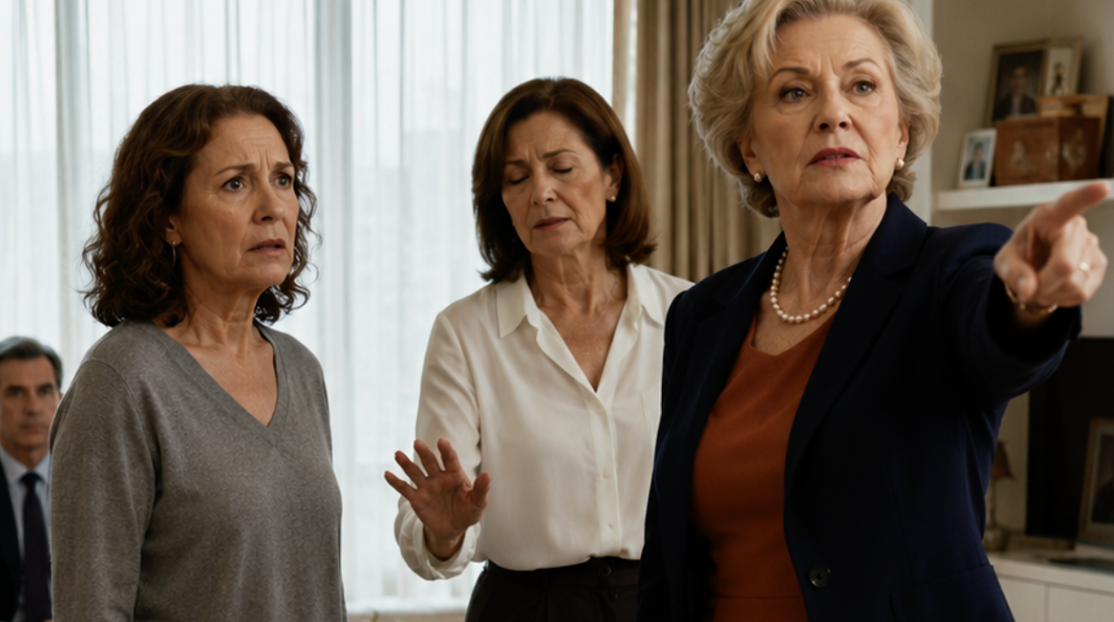
“Keys on the table. Right now. And don’t pretend you’re the mistress of this place while I’m still alive.” Klavdia Ivanovna said it in such a tone that Arina seemed to be standing not in her own apartment, but littering in someone else’s stairwell.
“And don’t you pretend that everyone here owes you something,” Arina didn’t even raise her voice, but every word seemed to clang. “The apartment is registered in my name. Do you want the papers? I can show them to you. Though you won’t read them anyway.”
“Papers…” her mother-in-law smirked crookedly and lifted her chin. “Girl, papers are for people who haven’t seen life. But life happened here. I raised my son here. I didn’t sleep at night here when he was coughing. I here…” she suddenly inhaled sharply, as if performing for an audience, “I would like to end my days here too.”
“Just not in my bedroom,” Arina cut her off so sharply that Dmitry, standing by the door, seemed to shrink by a head. “If you want to end your days, choose a place where people are happy to see you. They’re not happy to see you here.”
Dmitry shifted from foot to foot like a schoolboy who had lost his report card and hoped everything would somehow resolve itself.
“Mom, come on…” he began dully. “We talked about this…”
“Don’t ‘come on’ me, Dima.” Klavdia Ivanovna turned to him, and something metallic clicked in her voice. “I thought you were a man. But you’re standing there like a piece of furniture, silent while your mother is left out on the street.”
Arina instinctively stepped back and caught the wall with her palm. The fresh paint had long since dried, but the memory was still alive: a week ago she had been rolling paint onto the walls, Dmitry had been fiddling with the switches, and then they had sat on the floor, eating delivery from a box and laughing as if it were their own little celebration — renovation, exhaustion, a new life.
Now that laughter seemed not merely past, but as if it belonged to someone else.
“You promised,” Arina breathed, turning back to her mother-in-law. “You promised you would warn us, that you wouldn’t come whenever you felt like it. That you would stop moving everything around and… giving orders.”
“I don’t give orders,” Klavdia Ivanovna said calmly. “I know how things should be. It was always like this here. The nightstand goes here. The sofa goes like that. In the kitchen, this goes there. I lived here for forty years.”
“And now I live here.” Arina spoke quietly, but in such a way that the room seemed to grow colder. “And it will be the way I say.”
The word “I” hung between them like a nail.
Her mother-in-law turned pale.
“So…” she said slowly. “The home is yours. Then whose is my son?”
Dmitry lowered his eyes. As always, when he had to choose.
At that moment, the doorbell rang. Long and brazenly — as if someone else, too, was used to coming in without permission.
On the doorstep stood Vera Semyonovna, the neighbor in her eternal “going-out” robe and hair curlers, which for some reason she was not embarrassed to wear in front of either people or mirrors.
“Oh, what’s going on here…” She stuck her head through the crack like she was watching a soap opera. “You can hear it two floors away. I was already thinking of calling the district policeman.”
“Everything is fine,” Arina said tiredly. “It’s a family conversation.”
“A family conversation, yes, yes…” Vera Semyonovna sighed with the air of a person who knew everything about everyone. “Only the walls are thin. Dimochka, you should, well… separate them somehow.”
But Dmitry didn’t separate anyone. He didn’t do anything at all. He simply stood there, as if he had been placed there for decoration: “husband in the hallway, one unit.”
Klavdia Ivanovna left abruptly, slamming the door so hard that the chandelier in the corridor trembled. The silence that remained was deaf and sticky — like after a slap to the face.
Arina stood in the middle of the room and listened to the clock ticking. Tick. Tick. Tick. It sounded like a countdown.
“She came without calling again,” Arina finally said. “Again with keys, as if this were a hotel.”
“Mothers… they’re like that,” Dmitry muttered, and for some reason looked at the floor, as if the answer were lying there. “They’re used to… controlling things.”
“And you’re used to other people deciding for you.” Arina went into the kitchen, took out a bottle of mineral water, and poured some. Her hands were trembling, though she was trying to hold herself together. “First your mother. Then me. Convenient, isn’t it? You sit and wait while women tear each other apart, and you say, ‘I have nothing to do with it.’”
“You’re overreacting,” Dmitry grumbled.
“I am?” Arina smirked and nodded toward the living room. “Do you see the sofa?”
It stood by the window. Arina had put it against the wall. On purpose. She liked everything to be in its place. She liked the feeling that at least at home she could breathe freely.
“Mom just…” Dmitry faltered.
“Just took it and moved it. Like everything else.” Arina took a sip and felt that the water was cold, while everything inside her was hot, as if after a burn. “I think even the air in the apartment is hers now. So heavy. So foreign.”
The next day, Arina ran into Vera Semyonovna by the entrance. The woman was holding a net bag with groceries and was clearly not heading home, but “to have a talk.”
“Arinochka, of course, I don’t want to interfere…” she began in the way the most interfering people in the world always begin. “But you’re a brave girl. Not everyone can stand up to Klavdia Ivanovna. She’s like the local authority around here — she orders everyone around.”
“Let her order around whoever she wants,” Arina pulled up her hood because it was drizzling, and she wanted to hide at least from the drops, since hiding from people was impossible. “Just not me.”
“And you know…” Vera Semyonovna lowered her voice, as if she were about to reveal a hidden stash of gold. “She behaved like that even before the sale. She fought with the previous owner, shouted that the furniture was standing ‘wrong,’ that they were doing everything ‘incorrectly.’ She even called the district policeman. Said she had been deceived, that the documents had been swapped.”
“Swapped?” Arina stopped. “But she signed them herself. I personally sat at the notary’s office. I saw everything.”
“Who can understand them…” the neighbor shrugged. “People say that after her surgery, something in her head… shifted. One minute she cries, the next she gives orders, then she calls someone at three in the morning. She drove her son crazy, and now, as you can see, she’s switched to you.”
Arina went upstairs with that phrase — “shifted” — stuck in her head. It was very convenient to blame everything on age. Only somehow, it didn’t make living with it any easier.
That evening, she found a note on the kitchen table. Dmitry’s crooked handwriting. The sheet had been torn from a notebook, like in school.
“Arina, don’t be cruel. Mom is old. It’s hard for her. Don’t shout at her. Sometimes she just wants to come home.
D.”
The word “home” struck her temple so hard that Arina closed her eyes.
Home. Where was that? Her apartment? Their marriage? Those times when Dmitry still didn’t hide behind “well, mothers are like that”?
The continuation of the story is in the comment under the post 👇
— Keys on the table. Right now. And don’t pretend you’re the mistress of this place while I’m still alive. — Klavdia Ivanovna said it in a tone that made it sound as if Arina were not standing in her own apartment, but littering in someone else’s stairwell.
“Don’t pretend everyone here owes you something either,” Arina said without even raising her voice, but every word seemed to clang like metal. “The apartment is registered in my name. Do you want to see the papers? I can show you. Though you don’t read them anyway.”
“Papers…” her mother-in-law smirked crookedly and lifted her chin. “Girl, papers are for people who haven’t seen life. But life happened here. I raised my son here. I didn’t sleep at night here when he coughed. I…” She suddenly inhaled sharply, as if performing for an audience. “I would like to end my life here too.”
“Just not in my bedroom,” Arina cut her off so sharply that Dmitry, who was standing by the door, seemed to shrink by a whole head. “If you want to end it somewhere, choose a place where you’re welcome. You are not welcome here.”
Dmitry shifted from foot to foot like a schoolboy who had lost his grade book and hoped the problem would somehow resolve itself.
“Mom, well…” he began dully. “We talked about this…”
“Don’t ‘well’ me, Dima.” Klavdia Ivanovna turned to him, and something metallic clicked in her voice. “I thought you were a man. But you’re standing there like a piece of furniture, silent while your mother is left out on the street.”
Arina instinctively stepped back and touched the wall with her palm. The fresh paint had dried long ago, but in her memory everything was still alive: a week earlier, she had been rolling paint onto the wall, Dmitry had been fiddling with the switches, and then they had sat on the floor, eating takeout from a box and laughing as if it were their small celebration — renovation, exhaustion, a new life.
Now that laughter seemed not merely past, but someone else’s.
“You promised,” Arina exhaled, turning back to her mother-in-law. “You promised you would warn us before coming over, that you wouldn’t come whenever you felt like it. That you would stop rearranging everything and… giving orders.”
“I’m not giving orders,” Klavdia Ivanovna said calmly. “I know order. It has always been this way here. The nightstand goes here. The sofa goes like that. In the kitchen — this. I lived here for forty years.”
“And now I live here.” Arina said it quietly, but the room seemed to grow colder. “And it will be the way I say.”
The word “I” hung between them like a nail.
Her mother-in-law went pale.
“So…” she said slowly. “The home is yours. Then whose is my son?”
Dmitry lowered his eyes. As always, when he had to choose.
At that moment, the doorbell rang. Long and brazen — as if someone else were used to entering without permission too.
Vera Semyonovna stood on the threshold — the neighbor in her eternal “going-out robe” and curlers, which for some reason she was not ashamed of before either people or mirrors.
“Oh, what’s going on here…” She poked her head through the crack like she was peering into a TV series. “You can hear it two floors away. I already thought of calling the district police officer.”
“Everything is fine,” Arina said tiredly. “It’s a family conversation.”
“Family, family…” Vera Semyonovna sighed with the air of someone who knew everything about everyone. “Only the walls are thin. Dimочка, you should, well… separate them somehow.”
But Dmitry did not separate anyone. He did nothing at all. He simply stood there as though he had been placed for decoration: “husband in the hallway, one unit.”
Klavdia Ivanovna left abruptly, slamming the door so hard the chandelier trembled in the corridor. The silence that remained was dull and sticky — like after a slap in the face.
Arina stood in the middle of the room and listened to the clock ticking. Tick. Tick. Tick. It sounded like a countdown.
“She came again without calling,” Arina finally said. “Again with the keys, as if this were a hotel.”
“Mothers… they’re like that,” Dmitry muttered, for some reason looking at the floor as if the answer were lying there. “They’re used to… controlling.”
“And you’re used to someone deciding for you.” Arina went into the kitchen, took out a bottle of mineral water, and poured some. Her hands were shaking, though she tried to keep herself steady. “First your mother. Then me. Convenient, isn’t it? You sit and wait while women tear each other apart, and you’re just ‘not involved.’”
“You’re exaggerating,” Dmitry grumbled.
“I am?” Arina smirked and nodded toward the living room. “Do you see the sofa?”
It stood by the window. Arina had placed it against the wall. Deliberately. She liked things to be in their places. She liked the feeling that at least at home she could breathe calmly.
“Mom just…” Dmitry hesitated.
“Just took it and moved it. Like everything else.” Arina took a sip and felt that the water was cold while everything inside her was hot, as if after a burn. “It feels like even the air in the apartment is hers now. Heavy. Foreign.”
The next day, Arina ran into Vera Semyonovna by the entrance. The woman was holding a mesh bag of groceries and was clearly not going home, but “to have a talk.”
“Arinochka, of course I’m not interfering…” she began in the way the most interfering people in the world begin. “But you’re a brave girl. Not everyone can withstand Klavdia Ivanovna. She’s like the local authority here — lines everyone up.”
“Let her line up whoever she wants,” Arina pulled up her hood because it was drizzling, and she wanted to hide at least from the drops, since hiding from people was impossible. “Just not me.”
“And you know…” Vera Semyonovna lowered her voice as if she were about to reveal a hidden stash of gold. “She behaved like that even before the sale. She fought with the previous owner, yelled that the furniture was standing ‘wrong,’ that they were doing everything ‘incorrectly.’ She even called the district officer. Said she’d been deceived, that the documents had been switched.”
“Switched?” Arina stopped. “But she signed everything herself. I personally sat at the notary’s office and saw it all.”
“Who can understand them…” the neighbor shrugged. “They say after her surgery everything… went off track. One minute she cries, the next she gives orders, then she calls someone at three in the morning. She wore her son’s brain out, and now, you see, she has switched to you.”
Arina went upstairs with that “went off track” stuck in her head. It was very convenient to blame everything on age. Only somehow that did not make life any easier.
That evening, she found a note on the kitchen table. Dmitry’s crooked handwriting. A page torn from a notebook, like in school.
“Arina, don’t be harsh. Mom is old. It’s hard for her. Don’t shout at her. Sometimes she just wants to come home.
D.”
The word “home” struck her temple so hard that Arina closed her eyes.
Home. Where was that? Her apartment? Their marriage? Those times when Dmitry had not yet hidden behind “well, mothers are like that”?
Late at night, she heard rustling at the door. At first she thought someone had mistaken the floor. Then she heard the distinct click: a key in the lock.
Arina’s heart dropped. She approached on tiptoe, grabbed her phone as if it could protect her, and sharply opened the door.
Klavdia Ivanovna stood on the landing. In a coat thrown on hastily, with a bag, and slippers on her feet. Barefoot inside them. She looked as if she were not breaking into someone else’s apartment at night, but coming home from work.
“What are you doing?!” Arina’s voice broke.
“I came to spend the night,” her mother-in-law said calmly. “Dima said I could. It’s late, he said. Let Mom sleep over.”
Arina felt something rise inside her — not even anger, but cold clarity: she was simply being presented with a fact. Again. She called Dmitry. He answered sleepily, irritably — like a person torn away from a comfortable life.
“Yeah…” he mumbled.
“Dmitry. Do you know that your mother is standing at my door trying to get in?”
“Well, yes,” he yawned. “She’s not feeling well. I thought… let her stay the night. We’ll sort it out tomorrow.”
“‘Let her stay the night’…” Arina said slowly, as if tasting the words. “You decided for me?”
“Arina, don’t start,” he said tiredly. “Just let her sleep. What does it cost you?”
“It costs me the fact that I am nobody here anymore.” Arina said it almost in a whisper. “Do you understand?”
“Oh, for God’s sake…” Dmitry exhaled loudly. “Do whatever you want.”
And he hung up.
Klavdia Ivanovna had already walked past Arina as if she were a nightstand and headed into the living room. She pulled a robe out of her bag — prepared in advance, everything thought through. As if she had come to the dacha.
“I’ll sleep on the sofa, don’t be afraid,” she said, fluffing the pillow. “I’m not some beast.”
Arina stood and looked at her as if watching a foreign scene unfold in her own home. She wanted to scream, throw her out, shake Dmitry, break this calm certainty of her mother-in-law’s. But she had no strength. Her strength seemed to have drained somewhere beyond the doormat.
“You’re evil, girl,” Klavdia Ivanovna suddenly said, switching off the overhead light and leaving only the lamp. “You don’t understand kinship. Now it’s all money, money… and later you’ll be alone and understand.”
“I have the documents,” Arina said dully.
“Documents…” her mother-in-law snorted. “Scraps of paper. But I have the heart. I have the memory. And I had the keys until you staged this circus.”
Arina did not sleep. At dawn, somewhere outside the window, a bird suddenly cried out sharply, and for some reason that cry made her want to weep — not out of self-pity, but from exhaustion that had accumulated like dirt in the corners.
For the first time, she clearly felt it: her home was not a quiet harbor. It was an island someone was trying to take by storm. And the worst part was that the person who should have been standing beside her was hiding off to the side.
In the morning, when Klavdia Ivanovna left after surveying the hallway like an owner and muttering something like “as if locks matter,” Arina did what she had long postponed because she “didn’t want to take things to extremes.”
She called a notary.
“Hello,” her voice was surprisingly steady. “I need a consultation. Regarding unauthorized access to a residential property. Yes. Relatives. And also… regarding changing the locks and notification.”
The person on the other end clarified something, promised to outline the procedure, listed the documents. Arina listened and nodded, as if she were being given not legal steps, but an evacuation plan.
A couple of days later, the district police officer appeared in her apartment — Andrey, tall and thin, with the face of a man who had seen too many “family stories” and had long since stopped being surprised.
“So, Arina Sergeyevna,” he said, looking through the paper. “The statement has been accepted. But you understand… the husband’s mother, a family conflict…”
“Ex-husband,” Arina corrected automatically. She said it herself and felt the word “ex” scratch inside her: not official yet, but almost true.
“Are you officially divorced?” Andrey clarified.
“Not yet.”
“Then legally — husband.”
“Legally, the apartment is mine,” Arina did not give in. “And I don’t want people coming here whenever they feel like it.”
Andrey wrote it down and nodded.
“If there are attempts to enter — call. We’ll come and record it. Only…” He raised his eyes. “Stories like this drag on afterward. Courts, nerves, filth. Are you ready?”
Arina looked at the fresh paint, the evenly hung curtains, the cup in the sink that she had not managed to wash because she had spent the whole night listening to someone else’s footsteps.
“I’m already in it up to my ears,” she said quietly. “The question isn’t whether I’m ready. The question is how to survive and not go mad.”
The next day, she changed the locks. The new key shone in her palm in an unfamiliar way — like a small vow to herself. Vera Semyonovna stood nearby in the corridor and commented on the process as though without her participation the mechanism would not work.
“That’s right, that’s right,” she whispered. “Otherwise you’ll never wash them off afterward. She’s stubborn, Klavdia Ivanovna… oh, stubborn.”
Andrey checked several times, turned the key, clicked the lock.
“Now only your key. But keep in mind: while you’re married, your husband has the right of access.”
“Let him come by summons,” Arina said dryly.
Andrey smirked — without amusement.
“I understand.”
Dmitry called a week later. His voice was hoarse, as if he had not slept.
“Arina… we need to talk.”
“About what?” She already knew the answer, but asked anyway.
“About Mom.”
“Say ‘Mom is having a hard time,’ and I’ll hang up,” Arina warned emotionlessly.
A pause.
“She’s in the hospital.”
The silence became dense, like a cotton blanket.
“What happened?” Arina asked, and immediately grew angry at herself because something inside her still trembled.
“Blood pressure. The doctors say it’s nerves. Stress.”
“Stress…” Arina gave a short smirk. “From not being allowed to do whatever she wants in someone else’s apartment?”
“Arina, well…” Dmitry faltered. “Can I come over? Just to talk. No scandal.”
“Come,” she said after a second. “Only alone. No surprises.”
That evening he came. Rain drummed against the windowsill, and outside smelled of wet asphalt and minibuses that always belched smoke under the windows. Dmitry looked as if the week had chewed him up and spat him out: he had lost weight, his eyes were sunken, his stubble was uneven.
He sat on the very sofa his mother had dragged around like a flag.
“I understand everything,” he said quietly. “But you can’t just… she’s…”
“She’s what?” Arina did not raise her voice. She looked at him carefully, the way one looks at a person who had pretended for years not to hear. “She has a right? To my home? To my nerves? To you deciding for me?”
“I thought I could be between you,” Dmitry admitted, and suddenly rubbed his face with his hands like a boy. “That you both… well… would somehow get used to each other.”
“We won’t,” Arina said calmly. “This isn’t about ‘getting used to each other.’ This is about the fact that every time, you chose not me.”
Dmitry raised his eyes.
“You’ve changed.”
“I’m tired. Those are different things,” she replied. “And you know what? I choose loneliness. At least it doesn’t reach for my keys or arrange sleepovers by the decision of third parties.”
He was silent for a long time. Then he exhaled:
“Mom asked me to tell you… that she’ll come back anyway.”
Arina smiled without humor.
“Let her try.”
She said it and suddenly realized she herself was not sure where this story would turn next. Because with Klavdia Ivanovna, “let her try” was not the end of a conversation. It was the beginning of a war.
And at that very moment, in the hallway, as if in confirmation, the phone quietly chimed: a message had come from an unknown number. No greeting, no signature. One line:
“Locks don’t last forever. You’ll see that this apartment has its secrets.”
Arina slowly placed the phone on the table, looked at Dmitry, and suddenly felt the house grow cramped again — as though the walls had shifted inward by a centimeter.
“Dima,” she said evenly. “Who is this?”
He went pale.
“I… don’t know.”
Arina did not believe him. And in that same second she understood that everything ahead would only get worse — because now something else had entered their conflict: someone else’s hand, someone else’s game, some vile certainty that the apartment really did have “secrets.”
She silently approached the door and checked the lock — automatically, the way one checks a pulse.
Click.
Locked.
For now, locked.
She slowly turned back to Dmitry. He was sitting on the sofa, hunched over, pretending to study his shoes. As if somewhere on the soles it were written: how not to be a coward and not destroy your own family.
“Now you’re going to explain to me,” Arina said quietly, almost evenly, “who wrote this.”
She showed him the phone screen.
Dmitry raised his eyes, read it, and the corner of his mouth twitched. Not surprise — recognition. Fleeting. But it was there, and Arina caught it the way one catches the smell of smoke in a clean room.
“I… don’t know,” he repeated. And quickly added: “Maybe one of the neighbors. Vera Semyonovna loves horror stories.”
“Uh-huh.” Arina nodded like a doctor who had already understood the diagnosis, though it was too early to tell the patient. “Apartment secrets. That’s exactly how a normal neighbor writes.”
Dmitry swallowed.
“You’re winding yourself up. You’re just on edge, Arina.”
“Don’t speak to me in that tone,” her voice hardened. “You made me this way. You. Her. Both of you, with this habit of deciding how I should live.”
Dmitry stood up abruptly.
“Why do you keep blaming everything on me?! I’m between two fires!”
“No, Dima. You’re not ‘between.’ You’re off to the side.” Arina stepped closer, forcing him to retreat one step. “You’re one of those people who hides while someone else fights. And then comes out and says, ‘I didn’t want conflict.’”
He opened his mouth, closed it, and forced out:
“I didn’t want Mom to end up in the hospital.”
“And I didn’t want people walking into my home at night like into an entryway.” Arina looked at him now without anger. With a dry kind of disgust. “But somehow my wishes are always somewhere at the bottom of the list. After Mommy’s whims.”
Dmitry ran a hand through his hair.
“What do you even want? A divorce?”
“I want to live normally.” Arina exhaled slowly. “Without your family cult where the mother is the tsar, the son is furniture, and the daughter-in-law is unpaid service staff.”
“You’re talking like a stranger,” Dmitry said dully.
“That’s because I’ve become a stranger to you. You did that yourself.”
He picked up his jacket.
“I’ll go then.”
“Go,” Arina said calmly. “Only leave the keys. All of them.”
Dmitry froze in the doorway, stood silently for a moment, then threw the keyring onto the nightstand. It clinked as if the iron were laughing.
He left.
Arina locked the door behind him. She pressed her forehead to the cold metal and for the first time in a long while felt not pain, but relief. As if she had finally taken someone else’s backpack off her shoulders.
But the relief lasted exactly one minute.
The phone beeped again.
“You think you’ve won? You haven’t opened the chest.”
Arina’s chest went empty. Not frightened — empty. The way it feels when someone hits a nerve too accurately.
The chest.
She really had not opened it. She had closed it because “don’t pry into someone else’s past,” because “respect,” because “I don’t want to touch filth with my hands.”
But now the filth was crawling into her face on its own.
Arina got dressed and went downstairs.
The basement greeted her with dampness and the dim light of a bulb that flickered as if it too was tired of everything. In the corner stood that very chest — wooden, worn, with rusty hinges.
She had the key.
She herself did not understand what was worse: opening it, or continuing to live knowing it existed.
Her fingers trembled. The lock clicked.
The lid lifted heavily, as if resisting.
Inside were notebooks, letters, old photographs, a stack of paper envelopes, and… a thin folder with writing in felt-tip pen:
“APARTMENT. DOCUMENTS. DO NOT TOUCH.”
Arina’s throat tightened. She did not want this “do not touch.” She wanted a normal life. To come home and think about a TV show, about work, about what to buy on the weekend, not about who would set her up and where.
But she took the folder.
Opened it.
The first thing she saw was a certificate of ownership. Old, still Soviet-style formatting. And the surname there was… not Klavdia Ivanovna’s.
Another one.
A completely different one.
Then came copies of powers of attorney, some applications, extracts. Everything neatly arranged. Everything… prepared. And also a sheet of paper with a stamp. A court decision. Old. Yellowed at the edges.
Arina skimmed it and slowly sat down right on the concrete floor.
The apartment had once belonged not to Klavdia Ivanovna. And it had been bought with what the documents called a “disputed right.”
In plain language: she had bought an apartment where the past was not just “with memories,” but with a hole in the paperwork.
She pulled out another paper — a receipt. The handwriting was familiar, sharp.
“Money received. No claims. Klavdia I.”
And next to it — a second sheet. The same, but with a different date.
Arina raised her eyebrows.
Two receipts?
She looked at them and felt a crooked picture forming in her head: it was not that her mother-in-law “couldn’t let go of the apartment.” Her mother-in-law… possibly knew that there was a chance this apartment could go back into someone else’s hands. And then Klavdia Ivanovna would not be simply an offended old woman, but a person who had dragged Arina into someone else’s story.
The phone beeped again.
This time it was the same number.
“Understand now? Your little paper is a candy wrapper. And I want everything to be fair.”
Fair.
Arina laughed hoarsely. In the basement, her laughter sounded vile — like a cough.
“You’ve got to be kidding…” she whispered into the emptiness.
And then she heard footsteps.
Not from above, where the entrance was. Here. In the basement.
Heavy, confident.
Arina turned off her phone screen. She grabbed the folder, quickly pushed the chest back with her foot as best she could, and froze.
A figure emerged from the darkness.
Not Klavdia Ivanovna. Not Dmitry.
A woman of about forty-five, in a down jacket and with a bag in her hand, as if she had simply come to fetch potatoes. Her face was angry, tired. Too confident for a random passerby.
She looked at Arina and smirked.
“Well, hello. Mistress of the place.”
“Who are you?” Arina’s voice treacherously trembled, but she immediately pulled herself together. “What are you doing here?”
The woman came closer and stopped under the lightbulb.
“My name is Inna.” She narrowed her eyes. “I’m the one who should have lived in this apartment. If your mother-in-law hadn’t been so… quick-witted.”
Arina stood up.
“I don’t understand anything. The apartment was purchased officially. Through a notary. The documents are clean.”
Inna laughed shortly.
“Clean? Is that what they told you?” She tilted her head. “Do you think a notary is a saint? He just checks papers. But the history… the history existed before you.”
Arina took a step back.
“Leave. Right now. Or I’ll call the police.”
“Call them.” Inna calmly shrugged. “I didn’t break into your place at night. I’m not a ‘relative.’ I simply came to take back what’s mine.”
Arina squeezed the folder.
“This is my home.”
“For now, yes.” Inna looked straight into her eyes. “Soon it won’t be. Because Klavdia Ivanovna knew what she was selling. And she knew she could be pressured.”
Everything inside Arina began to roar, like a kettle.
“Klavdia Ivanovna is dead,” she said, and heard herself say it as if declaring that everything was over now.
Inna grimaced.
“Dead… of course. Convenient. And now who’s to blame? The daughter-in-law.”
Arina sharply lifted her chin.
“Don’t you dare. I am not responsible for your life going downhill. And I am not obliged to pay for someone else’s schemes.”
Inna stepped right up to her.
“Do you know your husband knew too?”
Arina froze.
“What?”
“Yes.” Inna nodded, as if confirming the obvious. “He knew his mother was selling the apartment ‘not entirely cleanly.’ And that she asked him to keep his mouth shut. And he did. Because it was convenient for him. He has always lived that way.”
Arina felt rage rising from somewhere below. Not hysteria — rage. Cold. Angry. Collected.
She took out her phone and dialed a number.
“Hello, Andrey? This is Arina Sergeyevna. Can you come now? Yes. Urgently. I have an unauthorized person in the basement. And… it seems the apartment story is much dirtier than we thought.”
Inna snorted.
“Well done. You learn fast.”
Ten minutes later, the district officer Andrey came down into the basement. With a flashlight, an irritated face, and the same expression of a man who had once again been dragged into someone else’s mess.
“Right…” He looked at Inna, then at Arina. “Who do we have here?”
Inna calmly showed her passport.
“I’m the former owner. And I want my property back.”
Andrey sighed as if he were now being forced to break up a fight at a parent-teacher meeting.
“This is resolved through court,” he said dryly. “No vigilante action here.”
Inna shrugged.
“I’m not taking vigilante action. I’m just talking. To the owner.”
Arina clenched her teeth.
“To the owner…” she repeated. “You all love that word so much.”
She went upstairs and did not sleep all night. The papers from the chest, Inna’s words, the message “locks don’t last forever” spun through her head.
By morning, she understood the main thing: she had been deceived.
And not deceived “somewhere back in the past.” She had been deceived by her own people. Her husband. His mother. Their sticky family system, where a woman was supposed to endure, stay silent, and be grateful that she had been allowed into their life at all.
She called Dmitry.
He did not answer immediately.
“Yes?”
“I was in the basement.” Arina’s voice was calm. “And do you know whom I met there? Inna.”
Silence.
“What Inna?” he said dully.
“Don’t act like an idiot,” Arina said without shouting. But even a person with no ear would have understood from that calm intonation: it was over. “You knew everything. And you kept silent.”
Dmitry did not answer for a long time.
Then he forced out:
“I didn’t want to drag you into it…”
“You already dragged me into it. You bought me together with the problem.” Arina swallowed. “You just thought I would swallow it. Like everything else.”
“Arina, come on…” he tried, as always, to switch on the “let’s not get emotional” mode.
“No.” She interrupted him. “Now you listen.”
And Arina told him everything. About the chest. About the papers. About the receipts. About Inna. About the fact that the district officer already knew.
And at the end she added:
“Tomorrow I’m filing for divorce. And for division of property. And separately, for a review of the transaction. Because if you and your mother think I’ll silently watch while my apartment is squeezed out from under me, you are mistaken.”
“You won’t be able to,” Dmitry said quietly. “It’s complicated.”
“You won’t be able to,” Arina answered. “Because you’ve always lived behind someone else’s back. And from now on, I’ll live behind my own.”
He was silent.
And in that silence there was no remorse. There was what there had always been: the habit of waiting for someone else to decide for him.
A week later, Arina sat in a lawyer’s office. A young man in a shirt with rolled-up sleeves flipped through the documents and frowned more and more.
“The situation is unpleasant,” he finally said. “But not hopeless. You are a bona fide purchaser. That is important.”
“And if they take the apartment away?” Arina looked straight at him. “What then?”
The lawyer shrugged.
“Then you’ll recover the money from the seller.”
“From the seller, who is already dead?” Arina smirked. “Wonderful. Very optimistic.”
The lawyer hesitated.
“From the heirs.”
Arina slowly inhaled.
The heirs.
That meant Dmitry.
She left the office and, for the first time in a long while, did not want to cry or scream. She just wanted to… disappear for twenty-four hours. No people. No conversations. No other people’s decisions.
But disappearing did not work.
Vera Semyonovna was waiting for her on the stair landing.
“Arinochka,” she whispered conspiratorially. “Don’t be frightened, but a woman came here looking for you. She said she was Klavdia Ivanovna’s relative. And that the apartment… that all of it was wrong.”
“Did she say her name?” Arina asked.
“No. Only her eyes were like a cat’s before it jumps.”
Arina went upstairs, opened the door, and saw a new envelope on the mat.
No stamps. So it had been delivered by hand.
Inside was a flash drive.
And a note:
“If you want to understand what you’re fighting for — watch this. Otherwise you’ll lose.”
Arina sat in the kitchen and looked at the flash drive for ten minutes. Then she inserted it into the laptop.
A folder titled: “Dima. Mom. 2024.” Video.
Dmitry. Her Dmitry. Sitting in that same apartment, before the renovation, with the old wallpaper. And saying to someone off camera:
“Mom, well, we’ll sell it to her. She’s stupid. She believes in documents. And then… then if anything happens, we’ll sort it out. The main thing is the money now.”
Klavdia Ivanovna’s voice off camera:
“And if she makes trouble?”
“She won’t,” Dmitry laughs. “She’s quiet. She’ll endure it. Well… or she’ll leave. She won’t have anywhere to go anyway.”
Arina switched off the laptop.
Sat down and stared at the wall.
Inside, it felt as though not her heart had been torn out, but her spine. Because this was not just betrayal. It was contempt. Calm, everyday contempt, which is more frightening than any hysteria.
And then… then Arina stood up.
She opened the closet, took out the folder with documents, and gathered everything into one bag. The chest papers, the flash drive, the receipts. Everything.
And she went not to the lawyer. Not to the district officer.
She went to Dmitry.
He was living with his sister in a panel-block apartment on the outskirts, in a district where the entrance always smelled of wet dogs and cheap cigarettes.
Dmitry opened the door in sweatpants.
“Arina?..”
She walked inside without taking off her jacket.
“Sit down,” she said calmly. “We’re going to talk. Like adults.”
He sat.
She placed the flash drive on the table.
“Did you record this?”
Dmitry went pale.
“I… don’t remember.”
“Of course.” Arina nodded. “You have a convenient memory. When you need to remember, you remember. When you don’t, you don’t.”
Dmitry’s sister Lena peeked out from the kitchen — thin, nervous, with a heavy gaze.
“What’s going on?” she asked.
“Nothing,” Arina looked at her calmly. “Your brother just sold me along with the apartment. Like a thing. We’re discussing the details.”
Lena frowned.
“Have you lost your mind?”
“No.” Arina smiled with one corner of her mouth. “I’ve just come to my senses.”
And then she said what had long been ripening inside her:
“Here’s how it’s going to be. You have a choice. Either you help me close this issue calmly, or I bring all of this out into the open in a way that will make you regret it. To court. To the police. Everywhere possible. And then Dima won’t be running between two women, but between offices.”
Dmitry raised his eyes.
“Are you threatening me?”
“No.” Arina leaned toward him. “I’m warning you. Because I am not your ‘quiet one.’ I am not your ‘she’ll endure it.’ Do you understand?”
Dmitry swallowed.
Lena slowly exhaled and suddenly said quietly, unexpectedly:
“Dima… what have you done…”
And for the first time, Arina saw someone in his family look at him not as a poor little boy, but as an adult responsible for his actions.
He sat with his head lowered, and in that moment he was pathetic.
But Arina no longer cared.
“Divorce tomorrow,” she said. “And you will sign everything necessary. And you will help me. Because otherwise I will make your life turn into a nightmare.”
She stood up.
And at the door, before leaving, she turned around:
“And you know what’s the funniest thing, Dima? You really thought I wouldn’t find out. That I would live in this home and be grateful I was allowed to. You really thought that.”
Dmitry whispered:
“I… didn’t want…”
“You never ‘wanted’ anything.” Arina opened the door. “Only somehow it always ended with me being the one hurt.”
She left.
Spring came quickly. Sunlight beat against the windows, dirty water ran along the roads, someone in the stairwell argued about the elevator, which again smelled of cats. Life went on with its ordinary Russian life — rough, noisy, without pathos.
A month later, the court recognized Arina as a bona fide purchaser. The case was murky and difficult, but the apartment was not taken away. Inna tried to pressure her, threaten her, make scenes, but Arina’s lawyer worked precisely — and Andrey, unexpectedly, did not disappear, but helped document the whole story.
Dmitry signed the divorce papers.
At the hearing, he did not look at Arina. He did not look at anyone at all. He sat and nodded, as always.
Arina walked out of the courthouse and felt something strange.
Not victory.
Freedom.
She returned home and put the kettle on. Sat down at the table.
The home was quiet. But now that silence did not press down on her. It was even, real.
Arina went to the window and looked out at the courtyard. Children were yelling, someone was dragging bags, horns honked somewhere.
Ordinary life.
She took the new key out of the drawer — the same shining one.
And quietly said to herself:
“Now this really is my home.”
The phone lay nearby. Silent.
And for the first time in a long while, Arina was certain that tomorrow she would wake up — and no one would enter her life without permission.
The End.