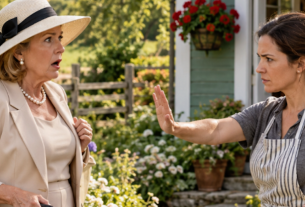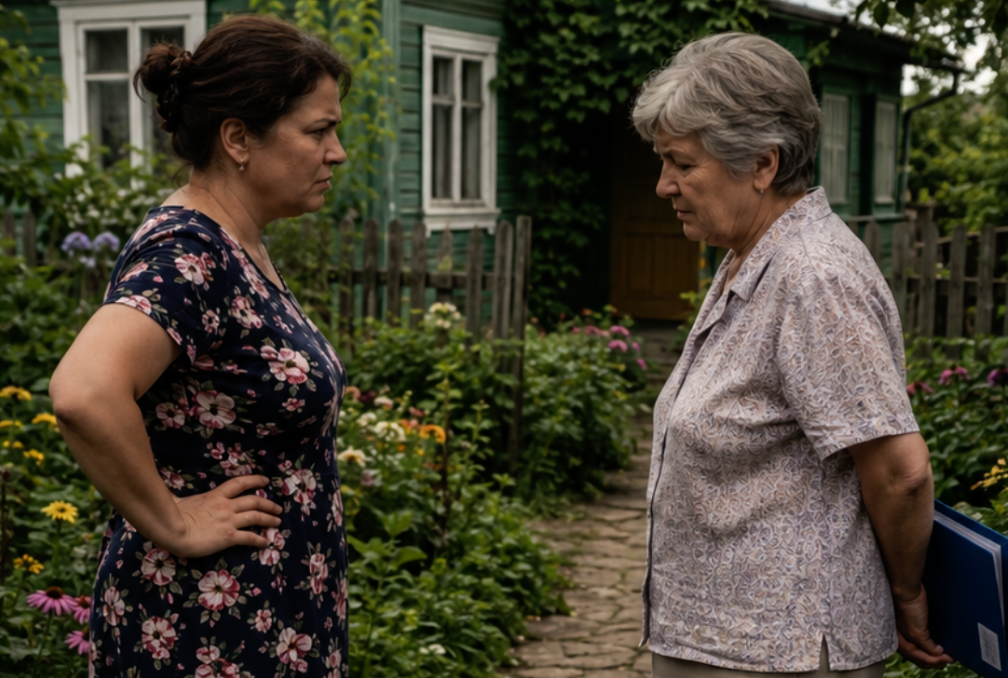
“Natalya! What are you doing here in the middle of the week?” Tamara Ivanovna’s voice from behind the fence made her flinch. “Your people drove off yesterday evening. Your mother-in-law, Antonina, was shouting all over the street that you’re nobody here now and that your name means nothing!”
Natalya stood by the gate of the garden community, clutching a bunch of keys in her hand. The metal of the rusty lock was cold and damp from the morning dew. The day before, Valery had told her he would be staying late at work because of the quarterly report, but deep inside, Natalya’s intuition had begun to ache.
She pushed open the wooden veranda door.
Instead of the familiar, beloved smell of pine resin, dried thyme, and old books, a sour stench hit her nose. It smelled like cheap beer halls on the outskirts of town: spilled sticky wine, stale rancid lard, and damp, moldy rags. On the table, covered with oilcloth printed with half-worn daisies, stood three empty bottles of cheap port wine. Beside them lay a plate with gray scraps of pork fat rind, thickly covered with flies.
She took a step into the room and froze.
On the bed lay a snow-white lace bedspread. Her grandmother had crocheted it by hand from fine cotton thread over two winters, treasured it, and allowed it to be used only on holidays. Now, right in the middle of that fragile whiteness, lay huge, trampled purple slippers made of cheap rubber. Dried gray clay crumbled from their soles onto the lace.
Natalya slowly caught her breath, turned around, and went out into the garden.
Where, just last Sunday, huge pink caps of Sarah Bernhardt peonies had grown—the very peonies her grandfather, Mikhail Dmitrievich, had brought forty years ago from a Crimean nursery—there was now a wasteland. The bushes had not simply been cut down; they had been crudely uprooted with a shovel, leaving holes behind, and then generously covered with gray salt from a packet to burn out the roots for good.
Nearby, in the fire pit, a charred chain glimmered dully among the ashes. The wooden swing with carved sides shaped like swan wings—the last thing her grandfather had made with his own hands before his death—was gone. It had simply been chopped up with an axe for firewood.
“Natalya, why are you silent?” Tamara Ivanovna had already come right up to the fence, leaning her chest against the pickets. “I’m telling you, that Antonina of yours was ordering everyone around here, shouting that enough was enough, that there was no need to live like gentry and grow useless bouquets. The family, she said, needed potatoes, and that girl could go assert her rights in the city—she was no lady. And those grandfather’s swings… she chopped them herself with an axe. Said the wood was good and dry, that it would make excellent shashlik. And your Valera just silently carried her bags and hid his eyes.”
Natalya sank down onto the old bench by the fence. Her palms touched the rough wood, gray from years of rain.
“Valera carried them?” she asked quietly, without expression.
“Yes, he even gave her the keys himself. I saw it with my own eyes when she took them from his hands. Antonina was bragging at the water pump too: ‘That’s it, we’ve cornered the girl. Now the dacha will be registered to our Valerochka. The documents have already been sent to the MFC.’”
Natalya took her phone from her jacket pocket and logged into her Rosreestr personal account.
The smartphone screen glared in the sun, and she narrowed her eyes at the spinning loading icon. At last, the Rosreestr page refreshed, and in the “Application Status” field, a red banner appeared: “State registration suspended.” Natalya tapped the link, downloaded the attached PDF file, and opened it.
It was a deed of gift for a land plot with cadastral number 50:18… and a log house. Donor: Natalya Sergeyevna Voronova. Recipient: Antonina Petrovna Voronova.
At the very bottom of the document, in the place for her signature, there was a flourish. Familiar, with its distinctive long tail, but Natalya saw it immediately: the line was uneven and trembling. Whoever had traced her signature through glass or from a tablet screen had been extremely nervous.
Her quiet, agreeable Valera, who always cleared his plate after himself and polished his shoes until they shone.
A February evening surfaced in her memory. Valera had come into the kitchen then, rubbing his neck—his habitual gesture when he needed to lie.
“Natalya, they’re collecting lists in the garden community for subsidized gas installation. Send me a scan of your passport and the land certificate. I’ll pass them on to the chairman so you don’t have to run around.”
Back then, she had even smiled and thought, “How caring.” She sent the scans and forgot about it.
Natalya closed the file and forced herself to take a deep breath of the warm country air, smelling of smoke from the burned swing.
Natalya was not just a dacha owner; she was a cadastral engineer, and she had seen far too often how close relatives tore one another apart over square meters. A year earlier, when Antonina Petrovna had first started talking about how “our Valerochka is like a dependent on grandfather’s land,” Natalya had silently gone to the MFC and filed an application banning any registration actions involving her property without her personal participation.
The Rosreestr registrar, seeing that note and the deed of gift brought by Valera under “power of attorney,” immediately blocked the transaction. Natalya had received the SMS notification about it three days earlier, but she had decided to come in person and see how far they were prepared to go.
Natalya rose, went into the house, pulled the desecrated lace bedspread off the bed, carefully folded it, and put it into her bag. She would wash it in the city. She took her mother-in-law’s greasy slippers from the table and, holding them with two fingers in disgust, threw them into the trash bin under the sink. Then she found an old rag and wiped the veranda table, removing the sticky traces of cheap wine.
She took out her phone and dialed Olga Nikolayevna, her former classmate, who now ran a notary office in the city center.
“Olya, hi. I need a tough, airtight draft agreement on the division of marital property. Yes, today. Include the city apartment, Valery’s car, and all his bank accounts. Write it so there’s not a single loophole. Yes, I’m getting divorced. No, I’m not crying. Olya, they burned my grandfather’s peonies.”
After hanging up, Natalya dialed a second number: the legal department of the city administration, where Valery had been working as a leading specialist for six years. She knew perfectly well that any hint of a criminal case, any complaint about fraud and document forgery, meant an immediate commission on official conduct and dismissal under the article “due to loss of trust.” A black mark after which no one would hire him for civil service, not even as a janitor.
“Hello, Lyudochka? Hi. Tell me, do you get the forms for complaints to the ethics commission from the secretary, or are they on the website? No, not for me. For my Valery. Yes, I’m preparing a surprise.”
Putting the phone on the clean table, Natalya looked at the empty flowerbed outside the window. Friday lay ahead. The day Valery and Antonina Petrovna were supposed to come here and solemnly declare themselves the owners of her land.
Natalya sat down in the armchair and began to wait.
The next day.
“Oh, Natalya, you’re already here? Excellent. Go help bring the boxes in from the trunk!” Antonina Petrovna burst onto the veranda, kicking the door open.
In her hands she was dragging a plastic crate of tomato seedlings, thickly wrapped in old yellowed newspapers. Behind her, breathing heavily, came Valery. He was carrying a huge sack of seed potatoes. A strange expression was frozen on her husband’s face: a mixture of importance and deeply hidden fear.
“Where should I put this?” Valery wheezed, not looking at his wife.
“Right on the table, son, where else?” her mother-in-law said, unceremoniously shoving Natalya’s notebook aside and planting her crate of soil straight onto the clean tablecloth. “Well then, Natalyushka, let’s not hold grudges. Young people are foolish, but life goes on. Valerochka and I discussed it and decided: it will be more secure for the family this way. A man should be the master. So surrender your useless bouquets. We’ll plant a proper vegetable garden here. Potatoes, onions… And you can stay in the city and rest.”
Natalya silently rose from her chair, reached out, took the crate by the edge, and calmly, with one smooth movement, swept it off the table. The plastic cracked loudly, and black soil and green tomato stems scattered across the clean veranda floor like a fan.
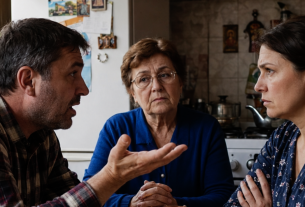
“What are you doing, girl?!” Antonina Petrovna shouted. “Have you completely lost your mind from greed?! Valery, look at her! She’s sick!”
“Sit down, Antonina Petrovna,” Natalya said sternly.
There was so much icy, absolute calm in her voice that her mother-in-law immediately fell silent and, putting her hands on her hips, noisily blew air through her teeth. Natalya turned to her husband.
“Valery, come to the table.”
Her husband hesitated and took a step back, but Natalya looked at him in such a way that he came over and stopped at the edge. Natalya opened her folder and slowly laid three sheets of paper on the table, one after another.
“Document number one,” she said, tapping her fingernail on the top sheet. “An official notice from Rosreestr about the suspension and blocking of your fraudulent transaction to gift my land. I filed the restriction requiring my personal participation a year ago.”
Valery’s chin visibly trembled. He quickly glanced at his mother, but she only pressed her lips together angrily.
“Document number two.” Natalya placed the second sheet in front of her husband. “A draft police report regarding attempted large-scale fraud and document forgery. This carries real prison time, Valery. Up to five years. Your fingerprints on the deed of gift at the MFC have already been recorded by the system.”
Valery turned pale.
“And document number three.” She slid the final sheet forward. “A copy of my appeal to the commission for compliance with official conduct requirements at the city administration. According to the law, an inquiry into the fact of criminal prosecution begins automatically. On Monday morning, this packet of documents will land on your supervisor’s desk.”
“Natalya…” Valery forced out, barely audibly. “Natalya, what are you…”
“Be quiet,” Natalya cut him off. “Now listen to my terms. You have exactly five minutes.”
“Either we go to the duty notary right now, and you sign the agreement on the division of property,” Natalya enunciated each word, looking straight into her husband’s pupils, which were dilated with terror. “Under this agreement, your share of our city apartment, the car, and all savings go to me. As compensation for moral damages and for the destruction of my grandfather’s garden. Or on Monday morning, these three papers go to their destinations.”
“Natalya!” Antonina Petrovna shouted, grabbing her son by the sleeve. “Don’t listen to her! She’s a blackmailer! What connections could she possibly have? She won’t go anywhere! It’s a bluff! Valery, son, hold firm. We’ll call my lawyer right now…”
“Mom, shut up!” Valery suddenly roared.
His pale face was covered in large beads of sweat. He roughly yanked his sleeve out of his mother’s fingers. His calm life in a warm office at the administration, with a guaranteed pension and a company Solaris, flashed before his eyes and melted away.
“Natalya… What about the apartment? I have to live somewhere…” he babbled.
“You’ll live with your mother,” Natalya replied in an icy tone. “She has a two-room Khrushchev apartment. There will be space. And right now, you will pack her things and put her outside the gates of the garden community. I don’t want her presence here ever again. Your five minutes are running out, Valery.”
“Valery! Are you throwing your own mother into the street?! Because of this girl?!” Antonina Petrovna began breathing heavily, clutching at her heart, but this time her usual theatrical trick did not work.
“Mom, pack your bags!” Valery shouted. “Do you understand that I could be sent to prison?! Is that what you wanted with your garden beds?! Because of your stubbornness, I’ll end up in court! Get packing now!”
He rushed into the room, opened the old wardrobe, and began throwing his mother’s things onto the floor: wool sweaters, worn-out housecoats, colorful scarves. Antonina Petrovna stood in the middle of the veranda. All her power over her son burst like a soap bubble in the face of his own self-interest.
Ten minutes later, Valery dragged a huge Chinese checkered bag onto the veranda, hastily fastened with a flimsy zipper.
“Valery…” his mother-in-law said quietly, hurt in her voice, but her son did not even look at her. He grabbed her by the elbow and practically dragged her toward the exit.
“Go, Mom. Faster, please. The commuter train is in twenty minutes. You’ll make it.”
Natalya stood on the porch, arms crossed over her chest, and silently watched the scene.
Twilight was quickly thickening over the garden community. Valery practically shoved his mother out through the iron gate, threw the bag at her feet, and slammed the bolt shut with a crash. Antonina Petrovna remained standing in the dust of the country road, the hem of her long skirt bunched under her feet. From the darkness came her muffled cry, breaking into a shriek:
“May you both be cursed, you monsters! Remember my words, Valerka! You’ll come crawling back to your mother yet!”
But Valery was already running back to the veranda, fussily wiping his forehead with the sleeve of his jacket.
“Natalya, I did everything you asked. Let’s go to the notary. I’ll sign everything. Please, just don’t send those papers…”
“Let’s go,” Natalya said quietly, taking her folder from the table.
The next day.
“Natalya, I’ve finished digging the hole under the third bush…” Valery stuck the shovel into the heavy gray clay and wiped the sweat from his forehead with the dirty back of his hand. “It needs more drainage here, right? Like your grandfather used to do?”
Natalya sat on the veranda, slowly stirring tea in her grandfather’s old cup with a gold rim. The house once again smelled of pine, dried thyme, and cleanliness. Her grandmother’s lace bedspread, carefully washed clean of clay and dried in the wind, gleamed white in the room on the made bed.
She shifted her gaze to her husband through the open window.
Valery looked exhausted. His once neat hairstyle was disheveled, his face was badly sunburned, and the hands of an office worker, patched crosswise with cheap cloth bandages, were covered in large yellow calluses. Beside him on the grass stood heavy black nursery pots. On each one was a white plastic tag: “Sarah Bernhardt Peony, 3-year-old.” Valery had spent on them his entire personal stash, which he had been saving for three years for a new powerful laptop.
“Add a bucket of sand and some ash,” Natalya answered curtly, without even taking a sip of tea.
Valery stood there for a while, shifting from foot to foot, as if hoping she would invite him onto the veranda or at least offer him some cold kvass. But Natalya looked past him, at the freshly whitewashed well frame.
“Natalya…” he called quietly, taking a step toward the porch. “I fixed everything, didn’t I? I found the proper bushes, ordered grandfather’s swing from a craftsman based on the drawings—they’ll bring it by next weekend… We can put everything back, can’t we? Like before? I did something stupid. I listened to Mom. But I’ve proven that I understand, haven’t I?”
Natalya set the cup on its saucer.
“You haven’t proven anything, Valery,” she said calmly, without a trace of anger. “And nothing can be brought back. You are here now not because you are a good husband, but because you are saving your own skin from a criminal case and dismissal under the article.”
Valery swallowed.
“But I’m trying…” he muttered, lowering his head.
“You are working off your debt to my grandfather,” Natalya said, rising and walking over to the veranda railing, looking down at him. “For daring to raise your hand against his memory and for stealing my passport. When this garden becomes exactly the way it was before you came here—lush, blooming, and clean—then I’ll think about it. Whether to file for divorce immediately or give you a little more time to serve as my driver and handyman. Now go and dig. The sun will set soon, and you still have three bushes left to plant.”
Her husband stood there for a second, then silently turned around, walked back to the hole, gripped the shovel handle, and once again drove the blade into the stubborn earth.
Natalya watched his bent back with a faint, almost imperceptible feeling of relief.
Beyond the fence, the neighbors in the garden community were already whispering eagerly, watching how the once-proud Valery obediently bent his back under his wife’s icy stare. Some women gloated, saying, “Serves the traitor right. Let him sweat now!” Others sighed sympathetically, “How can she treat a man like that? The woman has gone completely savage over some flowers. She’ll drain him dry and throw him away…”
But Natalya absolutely did not care what they said.