I sat in the stuffy hallway of the notary’s office, staring at the steadily ticking wall clock. The second hand jerked forward every second, and with each click, another illusion about my marriage died inside me.
Across from me sat my mother-in-law, Nadezhda Ivanovna, her back so straight it looked as though she had swallowed a ruler. A faint, almost triumphant smile of victory played across her face.
My husband, Oleg, sat beside her, hunched over and carefully studying the toes of his shoes. He was thirty-two years old, but at that moment he looked like a naughty first-grader whose mother had dragged him to the principal’s office.
“Veronika, why are you wasting time?” Nadezhda Ivanovna’s voice sliced through the silence, making the secretary at the neighboring desk grimace with irritation. “The notary is already waiting for us. We’ll go in, you’ll sign the gift deed, and that will be that. Then we’ll all live happily ever after. Debt-free.”
I slowly turned my gaze toward my husband.
“Oleg? Do you really think this is fair too?”
He twitched his shoulder nervously without looking up at me.
“Nika, Mom has a point… We’ll pay off the mortgage all at once. What difference does it make whose name is on the papers? We’re a family. And Mom has her principles. Her money, her rules.”
Family. Such a warm, beautiful word.
It was just a shame that, in Oleg’s and his mother’s understanding, family was a one-sided arrangement in which I was expected to obediently give away my only home to prove my “devotion.”
To understand how we had reached this absurd situation, you have to go back five years.
When Oleg and I first got married, we had nothing to our names except grand plans for the future. We lived in a rented apartment and saved every penny.
Then tragedy struck—my grandmother passed away.
I inherited her old one-room apartment in the suburbs. It was impossible to live there: the roof leaked and the pipes were rotten.
Oleg and I decided to sell it and use the money as the down payment on a nice, spacious two-room apartment in a new building.
I received three million rubles from the sale of my grandmother’s apartment. Our dream apartment cost seven million. We took out a fifteen-year mortgage for the remaining four million.
Because the entire down payment came from my personal, premarital funds, legally I could have claimed a larger share of the new apartment.
But I was in love, naive, and sincerely believed that Oleg and I were one and the same, together for life.
So we registered the apartment in equal shares—one half each.
Nadezhda Ivanovna had been unhappy from the very beginning.
At our housewarming, she demonstratively pursed her lips and walked from room to room as though we had bought a barn.
“Well, of course, there’s still so much renovation to be done,” she sighed, running a finger over the perfectly good wallpaper. “And why do you need such a huge place anyway? My poor Oleg is going to spend his entire youth paying off this mortgage. He’ll work himself to death for the bank.”
She conveniently ignored the fact that I earned just as much as Oleg and sometimes even more because of bonuses.
In her version of reality, her son was the sole breadwinner, while I was some dependent woman who had managed to land herself a comfortable life.
For years, I silently swallowed her sarcastic remarks.
We faithfully paid the mortgage. Over five years, we paid the bank a little more than two million rubles toward the principal. We lived our lives, renovated the apartment, and made plans to have a child.
Then, a month ago, something unexpected happened.
Nadezhda Ivanovna sold the country house she had inherited from her late husband.
Nobody had used it for about ten years. The land was overgrown with weeds, but property prices in that area had suddenly risen.
My mother-in-law received exactly two million rubles for it.
One evening, she showed up at our apartment without calling, carrying a cake and wearing the expression of someone who had come to save humanity.
“My children,” she began solemnly as she sat down at the kitchen table. “I’ve been thinking for a long time. I look at the way you struggle with this mortgage, at how thin and exhausted my poor Oleg has become, and my heart simply bleeds.”
Oleg immediately straightened up, adopting the expression of a martyr carrying the weight of the entire world on his shoulders.
I tensed.
Whenever Nadezhda Ivanovna offered free cheese, there was always an extremely clever mousetrap attached to it.
“So, I’ve decided to give you the money from selling the country house,” my mother-in-law announced. “You can pay off the remaining mortgage. Then you’ll live in your own apartment without any debt!”
“Mom, are you serious?!” Oleg jumped up and practically threw himself into her arms with tears in his eyes. “Thank you! You’re literally saving us!”
I was genuinely delighted too.
Two million rubles was an enormous amount of money. Anyone would dream of removing the burden of a mortgage from their shoulders.
“Thank you very much, Nadezhda Ivanovna,” I said, placing a cup of tea in front of her. “We’ll pay everything back. We can gradually give you the same amount every month that we’ve been paying the bank…”
“You don’t have to pay me anything back!” my mother-in-law interrupted with a regal wave of her hand. “I’m doing this for my son. But…”
She paused theatrically, narrowing her eyes.
“I do have one small condition. A legal formality, you might say.”
Something inside me dropped.
“What condition?” I asked cautiously.
“Well, the money is mine. Family money,” Nadezhda Ivanovna began indirectly, stirring her tea with a spoon. “I’m giving it to Oleg. And I want to make sure that if anything happens… well, life is long, anything can happen… my son won’t end up on the street.”
“What exactly are you suggesting?”
I already knew the answer, but I wanted to hear her say it out loud.
“I’m saying, Veronika, that before I transfer the money to the bank, you will go to a notary and sign over your share of the apartment as a gift. To Oleg.”
A ringing silence fell over the kitchen.
I looked at my husband, expecting him to become outraged, to tell his mother that such an ultimatum was completely unacceptable.
But Oleg remained silent.
“So,” I said slowly, struggling to keep my voice from trembling, “I invested three million rubles of my own personal money from my grandmother’s apartment. For five years, I paid half the mortgage from my salary. And now, because you’re contributing two million, I’m supposed to give Oleg the ENTIRE apartment? I’m supposed to leave myself without a home?”
“Why do you have to put it so crudely?” my mother-in-law frowned. “You’re a family! What difference does it make whose name is on the papers? Or…”
She narrowed her eyes.
“Are you already planning to divorce him and steal half the apartment from my boy?”
The next several weeks became hell.
I tried to reason with Oleg. I wrote numbers down on paper and showed him why the arrangement was mathematically and morally unfair.
If his mother wanted to protect her two million, she could make the money a designated gift to her son, or we could give her a share of the property proportional to her contribution.
But Oleg refused to listen.
His mother poisoned his mind every single day, skillfully exploiting his insecurities.
“She doesn’t trust you!” Nadezhda Ivanovna shouted into the phone so loudly that I could hear her from the next room. “She cares more about square meters than she does about her husband! That isn’t love, son! If she refuses to transfer her share to you, it means she has selfish intentions!”
Eventually, Oleg gave in.
Yesterday evening, he came home from work, threw his keys onto the cabinet, and announced:
“Either we go to the notary tomorrow and do what Mom said, or… or we’ll have to get divorced. I can’t live with a woman who doesn’t trust me and rejects help from my family.”
Blackmail.
Pure, filthy blackmail.
At that moment, it was as though a veil had fallen from my eyes.
I finally saw my husband for who he really was—a weak, easily manipulated man who was prepared to throw his wife onto the street for the sake of his mother’s approval.
And that was how we ended up here.
In the waiting room of the notary’s office.
“You may come in,” the secretary said, peeking out of the office. “The notary is ready to see you.”
Nadezhda Ivanovna smiled victoriously and marched toward the door first.
Oleg reluctantly followed her.
I stood up.
All the necessary documents were inside my handbag.
My mother-in-law was convinced that she had backed me into a corner. She thought my fear of divorce would force me to sign the papers and hand over property worth five million rubles with my own hands.
There was only one thing she didn’t know.
Yesterday morning, after Oleg’s ultimatum, I had visited a lawyer too.
And I had a completely different plan for this meeting—one that would settle this entire matter once and for all.
I took a deep breath and stepped into the office.
The notary’s room smelled of expensive paper, leather, and coffee.
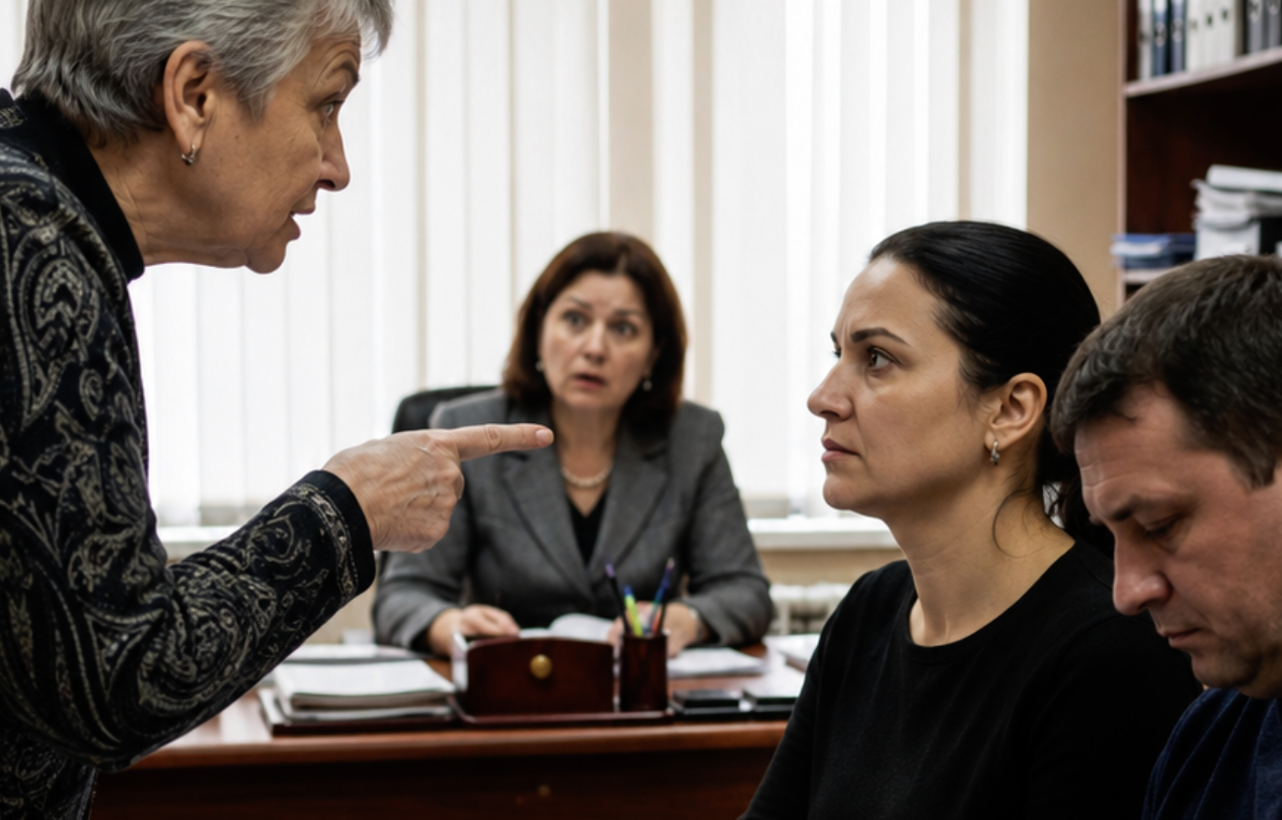
Behind a massive desk sat a stern, well-groomed middle-aged woman. She gave our colorful trio a sharp, professional look.
Without waiting to be invited, Nadezhda Ivanovna dropped herself into the most comfortable chair and placed her large handbag on the desk as though she owned the place.
Oleg perched on the edge of the chair beside her, his entire posture radiating extreme discomfort.
I remained standing near the door, clutching a folder containing my documents.
“I’m listening,” the notary said evenly. “What can I help you with?”
“We’re here to draw up a gift deed!” my mother-in-law announced triumphantly, as though she were speaking at a military parade. “Here is my daughter-in-law”—she casually nodded toward me—“and she wants to give her share of the apartment to my son. And I, as his loving mother, will pay off the rest of their mortgage in return. Two million rubles. Cash!”
She said “two million” with such pomp that you might have thought she was about to save the entire world rather than buy her son’s loyalty at her daughter-in-law’s expense.
The notary frowned slightly and looked at me.
“Please, take a seat. Let’s clarify something. A gift agreement is a gratuitous transaction. It cannot be made ‘in exchange’ for paying off a loan. If you transfer your share in exchange for money, that is a sale. If you give it as a gift, you must do so voluntarily and without receiving anything in return. Do you genuinely wish to give your share to your husband free of charge?”
The office became so quiet that we could hear the computer processor humming beneath the notary’s desk.
Nadezhda Ivanovna turned toward me, boring into me with a triumphant stare.
She waited.
Oleg swallowed nervously and lowered his eyes.
I slowly sat down in the empty chair, placed my folder on my lap, unzipped it, and looked directly into my mother-in-law’s eyes.
“No,” I said clearly. “I am not giving anything to anyone.”
Nadezhda Ivanovna’s jaw dropped.
Literally.
She gasped for air like a fish thrown onto dry land.
“What do you mean, no?!” she shrieked, completely forgetting her manners. “What the hell are you doing, you nasty little bitch?! We agreed on everything at home! Oleg, say something to her!”
Oleg jerked in his chair, red blotches spreading across his face.
“Nika…” he stammered. “But we… Mom brought the money… You promised…”
“I promised to come to the notary,” I replied coldly. “And I came. Now both of you listen to me carefully.”
I turned toward the notary, who was watching us with the completely unruffled expression of someone who had witnessed far worse family dramas within those walls.
“I would like to propose that my husband and I sign a marital agreement,” I said, taking out several papers. “Our apartment is mortgaged. We bought it for seven million rubles. At the moment, the outstanding balance is two million.”
“Go on,” the notary said with a nod.
Nadezhda Ivanovna tried to interrupt, but I raised my voice, refusing to surrender the initiative.
“My dear mother-in-law believes that in exchange for her two million rubles, I should hand over the entire apartment to Oleg. But let’s do some interesting mathematics.”
I spread the bank statements I had prepared across the desk.
“Here are the documents. The three-million-ruble down payment came from the sale of my late grandmother’s apartment. That was my personal, premarital property, which I invested in our shared home. Here are the bank statements proving that the funds moved from one account to the other on the very same day.”
The notary briefly examined the documents and nodded approvingly.
My mother-in-law began turning purple.
“Next,” I continued. “Over five years, Oleg and I paid two million rubles of mortgage principal from our shared family budget. That means one million from each of us. So let’s count. My three million in premarital money, plus one million paid during the marriage. My actual contribution to this apartment is four million rubles. Oleg’s contribution so far is one million.”
“How dare you count it like that?!” Nadezhda Ivanovna shouted, jumping to her feet. “It’s a jointly owned apartment! By law, everything is divided fifty-fifty!”
“You are mistaken, ma’am,” the notary cut her off in an icy tone. “In the event of divorce, the court will consider the origin of the funds. Premarital assets are not divided. Your daughter-in-law is entirely correct in her calculations.”
Those words hit my mother-in-law like a bucket of ice water.
She collapsed back into her chair, breathing heavily.
I turned toward my husband.
Oleg was as white as chalk.
It seemed that only now was he beginning to understand the hole his mother had persuaded him to push me into—and the hole he himself had ended up standing in.
“So, Oleg,” I said quietly, each word falling like a stone. “Your mother wants to contribute two million? Wonderful. I have no objection. But we will do everything legally. We will sign a marital agreement and redistribute the shares in the apartment proportionally to our contributions.”
I pushed the sheet containing my calculations toward him.
“My contribution is four million. Your contribution, including your mother’s money, would be three million. So the apartment will not be divided fifty-fifty. It will be divided proportionally. I will own four-sevenths, and you will own three-sevenths. No gift deeds. Everything will be fair—legally and mathematically.”
Nadezhda Ivanovna’s face became blotchy.
The realization that her brilliant scheme to take my home away from me had spectacularly collapsed struck her with full force.
She had planned to use two million rubles to effectively acquire an apartment worth seven million while leaving me on the street.
Now she was facing reality: even after contributing her money, her son would still own less than half.
“You greedy little bitch!” she hissed, spitting as she spoke. “You calculating creature! I knew all you cared about was square footage! Oleg, we’re leaving! She won’t get a single kopeck from me! Let her pay her own mortgage! We’ll see how she changes her tune when you divorce her!”
My mother-in-law grabbed her son by the sleeve and tried to drag him out of his chair.
But Oleg did not move.
He stared at the sheet containing my calculations, his eyes wide with horror.
“And now we come to the most interesting part,” I said with a faint smile, taking one final document from the folder. “If we get divorced right now, just as you threatened me yesterday…”
I paused, allowing myself to enjoy the moment.
“I will file a claim for division of property that takes my premarital contribution into account. The court may order the mortgaged apartment sold. Probably below market value, as often happens. Let’s say for six million. The bank will take the two million that is still owed. I will reclaim my three-million-ruble down payment. The remaining one million will be divided equally between us.”
I leaned closer to my husband.
“Do you understand, Oleg? If we divorce because Mommy tells you to, you’ll walk away from this marriage with five hundred thousand rubles in your pocket. No apartment. No wife. Just your mother.”
Oleg flinched as though I had slapped him.
He slowly turned toward his mother.
“Mom…” His voice trembled. “Mom, she’s right. If we get divorced now, I’ll end up homeless…”
“She’s bluffing!” Nadezhda Ivanovna screamed, no longer even attempting to control herself.
Her previously respectable face twisted into a furious grimace.
“The court will give everything to you! You’re the man! You paid the mortgage!”
The notary slammed the folder on her desk shut.
“That is enough. This office is not a marketplace. Either you are going to arrange a marital agreement, or you are going to leave.”
Nadezhda Ivanovna gasped with indignation, grabbed her handbag, and rushed toward the door.
At the doorway, she turned around.
“Choose, Oleg!” she screamed so loudly that the glass in the cabinets rattled. “Either you stand up right now, come with me, and we file for divorce, or I never want to see you again! You no longer have a mother if you stay with that snake!”
She stormed into the hallway and slammed the door so hard that the calendar on the wall nearly fell.
The three of us remained in the office.
The ticking of the clock, which had irritated me so much at the beginning, now sounded almost soothing.
Oleg sat with his head in his hands.
His shoulders shook.
For the first time in his life, he was facing a real choice instead of one invented for him by his mother.
And the price of that choice was measured not only in money, but also in his own independence.
I looked at him and understood that this was not over yet.
The most difficult decision was still mine to make…
A heavy, suffocating silence settled over the office.
Only the computer tower beneath the notary’s desk hummed steadily while traffic moved outside the window.
Oleg remained seated with his head in his hands, his shoulders trembling slightly.
For the first time in his life, he was facing a real decision rather than one manufactured by his mother.
And the cost of that decision involved not only money but his own independence—his identity as an adult man.
“Young man,” the notary said, her voice unexpectedly gentle but firm. “Are you going to sign a marital agreement? The document can be prepared within half an hour.”
Oleg slowly raised his eyes toward me.
They were filled with fear, confusion, and an almost childish sense of grievance.
“Nika…” he croaked. “Why did you have to do this? Why did you pull out all those papers in front of Mom? You humiliated her. She genuinely wanted to help us…”
I looked at the man with whom I had spent five years, the man with whom I had planned to have children and grow old, and felt the final drop of love inside me burn away.
All that remained was a cold, ringing emptiness.
“When people give money out of the goodness of their hearts, Oleg, they don’t attach conditions,” I replied calmly. “Demanding that a wife surrender her security and risk ending up on the street isn’t help. It’s a transaction. A fraudulent one, at that. And the worst part isn’t that your mother came up with it. The worst part is that you agreed.”
Oleg nervously licked his lips, stood up, and backed toward the door.
“I need to think,” he muttered, avoiding my gaze. “I can’t make a decision like this… in the heat of the moment. Mom is out there alone. She has blood-pressure problems…”
He rushed out of the office without even saying goodbye.
I was left alone.
Or rather, alone with the notary.
The stern middle-aged woman removed her glasses, rubbed the bridge of her nose, and suddenly gave me a warm, very human smile.
“You did well, young lady,” she said. “You prepared yourself properly. Do you know how many ‘loving’ mothers-in-law and immature husbands I see in this office? Dozens of them. And many daughters-in-law actually sign those gift deeds. Out of fear, foolishness, or pressure. Then they’re left with nothing. Pay for the consultation at the cashier, and take my advice: don’t delay the divorce. There’s nothing worth saving there.”
I left the office on shaky legs but with a clear mind.
I drove home alone.
When I opened the door to our beautiful apartment—the home we had struggled so hard to obtain—I didn’t cry.
I took two large suitcases down from the storage shelf and began packing Oleg’s belongings.
He appeared late that evening.
He looked disheveled and smelled of cheap cognac.
When he saw the suitcases in the hallway, he theatrically clutched his chest.
“So that’s how it is?” he sneered. “You’re throwing me out of my own apartment? Mom was right. All you ever wanted was my square footage!”
“Your square footage, Oleg, amounts to exactly what you paid for,” I replied coldly. “And we will divide everything strictly according to the law. Take your things and leave. Go to your mother. That’s where you belong.”
The next six months became an exhausting legal marathon.
Nadezhda Ivanovna, still convinced of her own brilliance, hired some questionable lawyer and filed a counterclaim.
They demanded that the apartment be divided strictly in half, arguing that my three million rubles were “just a coincidence” and that money within a marriage was shared anyway.
But the law was on my side.
My lawyer, whom I had first consulted before that memorable visit to the notary, built an airtight case.
We presented the court with the entire paper trail: the contract for the sale of my grandmother’s apartment, the bank statement showing the money arriving in my account, and the payment order proving that the exact same amount had been transferred to the developer’s account that very same day.
According to Article 36 of the Family Code of the Russian Federation, property acquired by one spouse during marriage using personal funds that belonged to that spouse before marriage is considered that spouse’s personal property.
The judge, exhausted by Nadezhda Ivanovna’s hysterics in the courtroom—she screamed so loudly that she was reprimanded several times—eventually issued what I considered a fair ruling.
The court recognized my right to four-sevenths of the apartment.
Oleg received three-sevenths.
Naturally, we could no longer continue living together.
We had to put the apartment up for sale.
We sold it for seven and a half million rubles.
Two million went to the bank to pay off the remaining mortgage.
From the remaining five and a half million, I received my lawful four million—my three million initial investment plus half of what had been paid during the marriage.
Oleg received one and a half million.
When the money reached our accounts, Nadezhda Ivanovna bombarded my phone with calls and curses.
Her brilliant scheme had ended in complete failure.
She never gave her son the two million rubles from the sale of the country house.
She told him:
“When you buy your own place, then I’ll give it to you. Until then, I’ll keep it with me. It’ll be safer that way.”
So now Oleg lives with his mother in her cramped two-room apartment.
With only one and a half million rubles, he cannot afford a decent apartment without taking out another enormous mortgage, and with current interest rates, he is afraid to do that.
Besides, his mother won’t allow it.
What if he runs into another “predatory woman”?
And me?
I added some of my savings to my four million and bought a cozy, bright one-room apartment in a good neighborhood.
Yes, I have a small mortgage again, but the monthly payment is manageable.
And most importantly, this home belongs only to me.
My fortress.
This story taught me one of the most important rules in life.
Love, trust, and family are wonderful things.
But when your only home and large sums of money are involved, love must sometimes take second place to clear thinking and legal awareness.
Never give in to manipulation.
Never give away your property just to prove your “true feelings.”
Someone who genuinely loves you will never ask you to sacrifice your security.
And if they do—
it’s time to pack their suitcases.
Without regret.
And without looking back.