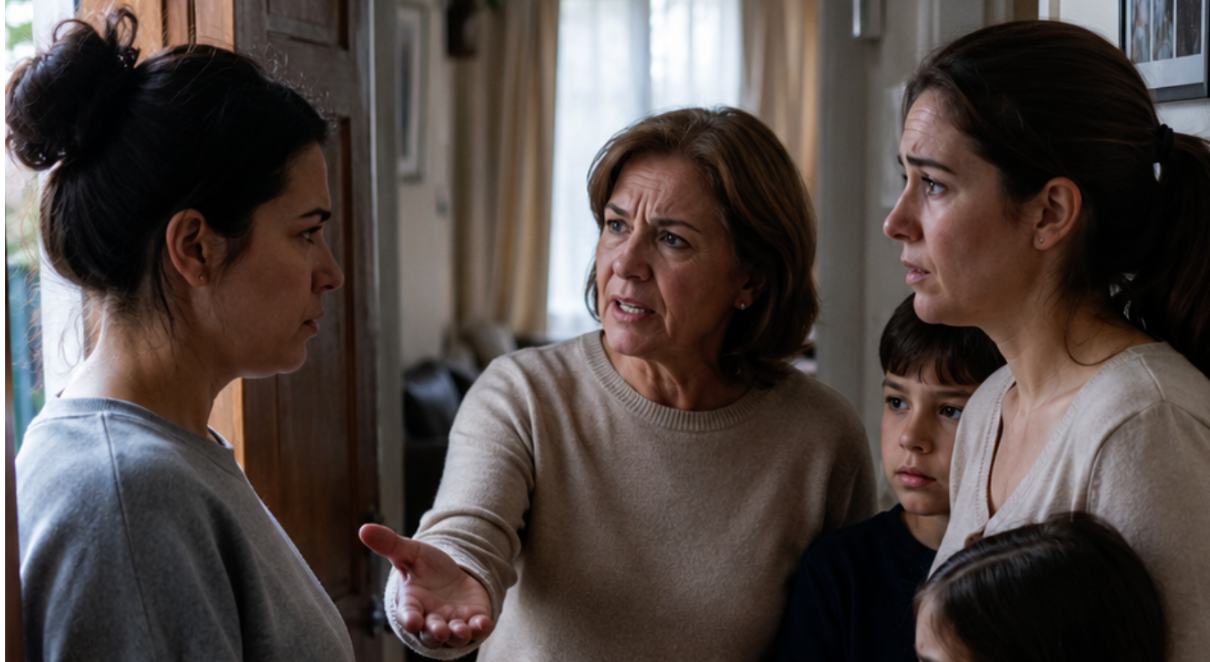
— You’re on your own. Give the house to your sister—she has it hard with the children, — Mother said. — Things are easier for you. Try to understand that already.
The balloons were blue and pink, along with one ridiculous green one that had stuck to the ceiling and refused to come down. Styosha was turning six, and she had announced the fact to every guest three times, just to make sure no one forgot. Veronika entered her sister’s apartment carrying a huge box tied with a ribbon and immediately found herself surrounded by children.
— Aunt Nika, is that for me?! — Styosha bounced so hard the floor seemed to shake.
— It’s for you. Just be careful—there’s an entire house inside, — Veronika said, crouching down. — A dollhouse. With a roof, windows, and even a tiny porch.
— And who’s going to live there?
— Whoever deserves it. Those are the rules, — Veronika winked. — Strict, but fair.
Myron immediately started pulling at the ribbon, while little Luka tried to chew on it, and the whole scene was noisy, warm, and wonderfully real. Milana brought out the cake. The candles flickered unevenly, and the children blew at them in different directions. Tamara Igorevna clapped her hands and kept repeating that her grandchildren were absolute treasures.
— Nika, you’re going to bankrupt us with your presents, — Milana laughed as she set out the plates. — Look at the size of that thing.
— Bankrupting you with one present is beyond my abilities, — Veronika replied. — I’m a modest woman with a single box.
— Exactly. It’s easy for you to be modest.
— Here we go, — Veronika raised an eyebrow. — Milan, it’s the child’s birthday. Could we at least make it through the candles before we start?
Milana smiled and went to cut the cake. Roman sat against the wall scrolling through something on his phone, reacting to the children’s shrieks as though they were distant thunder. Tamara Igorevna kept looking at her older daughter a little longer than usual.
Six months earlier they had buried Leonid Pavlovich, and this birthday was the first loud family celebration since then. Veronika welcomed the noise—it drowned out the silence that had lived inside her since winter. Styosha was already arranging tiny dollhouse furniture in the rooms.
— Aunt Nika, am I going to live in Grandpa’s real house?
The fork in Veronika’s hand froze for a second.
— Who told you that, sweetheart?
— Mom.
Milana called her out onto the balcony—“just two minutes, we need to talk.” She carefully closed the door behind them like someone who had been preparing this conversation for days.
— Nik, listen. We need to talk about the house.
— If we need to, then we need to, — Veronika leaned against the railing. — But I’m warning you: I’m in a good mood today, but it isn’t unlimited.
— You have to understand, — Milana began quickly. — We have three kids. Three, Nika! We’re renting a two-room apartment. Luka sleeps in his stroller because there’s nowhere to put a crib. And you and Gleb—it’s just the two of you. What do you need a house for?
— To live in it. Crazy idea, I know.
— Stop making jokes! You don’t need it. The roof needs work, the fence is falling over—it’s nothing but expenses. You’ll sell it and waste the money, while for us it could be a real chance. Just give up your half. I’m not saying give it away—just let us have it. We’ll sort things out later.
— “We’ll sort things out later” is the most expensive phrase in the Russian language, — Veronika said. — The only one more expensive is “I’ll pay you back.”
— Are you mocking me?
— I’m clarifying. You’re asking me to give you half of Dad’s house, but you’re wrapping it up in the phrase “let us have it.” Nice packaging. Unfortunately, packaging doesn’t change what’s inside.
Milana jerked her shoulder, her voice beginning to rise.
— I’m drowning in everyday problems, I have three children on my hands, and you’re talking to me about packaging! Do you have any idea what it’s like to have three children?
— No, I don’t, — Veronika replied calmly. — But I know perfectly well what it’s like to spend six months driving someone from hospital to hospital and sleeping on a sagging sofa.
— You’re bringing that up again!
— This is the second time I’ve mentioned it in six months. You’ve mentioned your three children twice in ten minutes. We both know how to count.
Milana gripped the railing.
— Dad would have wanted his grandchildren to live in his house!
— Dad wanted someone besides me to dial his phone number once in a while, — Veronika said. — He waited for calls, Milan. Ordinary calls. Not calls from a notary.
Behind the glass, the children were pushing the dollhouse across the floor. Milana stayed silent for about five seconds, then said evenly, without shouting:
— You’re just mean. You always have been.
— I’m fair, — Veronika replied. — Fairness often looks like cruelty when people aren’t used to it.
At home, Gleb listened to the whole story without interrupting. Only once did he clench his jaw.
— So, “just let her have it,” — he repeated. — And our one-bedroom apartment, which we’ve been paying the bank for twelve years, is apparently a palace in her eyes?
— In her version of reality, our life is easy and luxurious, — Veronika shrugged. — We walk on parquet floors and eat with silverware.
— She should come see our silverware. The spoons practically rattle from poverty.
— She came to see Dad twice in a year. She’s never been to our place. We’re not on her route.
— And you didn’t really tell her anything? — Gleb looked at her closely.
— I did. But gently. You know how it happens—you say “no,” but somehow it sounds like “let me think about it.”
— Nika, — he took her hand, — you don’t have to make yourself convenient for everyone.
— I know. I’ve just spent too long being polite, and in our family politeness is interpreted as agreement.
The phone stayed silent through the night, but at half past eight the next morning it rang. Tamara Igorevna skipped any greeting, as though she were simply continuing the conversation that had begun on the balcony the previous day.
— Veronika, you’re on your own. Give the house to your sister. She has it hard with the children. Things are easier for you. Try to understand that already.
— Good morning, — Veronika said. — Just saying it for form’s sake. Who knows, maybe it’ll actually turn out to be a good one.
— Stop clowning around. You’re the older sister. The older one should understand.
— Do you know what I’ve understood in thirty-six years? That “you’re the older one” has nothing to do with age. It means you’re the one who’s expected to give something up first.
— There you go again! — her mother’s voice sharpened. — Nothing was ever enough for you! Milana is struggling, and you’re sitting there counting square meters!
— I’m not counting square meters. I’m counting trips to the hospital. There were forty-one of them. Would you like me to give you the dates?
— What does that have to do with anything?!
— Everything. The house isn’t a prize you get for having lots of children. It belonged to a man whom I had to walk into the doctor’s office arm in arm because he was embarrassed to be pushed there in a wheelchair.
Her mother began breathing faster, as if searching for a bigger argument.
— Do you want your nieces and nephews to spend their childhood being dragged from one rented place to another?
— I want their parents to finally stop treating other people’s property as their emergency backup plan, — Veronika said. — That would actually be better for the children than any house.
— You’re heartless!
— Mom, — Veronika exhaled, — remember the pink bicycle.
— What bicycle?
— That bicycle. You bought one. For her. I was told, “You’re older, you can ride it later.” Later never came. There was also the doll I gave her “to play with” and never got back. And the coat that was supposedly “for me when I grew into it,” except by the time I did, it was already too small.
— Are you seriously going to throw old clothes in my face now?!
— I’m reminding you of the system, — Veronika replied. — The clothes are just illustrations. And you know the clearest one? I was fourteen and pushing a stroller around while everyone else my age was watching cartoons. I’m not complaining. I’m simply warning you: that method doesn’t work on me anymore.
She wasn’t the one who hung up first.
Zhanna was waiting for her at a corner table in a café, stirring mint lemonade.
— Tell me everything, — she ordered. — I can read it on your face. The relatives have mobilized.
— The relatives have launched a full offensive, — Veronika sat down. — They’re demanding half the house. Their argument is flawless: I don’t have children, therefore my life is easy.
— Excellent logic. By that standard, you don’t need food either. You’re not a hippopotamus.
— That’s approximately how it sounds.
Zhanna put down her glass.
— Nik, answer one question. When has Milana ever actually helped you? Not with words. With actions.
Veronika opened her mouth, then stopped. She went through the years in her mind like pages in a book and couldn’t find a single example.
— Never, — she finally said. — She visited. With a cake. And an apologetic smile. For half an hour.
— And you? You helped her find an apartment, babysat her children, brought medicine for your father.
— That’s different, — Veronika began, then stopped herself. — No. It isn’t different. That’s exactly the point.
Zhanna leaned forward.
— And there’s something else. You still haven’t told them?
— About what?
— About the three attempts. About the almost one million rubles. About the injections that made you sick, and how every single time you waited and hoped.
— No, — Veronika turned her glass in her hands. — Do you know why? Because I already know the answer. They’ll say, “Milana still has it harder.”
— Nik, that’s monstrous.
— It’s a family tradition. In our family, not having children is considered proof that you have an easy life. Don’t ask me who invented that rule.
— And you kept quiet.
— I was protecting people. Myself from their words, them from my truth. Turns out there was no point. They managed to hurt me anyway.
Zhanna was silent for a moment.
— What are you going to do?
— I’m going to the house, — Veronika said. — I want to see it with my own eyes. Everyone talks about it as though it’s a sack full of money, but I remember it as the place where Dad taught me how to hammer nails.
The house stood dusty and silent, as though waiting for someone to finally wake it. On the windowsill were apples shriveled to the size of walnuts—her father had picked them the previous autumn. The floorboard by the entrance creaked exactly as it had twenty years earlier.
Veronika walked through the rooms, running her palm along the corners. A gray sweater with stretched elbows hung in the wardrobe, the same one her father had worn while sitting on the porch. On a shelf she found a chipped mug with a half-faded inscription. She had given it to him during her first year at university—a silly mug with a cartoon cat.
On the veranda, in the bottom drawer, she found a squared notebook. In his neat handwriting, arranged in columns, were notes: roofing slate, timber, windows, wiring. Amounts, dates, figures crossed out and rewritten. At the bottom of the page was a note:
“Roof—in spring, if there’s enough.”
He had been saving.
He had been planning.
He hadn’t had enough time.
Veronika walked into the yard. In one corner stood an apple tree—the one she and her father had planted together when she was twelve.
He had told her then:
“A tree, Nikush, is like a promise. If you plant it, it means you’ll come back twenty years later to see how it’s doing.”
— I came back, — she said aloud. — Just like we agreed.
On Sunday, Tamara Igorevna walked into the yard without warning, carrying a handbag as though she had simply happened to be passing by. She surveyed the property like an owner and touched the porch railing.
— I knew you’d holed yourself up here.
— Hello. Come in. We don’t get many visitors, — Veronika put down the cloth she had been cleaning with. — Actually, we don’t get any.
— Stop being sarcastic. I came to talk.
— I guessed you weren’t here to pick apples.
Her mother set her bag on the step.
— Milana cries at night. Roman is sitting around unemployed again. They have no money, and their landlady has raised the rent. And you’re here cleaning windows. What do you have to worry about? Life is easier for daughters without families.
Veronika slowly straightened.
— Say that again.
— Say what? The truth? Your life is easier. You’re alone. No diapers, no sleepless nights.
— All right, — Veronika said evenly. — Then listen to me tell you about my sleepless nights. Three attempts. Three. Almost a million rubles that Gleb and I scraped together. Injections every day. Hormones that made me shake. And three times—nothing.
Tamara Igorevna froze.
— You… you never told me.
— Why would I? — Veronika stepped closer. — I knew what I would hear. That Milana had it harder. That she had three children while I had “nothing but nerves.” I was protecting all of you from a conversation that would make you uncomfortable. I would still be protecting you if you hadn’t come here to explain to me how easy my life is.
— But I didn’t know…
— Because you never asked, — Veronika cut her off. — Not once in four years. But you never forgot to ask when I was taking Dad for his next scan. Me, Mom. Not her. Not you. Forty-one trips. Thirty-eight nights on that sofa. Pharmacies, IV drips, bedpans, sheets. Where was Milana and her difficult life during all of that? And where were you?
— She has children!
— She has children. And Dad had one daughter, — Veronika didn’t raise her voice even slightly. — That isn’t an accusation. It’s simply a fact that all of you would now like to rewrite because square meters are involved.
Her mother tightened her grip on the strap of her handbag.
— You’ve become hard.
— I’ve become precise. Those aren’t the same thing, although they can look similar from the outside.
— So you won’t give it up?
— No.
— Do you understand that your sister will never forgive you?
— I do, — Veronika nodded. — In our family, forgiveness is only handed out to people who give things away. I’m not getting in that line.
Tamara Igorevna picked up her bag and headed toward the gate. At the gate, she turned around.
— Your father wouldn’t approve of you.
— Dad, — Veronika said, — kept a notebook full of calculations for repairing the roof. Want me to show you? It’s all in his handwriting. He was planning to live here. Not divide it up.
The gate slammed shut.
The yard became quiet again.
But this wasn’t emptiness. It was like a room that had finally been cleared of someone else’s furniture.
Veronika went to the notary on Tuesday. She formally registered her half, obtained an appraisal, and called her sister.
— Milan, I’m offering to buy your share. At market value. I’m not underpricing it by a single ruble.
— Are you serious? — her sister’s voice broke immediately. — You want money from me? From your own sister?!
— I want to buy property at the price that property is worth. Shocking arrogance, I know.
— You’re selfish! You’ve always thought only about yourself! I have three children, and you!…
— You’re repeating yourself, — Veronika said. — So I’ll give you a new answer. You had six months to come and see Dad. You came twice. With cake. The cake was good, I’ll give you that. But nobody hands out houses in exchange for cake.
— How can you even say something like that?!
— Easily. My tongue has had twenty years of silence to train for this.
— You’ll regret this, do you hear me?! You’ll be left without a family!
— I’ll still have a family, — Veronika replied calmly. — The part of it that doesn’t treat me like a warehouse full of spare resources.
The call disconnected.
Her mother stopped calling that same day. The phone fell silent, and the quiet Veronika had feared all her life turned out to be nothing more than a chance to breathe.
A month later, she and Gleb sat down to calculate everything. They calculated for a long time, soberly and carefully, with a calculator and lists.
— Look, — Gleb ran his pen down the sheet of paper. — If we sell the apartment, we can pay off the bank completely. Completely. Twelve years of payments, and then it’s over.
— And we’re left with a house that needs repairs, — Veronika pointed out.
— We’re left with a house that has a porch, an apple tree, and enough room to breathe. We’ll redo the roof according to your father’s calculations. He already worked everything out for us.
— And my sister?
— Your sister, — Gleb looked at her, — will receive exactly what her share is worth. We’ll buy out her half. And that will be the end of it.
The transaction went through without shouting. Everything was handled through the notary, and the money was transferred to the account.
Milana came to sign the documents without looking at her sister and said only one thing:
— You sold us out.
— I bought you out, — Veronika corrected her. — Different verbs. And by the way, I paid market value, not a discounted price based on family pity. That’s called respect.
The money disappeared within six months.
No one really understood how. First there was a car for Roman, then a vacation, then some kind of investments that he described with great confidence and very little clarity.
By winter, Milana was once again searching for a cheaper apartment, while Tamara Igorevna called acquaintances and complained that her older daughter had “abandoned everyone.”
Veronika didn’t gloat.
She had simply stopped allowing herself to be everyone’s backup plan, and for the first time in her life, there seemed to be room around her.
Spring arrived early and brazen, bringing mud and a brilliant blue sky. Veronika and Gleb came to the house on Saturday, threw open every window, and carried boxes of old junk outside.
— Nika, look! — Gleb was holding a ring of keys. — Every key has a label. Your father labeled everything.
— That was him, — Veronika smiled. — He liked order more than conversation.
Aunt Raya appeared over the fence carrying a bucket.
— Oh, Veronichka! So you’ve finally come! Thank God. The poor house has been standing here all alone, missing everyone.
— We’re here for good, Aunt Raya.
— For good is good, — the neighbor set down her bucket. — You know, Lenya spent that entire last year waiting for you. He’d come out onto the porch and sit there listening for a car. I’d say, “Lenya, why are you sitting out here in the cold?” And he’d say, “Nikusha is coming.”
Veronika lowered her hands.
— He really said that?
— Exactly that. And whenever you arrived, he lit up. Became a different person. He’d even straighten his back. Then you’d leave and he’d become quiet again. I don’t know how many times he told me, “I’ve only got one person I can rely on, Aunt Raya. Just one.”
— And Milana?
— The younger one? — the neighbor looked away. — Don’t be angry. He saw everything himself. Once he said, “She comes, sits for twenty minutes, and spends the whole time looking at the clock.” After that, he never mentioned it again.
That evening, Veronika carried the old armchair out onto the veranda and sat down.
She put on her father’s gray sweater. The sleeves were too long, just as they had been when she was a child and secretly wore it around the house. In her hands she held the chipped mug with the cartoon cat.
Gleb brought out a blanket, spread it over her knees, and sat beside her on the step.
— Any regrets? — he asked.
— About what?
— About them.
Veronika thought for a moment.
— Only one. For twenty years I believed that if I made myself convenient enough, people would love me. But people don’t love you because you’re convenient. They either love you simply because they do—or they don’t love you at all.
— Wise.
— Expensive, — she said with a faint smile. — I paid for every word.
He nodded toward the corner of the property.
— Look. Your apple tree has buds.
— Ours, — Veronika corrected him. — Dad and I planted it together. He held it upright while I filled in the soil. Back then, twenty years seemed like forever to him.
— We made it.
— We did, — she ran her finger along the chipped rim of the mug. — You know what the most honest thing in the world is? A tree. You can’t lie to it and say you took care of it. If you didn’t, it simply won’t blossom. That’s all.
Gleb rested his head against her knee.
Beyond the fence, Aunt Raya’s bucket rattled somewhere in the distance, while fresh air moved freely through the house with every window standing wide open.
It was the first spring without her father—and the first spring in his house, where there was now only one surname on all the ownership papers.
Veronika raised the mug as though making a toast.
— To those who don’t mistake someone else’s property for their own. And to those who learn to say “no” in time.