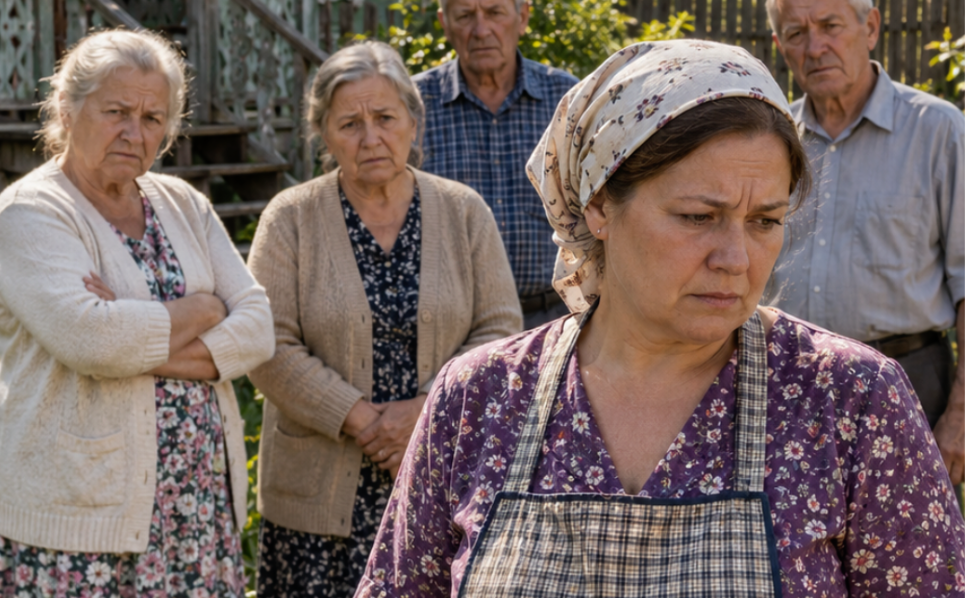
Galina Petrovna heard the familiar sound of car doors slamming and involuntarily tensed. Friday, half past six in the evening. Right on schedule. She did not even bother going to the window—she already knew what she would see: Nikolai’s blue Renault Logan, with his entire family climbing out of it, followed by Svetlana’s battered Lada carrying her whole brood. Another weekend at the country house was beginning.
“Aunt Galya!” her niece’s cheerful voice rang out from the yard. “We’re here!”
Galina Petrovna put down her book and slowly rose from the armchair. Only an hour earlier, she had made herself comfortable on the veranda with a detective novel and poured herself a cup of tea. It had promised to be a perfectly peaceful evening for a fifty-eight-year-old woman living alone. Now she would have to pretend to be delighted by the unexpected visit—although “unexpected” was only technically the right word.
“Hello, Galya!” Nikolai was the first to burst into the house, without taking off his shoes. His wife Marina and their two children followed behind him. “How are you? How’s your health?”
“Fine,” Galina Petrovna replied curtly, watching ten-year-old Maksim already inspecting the contents of the refrigerator. “Are you staying long?”
“Until Sunday, as usual. The weather’s nice, and the children have missed the country house. Besides, it’s more fun for you when we’re here, isn’t it?”
More fun. Galina Petrovna nodded and went to put the kettle on. A minute later, Svetlana entered the house with her husband, Sergei, and their three children. The house was instantly filled with voices, pounding footsteps, and the sound of furniture being moved.
“Aunt Galya, do you have anything we could eat?” Marina asked, settling herself in the kitchen. “We’re hungry after the drive.”
“Let’s see.” Galina Petrovna opened the refrigerator and examined its contents. There was the chicken she had been defrosting for tomorrow’s lunch, a little sausage, some eggs, and vegetables for a salad. More than enough for one person, but clearly not enough for eight.
“Do you have any bread?” Sergei asked.
“Half a loaf.”
“Mom, I’m hungry too!” whined seven-year-old Anya, Svetlana’s daughter.
“In a moment, sweetheart. Aunt Galya will feed us.”
Galina Petrovna felt the familiar tension gathering in her shoulders. Aunt Galya would feed them. Naturally. Who else would?
“I’ll go to the store,” she said, taking off her apron. “We need more groceries.”
“Would you like me to come with you?” Svetlana offered without much enthusiasm.
“No, there’s no need. I’ll be quick.”
The local store was a twenty-minute walk away. As Galina Petrovna trudged along the dirt road, she calculated the coming expenses in her head. Bread, milk, sausages for the children, something for breakfast, fruit. At least fifteen hundred rubles. And that would cover only tonight and tomorrow morning.
At the store, she ran into her neighbor, Anna Dmitrievna.
“Galya, have your relatives come again?” the woman asked knowingly as she looked at the full shopping cart.
“They have,” Galina Petrovna replied briefly.
“Every weekend, as if it were their job. You’d think they could bring something with them at least once.”
“Oh, come on. They’re family.”
“Family, family…” Anna Dmitrievna shook her head. “I have relatives too, but at least they ask whether I need any help.”
On the way home, Galina Petrovna thought about her neighbor’s words. It was true: during all these months—and it had started back in May—not one of her guests had ever asked whether she needed help paying for the groceries. They arrived as though it were their own home, where food simply appeared in the refrigerator by itself.
The usual scene awaited her when she returned. The children were running around the property, the men were smoking on the veranda, and the women were sitting in the kitchen drinking tea.
“Galya, you were gone for quite a while,” Marina remarked. “We were beginning to worry.”
“There was a line at the store,” Galina Petrovna lied as she began unpacking the bags.
“Oh, sausages!” Svetlana exclaimed happily. “Just what the children need.”
“And you bought fruit too. Good. Maksim was asking for apples the entire way here.”
Galina Petrovna remained silent as she sliced the bread. If he had been asking for apples, they could have bought some on the way.
The evening followed its usual pattern. The children made noise, demanded attention, and played games inside the house. The adults drank tea and discussed the news. Galina Petrovna cooked, set the table, and cleared away the dishes. By ten o’clock, she was dead on her feet.
“Galya, where are we supposed to sleep?” Svetlana asked.
“There’s a sofa in the living room and a folding bed on the veranda. The same as usual.”
“And the children?”
“The sleeping bags are in the closet. Arrange yourselves however you like.”
Galina Petrovna went into her bedroom and locked the door. Through the thin walls, she could hear voices, children’s laughter, and the creaking of the floorboards. She did not fall asleep until midnight.
At half past six the next morning, she was awakened by the children. They had woken up early and were demanding breakfast.
“Aunt Galya,” Marina said, knocking softly on the door. “I’m sorry to wake you. Maksim got up and woke everyone else.”
“I’m coming,” Galina Petrovna groaned.
Breakfast, lunch, an afternoon snack. An endless succession of “What do we have to eat?” and “The children could use something sweet.” By Saturday evening, the refrigerator was empty, and Galina Petrovna had to go to the store again.
“Maybe I could go?” Nikolai offered, though he did not sound very certain.
“No, it’s all right. I know what we need.”
“Would you like me to give you some money?”
“No need,” Galina Petrovna said dismissively, even though there was very little left in her wallet.
Sunday proved especially difficult. The children were cranky, while the adults discussed their plans for the following weekend.
“Maybe we should come earlier next Friday,” Svetlana mused. “We could sneak away from work around four.”
“Great idea,” Sergei agreed. “We’d have more time to relax.”
“Perhaps we could come during the week sometimes too,” Marina added. “The children are at home all summer anyway.”
Galina Petrovna said nothing as she stirred the soup. So they would come during the week as well. Wonderful.
“Aunt Galya, what are we having for dinner?” Maksim asked.
“Soup.”
“What else?”
“Nothing else. We’ve run out of food.”
“What do you mean, you’ve run out?” Marina asked in surprise. “You went to the store yesterday.”
“We’ve run out,” Galina Petrovna repeated.
“Then we’ll go again. The children need something to eat.”
“Go yourselves.”
A silence fell over the kitchen. Galina Petrovna continued stirring the soup, feeling their astonished eyes on her.
“What do you mean, ourselves?” Svetlana asked.
“Exactly what I said. The store is open, and you know the way.”
“But we don’t know what to buy…”
“Buy whatever you eat. Milk and bread for the children, and something for dinner.”
“Galya, you’re acting a little…” Nikolai began.
“A little what?”
“I don’t know. Strange. You always used to go yourself.”
“I used to be a fool,” Galina Petrovna said calmly.
The silence became even more strained. The children stopped playing and began listening to the adults’ conversation.
“Aunt Galya, are you angry?” Anya asked timidly.
“No, sweetheart, I’m not angry. I’m simply tired.”
“Tired of what?” Sergei asked, confused. “We help you. We wash the dishes and clean up after ourselves.”
“You clean up?” Galina Petrovna turned toward him. “Seryozha, look around. There are dishes in the sink, towels on the floor, and crumbs all over the table. Is that what you call cleaning up?”
“Well… we’re guests. We relaxed a little.”
“Guests. Every weekend. For the third month in a row.”
“Mom, I’m hungry,” Svetlana’s youngest son whined.
“In a moment, Petya. Aunt Galya, what’s wrong with you? We’re not your enemies. We’re family.”
“Family,” Galina Petrovna repeated. “All right. Family. Tell me, Sveta, how much did you spend on groceries this weekend?”
“What do you mean? I… I don’t know. Why?”
“I know. Three thousand four hundred rubles. In two days. That’s an entire week’s worth of my pension.”
“But we didn’t ask you to…”
“You didn’t ask?” Galina Petrovna moved the pot aside. “‘Do you have anything to eat?’ ‘The children could use something sweet.’ ‘We’ve run out of bread.’ Weren’t those requests?”
“Well, we thought…” Marina began.
“What did you think? That I print money? That food appears in the refrigerator by itself?”
“Galya, there’s no need to talk like that,” Nikolai said, trying to calm her. “We didn’t know things were difficult for you. You should have told us.”
“I should have told you. Fine. I’m telling you now: it’s difficult for me. Every weekend, I spend half of my monthly budget on you. Every weekend, I cook from morning until night. Every weekend, I clean up after eight people. I’m fifty-eight years old, I’m a widow, and I want to relax at my country house—not run a boardinghouse.”
The children fell silent. The adults exchanged uneasy glances.
“Aunt Galya,” Svetlana said quietly, “we didn’t do it deliberately. We simply got used to it. We thought you enjoyed having us here.”
“Having you here?” Galina Petrovna gave a bitter laugh. “Sveta, have you ever invited me to your country house? Or even to your apartment in the city?”
“Well… our apartment is small…”
“And mine is large? This is a small house, in case you haven’t noticed. It’s practically one room, an entryway, and a veranda.”
“Aunt Galya, is there anything to eat?” Maksim asked, unable to hold back any longer.
That was when Galina Petrovna exploded.
“You came empty-handed, so drink water!” she shouted, turning toward the boy. “There’s the water, and there are the glasses! There’s nothing else!”
A deathly silence followed. Maksim backed toward his mother. The other children shrank into themselves.
“Galina Petrovna,” Marina said coldly. “What kind of tone is that? Why are you shouting at a child?”
“Because I can’t take it anymore!” Galina Petrovna sank onto a stool and covered her face with her hands. “Do you understand? I can’t do this anymore! Every Friday, I hear your cars arriving, and I get a migraine. Every Friday, I realize that my weekend is over before it has even begun. I plan to read, work in the garden, or simply sit with a cup of tea—but instead, I become a cook and a housekeeper.”
“But we’re not forcing you,” Sergei said, bewildered.
“You’re not forcing me? Then what would you call it? You arrive without asking whether it’s convenient. You settle in without asking whether there’s enough room. You eat without asking whether there’s any food. And when there isn’t, you look at me as though it’s my fault.”
“We thought you were happy to see us,” Svetlana muttered.
“Happy? I was happy the first time. The second time. Maybe even the third. But now I’m afraid of weekends. Do you understand? I dread them!”
Galina Petrovna stood and paced around the kitchen.
“Do you know what I do on Thursday evenings? I make a shopping list for the weekend. I calculate how much money I’ll need. I plan the menu. It’s as though I’m running a café instead of owning a country house.”
“Galya, we didn’t know…” Nikolai began.
“You didn’t know? Or you didn’t want to know? It was convenient for you not to know. You had a free country house, free food, and a free housekeeper. Why would you want anything to change?”
“But we’re family,” Svetlana repeated. “Relatives are supposed to help one another.”
“Supposed to?” Galina Petrovna looked at her. “Fine. Then help me. Here are the electricity, water, and gas bills. We’ll divide them among everyone. Here are the receipts from the store. We’ll divide those too. And here is the list of household chores. We’ll assign them to everyone.”
“That’s ridiculous,” Marina protested. “We’re guests!”
“Guests,” Galina Petrovna slowly repeated. “Every weekend. Two days at a time. For three months. You aren’t guests—you’re lodgers.”
“Mom, when are we going home?” Petya whispered.
“Exactly,” Galina Petrovna said. “When are you going home? And when are you going to stop coming here?”
“What?” Svetlana asked, unable to believe what she was hearing.
“I’m asking you not to come here anymore. Find yourselves another country house. Another free meal ticket. Another Aunt Galya.”
“Are you throwing us out?” Nikolai asked, stunned.
“I’m asking you to respect my wish to relax at my own country house. Alone.”
“But we’re relatives!” Marina exclaimed.
“Relatives who have taken advantage of my hospitality for three months without once wondering whether it was too much for me. Relatives who eat my food without thinking that I’m spending the last of my money on it. Relatives who have turned my country house into their own.”
“Galya,” Nikolai said quietly. “We truly didn’t think…”
“Exactly. You didn’t think. You didn’t think for three months. But I did. Every Friday, I wondered where I would find the money for groceries. Every Saturday, I wondered how I was going to feed eight people. Every Sunday, I wondered when you would finally leave.”
“We could…” Svetlana began.
“You could what? Bring sandwiches next time? Wash the dishes? Give me money for the groceries? It’s too late. I’m tired of being convenient. I’m tired of being the kind relative who is always happy to welcome guests.”
“But where are we supposed to go?” Marina asked in confusion.
“I don’t know. Rent a country house. Buy a piece of land. Visit other relatives. It isn’t my problem.”
“Aunt Galya,” Anya cried. “Does this mean we’ll never come here again?”
Galina Petrovna crouched in front of the girl.
“Anechka, if your mother and father call me and arrange a visit first, if they bring food for themselves and for you, and if they help around the house, then you can come. But not every weekend, and not for two days at a time.”
“That’s impossible,” Sergei grumbled. “Calling and asking permission every single time…”
“Impossible?” Galina Petrovna asked in surprise. “I thought it was called good manners.”
“Mom, let’s go home,” Maksim pleaded.
“Yes,” Galina Petrovna agreed. “Go home. Now. Don’t wait until the end of Sunday.”
They packed in deathly silence. The children said nothing, and the adults exchanged glances, but no one dared to speak. Galina Petrovna stood by the window, looking out at the garden.
“Galya,” Svetlana said, approaching her. “We honestly didn’t mean to…”
“I know. Just leave.”
“Perhaps we could talk calmly and find a compromise?”
“No. I’ve said everything I needed to say.”
Half an hour later, the cars drove away. Galina Petrovna was left alone in a house where everything still bore traces of her recent guests: crumpled sofa cushions, crumbs on the table, and a forgotten child’s toy lying in the corner.
She slowly walked through the house, opening the windows. Then she sat down in the armchair on the veranda, picked up her book, and tried to read. She could not—the lines blurred before her eyes.
But for the first time in three months, the house was quiet. Truly and completely quiet. And for the first time in three months, Galina Petrovna realized that tomorrow—Saturday—she would be able to wake up whenever she wanted. She could eat whatever she chose for breakfast. She could spend the day however she pleased.
She closed the book, leaned back in the armchair, and smiled for the first time in a long while.
The telephone rang that evening.
“Aunt Galya?” Svetlana’s voice sounded uncertain. “It’s me, Sveta.”
“I’m listening.”
“We’ve been thinking… Perhaps we really were wrong. Maybe we could make a fresh start?”
“Sveta, I’m tired. Very tired. I need some time.”
“How much time?”
“I don’t know. Maybe until autumn. Maybe until spring. Or perhaps forever.”
“But we’re family…”
“Family,” Galina Petrovna repeated. “Only I forgot that three months ago, when I stopped being your relative and became your domestic staff.”
“Aunt Galya…”
“That’s enough, Sveta. Let’s end this conversation. I need to rest.”
She hung up, turned off her phone, and went out into the garden. The summer evening was warm and peaceful. Grasshoppers chirped somewhere nearby, and the air smelled of jasmine and freshly cut grass. Galina Petrovna sat on the bench beneath the apple tree and, for the first time in a long while, felt that the country house belonged to her again.