The key turned in the lock with a soft click that seemed far too loud to Sonya in the morning silence of the apartment building. She pushed the door open, stepped into the entryway, and froze. Her husband’s shoes were standing on the mat. Beside them, tossed down somewhat carelessly, was a pair of women’s suede ankle boots. Sonya knew those boots. Just the week before, she had helped Rita choose them at the shopping mall.
A quiet conversation drifted in from the kitchen. Their voices sounded calm and comfortably domestic.
“Pasha, who cuts cheese like that?” Rita’s voice said. “You know I like thin slices.”
“It’s more filling this way,” Pavel replied. A chair creaked. “Do you want me to warm up your coffee?”
Sonya slowly removed the bag from her shoulder and placed it on the cabinet. She had forgotten her work laptop. She had left home an hour earlier, driven to the office, realized that she had left the laptop bag on the living-room sofa, and returned. Pavel had left half an hour before she did. He had said he had an important meeting with senior management and had put on a freshly ironed shirt.
She did not take off her coat. She walked down the hallway and stopped in the kitchen doorway.
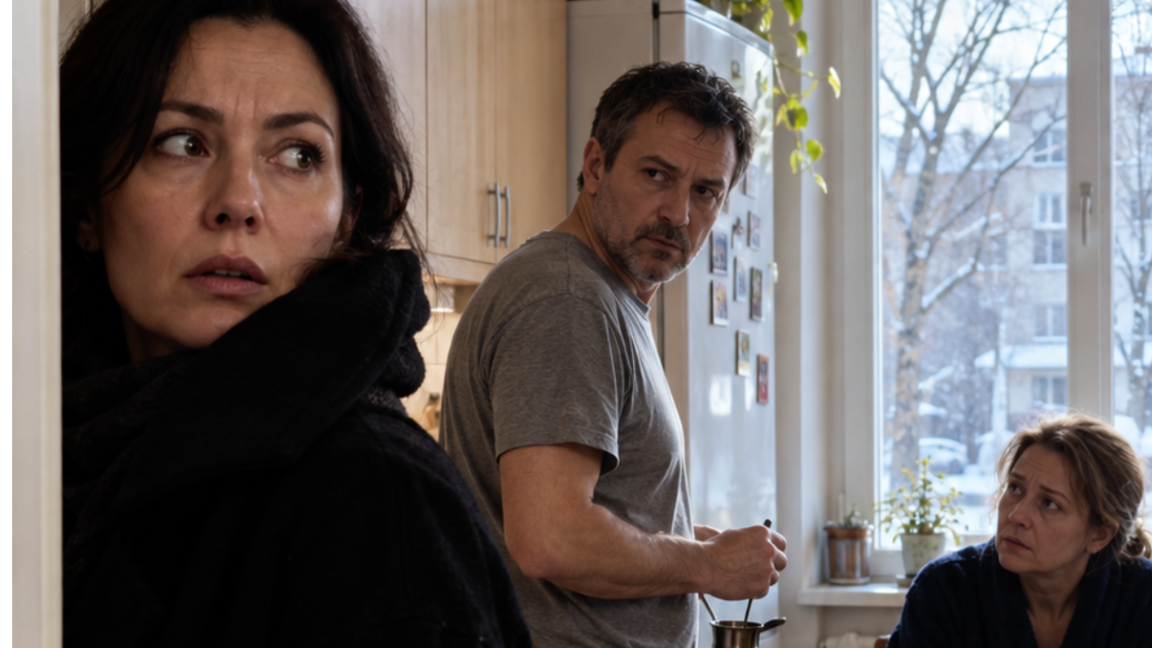
Rita was sitting at the table in Sonya’s housecoat—the very same dark-blue one Pavel had given her for International Women’s Day. She held a mug in both hands and stared out the window. Pavel stood by the stove, stirring something in a cezve. He was wearing sweatpants and a T-shirt.
Pavel was the first to turn around. The hand holding the spoon froze above the stove. Neither fear nor shame appeared on his face. There was only mild irritation, as though Sonya had walked into the room during an interesting part of a movie.
“Why did you come back?” he asked, carefully placing the spoon on a saucer.
Rita flinched, turned her head, and blinked rapidly. Then she slowly placed her mug on the table.
“Sonya,” she said, her voice slightly higher than usual. “We were just… A pipe burst at my place this morning. There’s no water, and I’m waiting for the repairman. Pasha was driving past and decided to stop by and help. I was freezing after dealing with the pipes.”
Sonya looked at Rita’s feet in their fluffy socks. At the plate of sliced cheese. At the cezve, where the coffee foam was slowly rising. Rita lived on the other side of the district. Pavel could not possibly have been passing her house on his way to work. And he was wearing clothes he only wore at home.
“I forgot my laptop,” Sonya said.
She walked past them into the living room and picked up the black case from the sofa. The apartment was silent except for the low hum of the refrigerator. Sonya returned to the entryway.
“Sonya, don’t start imagining things,” Pavel called after her as she reached the door. He came into the hallway with his hands tucked into the pockets of his sweatpants. “I know how you like to jump to conclusions without any reason. Rita needed help. We’re adults.”
“I’m not imagining anything.” Sonya looked at his hands in his pockets. “Just lock the door behind me. Properly—turn the key twice.”
She walked down the stairs without calling the elevator. She got into her car and started the engine. The dashboard clock read 9:42. An ordinary Tuesday.
The drive to the office took forty minutes. Sonya drove steadily, stopping at red lights and allowing pedestrians to cross. Her mind was empty. She thought about needing to stop at the gas station and about the frost that had been forecast for that evening.
At work, she turned on her laptop and opened her email. She immersed herself in her routine tasks, preparing spreadsheets and answering calls from suppliers. It was only around three in the afternoon, when her colleagues went outside for a smoke, that she leaned back in her office chair and looked out the window.
Twenty-two years of marriage. Eighteen years of friendship with Rita.
Rita was the godmother of their son, Denis. When Denis moved to another city to study, Rita began visiting more frequently. She said Sonya needed distractions from her empty-nest syndrome. They went to the theater together and drank wine on Fridays. Rita often complained about her loneliness and the absence of a strong man to rely on. Sonya felt sorry for her and always invited her to family celebrations.
“Pasha, help Rita with her car.”
“Pasha, take a look at what’s wrong with Rita’s electrical outlets.”
Pavel always helped. Sometimes he grumbled for appearances’ sake, but he always went.
Sonya opened the banking app on her phone. She and Pavel had a joint account into which they had been putting money for the past five years. They wanted either to buy a small country house or simply to have a financial cushion for retirement. Sonya rarely checked the balance. Pavel handled their major expenses.
She scrolled through the transaction history for the previous six months. Large cash withdrawals. One hundred thousand. Then another fifty thousand. Then two hundred thousand. There were no notes explaining any of them.
A month earlier, Rita had completely renovated her kitchen. She had boasted about the expensive cabinets and Italian tiles. She claimed that she had taken out a loan and that the bank had offered her favorable terms.
Sonya stared at the numbers on her phone. The withdrawal of two hundred thousand coincided with the day Rita had told her about buying new kitchen appliances.
Her chest tightened—not because of the money itself, but because she suddenly understood how smoothly and for how long the two of them had been playing their game. They were not merely sleeping together. They were building a life for themselves at her expense—using her time, her trust, and her money.
That evening, Sonya stopped at the supermarket. She bought milk, bread, and chicken fillets. She walked between the aisles, choosing her groceries as carefully as she always did.
The apartment smelled of fried meat. Pavel was standing at the stove. He was still wearing the same sweatpants. When he heard Sonya taking off her shoes, he looked out into the hallway.
“Oh, you’re home. I made dinner. Are you tired?”
He spoke with exaggerated cheerfulness. It was the tone he always used when he forgot to collect the car from the repair shop or spent more money than they had agreed upon.
Sonya entered the kitchen and placed the bag of groceries on the table.
“Where’s Rita?” she asked.
“She left, obviously. Her water came back on around lunchtime. Come on, Sonya, sit down and eat. Let’s not have one of your silent scenes. Nothing happened.”
He placed meat on their plates, set one in front of her, and sat opposite her.
“Pasha.” Sonya looked at his hands—the same hands that had poured coffee for another woman in her home that morning. “How much money did you give her for the renovation?”
Pavel stopped chewing. Slowly, he placed his fork on the edge of the plate.
“What does Rita’s renovation have to do with anything?”
“About four hundred thousand has been withdrawn from our joint account over the past six months. You didn’t buy any car parts or appliances. We haven’t traveled anywhere.”
He leaned back in his chair. His expression became hard and defensive.
“I lent it to her. She was having a difficult time. You’re always saying we should help the people close to us. I was going to tell you when she started paying it back. I didn’t want you worrying unnecessarily. You make a fuss over every penny.”
“Was she warm enough in my housecoat?”
Pavel exhaled loudly and rubbed the bridge of his nose.
“Sonya, stop it. You’re making a mountain out of a molehill. Yes, Rita came over. Yes, she put on your housecoat because her clothes got dirty while she was dealing with the pipes at home. We were only talking. You’re always at work, always buried in your spreadsheets. Sometimes I just want a little human companionship.”
“On Tuesday mornings? When you’re supposed to be in a meeting?”
He said nothing. He picked up his fork and began eating again.
“You know what your problem is?” he said with his mouth full. “You don’t know how to be flexible. You see everything in black and white. Rita and I are friends. Yes, perhaps we’re a little closer than you would like. But I’m not destroying our family. I’m here with you. The apartment is clean, and dinner is ready. What else do you need? Go ahead—make a scene and file for divorce. Who will benefit from that? You’ll be fifty soon. You’ll end up alone in an empty apartment.”
Sonya listened to his calm, confident voice. He sincerely believed what he was saying. He thought he was doing her a favor by remaining there. He believed that his physical presence somehow compensated for the lies, the stolen money, and the betrayal committed inside their own home.
Sonya’s phone, lying on the table, vibrated briefly. It was a message from Rita.
“Sonya, I’m beside myself. Please, let’s meet and talk. You misunderstood everything. Pasha is only helping me because he’s such a kind man. Please don’t destroy your family over something so trivial. You two are the perfect couple.”
Sonya read the message and looked at her husband.
“Get up,” she said.
“What?” Pavel frowned.
“Get up from the table and go pack your things.”
“Sonya, have you lost your mind?” He raised his voice but did not move. “What things? This is my apartment too. We bought it together.”
“You own a share of it. I’m not disputing that. We’ll settle everything through the courts and our lawyers. But you won’t spend another night here. Go to Rita. She has a wonderful new kitchen now, so you’ll have somewhere to drink your coffee in the mornings.”
Pavel smirked. There was so much condescension in that smirk that Sonya felt nausea rising in her throat.
“You’re going to calm down,” he said as he stood. “I’ll sleep in the living room. We’ll talk tomorrow, after this hysterical fit of yours has passed.”
He left the kitchen. Sonya remained seated at the table. She did not cry. She stared at the meat cooling on her plate. Then she stood, picked up the trash bag, and dumped the food into it. She washed the plate.
She went into the bedroom and took Pavel’s large sports bag from the top shelf of the wardrobe. She opened it and began packing his clothes—shirts, jeans, underwear, and socks. She worked mechanically, as though she were preparing him for a long business trip.
Pavel appeared in the bedroom doorway as she was placing his shaving supplies into a toiletry bag. Red blotches covered his face.
“What are you doing?” He stepped toward her and tried to snatch the bag away. “Have you completely lost your mind? I’m not going anywhere!”
Sonya released the handles of the bag and straightened up.
“Pasha, if you don’t leave voluntarily right now, I’ll call Denis and tell him everything. I’ll tell him about Rita. I’ll tell him how you paid for her renovation with the money we were saving for the down payment on his first apartment. I’ll show him the bank statements.”
Pavel froze. Denis was his pride and joy—the son before whom he had always presented himself as the perfect, infallible father and successful head of the family. Losing his son’s respect frightened him more than losing Sonya.
“You won’t do that,” he hissed through clenched teeth. “You won’t drag the child into this.”
“He’s twenty-one. He’s an adult. I’ll call him right now.”
She picked up her phone from the bedside table and unlocked the screen.
Pavel stared at her for a long time. The condescension had disappeared from his eyes. In its place was anger—the petty, cowardly anger of a man who had been caught red-handed and deprived of every opportunity to make excuses.
Without saying a word, he bent down and zipped up the bag. Then he slung it over his shoulder.
“You’ll regret this,” he said at the door. “Who would want you with a personality like that? You’ll come crawling back to me.”
Sonya did not reply. She stood in the hallway until she heard the lock click. Then she approached the door, turned the key twice, and fastened the security chain.
The apartment became very quiet. Sonya went into the kitchen and poured herself a glass of water. She drank it in small sips. A heavy, leaden exhaustion washed over her. But along with the exhaustion came a strange feeling she had almost forgotten—the feeling of breathing clean air.
A month passed.
Autumn had fully taken hold. The trees outside stood bare, and every morning a thin crust of ice formed over the puddles.
Sonya drank her morning coffee alone. She had grown accustomed to the silence. It turned out that without Pavel, there was far less irritation in the apartment. No one left crumbs on the table, criticized the programs she watched, or sighed heavily whenever she stayed late at work.
She spoke to Denis the day after her husband left. She told him the truth, without unnecessary details or emotion.
“Your father and I are getting divorced. He’s living with Aunt Rita now. This is a decision we made as adults.”
Denis was silent on the phone for a moment before answering briefly, “I understand, Mom. Call me if you need any help.”
He did not stop communicating with his father, but he kept his distance.
The division of their property proceeded slowly but methodically. Sonya’s lawyer turned out to be meticulous and levelheaded. He quickly found a way to prove that the money from the joint account had been spent without the wife’s consent, and the amount was now being considered in the division of the apartment. Pavel was furious. He called in the evenings, first trying to appeal to her sympathy and then resorting to threats. Sonya simply ended the calls.
One November evening, as she was returning from work, Sonya encountered Irina—an acquaintance she and Rita had in common—outside the entrance to the building. Irina hesitated and avoided looking her in the eye, but curiosity eventually got the better of her.
“Hi, Sonya. Listen, I saw Rita the other day.”
Sonya adjusted the collar of her coat.
“How is she?”
“She looks completely worn out and keeps complaining.” Irina lowered her voice even though no one else was in the courtyard. “She says Pasha turned out to be a completely different person when she had to live with him every day. His blood pressure keeps fluctuating, he forgets to take his pills, and he demands a three-course lunch—the way you trained him to expect. But she isn’t used to spending that much time standing over the stove. He’s giving her less money now too. Apparently, he says he’s spending so much on lawyers. They argue constantly. Rita practically cried to me, asking why she had ever gotten involved in this when everything had been perfectly fine before.”
Irina fell silent, waiting for a reaction. She expected Sonya to gloat or ask for more details.
Sonya looked up at the dark windows of her apartment.
“These things happen,” she said calmly. “But those are their problems now, Irina. Have a good evening.”
She nodded to Irina and walked toward the entrance. She took out her keys, unlocked the door, and stepped into the brightly lit lobby. Then she went up to her floor.
The apartment was warm. Sonya removed her coat and hung it neatly in the wardrobe. She took off her shoes, went into the kitchen, and switched on the kettle. Her laptop lay on the table, with a notebook containing her plans for the following day beside it.
She approached the window. A woman was reflected in the glass—a woman with faint wrinkles around her eyes, tired after a day at work but standing with her back straight. A woman who no longer expected to be betrayed in her own home.
The kettle clicked off. Sonya took out a cup. She knew with absolute certainty that tomorrow would be an ordinary day. The day after tomorrow would be ordinary too.
There would be no more lies, no more whispered conversations behind her back, and no more need to make herself convenient for people who did not deserve it.