Sonya could only fall asleep on her left side, hugging a stuffed rabbit with one torn ear. Galina would sit beside her, stroke her hair, and quietly count aloud to twenty. Usually, by fourteen, the little girl’s breathing would become steady, her eyelashes would stop trembling, and her fingers would loosen their grip on the rabbit’s paw.
That first evening, when Tamara Nikolayevna brought three-year-old Sonya over, Galina had no idea what to do. The girl stood silently in the hallway, wearing pink tights and sporting a scratch on her chin. She did not cry. She simply stood there, waiting for someone to explain why the world had suddenly become so quiet.
“Galya, could you keep her for a couple of days?” Tamara Nikolayevna asked as she took off her coat. “Lyosha’s parents are completely irresponsible—you know that. You can’t trust them with a child when their own lives are such a mess.”
“Of course, Tamara Nikolayevna. She can stay.”
“Vera would have wanted Sonya to be in good hands,” her mother-in-law said, her voice trembling. “I understand this isn’t a small thing to ask. But I’ll be nearby. I’ll help.”
Sonya nodded. And that was how it began.
Two days turned into a week. A week turned into a month. Galina bought children’s bedding, found a recipe for applesauce online, and made an appointment for Sonya with a pediatrician. Tamara Nikolayevna came every other day, bringing books or dresses. They took walks together in the courtyard, and the neighbors would ask, “Is she yours?”
Each time, Galina replied, “This is Sonya.”
And each time, there was a little more in that answer than merely a name.
On the first evening, Igor looked at the little girl sitting at the table and said nothing. He went into the other room and turned on the television. When Galina went to check on him, he was lying on the sofa, scrolling through his phone.
“How are you?” she asked.
“Fine. Let her stay if she needs to.”
“Thank you.”
“There’s nothing to thank me for, Galya. Just let her stay. Temporarily.”
He repeated that word—temporarily—many times afterward. Like an incantation. Like a shield. Like an excuse not to become attached, not to get involved, and not to notice anything. Sonya kept her distance from him, as though she understood that this man was a wall, not a door.
Two months later, Tamara Nikolayevna came over one evening after Sonya had already fallen asleep. They sat in the kitchen, and Galina poured tea. Her mother-in-law stirred her cup for a long time, even though she had not added any sugar.
“Galya, I need to have a serious conversation with you.”
“I’m listening.”
“I asked around about Lyosha’s relatives. They have no intention of taking Sonya. They have no time for her. There’s drinking involved—you understand. If no one files the necessary paperwork, they’ll have to consider placing her in an institution.”
Galina set down her cup slowly and carefully, positioning it precisely in the center of the saucer.
“I’ve been thinking about that, Tamara Nikolayevna. I’ve thought about it every day.”
“I know you can’t have children of your own,” her mother-in-law said quietly, without pity or awkwardness, simply stating a fact. “And I know you’re afraid of how Igor will react. But Sonya has already grown attached to you. Yesterday, in front of me, she said ‘Galya’ and reached for your hand. She needs someone. Someone specific. Someone permanent.”
“What about you? Couldn’t you…”
“I’m sixty-two, Galya. I’ll be there for her, I’ll help with my granddaughter, and I’ll be her grandmother. But they won’t grant me guardianship at my age. And I don’t have the energy I once had.”
Galina was silent. The television was playing through the wall—Igor was watching something about cars.
“I’ll talk to him,” Galina finally said.
She spoke to him that same evening. Igor sat in an armchair, and his expression changed as Galina explained the situation. At first there was indifference. Then irritation. Finally, open disapproval.
“Galya, are you serious? You want to take in someone else’s child permanently?”
“She isn’t someone else’s child. She’s your niece—more precisely, your sister’s daughter.”
“My sister died. That doesn’t mean I’m obligated to raise her child.”
“No one is saying you’re obligated. I’m saying Sonya needs a home.”
“There are social services. There’s a system. Let the system deal with it.”
“The system means institutional walls and strangers. She’s three years old, Igor. She falls asleep in my arms.”
He stood up and paced around the room. He stopped beside the bookcase and ran his finger over the spines of books he had never read.
“You know why I married you,” he suddenly said. “You told me before the registry office that you couldn’t have children. I accepted that. I decided we would live together, just the two of us. No children. That was my choice.”
“I remember.”
“And now you want to change the rules. You want to bring a child into the house and tell me, ‘Live with it.’”
“I want to give this little girl a family. If you’re not ready, say so plainly.”
“I’m not ready.”
“All right. I heard you.”
Galina stood up and left the room. She went to Sonya, adjusted her blanket, and sat on the edge of the bed until midnight, watching the sleeping girl move her lips as though she were speaking to someone invisible and kind.
The following morning, Galina told Igor simply:
“I’ll make the decision myself. You don’t have to be involved.”
“Do whatever you want,” he replied.
And she did.
Vera and Lyosha’s apartment had been empty for four months. It was a two-bedroom apartment on the seventh floor, with broad windowsills and small floral-patterned wallpaper that Vera had chosen herself. By law, the apartment had passed to their only heir—Sonya. Tamara Nikolayevna suggested that they move there so it would not remain vacant.
Igor agreed immediately. Their one-room apartment was cramped, while this one had two bedrooms, a larger kitchen, and a balcony. He moved their belongings over one weekend, arranged the furniture, and hung a curtain rod. Galina noticed how quickly he made himself at home—how confidently he moved through rooms that belonged to someone else, as though he had always lived there.
“Not a bad place,” he said, looking around the kitchen. “We should have moved here ages ago.”
“This is Sonya’s apartment,” Galina reminded him.
“Sonya is three. She doesn’t care about an apartment.”
“Not now. But she’ll grow up.”
“Galya, don’t start.”
She did not start. But she remembered.
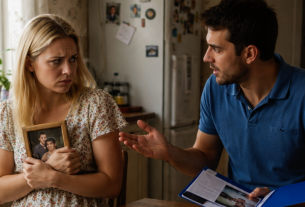
Their first serious argument happened a month after the move. Igor came home from work in a foul mood, saw toys scattered across the hallway, and began shouting. Not at Sonya—at Galina. He yelled that he was tired, that the apartment had turned into a daycare center, and that he had never agreed to any of this.
“I didn’t sign up for this, Galya! Do you hear me? I didn’t sign up for it!”
“You agreed to move into this apartment. You didn’t object when I said I would file the paperwork.”
“I thought you’d get over it! That you’d play mommy for a while and then calm down!”
“Play mommy? Is that how you see it?”
“What else am I supposed to call it? The child isn’t yours. The apartment isn’t yours. You have no real rights here, and neither do I!”
Galina looked at him for a long time. Calmly. She knew how to look at people that way. She was simply recording what was happening, as though writing it down in an invisible notebook.
“Sonya called me ‘Mom’ the day before yesterday,” she said evenly.
“So what? She’d call the cat ‘Mom’ if it stayed beside her every day.”
Galina left the kitchen. Igor stayed behind. A minute later, she heard him open the refrigerator, take out some food, and turn on the television. For him, life continued along its familiar course. For Galina, the course had already changed.
The second argument was worse. Igor raised his voice in front of Sonya. The girl crawled under the table and sat there hugging her rabbit. Galina pulled her out, carried her to her room, and put her to bed. Then she returned to the kitchen and said only one thing to Igor:
“If you ever shout in front of the child again, I’ll file for divorce.”
“Go ahead,” he snapped. “File for divorce if some strange girl matters more to you than your husband.”
“She isn’t a stranger to me.”
“She’s nobody to you, Galya. Legally, she’s nobody. And I’m your husband.”
“For now.”
Two weeks later, Igor himself brought up divorce. He did it calmly and matter-of-factly, as though discussing the purchase of a new sofa. Galina signed the application without saying a word. The marriage was officially dissolved within a month.
Igor continued living in the apartment. He took the smaller bedroom. He thought everything had worked out perfectly: he still had an apartment, no wife making demands, and the freedom to live however he pleased. He did not notice Galina sitting at her laptop in the evenings or going somewhere during the day while Sonya stayed with Tamara Nikolayevna. He was not interested. He did not care.
Galina, meanwhile, was gathering documents. Methodically and patiently, one step at a time. Medical certificates. Character references. A housing inspection report. Approval from the guardianship authorities. Each document was like another brick in the wall she was building—not around herself, but around Sonya.
“Tamara Nikolayevna, I need your signature here,” she said one day, handing her mother-in-law a form.
“What is it?”
“The closest relative’s consent to the adoption. You’re her grandmother. Your opinion carries weight.”
Tamara Nikolayevna took the pen and signed without reading it.
“I would sign ten papers like this, Galya. Twenty, if necessary. You’re the best thing that ever happened to that little girl.”
“Thank you.”
“Does Igor know?”
“No. And for now, he doesn’t need to.”
Her mother-in-law nodded. Not because she approved of keeping secrets, but because she knew her son and understood that he was capable of ruining anything that did not belong to him, simply out of spite.
Three months after submitting the documents, Galina received the official decision. Sonya legally became her daughter—adopted on paper, but her one and only daughter in Galina’s heart. Galina placed the documents in her bag, collected Sonya from her art class, and bought her ice cream on the way home. Strawberry, in a wafer cup.
“What are we celebrating?” Sonya asked, licking the edge.
“Something good,” Galina replied. “Just something good.”
Life in the apartment continued along separate paths. Galina and Sonya occupied the larger room; Igor lived in the smaller one. They rarely crossed paths. He left early, returned late, and ate dinner by himself. Galina cooked for herself and her daughter, cleaned the apartment, and took Sonya for walks. Sometimes Tamara Nikolayevna took her granddaughter for the weekend. Then the apartment would fall into the strange, uncomfortable silence of two people who had nothing to say to each other.
One evening, Igor came out of his room in a good mood. He was freshly shaved, wearing a new shirt, and holding his phone. He stopped in the kitchen doorway and looked at Galina, who was chopping vegetables for a salad.
“Galya, we need to talk.”
“Go ahead.”
“I’ve met a woman. A good woman. I want her to move in here.”
Galina put down the knife. Slowly and carefully.
“What do you mean by ‘here’?”
“Here. Into this apartment. You understand that this situation is ridiculous. We’re divorced, but we’re still living together. It isn’t normal.”
“I agree. It isn’t normal.”
“Excellent. Then pack your things. And take Sonya—the girl—to my mother.”
Galina dried her hands on a towel and looked at Igor. He stood confidently with his shoulders squared, looking like a man who had finally decided to put his life in order.
“Igor, do you want me to leave?”
“It isn’t about what I want. I’m telling you that it’s time. The apartment belonged to Vera. Vera was my sister. So essentially, this is a family apartment. Mine.”
“Essentially—or legally?”
“Don’t twist my words, Galya. Pack your things. I’m serious.”
He went into the hallway, pulled an old suitcase out of the storage closet—the same one Galina had used when she first came to this home—and set it down in the middle of the hallway. Demonstratively. With a loud thud. Then he threw the front door wide open.
“The apartment, the suitcase, the door—the way out is right there,” he commanded, and waited.
Galina looked at the suitcase. At the open door. At Igor, standing with his feet apart like a landlord evicting a tenant.
Then she silently took a towel from the hook and went into the bathroom. The door closed softly behind her, without a click.
Igor remained standing in the hallway. One minute. Two. Five. He heard the water begin to run. Galina had turned on the shower.
He did not understand.
He had expected shouting, doors slamming, frantic phone calls to friends, and panicked packing. Instead, she had gone to take a shower.
He closed the front door, returned the suitcase to the storage closet, and sat down in the kitchen to wait. Something nagged at him inside—a mixture of irritation, confusion, and vague anxiety that he could not put into words.
Forty minutes later, Galina emerged from the bathroom. Her hair was wrapped in a towel, and she wore a robe and slippers. She looked into the children’s room, where Sonya was drawing at a small table.
“Sweetheart, finish up. In ten minutes, it’s time to brush your teeth and go to bed.”
“All right,” the girl said without looking up from her drawing. “I just need to finish the house.”
“Go ahead and finish it.”
Galina returned to the kitchen, poured herself some mineral water, and sat down opposite Igor. He stared at her with the expression of a man seeing a stranger for the first time.
“You aren’t packing,” he said.
“No.”
“Didn’t you understand what I said?”
“I understood perfectly. Wait twenty minutes. I’ll put my daughter to bed, and then we’ll talk.”
“What daughter?” He gave a derisive snort. “Galya, stop playing with dolls and pretending to be a mother.”
She did not answer. She stood up and went to Sonya.
Twenty minutes. Teeth, pajamas, rabbit, blanket, counting to twenty. Sonya fell asleep at thirteen.
Galina returned to the kitchen and sat in the same chair. Calmly. Her hands rested on the table, her fingers intertwined. She was in no hurry. Igor waited nervously, fidgeting and tapping his foot against the chair leg.
“Well?” he snapped. “Are you going to explain what this circus is about?”
“There is no circus, Igor. There are facts. Listen carefully because I won’t repeat myself.”
“Go ahead. Let’s hear your facts.”
“Four months ago, I submitted an application to adopt Sonya. Three months ago, the court approved it. From that moment on, Sonya became my daughter. Officially. With all the corresponding rights.”
Igor stopped tapping his foot. He stared at Galina as though she had begun speaking an unfamiliar language.
“What did you do?”
“I adopted Sonya. I’m her legal representative. Her guardian. Her parent. Her mother.”
“Without my knowledge?”
“We’re divorced, Igor. I don’t need your knowledge or your permission.”
“You… You did this deliberately. You planned it.”
“I did it because Sonya needed a family. But since you want to talk about the apartment, let’s talk about the apartment.”
She took some papers from a drawer and placed them in front of her.
“The apartment we’re currently sitting in legally belongs to Sonya as the only heir of Vera and Alexei. Sonya is a minor. I’m her legal guardian. Until Sonya turns eighteen, I make every decision concerning this property.”
“No,” Igor said. “No, no, no. This was my sister’s apartment.”
“Exactly. Your late sister’s apartment. It passed legally to her daughter, who is now my daughter.”
“You can’t… I live here!”
“You aren’t officially registered here. You moved in, but your residence was never legally formalized. I checked.”
Igor stood up and paced from one wall to the other. He stopped and turned around.
“Does Mother know?”
“Tamara Nikolayevna signed her consent to the adoption. She supported the decision.”
“Mother? My mother?”
“She is Sonya’s grandmother. She cares about her granddaughter’s future—unlike you.”
“You conspired against me. Both of you plotted behind my back!”
“Don’t shout. My daughter is sleeping.”
“To hell with the child!”
Galina returned the documents to the drawer. She stood up and pushed in her chair.
“That’s precisely why, Igor. ‘To hell with the child.’ You said it, not me. To you, a living little girl—your own sister’s daughter—is an inconvenience. Garbage. A misunderstanding. To me, she is the only person worth getting out of bed for every morning.”
He stood there breathing heavily, and Galina watched panic in his eyes give way to calculation, calculation to despair, and despair to powerless rage.
“I’ll challenge it,” he said hoarsely.
“Challenge what, exactly? The adoption is legal. The inheritance is registered in Sonya’s name. You aren’t a registered resident, you aren’t her guardian, and you aren’t my husband. You don’t possess a single document connecting you to this apartment. Not one.”
“I’ll find a way.”
“Go ahead and look. In the meantime, you need to vacate the room. Tomorrow. I plan to furnish it for my daughter.”
“Tomorrow?”
“Tomorrow. You don’t have many belongings. You’ve always lived lightly, after all—without attachments or responsibilities. Now that will finally work in your favor.”
Igor said nothing. He stood in the middle of the kitchen in his new shirt, freshly shaved and smelling of cologne, having planned to bring another woman into this home. He looked as though someone had pulled a chair out from under him.
“You have no right…” he began.
“I do. On paper, legally, and in practice. I’m the legal representative of the property owner. You’re a stranger in this apartment. A stranger, Igor. Remember that word.”
“I’ll talk to my mother.”
“Go ahead. She’ll tell you the same thing. She made her decision long ago.”
He moved abruptly toward the door, then stopped and turned around.
“You could have told me earlier. You were waiting for this moment. You waited until I gave you an excuse.”
“No, Igor. I was waiting for you to show me who you truly are. And you did. ‘The apartment, the suitcase, the door.’ Remember? Well, here’s the apartment,” she said, gesturing around the kitchen. “The suitcase is in the storage closet, and there’s the door. The way out is right there.”
He stood without leaving, staring at the woman he had known for twelve years and apparently had never known at all. He looked at her calm face, her steady breathing, and her hands that did not tremble—because there was no reason for them to tremble. Everything had already been decided, signed, officially recorded, bound, and numbered.
“Tomorrow morning, Igor,” she repeated. “I want the room empty by tomorrow morning.”
She switched off the kitchen light and went to her sleeping daughter. The door closed quietly behind her.
Igor sat in the dark kitchen until dawn. At six in the morning, he silently packed his belongings into two bags—he never used the suitcase—and left. The door closed quietly, like the final page of a book no one would ever want to read again.
Sonya woke up at at seven. She came into the kitchen and climbed onto a chair.
“Where is Uncle Igor?”
“He left,” Galina said, pouring milk into a mug decorated with a giraffe.
“Forever?”
“Forever.”
“All right,” Sonya said, reaching for a cookie.
Tamara Nikolayevna called around lunchtime. Her voice was steady, but Galina heard that special note that appears in the voice of someone who has made a choice between her son and the truth.
“He called me, Galya. He shouted and accused me.”
“I’m sorry.”
“Don’t be. I raised him, but I’m not responsible for the person he became. How is Sonya?”
“She’s drawing and eating cookies. She asked where he had gone.”
“What did you tell her?”
“I said he was gone forever.”
Tamara Nikolayevna was silent for a moment.
“I’ll come tomorrow. I’ll bring Sonya the book I promised her—the one about the bear who builds a ship.”
“She’ll be happy.”
“And you should be happy too, Galya. You deserve it.”
Galina ended the call and looked at Sonya, who was sitting on the floor drawing. On the sheet of paper was a house with two windows, a red roof, and a little person standing by the door. The little person was smiling.
“Who is that?” Galina asked.
“That’s me,” Sonya said. “And here’s you. And here’s Grandma. And this is the giraffe.”
“The giraffe?”
“Yes. He lives with us. He’s kind.”
Galina sat down on the floor beside her. Without looking up, Sonya leaned against her side—naturally and comfortably, the way people lean against someone they know they can trust.
It was quiet beyond the wall. The second room stood empty, and there was neither loss nor bitterness in that emptiness.
There was only space.
Space for a child’s desk. For a shelf filled with books. For a life that had finally begun for real.