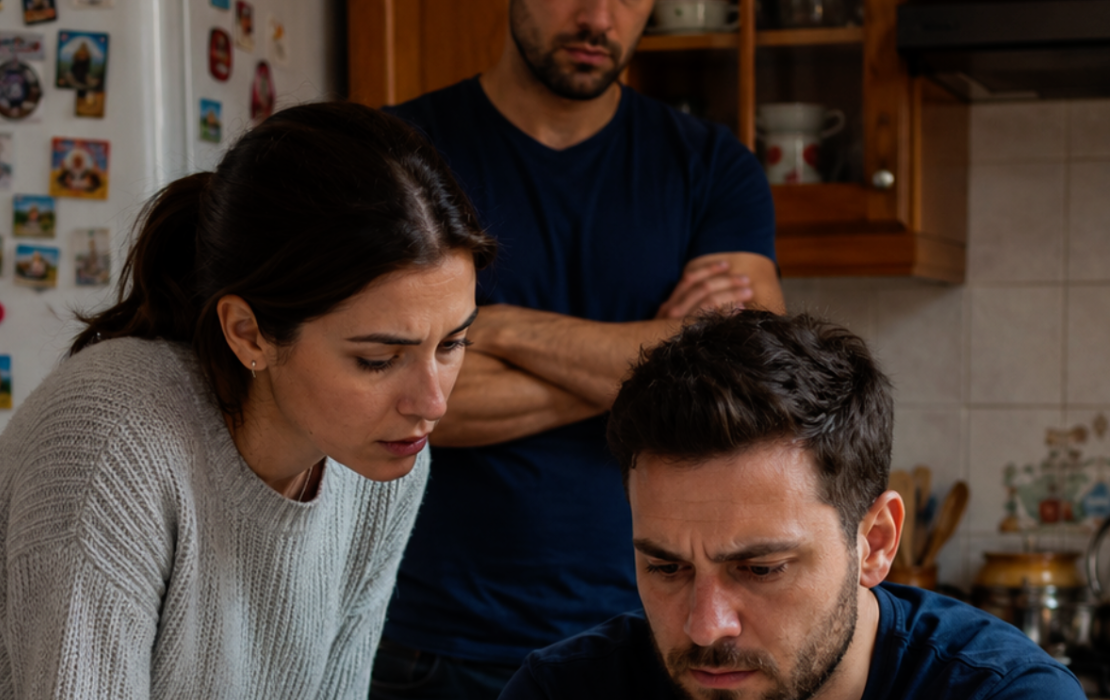
“Not a single kopeck. You won’t see another penny from us. Live however you want, but I’m tired of being good for everyone.”
My mother-in-law gasped with outrage on the other end of the line, while Oleg, our “unrecognized business genius,” standing in the middle of my kitchen, turned so red he looked like an overripe tomato ready to burst. But he stayed silent. There was nothing to say—the facts were right there on the table.
It all began six months earlier, in November.
We live in Voronezh, an ordinary family: I’m Ira, I work as a logistics coordinator for a transport company, and my husband Sasha is an engineer at a factory. We’re not exactly reaching for the stars, but we pay our mortgage on time and put money aside for a vacation in Turkey.
Oleg, Sasha’s younger brother, had always been “different.” At thirty-nine, he refused to “work for someone else,” despised office plankton—that is, people like us—and was always cooking up some kind of “scheme.” One day he was reselling sneakers, another day he was mining crypto on his mother’s balcony, then he was investing in some kind of mushrooms. He never had any money, but somehow he always had the latest iPhone and endless talk about “passive income” and “financial freedom.”
That evening, he showed up at our place without calling.
Outside, freezing rain was pouring down, while inside our home it was warm and smelled of freshly baked apple charlotte. Oleg burst into the hallway, soaked but excited. His eyes had an unhealthy shine, and his hands were trembling slightly.
“Hey, Sasha, Ira!” he said, tossing his wet jacket straight onto the floor—which was the first warning sign, because he was usually neat. “Got any tea? We need to talk. Seriously.”
We sat down in the kitchen. Oleg didn’t touch the pie, but he greedily downed a glass of water in one gulp.
“So here’s the thing…” he began, his eyes darting around the kitchen. “My partners screwed me over badly. A payment from China got stuck. I’ve got a cash-flow gap, literally just for twenty-four hours. The goods are sitting at customs, penalties are adding up every hour—I need fifty thousand. Tomorrow the money will come in from the client, and I’ll pay you back with interest right away. It’s not hard for you to help, is it?”
He took out his phone and started shoving the screen in our faces. Some kind of chart with green and red candlesticks was open on it.
“Look, see? The trend is going up! This is traffic arbitrage with physical goods, a guaranteed deal, three hundred percent margin! I’m just short on liquidity right now, I put everything into turnover.”
I’ve worked in logistics for ten years, and I know what a cash-flow gap and customs actually look like. I also know that “traffic arbitrage” and “goods stuck at customs” are two completely different things. But Oleg spoke so fast, throwing around terms like “volatility,” “hedging,” and “leads,” that it was impossible to get a word in.
I looked at Sasha. My husband was squirming. He was ashamed that he, the older brother, was sitting there warm and well-fed while his younger brother—so talented, supposedly—kept banging his head against the wall.
“Oleg, we had that money set aside for the car insurance…” Sasha began uncertainly.
Just then Sasha’s phone rang. The screen showed: “Mom.”
“Sashenka!” came the voice of my mother-in-law, Galina Petrovna, loud enough for me to hear too. “Help Oleg! He called me, something terrible has happened! His business is about to take off, he’ll buy you a new car later! Don’t be stingy, he’s your brother! His heart hurts from all the stress!”
That was the forbidden move. Oleg’s “bad heart” was my mother-in-law’s favorite song.
Sasha sighed, looked at me guiltily, and transferred fifty thousand.
Oleg immediately brightened, grabbed his jacket, and ran off without even finishing his tea.
“I’ll pay you back tomorrow by lunchtime!” he shouted from the stairwell.
Of course, there was no money the next day. “The bank is checking the transaction,” “the SWIFT transfer got stuck,” “my partner got sick.” He paid it back a month and a half later, in installments of five thousand at a time, after borrowing from an old school friend on his word of honor, as I later found out.
Dancing on the Same Rake
Two months passed. We had just started to breathe a little easier when he came over again.
This time, Oleg looked awful. His face was gray, there were black circles under his eyes, and his clothes were stale. He smelled of sweat and cheap cigarettes, even though he told everyone he only smoked IQOS.
“What happened?” Sasha asked, frightened.
“I wrecked the car,” Oleg muttered, staring at the floor. “The bumper’s ruined, headlight smashed. I drove into a Mercedes at a traffic light. The insurance company is dragging its feet, bastards say it’s not covered. But I need to drive, I’ve got things to handle, meetings with investors… Give me thirty thousand for repairs, or the business will stall. I’ve already arranged it at a garage, they’ll do it cheap.”
Sasha reached for his phone.
“Wait,” I said, catching my husband’s hand. “Oleg, show us the car.”
Oleg twitched as if he’d been electrocuted.
“It’s… already at the shop. Uncle Vanya’s garage on the left bank.”
“Do you have photos? You would have had to take pictures for the insurance company. Show us the damage.”
Oleg flared up, the veins in his neck swelling.
“Ira, you don’t trust me?!” he shouted, jumping up from his chair. “I’m family, and you’re checking up on me like I’m some kid! Are you really too stingy to help your own family?! I’m stressed, I almost crashed, and you’re interrogating me?!”
“I’m not interrogating you. I want to see what we’re giving our money for.”
“Oh, choke on it!” He grabbed the little cookie bowl from the table and hurled it at the wall. It shattered into pieces.
Sasha turned pale.
“Oleg, calm down! Ira is right. Show us the photos.”
“You’re controlling me! You don’t even see me as a person!” He started pacing around the kitchen. “Mom was right, Ira has you under her heel!”
And then the phone rang again. My mother-in-law.
“Ira! What are you doing?!” she shrieked into the phone. Oleg had apparently managed to call her while I was collecting the shards. “The boy has depression, he doesn’t want to live, and you’re counting money! If he does something to himself now, that will be on your conscience! Give him those miserable pennies, I’ll pay you back from my pension!”
Sasha broke. He couldn’t withstand his mother’s tears and his brother’s hysteria. He transferred thirty thousand.
Oleg calmed down instantly, muttered “thanks,” and left.
But I noticed one detail that wouldn’t leave me alone. Oleg never let go of his phone, not even for a second. The screen was always turned face down or covered by his palm. When I passed by with a broom, he sharply locked the screen, as if he were hiding messages from a mistress—but he didn’t have a mistress.
The Clue in the Notification
The situation kept getting worse. Oleg started coming to our place as if it were his job. One time, “my tooth hurts, I have an abscess, they need to cut it open urgently.” Another time, “a tax bill came in, they’ll freeze my accounts.” Then, “I need to pay for hosting, the website will go down.” The amounts kept growing: five, ten, fifteen thousand. Sasha gave him money, my mother-in-law applied pressure. I felt us sliding into a financial pit, but I had no direct proof that he was lying.
One Saturday, Oleg was sitting at our place, surprisingly quiet, even affectionate.
“Guys, thank you,” he said, spreading butter on bread. At our place, he ate for three; apparently there was nothing at home. “Everything will work out soon. The crypto thing took off. I’m waiting to withdraw the funds, and I’ll pay you back double.”
He got up and went to the bathroom, leaving his phone on the table, charging.
“Ira, see? He’s normal,” Sasha whispered. “Maybe it really did take off?”
At that moment, Oleg’s phone screen lit up. A push notification came in.
I don’t like snooping through other people’s phones. It’s dirty. But as a logistics worker, I’m used to checking invoices when cargo is delayed. And our “cargo” had been delayed for six months already.
I glanced sideways. The phone was lying next to my hand.
A bright icon with an orange ball.
The text read:
“Your bet on the Real Madrid vs. Barcelona match won! Odds: 3.5. Claim your winnings now!”
Then another one came in from the app:
“Oleg! You’ve been credited a 1,000-ruble free bet. Win back your last loss! The ‘Strawberries’ slot is waiting!”
Heat rushed over me.
There was no business. No partners in China. No arbitrage. No wrecked car. There were bets.
The fifty thousand “for a cash-flow gap” had gone to a bookmaker. The thirty thousand “for the bumper” had gone into slot machines. The money “for the tooth” had gone there too.
Oleg returned from the bathroom, wiping his hands on his pants. He saw me looking at his phone and went white. He grabbed the device and shoved it into his pocket so sharply that he nearly tore his jeans.
“What are you staring at?” he asked rudely, his voice trembling.
“Nice odds,” I said calmly, looking him straight in the eye. “3.5. Bet on Real Madrid, did you? Pity you never fixed the bumper. And the tooth, apparently, healed itself.”
Oleg froze. His eyes darted around. He understood that I had seen everything.
“You… you misunderstood,” he mumbled. “That’s advertising. Spam.”
“Spam with your name? ‘Oleg, you’ve been credited a free bet’?”
He bolted out of the apartment without saying goodbye, almost knocking the cat over.
That evening, Sasha and I had a difficult conversation.
“You’re making this up!” my husband went into full defense mode when I told him about the notifications. “So some advertisement came in, and what? Everyone gets those now. He just likes sports! Maybe he placed a hundred-ruble bet for fun, what’s the big deal? You’re just stingy with money, so you’re looking for an excuse!”
“Sasha, he’s asking for tens of thousands. This isn’t a hundred rubles! He’s a gambling addict! Do you understand that we’re feeding his illness?”
“Don’t you dare talk about my brother like that!” Sasha raised his voice at me for the first time. “He’s a talented guy. He’s just unlucky! And you… you’re mercenary!”
Then my mother-in-law called. Sasha had clearly already complained to her about my “suspiciousness.”
“Ira, you’re heartless!” Galina Petrovna cried into the phone so loudly that Sasha put her on speaker. “The boy has depression, he’s trying to find himself, and you’re snooping in his phone! Spy! If something happens to him, I’ll curse you!”
I sat in the kitchen and felt the ring tightening around me. I was outnumbered. Against me stood blind maternal love and brotherly guilt. If I started a war now, I would become enemy number one: the evil daughter-in-law who counts every kopeck and hates the family. And Oleg would keep milking everyone, hiding behind depression, until he gambled away his mother’s apartment—and ours along with it.
I had to act without emotion. Emotions didn’t work here. What I needed was a cold, calculated, accounting trap.
Three days later, Oleg called Sasha. His voice was cheerful, but with a note of hysteria.
“Sanya, brother, save me. It’s a sure thing, my last chance. Buying out goods—customs confiscated stock, iPhones at half price. I need a hundred thousand. In a week I’ll return two hundred, I swear on my tooth! I swear on Mom!”
Sasha looked at me. Doubt and hope were fighting in his eyes.
“Ira… maybe it’s true? Confiscated goods… two hundred thousand… We could pay off part of the mortgage…”
I took a deep breath.
“Fine, Sasha. Let him come. We’ll help.”
Sasha beamed.
“You’re the best! I knew you’d understand!”
Oleg flew in an hour later. He looked like an addict waiting for a dose. His eyes shone feverishly, his movements were sharp and twitchy. He didn’t even take off his shoes; he walked straight into the kitchen wearing them.
“Guys, you’re saving me!” He was already reaching with a trembling hand toward Sasha’s phone to dictate the card number. “This is the deal of the century!”
“Stop,” I said loudly.
I took a notebook, a pen, and my phone out of the drawer.
“Oleg, sit down. Since this is business, let’s do it like adults. We’re investors, after all. We’re investing one hundred thousand. That’s serious money.”
Oleg tensed. The smile slid off his face.
“What do you mean?”
“First, we write an IOU. Do you have your passport with you?” I opened the notebook. “Write: ‘I, full name, passport details, borrowed 100,000 rubles from full name. I undertake to repay it by such-and-such date.’ And I’ll take photos of your passport. All pages.”
Oleg grimaced as if from a toothache.
“Ira, come on, we’re family… Why all this paperwork?”
“Money likes accountability. Write, or there will be no money.”
He reluctantly took out his passport. His hands were shaking so badly that he could barely form the letters.
“Second,” I continued. “The transfer will include the payment note: ‘Loan funds under IOU dated such-and-such.’ That way there won’t be questions from the tax authorities, and in court, if necessary, we’ll have proof.”
“What court?!” he squealed. “Are you planning to sue me?!”
“It’s a formality, Oleg. You’ll return it in a week, right?”
“Well… yes…”
“And third, the most important part. Since we’re investing in ‘buying out confiscated goods,’ show us the documents for the merchandise. The consignment note, invoice, correspondence with the supplier—or at least a statement from your account for the last month.”
“What?!” Oleg jumped up, knocking over the chair.
“A statement, Oleg. A regular one from SberOnline or Tinkoff. Open the app right now. I want to see the movement of funds. I want to make sure the previous fifty and thirty thousand went to partners in China and an auto repair shop, not to a casino.”
The silence in the kitchen became ringing. Sasha stared at his brother with wide eyes.
Oleg turned red to the roots of his hair. The veins in his neck swelled, and spit flew from his mouth.
“You… you’re checking up on me?!” he screamed so loudly the glass rattled. “You’re digging into my pocket?! Who do you think you are?! This is a violation of personal boundaries! I’m your brother, and you’re making me go through bureaucracy! To hell with you and your pennies!”
He grabbed Sasha’s favorite mug from the table and hurled it onto the floor with all his strength. Shards flew all over the kitchen, and one scratched my leg.
“You don’t trust me! Traitors! Bastards! Mom was right—you’re a witch!”
He rushed around the kitchen, kicking the furniture.
“Show me your phone, Oleg!” Sasha suddenly shouted. He stood up, and I saw his fists clench. “Just open the app. If there are no bets there, Ira will apologize.”
“Go to hell!” Oleg shoved his brother in the chest. “Henpecked loser!”
The Masks Come Off
Sasha staggered but stayed on his feet. He looked at his brother, and I saw the illusion of the “unfortunate genius” dying in his eyes. Standing before him was an aggressive, lying addict, ready to hit his own flesh and blood for another dose of gambling adrenaline.
I looked at Oleg calmly. I knew I had won.
“Decided to climb onto my neck, did you? Well then, get off!” I said loudly and firmly, cutting through his shouting. “The show is over, Oleg. You won’t see another kopeck from us. Not for ‘business,’ not for ‘teeth,’ not for ‘a hamster’s funeral.’ Live however you want, but I’m tired of being good for everyone.”
Oleg froze. He realized he had gone too far and that the mask had slipped.
“You’ll come crawling back…” he hissed. “When I make it big…”
He flew out of the apartment, slamming the door so hard that plaster fell from the ceiling.
Sasha sat down on a chair and covered his face with his hands.
“Ira… Is he really… Is he really gambling?”
“Yes, Sasha.” I came over and hugged him. “He’s sick. And if we give him even one ruble, we won’t be helping him. We’ll just buy him another ticket to the bottom.”
That same evening, I acted quickly and harshly. While Sasha was still in shock, I took control.
I went into Sasha’s online bank account and lowered the transfer limits to the minimum. I moved our main savings—the money for the car and the vacation—to my own savings account, which my husband could not access.
“Sasha,” I said, handing his phone back. “This is for your own safety. You have a soft heart. If he comes to you crying, you might give in. Now you don’t have the money. If you want to sponsor a gambling addict, find a side job, go load freight cars, and pay him out of your own pocket money. Not one kopeck from the family budget. If I find out you transferred money behind my back, it’s divorce. I’m serious.”
Sasha nodded.
Then I called my mother-in-law. She picked up instantly, apparently waiting for news of her son’s “rescue.”
“Well? Did you transfer it?!” she shouted.
“Galina Petrovna, listen to me carefully,” I said in an icy tone. “Your son is a gambling addict. He bets on sports. He just smashed a mug and tried to hit Sasha when we asked him to show his bank statement. We didn’t give him the money, and we won’t.”
“You’re lying! You drove him to this!”
“Think whatever you want, but I’m warning you: don’t you dare sell the dacha or take out loans. He will gamble everything away. And when debt collectors come to you to collect his debts, don’t come knocking on our door. We won’t open it. And check whether he’s registered at your apartment. If he takes out microloans using your address, collectors will cover your entrance with graffiti and pour glue into your locks. These aren’t horror stories, Galina Petrovna. This is reality. Save yourself, not his ‘business.’”
There was a heavy silence on the other end of the line. The mention of debt collectors and her apartment worked better than any persuasion. Fear for property is stronger than love in the older generation.
I blocked Oleg everywhere: on my phone, in messengers, on social media.
Three months passed.
Oleg lives with his mother. He has no money. He sold his car—the very same “wrecked” car—and gambled the money away in two days. My mother-in-law calls rarely now. Her voice is quiet and frightened. She complains that things are disappearing from the house: first the blender, then the television, and now her gold earrings. She hides her pension in her underwear.
We bought tickets to Turkey with that same money—the money that could have gone to a bookmaker.
Sometimes I feel sorry for Oleg. But then I remember his twisted face, the shattered mug, and the pity disappears.
I saved my family, and that is what matters most. As for Oleg… he made his choice.