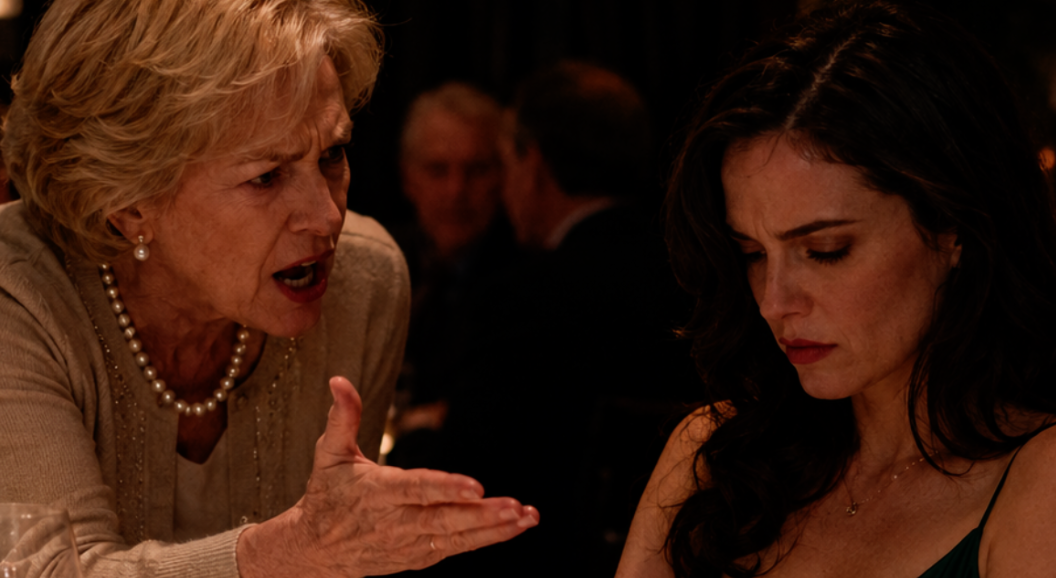
“Excuse me for disturbing you,” the administrator in a strict black suit appeared as if out of nowhere and placed a leather folder in front of Alina. “The banquet bill still hasn’t been settled. Could you tell me whether payment will be in cash or by card?”
Alina automatically opened the folder and felt as if the floor had swayed beneath her feet.
Two hundred forty-eight thousand rubles.
The numbers blurred before her eyes — hall rental, hot dishes, alcohol, musicians, photo zone, cake…
She slowly raised her eyes. Across the hall, at the main table, Nina Pavlovna was hugging her cousin by the shoulders and, glowing with happiness, saying in a practiced voice:
“The children decided to throw us a real celebration! Themselves, can you imagine? Not everyone is so lucky. Not everyone can afford such generosity.”
The relatives nodded approvingly. Someone applauded.
Alina stood in the middle of the banquet hall with the open folder in her hands, and the only thing she could think about was the small number on the screen of the banking app — the money she and Igor had been saving for a year and a half.
Their down payment.
Their future apartment.
It had all begun five weeks earlier, on an ordinary Thursday in March.
Alina came out of the commercial director’s office, quietly closed the door behind her, and only in the hallway allowed herself to smile. For three years she had been negotiating with the largest pharmacy chain in the Volga region, and now the contract had finally been signed. Her annual bonus — four hundred twenty thousand — was supposed to arrive with her next salary. Her hands were trembling as she dialed Igor.
“They approved it,” she breathed into the phone. “The full amount. Can you imagine?”
“Wait… are you serious?” her husband’s voice broke. “Alina, that means we have enough. Enough for the down payment!”
They had been saving for a year and a half. They had denied themselves vacations, counted every purchase. They lived with his mother in a two-room Khrushchev-era apartment because renting a place would have pushed their dream back by another year. With the bonus, the amount finally came together.
That evening Alina came home feeling elated. Igor met her in the hallway, hugged her, and spun her around so quickly that her shoulder hit the coat rack.
“Quiet down,” came a voice from the kitchen. “What’s all this commotion?”
Nina Pavlovna was standing in the doorway, wiping her hands on a towel. She was a short, sturdy woman of sixty-two, with a sharp gaze and a habit of noticing absolutely everything.
“Mom, Alina got a bonus at work,” Igor couldn’t help saying. “A big one. Now we have enough for the apartment.”
Alina winced almost imperceptibly — she would have preferred not to share the details — but she said nothing.
“A bonus?” Nina Pavlovna raised her eyebrows. “And how much, if it’s not a secret?”
“Mom, that doesn’t matter…”
“Why doesn’t it matter? I’m happy for you. Can’t a mother know?”
Igor hesitated, then named the amount. His mother shook her head as if weighing the number on invisible scales, and suddenly smiled warmly.
“Well done, Alina. I’ve always said that if someone in the family earns well, life should become easier for everyone.”
The phrase hung in the air. Alina smiled back, but something scratched inside her — small, shapeless, like a splinter under the skin.
From that Thursday on, Nina Pavlovna seemed like a different person. The remarks disappeared — about slippers left in the wrong place, dinner being too late, towels folded incorrectly. Her mother-in-law greeted Alina after work with pies — sometimes cherry, sometimes cabbage — and asked about her day with unexpected tenderness. On the phone with her friends, she would say without lowering her voice:
“Our daughter-in-law is a clever girl. Such a position she has, such contracts she handles!”
Alina was both pleased and wary of the change.
Then, two weeks later, during Sunday lunch, Nina Pavlovna solemnly announced:
“In May, your father and I will have our twenty-fifth anniversary. Our silver wedding. I want to celebrate properly — at a country restaurant, with live music and guests.”
Alina looked at Igor. He lowered his eyes to his bowl of borscht and awkwardly shrugged.
“Well, let my parents enjoy themselves for once. They deserve it.”
Preparations for the silver wedding consumed the entire month of April. In the evenings, Nina Pavlovna browsed restaurant websites at the kitchen table, called Alina over, and poked at the tablet screen.
“Look, this hall has panoramic windows overlooking the river. Beautiful, isn’t it? And the menu is decent — veal, salmon, duck. We won’t be embarrassed in front of people.”
Alina nodded, assuming her mother-in-law was simply sharing her dreams. But the scale grew with every day. A decorator appeared, coming over to discuss flower arrangements. Then came a musician, a violinist from the philharmonic. Then a photographer.
When Alina cautiously asked whether it was all a bit too grand, Nina Pavlovna waved her off.
“You only live once. Twenty-five years doesn’t happen every day.”
She called acquaintances and relatives every day. Alina involuntarily overheard scraps of conversations through the half-closed door:
“The children decided to give us an unforgettable gift… Yes, they’re taking care of everything… No, I’m not even interfering — they want to do it themselves…”
The words stung Alina. That evening, when she and Igor were alone in their room, she approached him.
“Igor, your mother is telling everyone that we’re paying for the banquet. Is that true?”
“She’s just showing off. You know Mom,” he said, rubbing the bridge of his nose. “Don’t think about it. My parents will pay themselves.”
Alina wanted to believe him. She wanted to — and almost did.
The day of the celebration arrived. The country restaurant turned out to be even more luxurious than in the photos: white tablecloths, crystal glasses, flowers on every table. Nina Pavlovna appeared in a new cherry-colored dress and was literally glowing. She accepted congratulations, hugged guests, and repeated the same thing to everyone:
“This is all from the children. Their idea, their gift. Isn’t it wonderful?”
Aunt Valya, her mother-in-law’s sister, sat down beside Alina and touched her hand.
“What a clever girl you are. Nina is lucky to have such a daughter-in-law. Not everyone would go to such lengths for her mother-in-law.”
Alina forced a smile and said nothing. Inside, a heavy, anxious feeling was growing — like before a storm, when the sky is still clear, but the air has already become heavy and still.
By evening, the toasts had grown louder, the laughter freer, and Nina Pavlovna even more confident in her role as queen of the celebration. Alina caught the relatives’ glances on her — respectful, envious, assessing — and didn’t know what to do with her hands.
The guests began leaving around eleven. The men were finishing off the cognac, the women were hugging in the cloakroom, promising to call each other more often. The celebration was dying down slowly, like the candles burning out on the tables.
It was at that very moment that the administrator touched Alina lightly on the elbow.
“You are Alina Dmitrievna, correct? The event organizer?”
She didn’t have time to object — the leather folder was already being handed to her.
“There must be some mistake,” she began, but the administrator politely shook his head.
“Nina Pavlovna confirmed several times that you would be the one paying. We coordinated all the details with her by phone, but the booking and invoice were made in your name.”
Alina opened the bill.
Hall rental — forty-five thousand. Banquet menu for thirty-eight guests — one hundred twelve thousand. Alcohol — thirty-one thousand. Violinist — fifteen thousand. Photographer — twenty thousand. Decor and photo zone — fifteen thousand. Cake — ten thousand.
Total — two hundred forty-eight thousand rubles.
Her hands went cold.
She found Igor on the veranda. He was smoking, looking out at the dark river.
“Igor, no one has paid for the banquet. The bill was issued to me. In my name.”
Her husband put out his cigarette and remained silent for a long time. Then he said quietly:
“Mom told me… well, that we would help with the celebration. I thought she meant part of the expenses. Some kind of gift.”
“Helping and paying for everything are two different things. Do you understand that?”
He did not answer.
Alina returned to the hall and approached Nina Pavlovna, who was saying goodbye to the last guests.
“Nina Pavlovna, the administrator brought me a bill in my name. Two hundred forty-eight thousand. You listed me as the organizer without my knowledge.”
Her mother-in-law straightened. The smile did not leave her face — it simply became different. Hard.
“And what surprises you? You’re family. You have a bonus, you have the means. Are you really sorry to spend money on your husband’s parents?”
“That money is for our apartment. For the mortgage down payment.”
Nina Pavlovna swept her gaze over the remaining relatives and suddenly threw up her hands.
“Do you hear that? She doesn’t mind spending money on herself, but for family — she does! We lived our whole lives for our son, gave him our last, and now, apparently, two hundred thousand is too much!”
The silence lasted only a moment. Alina straightened, and for the first time in all the years she had spent near her mother-in-law, her voice did not tremble.
“Gifts aren’t made through deceit, Nina Pavlovna. If you wanted a celebration, you should have sat down and talked about it. Not written me down as the organizer behind my back and turned me into a wallet in front of an entire restaurant.”
The hall became very quiet. Aunt Valya suddenly became interested in the contents of her handbag. Igor’s cousin pulled his wife toward the exit, muttering something about the late hour. The relatives left quickly, avoiding everyone’s eyes.
Her father-in-law, Viktor Petrovich, sat in the corner, crimson-faced and motionless. He stared at the table and said nothing — heavily, guiltily.
“You’re just greedy!” Nina Pavlovna flared up. “You have hundreds of thousands sitting there, and you begrudge pennies for your own relatives!”
But the words hung in the emptiness. Alina had expected shame — the familiar, suffocating kind — but instead she suddenly felt light. As if a string pulled tight inside her had finally snapped.
The administrator waited patiently. Nina Pavlovna, pressing her lips together, took out a credit card and silently paid.
In the car on the way home, her mother-in-law did not say a word — not until the turn onto their street. Then she said in an icy tone, looking at the back of her son’s head:
“Choose, Igor. Either your wife learns to respect family, or you won’t have a family at all.”
Igor tightened his grip on the steering wheel and said nothing.
At home, the front door slammed — Nina Pavlovna locked herself in the bedroom. Alina and Igor remained in the kitchen. The wall clock ticked. Water dripped from the tap.
“Well, she just wanted a beautiful celebration,” Igor began quietly. “Maybe it all turned out badly, but she didn’t mean any harm…”
“Didn’t mean any harm?” Alina sat down across from him. “She registered me as the event organizer at the restaurant. Without my knowledge. That isn’t a celebration, Igor. That’s a trap.”
He rubbed his face with his hands.
“It hasn’t been about the money for a long time,” she continued. “It’s about the fact that for two years I’ve been living with the feeling that I owe everyone. Your mother put me in a position where refusing meant disgrace. In front of people, in front of relatives, in front of everyone. She planned it.”
Igor was silent for a long time. Then he raised his eyes — red and tired.
“And what are you suggesting?”
“That we leave. Rent an apartment. Live separately.”
“And the down payment? We’ll have to postpone buying…”
“But we’ll save ourselves.”
Four days later, they moved their things into a small one-room apartment on Proletarskaya Street — closer to Alina’s office, farther from her mother-in-law. Nina Pavlovna stood in the hallway with her arms crossed and did not say goodbye. Igor hugged his father at the door, and Viktor Petrovich whispered to him:
“You’re doing the right thing. You should have done it long ago.”
Three months passed. One evening, Igor came home from work, sat down beside Alina on the sofa, and suddenly said:
“You know, I’ve only just realized how quiet it is at home now. Truly quiet. Without that… constant buzzing.”
Alina smiled and rested her head on his shoulder. She no longer flinched at the sound of a door opening and no longer felt guilty for buying a dress or having an extra cup of coffee at a café.
Nina Pavlovna, of course, did not give up. She complained to her female relatives over the phone:
“My daughter-in-law turned my son against his mother. Ungrateful girl.”
But Aunt Valya had already told everyone about the restaurant bill, and Nina Pavlovna found less and less sympathy.
Sometimes, as she was falling asleep, Alina remembered that May evening — the violin, the laughter, the glasses glittering in the lights, and the leather folder in the administrator’s hands. The memory no longer burned.
Because it was then, in the middle of someone else’s celebration, that she stopped being convenient for other people’s expectations for the first time — and chose herself.