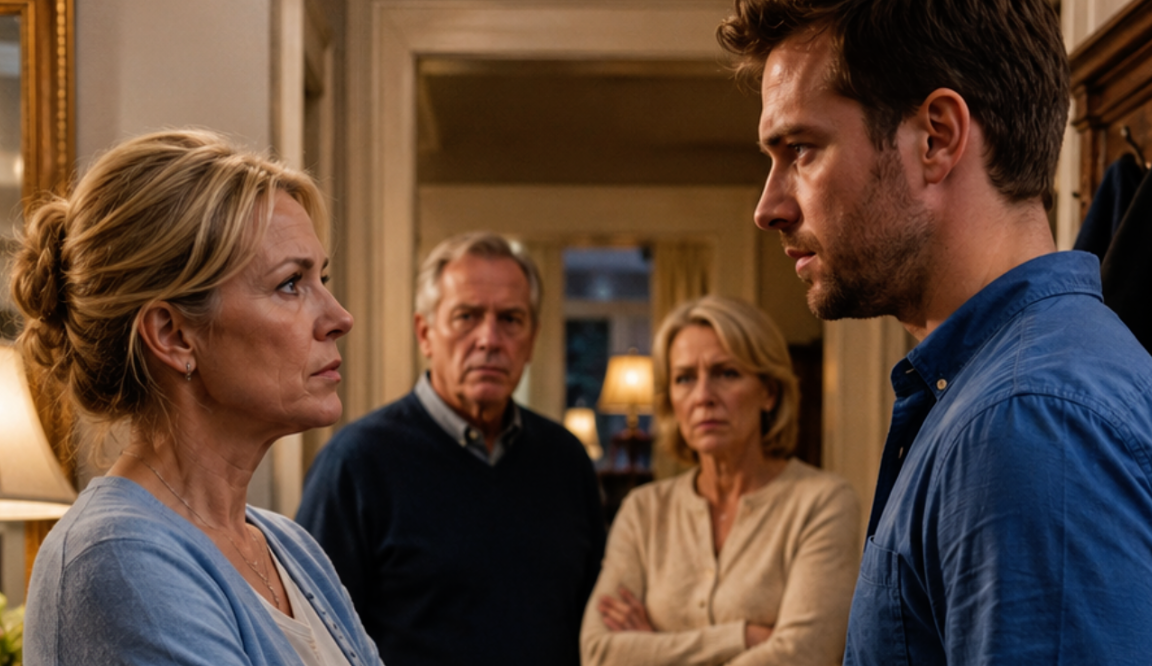
“It will be better for everyone this way, Mom,” Kirill said, placing my travel bag by the door without even trying to pretend he felt awkward. “Leave quietly. Don’t make it complicated.”
I stood in the middle of the hallway, still wearing my house slippers, and looked at my own son as if I were seeing his face without its childhood features for the first time. Tall, clean-shaven, in an expensive shirt from his father’s company, with that same cold squint I had once mistaken for adult composure. That evening, I understood for the first time: it was not composure. It was self-interest, turned into a habit.
Behind him, near the mirror, stood Alyona. My younger sister. In a light-colored coat, with a confidence that did not belong in my home and with that gleam in her eyes I had known since childhood. That gleam appeared whenever she was already mentally trying on someone else’s possession. A doll. A dress. A man. Someone else’s life, too.
Pavel was not hiding. On the contrary. He stood in the kitchen doorway, leaning his shoulder against the frame, and looked at me almost with relief. As if he had not destroyed thirty years of marriage, but had simply closed an old, inconvenient contract.
“I don’t want to lie anymore,” he said evenly. “Alyona and I have had something for a long time. You felt it yourself. There’s no need to put on a performance now.”
The apartment smelled of fried fish, Alyona’s perfume, and damp autumn air drifting in from the balcony because someone had left the door slightly open. The kettle was cooling in the kitchen, the clock was ticking in the bedroom, and my son was standing by the threshold with my bag as if he were not throwing out his mother, but taking an expired suitcase out of the storage room.
“Are you serious right now?” I breathed.
Kirill did not even look away.
“Mom, don’t humiliate yourself. Dad has already decided everything. It’s better for you to leave peacefully.”
Alyona gave a faint shake of her head, pretending to be sympathetic.
“Marina, please don’t start a hysterical scene. We’re adults.”
That “Marina,” said by my sister in the tone of the mistress of the house, was the most disgusting thing. Not the affair with my husband. Not my son by the door. But her certainty that now she could call me that in my own home.
I turned my gaze to Pavel.
“How many years?”
He shrugged.
“What difference does it make?”
“To me, a big one.”
“A year,” Alyona tossed out lazily. “If emotional bookkeeping matters so much to you.”
I looked at the three of them and did not feel anything people expect a woman to feel in scenes like this. I did not scream. I did not lunge at my sister. I did not cling to my husband. There was something else inside me. A very cold, very clear understanding that there was no family left in this house anymore. It had not ended now. Now someone had simply turned on the light.
“All right,” I said.
Pavel frowned.
“What do you mean, all right?”
“All right. It’s good that you decided not to drag this out any longer.”
Kirill moved the bag closer to the door.
“Then let’s do this without a scene.”
I looked at him.
“You are not my son right now. You are a messenger for someone else’s will.”
He smirked.
“Mom, you’ve always loved dramatic words.”
“No. You simply grew into a man who handed his mother a bag while his father was sleeping with her sister.”
That was when he flinched. Not from shame. From irritation. He did not like that I had called things by their names, without any lace around them.
Pavel quickly stepped in.
“That’s enough. Leave, Marina. We’ll talk calmly tomorrow.”
“Tomorrow you’ll have already transferred something into someone else’s name? Or will you not have time today?”
Alyona snorted.
“You were a bookkeeper to the bone, and you still are.”
“And you used to drag away what belonged to others, and you still haven’t stopped.”
I picked up the bag myself. Not because they had convinced me. Because I saw that if I stayed now, they would feed on my humiliation. And that evening, I needed everything except humiliation.
The stairwell smelled of dust, cat food, and damp concrete. The elevator descended slowly, as if it, too, knew that a woman at fifty-three was going down not with a bag of gifts, but out of her former life.
I did not go to a friend or to a hotel. I rented a room in an old building near the office. The landlady was silent, wearing a knitted vest and walking with a heavy step. She showed me a narrow bed, a wardrobe, and said only one thing:
“One month in advance. Don’t throw your things around. Don’t make noise at night.”
That was exactly what I needed. Not sympathy. Not questions. A room with yellow light and the right to lock the door from the inside.
That night, I hardly slept. Not because of Pavel. Not because of Alyona. Because of Kirill.
Pavel had long ago stopped being a man I could hold on to with my soul. We lived like good neighbors with a shared last name, one kitchen, and one company, which he considered his own while I had kept it afloat for many years with numbers, contracts, and quiet order. He loved comfort, a respectable appearance, the confident gait of a master, and women who looked up at him from below. Alyona suited that perfectly. Since childhood, she had known how to look at the right people as if they already owed her half their lives.
But Kirill… there was something different in him, something more painful. Not a boy’s blindness. Not hotheaded foolishness. The cold calculation of a grown man who had already figured everything out. He had not handed me the bag in a fit of emotion. He had long ago taken the side of benefit. And I knew why.
I had carried the secret about Kirill inside me for nine years.
Back then, he had undergone a serious operation. Not fatal, but serious. They needed compatibility tests, genetic markers, an entire folder of laboratory sheets. One of the doctors looked at the results, then at me, then back at the papers, and said very carefully:
“There may be an error here in the paternal line. It would be better to double-check.”
At first, I did not understand. Then I understood everything at once.
I did the DNA marker test quietly, through an acquaintance’s laboratory in the regional center. I paid in cash. I received the envelope. I opened it in the car. And then I sat there for about forty minutes, gripping the steering wheel while wet snow fell outside.
Pavel was not Kirill’s father.
I knew who was. But I had buried that name long ago, before I had even learned how to live without shame. A mistake of my youth, which no one except me remembered anymore. More precisely, I tried very hard to believe that no one remembered. Kirill had been born within the marriage, Pavel had registered him as his own, loved him as his own, and I decided that this truth was no longer needed by anyone. Not by him, not by me, and certainly not by the boy.
I kept the envelope. Not as a weapon. As a cross. A heavy, old cross you do not wear around your neck, but carry inside.
And now, sitting on someone else’s bed beneath a yellow bulb on the ceiling, I suddenly thought: what if he had guessed long ago? If not fully, then enough for the puzzle to come together. Why else had he, in recent months, behaved so easily around Pavel, around his company, around his schemes, as if he were paying not with gratitude, but with something else?
In the morning, I came to the office before everyone else. The construction company smelled of paper, cartridge dust, and cheap coffee from the machine by the window. I turned on the computer, opened old folders, and began doing what I knew how to do better than any hysterics: gather facts.
Raisa Belova appeared in my doorway closer to ten. Pavel’s former secretary, tired, gray-faced, with a bag stuffed full of papers. She had resigned back in the summer, quietly and without scenes. Back then, I thought she was simply exhausted. Now, by her eyes, I saw: she had not been exhausted. She had reached her limit.
“May I?” she breathed.
“Come in.”
She closed the door and placed a thick folder on the table.
“I stayed out of it for a long time. I thought you would figure it out yourself. Then I decided it was already too late to keep silent.”
I looked at her carefully.
“What is this?”
“Everything your husband has been siphoning out of the company for years. Through a shell company registered to Alyona.”
For a second, I thought I had misheard.
Raisa sat down and pulled payment orders, contracts, and acts from the folder.
“Vector-Resource LLC. Formally, unrelated people. In reality, a pass-through company. Money went to fake services, then moved to personal cards, rent, renovations, trips. Some of it went to Alyona. I saw it a long time ago, but back then there were no direct links. And then once Pavel left a rental agreement in my printer for an apartment registered to her. And also a payment for her car. It’s all here.”
She pushed the papers toward me.
“Why now?”
Raisa gave a humorless smirk.
“Because yesterday I saw your sister getting out of his car outside the lawyer’s office on Lenin Street. And because if you don’t strike first, they will turn you into a nervous menopausal woman who lost her mind from jealousy.”
I looked at the folder and felt no panic rising inside me. Clarity. Pavel and Alyona had not merely slept behind my back. They had built a parallel life using the money I had processed through reports and protected from audits, without even knowing that I was protecting their lies.
“Thank you,” I said.
“Don’t thank me. Thank yourself later, if you don’t back down.”
After Raisa left, I opened the first contract and suddenly caught myself thinking: pain leaves when betrayal takes shape. Sheets. Amounts. Dates. Companies. Emails. Signatures. Someone else’s vileness stops being a fog and becomes a table. And I knew how to work with tables.
Two days later, Pavel came into my office. Without knocking. In an expensive jacket, smooth, composed, as if he still believed he controlled the situation.
“You’re putting on a circus,” he hissed. “Why did you start digging into the company?”
“And why did you start digging into my sister and our shared account?”
He closed the door.
“Don’t act ridiculous. I want to settle everything peacefully.”
“You already said that that evening. I remember how your peace ended.”
He sat across from me and suddenly began speaking almost softly:
“Marina, let’s do this without court. We’ll transfer the country house to Kirill, I’ll give you the account, and we won’t touch your mother’s apartment. We’ll separate quietly.”
My mother’s apartment.
That was when I lifted my eyes to him.
Tamara Nikitichna, our mother, had transferred her apartment to me six months before her death. Not through a will. Through a deed of gift. For too many years, she had turned a blind eye to Alyona, and before her death, apparently, she finally saw things a little more clearly.
“Marina,” she had whispered to me then in the hospital, barely breathing. “You are the only one I have who knows how to love, not take.”
I had not asked her for the apartment. I even argued with her. But she insisted. And Pavel and Alyona, of course, knew about it. That was why they were even more nervous: without my mother’s apartment, their new beautiful life did not fit together quite so conveniently.
“Are you already dividing what belongs to someone else?” I asked.
“It’s not someone else’s. It’s family property.”
“No, Pasha. Our family property ended the minute you walked into our home with my sister.”
He smirked.
“Look at your son, too. He’s with me.”
“I’ve already seen that.”
“Then draw your conclusions.”
“I have.”
He stood up.
“You won’t manage this alone.”
“Have you ever tried leaving me a chance to test that?”
He left, slamming the door. And after that, for the first time, I opened the safe that stood under the desk in my rented room and took out that same old envelope. The tests. The DNA. The nine-year-old truth.
I looked at the sheet with the result for a long time, then carefully put it back. Not for revenge. Not yet. But in that moment, I already knew: if Kirill went all the way against me, I would no longer keep carrying his beautiful version of the family on my back.
They came to the first hearing together.
Pavel, in an expensive coat, with the face of a decent man who had been pushed too far.
Alyona, in a light blouse, with trembling lashes and a thin crease at her mouth.
Kirill, collected, with a folder, as if he had not come to court at all, but to a business meeting.
They tried to make me look unstable. Resentful. Suspicious. A woman who was “handling her age badly” and taking revenge on her husband out of despair. Alyona even sobbed once, saying that “Marina has always hated me and now wants to leave me without a roof over my head.”
I listened to all this and thought only about how habitually they all lived inside a script where I was supposed to stay silent again while they divided my life among themselves.
Then I stood up and placed Raisa’s papers on the table.
The shell company.
The diverted money.
Payments to Alyona.
Accounts.
Contracts.
Acts.
Correspondence about fake services.
Pavel went pale first.
Alyona stopped pretending to be the victim and sharply straightened.
Kirill shifted his gaze to his father. And in that second, I understood: he was not quite as calm as he seemed. He did not know the scale of it. Or he was pretending he did not.
The judge leafed through the papers for a long time. The courtroom was quiet. Only someone in the corridor was tapping their heels on the tile.
“So family funds and corporate money were being used to support your sister?” came the dry question.
Pavel opened his mouth, but no words came.
That was when Kirill intervened.
“This has nothing to do with the division of property,” he said coldly. “The personal relationships of adults…”
I turned to him and suddenly saw not a son, but a man who had been living with this truth for a year and still chose the side where there was more money and less gratitude.
“And is your signature on the transfer of the country house also a personal relationship?” I asked.
He twitched.
“What?”
I took out another folder. I had prepared it separately. Slowly. Far too calmly for someone who had been thrown out the door.
“I have copies of the contracts you signed for your father under power of attorney. I have the dates. I have the banking trails. And I have one old paper that I did not keep for a day like this. But it seems you made your choice a long time ago.”
Pavel turned sharply toward me.
“What the hell are you talking about?”
I placed the envelope in front of Kirill.
He recognized it by my hands before he recognized it by its contents. I could see it on his face. He went white. Then he pulled himself together again.
“What is this?”
“What you have apparently known for a long time. You just didn’t think I knew it too.”
He did not take the paper right away. Pavel looked at both of us with irritated confusion. Alyona’s gaze darted from one person to the other.
When Kirill finally unfolded the sheet, his fingers trembled for the first time during the entire process.
“Nine years ago, after your operation, the doctors questioned your relationship to Pavel,” I said very evenly. “I checked and buried that truth because I thought family mattered more. Then, judging by everything, you came to it yourself. And still you chose him. Not as a father. As a wallet.”
Pavel went as pale as if he, not his son, had been struck.
“Marina, you’ve lost your mind…”
“No. I was simply silent for too long.”
Kirill sat there, looking at the paper, and for the first time something alive appeared in his face. Not love. Not remorse. A blow. Naked and late.
“You knew all this time?” he breathed.
“Yes.”
“And you kept silent?”
“Yes. Because I was raising a son, not writing other people’s mistakes on the wall.”
“And now?”
“And now you yourself chose to become a stranger to me.”
The courtroom was so silent that Alyona’s mouth-breathing could be heard. Pavel wanted to say something, but he could no longer keep either his face or the course of the game under control. Their scheme, built on my silence, had burst in several places at once. The money, the companies, the country house, my mother’s apartment, the son who turned out not to be his, but who for years had sat on the same side of the table with him. I did not scream. I did not throw the paper. I simply stopped covering them with my silence.
After that hearing, Pavel no longer looked like the master of life. Alyona no longer called with dramatic sobs. Kirill did not come to me. And he did the right thing. Some conversations do not happen between people, but inside them. And such conversations need no outside witnesses.
I defended my mother’s apartment.
The accounts, too.
The company scheme went into a separate investigation, and Pavel understood that far too late.
The country house remained under arrest until the end of the proceedings.
Alyona moved out of the apartment where she had already mentally hung new curtains.
And for the first time in thirty years, I lived alone in a space where I did not have to guess who was sleeping with whom, who was covering for whom, and who had once again decided that I would endure everything.
In spring, I opened the window in my new apartment — not my mother’s, not our shared one, simply mine, temporary but quiet. Tulips stood on the windowsill, a jacket lay on the chair, and there were no unfamiliar cups in the sink. A fine rain was falling outside, and I stood there thinking about a strange thing: fear does not leave when justice is returned to you. It leaves at the moment when you stop being afraid of the truth about the people you loved.
I no longer had a husband.
Nor a sister in the old sense.
And no son either, though that was the hardest thing to admit.
But the roles they had forced onto me had ended too.
And in that emptiness — heavy, honest, and unfamiliar — there was far more air than in my old home, full of relatives.