Saturday morning began for Katya at five o’clock, while a deep blue darkness still hung outside the window and the house slept, wrapped in silence. Barefoot, she walked into the kitchen, careful not to make the floorboards creak, and switched on the soft light above the countertop. Today was Dima’s birthday, and Katya planned to prepare a festive dinner that was meant to be more than just a celebration—it was supposed to become a kind of quiet reconciliation.
Something had broken between them over the past six months. Not loudly, not with scandals, but unmistakably, like a crack in a favorite cup. Dima stayed late at work more and more often, looked her in the eyes less and less, and whenever he did, Katya saw a strange mixture of guilt and irritation in his gaze. She had decided that the warmth of home and her signature spinach pie, made from her late mother’s recipe, might be able to melt the coldness between them.
She took out the duck and began rubbing it with spices, her hands moving almost automatically as she remembered her mother’s lessons. Her mother had died eight years earlier from an aggressive form of cancer, and ever since then Katya had treasured her handwritten recipe notebook like a sacred relic. There, among the yellowed pages, written in faded ink, was the recipe for that very pie—puff pastry, fresh spinach, feta cheese, and a touch of nutmeg.
Every time Katya made it, she felt as though her mother were somewhere nearby, giving advice and smiling. It was not just food. It was a thread connecting her to the past, to a time when she had felt loved and protected.
By eight in the morning, when sunlight had already flooded the kitchen, the doorbell rang. Katya flinched. She was not expecting anyone so early.
Standing on the doorstep was her mother-in-law, Valentina Petrovna, carrying two heavy shopping bags. She was a tall, stately sixty-three-year-old woman with perfectly styled hair and a sharp gaze that seemed capable of instantly scanning a room for disorder.
“I came to help,” she announced, walking into the hallway without ceremony and without even taking off her shoes. “You wouldn’t manage without me anyway. My Dimochka is used to good cooking, not these little experiments of yours.”
Katya clenched her teeth but said nothing. She had learned long ago that any argument with her mother-in-law ended in defeat. Valentina Petrovna had an astonishing ability to twist any situation until she became the victim and Katya the ungrateful hysteric.
So Katya simply went back to her cutting board.
Meanwhile, her mother-in-law took control of the kitchen, shamelessly moving pots around, peering into pans, and commenting on every movement her daughter-in-law made.
“Those fashionable new spices again,” she snorted when she noticed a jar of cumin. “Women used to cook without all these foreign gimmicks, and families were stronger back then. You complicate everything, and then wonder why men run away.”
“Valentina Petrovna, it’s just a seasoning,” Katya replied quietly, feeling irritation beginning to boil inside her.
“Just a seasoning,” her mother-in-law mocked. “Why don’t you try cooking simple food without showing off? Maybe then Dima would rush home instead of staying out until late at night.”
Katya remained silent. She knew why Dima stayed late, but the subject was far too painful to discuss with a woman who would always take her son’s side in any conflict, even if he was wrong three times over.
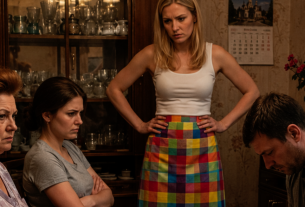
By six in the evening, the apartment was full of guests. Dima’s colleagues came, along with two married couples and his old university friend Sergey and his wife. Dima was in high spirits, joking constantly, pouring champagne, and clearly enjoying his role as host.
Katya, however, did not feel like the hostess. She felt like hired help.
She rushed between the kitchen and living room, carrying dishes, changing plates, making sure everyone’s glass remained full. Her mother-in-law sat at the head of the table, in the place that by right should have belonged to Katya, graciously accepting compliments on her appetizer. She had, after all, brought her famous aspic.
When it was time for the main course, Katya carried in the duck, and the guests murmured approvingly. Dima stood up with his glass.
“I want to propose a toast to the most important women in my life,” he began, and Katya’s heart stopped for a moment. “To my mother, who has always been my support…”
He stepped over to Valentina Petrovna and kissed her on the cheek. His mother beamed.
“…and to my Katya, who tries her best to live up to expectations.”
He pecked Katya on the temple without even looking at her.
“Tries her best to live up to expectations.”
As though she were a puppy performing a command.
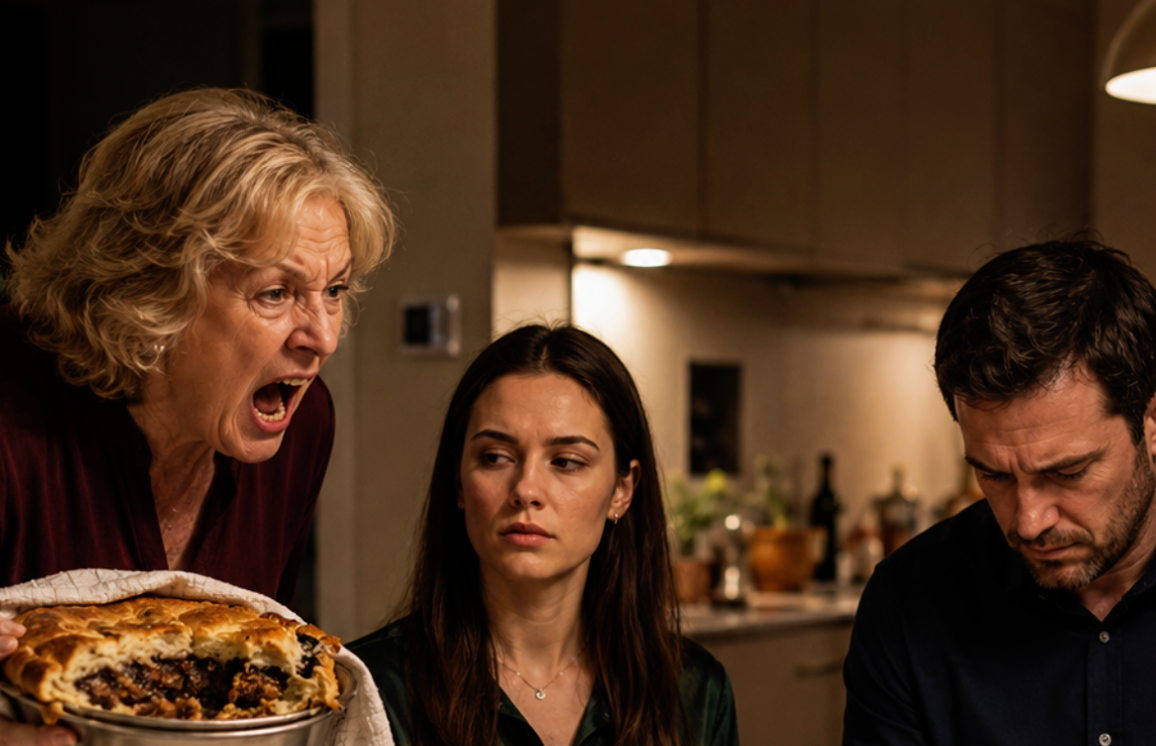
Katya swallowed her hurt and went into the kitchen for the pie. This was supposed to be her crowning achievement. A golden crust, delicate pastry, a filling that melted in the mouth. She placed the pie on the table, and the guests gasped. It truly looked magnificent.
Valentina Petrovna slowly, almost theatrically, cut herself a piece. She raised it to her mouth. Chewed. Put down her fork.
Then, looking Katya directly in the eyes, she said loudly enough for everyone to hear:
“A little dry. And the spinach is bitter. Then again, Katyusha has never had much talent for cooking. Dimochka only eats out of politeness because he’s afraid of upsetting you.”
An awkward chuckle rippled around the table. One of the guests froze with a fork halfway to his mouth.
Katya felt blood rush to her cheeks. She opened her mouth to object, but her mother-in-law was not finished.
She stood up, picked up the serving dish with the pie—the very pie made from her mother’s sacred recipe—and headed toward the trash can.
“I won’t let anyone ruin my son’s stomach,” she said.
And with one movement, she tipped the entire pie into the garbage.
A dull thud echoed through the sudden silence.
“There. My cake will finish the dinner. I spent the whole night baking it.”
Katya stared at the trash can, where her pie now lay among vegetable peelings and used tea bags—crushed, ruined, soaked in the smell of garbage.
Her mother’s recipe.
Her memories.
Her love.
Something inside her snapped.
Yet outwardly, she remained calm.
Slowly, very slowly, she untied her apron, lifted it over her head, and carefully hung it on the hook beside the stove.
“From this day forward, I am no longer cooking in this house,” she said quietly but clearly. “At all.”
A ringing silence fell over the room.
Dima gave a nervous laugh.
“Katya, come on. What’s wrong with you? Mom was only joking. You know what she’s like.”
“That was not a joke, Dima,” Katya replied without looking at her husband. “That joke cost me five years of my life. I am no longer taking part in this circus.”
She turned and walked out of the living room.
Behind her, Valentina Petrovna said in an exaggeratedly sweet voice loud enough to be heard all the way down the hallway:
“Never mind. She’ll get over her tantrum. She was never much of a cook anyway. But don’t worry, I’ll always feed you.”
Katya entered the bedroom, closed the door, and sat on the bed. Her hands were trembling.
She picked up her phone and opened a photograph of herself and her mother baking the first pie Katya had ever made. Katya was eleven in the picture, with ridiculous little pigtails and flour all over her face. Her mother had an arm around her shoulders and was laughing.
Katya stared at the screen and, for the first time in five years, felt no desire to make peace, give in, or make herself convenient.
Where patience had once lived inside her, a cold and quiet fury was now growing.
The next morning, the kitchen greeted Dima with sterile cleanliness.
No pots on the stove.
No sandwiches on the table.
No smell of freshly brewed coffee.
Katya sat at the table with Alice, their three-year-old daughter, feeding her oatmeal with berries. In front of Katya herself stood a cup of black coffee.
“Where’s breakfast?” Dima asked in confusion.
“There’s food in the refrigerator,” Katya replied calmly. “The stove works. Cook.”
“What do you mean, cook?” He frowned. “Are you seriously upset about yesterday? Katya, come on. That’s my mother. You know what she’s like.”
“I do know what she’s like,” Katya agreed. “That is exactly why I am no longer cooking.”
Dima stood there for a moment, expecting her to laugh and say it had been a joke.
Katya simply continued feeding their daughter without looking at him.
With an irritated bang, Dima slammed the refrigerator door, grabbed an apple, and left for work.
And so a new reality began.
Katya kept her word.
She did not cook for her husband or her mother-in-law.
At all.
Not once.
She still fed Alice simple, healthy food, which the two of them ate together in the nursery at a small table. Katya cooked for herself too, but only exactly as much as she could eat in one sitting so that nothing would be left in the refrigerator to tempt Dima.
During the first few days, her husband tried to laugh it off.
He ordered pizza, sushi, and burgers.
On the third day, he woke up with heartburn.
On the fourth, with a heavy feeling in his stomach.
On the fifth, he stared longingly at a photograph from the previous year’s family dinner, with meat patties and mashed potatoes, mushroom soup, and cherry pie.
Back then, Katya had still cooked with pleasure.
Now she did not.
When Valentina Petrovna heard about her daughter-in-law’s rebellion, she reacted predictably.
She began arriving every day with containers of her own food. Borscht in a plastic tub, meat patties wrapped in foil, fruit drink in a three-liter jar.
She occupied the kitchen, reheated her meals, fed her son, and demonstratively left behind a mountain of dirty dishes.
Pots with dried grease stuck to the sides.
Plates covered in congealed sauce.
Frying pans that needed to soak for hours.
She washed nothing herself.
“I did the cooking,” she told Katya one day when they crossed paths in the kitchen. “Washing up is a woman’s duty.”
“Your dishes are your duty,” Katya replied, pouring herself some tea. “I won’t touch them.”
And she did not.
That evening, an exhausted Dima came home from work and was forced to wash the entire mountain of accumulated dishes himself.
He grumbled and cursed under his breath, but Katya remained firm.
She sat in the living room reading a book and did not even turn around when pots and pans crashed in the kitchen.
After a week, Dima finally lost patience.
He entered the bedroom, where Katya was putting Alice to bed, and sat down on the edge of the mattress.
“Katya, enough. Stop this circus. Mom is upset.”
“What is she upset about?” Katya asked quietly so as not to wake their daughter.
“Because you ignore her. Because you’ve stopped fulfilling your responsibilities.”
“My responsibilities?”
For the first time in a long while, Katya looked her husband directly in the eyes.
“Dima, let’s be specific. You think my responsibility is to provide free domestic service for you and your mother, the woman who threw food made from my late mother’s recipe into the garbage?”
“Why do you have to exaggerate everything…”
“I am not exaggerating. It is a fact. And here is another fact: you sat there and said nothing. You did not stand up. You did not say one word in my defense. You allowed your mother to humiliate me in front of guests and destroy something precious to me. You chose the position of a comfortable observer, Dima. It was convenient for you that I endured everything, swallowed my feelings, and gave in. It was convenient for you to have two women fighting for the right to serve you. Well, I have left the game.”
He opened his mouth but found no answer.
The phrase “comfortable observer” lodged itself in his mind, and he replayed it again and again while lying awake at night.
Katya had said it calmly, without hysteria, and that made it hurt even more.
Two weeks passed.
The house changed.
Before, it had always been full of smells—baking, soups, meat stewing with vegetables.
Now it smelled of emptiness and, occasionally, burned oil when Dima attempted to fry eggs for himself.
Katya watched the transformation in silence, like a scientist observing a laboratory experiment.
It hurt, but the pain was cleansing.
She was stripping the pretty wrapping paper from their marriage and looking at what lay underneath.
It turned out there was nothing.
Beneath the wrapping there was no respect.
No gratitude.
No love.
Only a household that had rested entirely on Katya’s shoulders.
She bought groceries, planned the meals, checked expiration dates, preserved fruit drinks for winter, froze berries, pickled cucumbers.
All of it had happened invisibly, as though by itself, and Dima had never once considered how much effort lay behind an ordinary dinner.
Now that Katya had left the game, the entire system collapsed.
The refrigerator filled with ready-made convenience foods, the sink with dirty dishes, and the air with tension.
One afternoon, while Dima was at work and her mother-in-law had not yet arrived with her food containers, the doorbell rang.
It was their neighbor Lyuda, who lived one floor below, worked as a dispatcher for the emergency service, and knew everything about everyone.
People like her were walking encyclopedias of local gossip, yet somehow also extremely useful.
“Katya, lend me a couple spoonfuls of salt,” she asked from the doorway. “I’ve got soup on the stove and just realized I’m out.”
Katya invited her into the kitchen.
Lyuda looked around at the sterile countertops and glanced into the sink, where one lonely cup stood by itself.
“I heard you declared war,” the neighbor said with a snort. “The whole building is already talking about it. Valentina Petrovna writes in the residents’ group chat that you’re ungrateful and that she’s the only one holding the family together while you sulk over who knows what. And you know what else? She boasts that she’ll drive you out of the apartment because she knows her son better than you do, and he won’t put up with you for long.”
“Let her boast,” Katya said with a shrug as she poured salt into a small bag.
“You hold your ground,” Lyuda suddenly said seriously. “I’ve known that Valentina since the nineties. She’s always been like that. She’ll crush anyone she doesn’t like. Do you know what she did to her husband, Stepan Andreyevich? He used to be an artist. He painted. She ridiculed him and said his work was rubbish and that a man should earn real money. Now he’s retired, quiet as a mouse, spending all day sitting in his garage.”
Katya remembered those words.
They became another piece of the puzzle slowly forming in her mind.
The conflict intensified.
Sensing resistance, Valentina Petrovna launched an open offensive.
She started secretly slipping her homemade pastries to Alice when Katya was not looking.
But the three-year-old girl, raised by her mother, had firmly learned the rule: “We eat with Mommy.”
She refused her grandmother’s treats and repeated:
“I eat with Mommy.”
This infuriated Valentina Petrovna.
“You are turning the child against her grandmother!” she shouted, storming into Katya’s room while she was playing with her daughter.
“A child has the right to refuse something she doesn’t like,” Katya replied calmly, without getting up from the floor. “Sound familiar?”
Valentina Petrovna’s face turned crimson.
She recognized the reference to her own remark about the pie and nearly choked with rage. Unable to find words, she stormed out of the room and slammed the door so hard that Alice’s lower lip began to tremble.
“Mommy, is Grandma angry?” the girl asked.
“Grandma simply doesn’t know any other way to behave,” Katya replied, hugging her daughter. “But we should never let anyone hurt us, not even Grandma.”
That same evening, a conversation took place that clarified many things.
After dinner—cabbage rolls reheated from his mother’s containers—Dima went out onto the balcony for some air.
Katya followed him and closed the door behind her.
Below them, the city murmured, traffic lights blinked, and the air smelled of autumn dampness and approaching rain.
“Katya, I’m tired,” Dima said without turning around. “I’m constantly caught between two sides. Mom demands one thing, you demand another. I can’t live like this anymore.”
“Then choose,” Katya suggested quietly. “Once and for all. Either you stand with your wife, or you stand with your mother. There is no third option.”
Dima remained silent for a long time.
Then he turned toward her, and in the dim light from the streetlamp, Katya saw his face—tired and gaunt, with dark circles under his eyes.
“You don’t understand,” he muttered. “Mom has no one but me. Dad… you can see what he’s like. He’s retreated into his shell. If I abandon her…”
“And if you lose me and Alice?” Katya interrupted. “Have you thought about that?”
“You won’t leave,” he said, although there was no confidence in his voice. “You’re not like that.”
“You’re right. I’m not,” Katya nodded. “I endured things for a long time. But everyone has a limit. And you know what else? When we got married, you talked about how this apartment came to us from my grandmother. We used maternity capital to renovate it. You do remember that the apartment is legally mine, don’t you?”
Dima tensed.
His back became unnaturally straight.
“Well… yes, I remember. Why?”
“Because your mother is demanding that I transfer a share of it to you. For stability, as she puts it. Did you know about that?”
He did not answer.
But his silence was more eloquent than any words.
Katya looked at her husband and felt everything inside her turn cold.
He had known.
He had known and kept quiet.
He had waited for her to give in on her own, surrender everything herself, bend as she always had before.
“This doesn’t just smell like trouble,” she said slowly. “It smells like the truth. And the truth stinks.”
She went back inside, leaving Dima alone on the balcony.
He did not follow her.
He stood there looking down at the moving lights of cars, while one phrase repeated endlessly in his mind:
“The truth stinks.”
Katya did not sleep that night.
She lay in the darkness, listening to her daughter breathing in the next room and her husband softly snoring beside her.
Dima slept on his back with his arms spread out. His phone lay faceup on the bedside table.
He had forgotten to lock it before going to sleep—something that rarely happened, but he was exhausted that night.
Katya had not planned to check his phone.
She had always believed that marriage required respect for personal space.
But the screen lit up with an incoming message, and she glanced at it automatically.
She saw his mother’s name among the notifications.
She saw part of the message:
“…be patient, we’ll retrain the girl, and then there’s the apartment…”
Her hand reached for the phone almost by itself.
The messages were old.
Two months old, judging by the dates.
But they were still there.
Dima had not deleted them.
Katya read, and the ground seemed to disappear beneath her feet.
“Dima, be patient. We’ll retrain the girl, and then there’s the apartment in the city center. I told you that you should have married Liza. At least her parents have money and no ridiculous ambitions.”
And below:
“She has nowhere to go. She has nobody. Put enough pressure on her and eventually she’ll give you everything herself.”
Katya took screenshots.
Her fingers moved mechanically while her thoughts raced.
Liza.
The same Liza who had been Dima’s classmate and had dated him before Katya.
Tall, athletic, from a wealthy family.
Her mother-in-law had always used her as an example.
“Liza would do this.”
“Liza would never allow that.”
Katya had assumed it was merely an old woman’s grumbling.
Now she understood.
It had been a plan.
A plan developed over years.
The next day, Katya made a phone call—or rather sent a message—that was not easy for her.
She found Liza on social media. They did not follow each other, but they had mutual acquaintances.
Katya wrote a short message:
“Hello, this is Katya, Dima’s wife. Could we meet? I need to talk to you about something important.”
Liza replied almost immediately.
“Hello. Sure. I actually wanted to talk to you too.”
They met at a coffee shop two days later.
Liza was nothing like Katya had imagined.
She was neither arrogant nor smug, but rather a tired, slightly cynical woman with short hair and a perceptive gaze.
She worked as a family-law attorney, had two children, and had recently divorced.
“I don’t want to play games,” Liza said as she stirred her cappuccino. “You want to ask what happened between Dima and me and why his mother still keeps mentioning my name?”
“More or less,” Katya nodded.
“Then listen. Dima and I dated at university. I thought we were serious, but his mother ruined everything. She controlled every date we went on and called ten times in a single evening. When I tried to establish boundaries, she threw a hysterical fit and accused me of trying to separate her from her son. Naturally, Dima did not defend me. He said, ‘Mom is just worried.’ So I left him.”
“But your former mother-in-law still talks about you constantly,” Katya observed.
“Yes, and it’s disgusting. After you two got married, Valentina Petrovna called me. Can you imagine? She suggested I ‘talk some sense into the fool,’ as she put it. She said you were some rootless provincial nobody, that you had no money or connections, and that your apartment was the only reason marrying you had been worthwhile. She said the girl needed to be retrained and then you should be forced out.”
“And what did you say?” Katya asked quietly.
“I told her to go to hell. Permanently. I said I had no intention of ever living with a mother-in-law like her and that Dima was spineless if he allowed his mother to behave that way. I called him too, by the way. I told him, ‘Dima, wake up. Unless you defend Katya, you’re going to lose both her and your child.’ He just muttered something about me staying out of it.”
Katya sat in silence.
Everything was falling into place.
The performance with the pie had not been an accident.
It was part of a long, systematic campaign.
For years, her mother-in-law had provoked scandals and painted Katya as hysterical, preparing for the moment when she could tell her son:
“See? I told you so. She is unstable. Leave her. Take the apartment. I’ll arrange everything.”
“Thank you for telling me,” Katya finally said. “This explains a lot.”
“Call me if you need anything.”
Liza wrote her phone number on a napkin.
“I’m a good lawyer. If you need help, I’ll help you.”
Katya took the napkin.
It turned out to be one of the best decisions of her life.
She had no intention of sitting idle, but she also did not want to act impulsively.
She needed to understand exactly what she was dealing with.
And this was when someone she had barely noticed before entered the picture—her father-in-law, Stepan Andreyevich.
He had always existed somewhere on the periphery of family life.
A quiet, stooped man of about sixty-five with sad eyes and a habit of sitting in corners as though trying to occupy as little space as possible.
At family gatherings, he barely spoke. He only nodded and smiled.
Whenever Valentina Petrovna began another tirade, he seemed to shrink, as though expecting a blow.
Katya had once assumed it was simply part of his personality.
Now she suspected there was more to it.
The opportunity to talk came unexpectedly.
Katya was returning from a walk with Alice when she saw her father-in-law sitting on a bench outside the apartment building.
He was smoking and staring into nothingness.
“Would I be disturbing you?” Katya asked as she sat beside him.
“Not at all,” he said, putting out his cigarette. “I sit here often. At home… it’s noisy.”
“I understand.”
Katya nodded.
“Stepan Andreyevich, may I ask you something personal?”
He tensed but nodded.
“Why do you allow her to treat you that way? You are a grown man.”
Her father-in-law remained silent for a long time.
Then he began to speak quietly, almost with difficulty, but there was relief in his voice, as though he had been waiting years for someone to ask that question.
“I wasn’t always like this, Katya. When I was young, I painted. I had a studio in an attic. I exhibited my work. I was even invited to join the Artists’ Union. Then Valya became pregnant. She had to quit her job, and her parents stopped speaking to her because of some old family quarrel. I took three jobs. I stopped painting. She told me, ‘Your scribbles won’t feed a family. Be a man.’ So I became one. Gradually, I stopped being myself. She… she knows how to persuade you. She knows how to twist everything until you feel like worthless trash and she feels like your savior.”
“But you could return to painting now,” Katya said.
“Oh, no.”
He waved one hand dismissively.
“She says it’s foolishness. She says an old man should be ashamed to play around with paints. And I believe her, do you understand? I believe it myself now.”
Katya looked at this broken man and saw a possible future version of Dima.
Or perhaps her own future, unless she stopped everything now.
“Did you know she wants to take my apartment?”
Stepan Andreyevich lowered his head.
“I knew. And I said nothing. Katya, I… forgive me. I’m a coward. I’ve always been a coward. She’s strong. She puts pressure on people, and I… I couldn’t do anything.”
“Thank you for being honest,” Katya replied quietly.
She realized something important.
Her mother-in-law was not an evil genius.
She was a deeply unhappy woman who, many years ago, had herself fallen into the trap of so-called traditional values.
She had dreamed of freedom, but had been forced into marriage, motherhood, and the burial of her own ambitions.
Now she hated anyone who tried to preserve their own identity.
Katya was not simply a daughter-in-law to Valentina Petrovna.
Katya was everything Valentina had failed to become—a woman who refused to remain a victim.
But understanding did not mean forgiveness.
Katya had no intention of becoming like her father-in-law.
She had no intention of allowing herself to be broken.
Several days later, she announced:
“On Friday, I’m cooking dinner. A special one. For the whole family.”
Dima looked at her in surprise.
He assumed Katya had come to her senses, that the war was over and life would return to normal.
For the first time in weeks, he smiled.
“I’m glad, Katya. Is Mom coming too?”
“Definitely,” Katya replied. “And ask your father to come. And one other person. It will be… a farewell dinner.”
He did not notice her tone.
He did not hear how strange the word “farewell” sounded.
He was already calling his mother to happily announce that Katya had finally come to her senses.
On Friday, the apartment filled with smells that had been absent for months.
Katya cooked from early morning.
She baked that same pie—the spinach pie with feta and nutmeg from her mother’s recipe.
She mixed the dough slowly, almost meditatively, and every step felt like a ritual.
She was not cooking to please anyone.
She was cooking to say goodbye.
By seven in the evening, the guests had arrived.
Valentina Petrovna entered first—cautious but triumphant.
She believed she had won.
Stepan Andreyevich followed her and immediately retreated into a corner, avoiding everyone’s eyes.
Dima was lively and excited, bustling around and opening wine.
The fourth guest was Liza.
When Valentina Petrovna saw her, her face fell.
“And what exactly is she doing here?” she hissed.
“Liza is my friend,” Katya replied calmly. “I invited her. Please sit down.”
The table was set beautifully.
Crystal glasses.
Starched napkins.
The expensive dinner service Katya brought out only for special occasions.
At the center of the table stood the pie, golden and fragrant with butter and spices.
Valentina Petrovna demonstratively pushed her plate away when Katya put a piece in front of her.
“I’m not eating that,” she declared. “I remember what happened last time. Spare me your experiments.”
“As you wish.”
Katya shrugged.
“But I would like everyone to listen to me.”
She stood up.
Silence filled the room.
The same ringing silence that comes before something important happens.
Katya looked at everyone present.
Dima, tense.
Her mother-in-law, triumphant.
Her father-in-law, frightened.
Liza, calm.
“Two months ago,” Katya began, “in this very home, at this very table, a woman I once called Mom threw a pie made from my late mother’s recipe into the garbage. She called me a talentless cook and said she would not allow her son’s stomach to be ruined. My husband sat beside her and said nothing. That was the last day I considered this house my family.”
“Katya, maybe we shouldn’t…” Dima began.
She stopped him with one raised hand.
“We should. I remained silent for too long. I thought this was merely a generational conflict. I thought my mother-in-law simply could not accept that her son had grown up. But I was wrong. This was not just a quarrel. It was a deliberate campaign to destroy my self-esteem and take control of my property.”
“How dare you!” Valentina Petrovna exploded.
“I read your messages to Dima,” Katya continued calmly. “‘Be patient, we’ll retrain the girl, and then there’s the apartment in the city center.’ ‘You should have married Liza. At least her parents have money.’ ‘Put enough pressure on her and she’ll give you everything herself.’ Are those your words?”
The room became so silent that they could hear a television playing in the neighboring apartment.
Dima turned pale as paper.
Valentina Petrovna opened and closed her mouth, unable to find words.
“How did you…” Dima whispered.
“You forgot to lock your phone,” Katya replied. “But that is not the point. The point is that you knew. You knew and stayed silent. You allowed your mother to trample me, destroy things I loved, and plan how to take the apartment my grandmother left me. You sat and waited for me to break and give you everything voluntarily. You are a comfortable observer, Dima. You always have been.”
“Lies!” her mother-in-law screamed, jumping to her feet. “It’s all lies! You forged those messages! You have always been a lying bitch!”
“Liza,” Katya said without raising her voice.
Liza took a tablet from her bag.
“I have notarized screenshots of the correspondence,” she said in a professional tone. “I also have a recording of a telephone conversation in which Valentina Petrovna suggested that I ‘influence Dima’ and help ‘drive out the provincial nobody.’ The recording is two years old, but there is no expiration date on moral damages. Should Katya decide to take legal action, these materials can become part of her case.”
Valentina Petrovna collapsed back into her chair.
Her face changed from crimson to gray.
Dima sat completely still, staring at one point in front of him.
Katya continued.
“You talked about traditional values, Valentina Petrovna. About how a wife must be obedient, how a home depends on a woman, how the kitchen is a woman’s place. But do you know what I learned over these past two months? Traditional values are not slavery. They are not about one woman destroying another while hiding behind the sacred idea of family. Real traditions mean that everyone at the table is equal. That your work is respected. That your memories are not garbage.”
She turned toward Dima.
“You asked why I stopped cooking. You thought it was a whim. It was a test. And you failed it. You showed me that you did not want a wife. You wanted a function. A cook. A cleaner. A nanny. And an apartment. I stopped cooking, and suddenly the entire family smelled of truth. It turned out there was no love here. There was only domestic abuse and a battle over property.”
“I… I never wanted…” Dima stammered.
“You did,” Katya said sharply. “You wanted everything to resolve itself. You wanted your mother to calm down, me to give in, and the apartment to become yours. You thought I had nowhere to go because I had nobody. You were wrong. I have a daughter. I have the memory of my mother. I have myself. And that is enough.”
She removed her wedding ring.
A simple gold band Dima had placed on her finger five years earlier.
She dropped it into the glass of unfinished wine.
The ring struck the glass with a dull clink.
“I am filing for divorce.”
“You wouldn’t dare!” Valentina Petrovna shrieked. “This is our apartment! You have no right!”
“The apartment belongs to me,” Katya reminded her. “It is premarital property. Your eviction is only a matter of time.”
“Dimochka, say something!” his mother screamed at him. “Tell her she’s lying!”
But Dima said nothing.
He stared at the ring in the wine glass, and his lips trembled.
Katya could see that he wanted to say something, but the words would not come.
Perhaps he wanted to apologize.
Perhaps he wanted to fix everything.
But Katya no longer believed in repairs.
“Dinner is over,” she said. “Thank you for coming. Valentina Petrovna, Stepan Andreyevich, it is time for you to go home. Liza, please stay.”
Her mother-in-law left first without saying goodbye.
Her father-in-law shuffled after her, casting Katya a look full of sadness and shame.
Dima lingered in the doorway.
“Katya…”
“Go, Dima. There will be no more conversations.”
He left.
Only Katya, Liza, and Alice remained in the apartment.
Alice slept peacefully in her bed, unaware that her world had just changed forever.
“How are you?” Liza asked.
“Strange,” Katya replied. “I thought it would hurt more. But actually… it feels as though a weight has been lifted from my heart.”
“This isn’t over yet,” Liza said, opening her laptop. “We need to prepare the divorce petition properly. I have a plan.”
The divorce went faster than Katya had expected.
Dima contested nothing.
He signed the papers silently, staring off to one side, and for the first time Katya saw something in him that resembled awareness.
He had lost everything.
His wife.
His daughter.
The apartment.
His future.
His mother, of course, took him back, and now the two of them lived together in an old two-room apartment on the outskirts of the city.
Valentina Petrovna got exactly what she had wanted—complete control over her son.
But Katya suspected that this victory was indistinguishable from defeat.
Meanwhile, Katya began a new life.
She used savings Dima had never known about because he had never taken any interest in her affairs.
For several years, she had been running a baking blog that slowly gained followers, and she had managed to save some money.
Now she invested it in renting and renovating a small ground-floor space in their own apartment building—a former shoe-repair workshop.
It took three months to transform the place into a cozy café with an open kitchen.
The name came naturally.
“For Our Own.”
No pretension.
No extravagant furniture.
Wooden tables.
Warm light.
And on the walls, paintings by Stepan Andreyevich.
When Katya suggested displaying her father-in-law’s old work, he initially refused, but she insisted.
Now his landscapes—slightly naive but sincere, painted during the years when he had still been happy—decorated the café walls.
Many people came to the opening.
Lyuda brought friends from the building residents’ chat.
Liza came with her children.
Young mothers Katya had met while taking walks with Alice also came.
But the most unexpected guest was Stepan Andreyevich.
He stepped timidly through the door and froze when he saw his paintings.
“Those are… mine,” he whispered.
“They are,” Katya confirmed. “And they are beautiful. I want people to see them.”
He began to cry.
Quietly, almost shyly, but tears rolled down his wrinkled cheeks, and Katya hugged him.
For the first time in many years, someone had told him that what he created had value.
The café quickly became popular.
Katya cooked everything herself—soups, salads, pastries.
The signature dish, of course, was the same spinach pie.
She placed it in the display case every morning, and by noon there was never so much as a crumb left.
The taste of truth, as she privately called it, turned out to be in great demand.
One day, Dima walked into the café.
Katya had not seen him for six months.
He had lost weight.
His face was gaunt.
Deep shadows lay beneath his eyes.
He stood awkwardly by the counter, hesitant to come any closer.
“Katya… can we talk?”
“Talk.”
“I’ve realized everything. I… I learned to cook. Can you believe it? I can make borscht now. I fry meat patties. Mom still criticizes everything, of course, but I try.”
“Good,” Katya nodded. “It’s a useful skill.”
“Katya, maybe… maybe we could start over? I promise things will be different.”
Katya looked at him.
There was genuine pain and regret in his eyes.
Perhaps he really had understood a great deal.
Perhaps he truly had changed.
But she no longer felt anything for him except mild sadness.
“You are too late, Dima. Five years too late. I’m not going back into the pressure cooker. It was hot in there, but I couldn’t breathe. Now I can. And I don’t want to stop.”
He left.
Katya did not watch him go.
That same evening, after the café had closed, she sat at the table farthest from the entrance with a cup of tea.
In the kitchen, Alice was finishing the dishes. The girl was now allowed to help her mother and did so with great seriousness and importance.
Outside, twilight thickened.
Streetlights glowed.
Passersby hurried home.
And at a table in the warm light of the café sat Katya, looking at the display case where the final piece of spinach pie rested beneath the glass.
She thought about how strangely life had turned out.
She had stopped cooking in order to defend herself.
Then she had begun cooking again—but now only for people who valued her work, who did not throw her pies into the garbage, who did not demand but thanked her.
She had not lost her love of cooking.
She had not learned to hate the kitchen.
She had simply stopped being a slave on her own territory.
When you cook for those who respect you, cooking stops being an obligation.
It becomes a gift.
And that gift must be protected.
Stepan Andreyevich walked in.
He now worked at the café, helping in the kitchen, washing dishes, and greeting guests.
Valentina Petrovna had exploded with rage when she learned that her husband had found something meaningful to do, but there was nothing she could do about it.
He had left her quietly, without scandal.
One day, he simply did not return home.
He had said only:
“I don’t want to sit in the corner anymore.”
That one sentence had been enough to break the chains of forty years.
“How are you, daughter?” he asked, sitting beside her.
Katya smiled.
She liked it when he called her daughter.
There was something warm and almost forgotten in the word.
“I’m good, Stepan Andreyevich. Everything is good.”
Alice finished the dishes and ran to the table, demanding praise for her work.
Katya hugged her daughter and breathed in the scent of her hair, which smelled of children’s shampoo and fresh pastries.
Everything truly was good.
Once, Katya had thought she had lost her home when she stopped cooking.
It turned out she had merely scraped someone else’s mold from the walls.
And now she baked again.
Not to earn love.
Simply because she enjoyed it.
For people who were not allergic to the truth in her pie.
For people who understood that spinach does not turn bitter because of a bad cook.
Spinach turns bitter when it is watered with lies.
And as for those who did not like her cooking, Katya no longer opened the door to them.