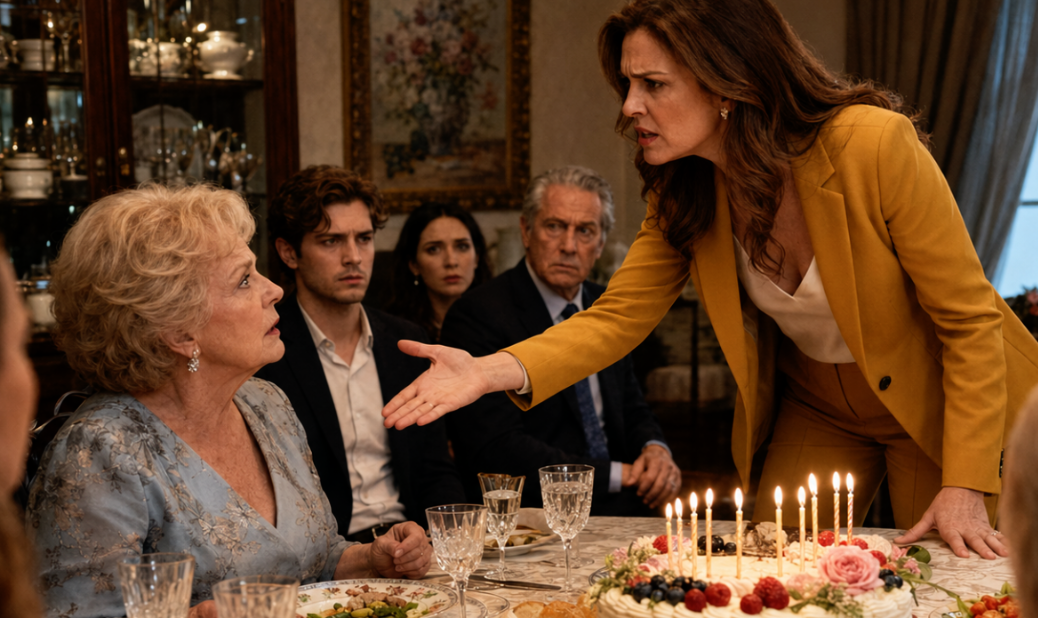
“You are obligated to help your mother! Her pension is tiny!” Artyom declared indignantly in the middle of the family dinner, slamming his palm on the table so hard that the dishes rattled.m
Elena slowly put down her fork and looked first at her mother, then at her brother. Tamara Pavlovna nervously twisted a napkin in her hands, avoiding her daughter’s gaze. Artyom’s wife froze with a wineglass in her hand.
“Really?” Elena said calmly, leaning back in her chair. “Then let’s calculate how much money Mom has invested in you over the past fifteen years. I wonder what the total will be.”
The table immediately fell silent. Artyom turned red, while their mother lowered her eyes even further and stared at her plate.
No one yet knew that this ordinary Sunday dinner would end in a major family scandal that would change their relationships forever.
Elena had not always been so firm. Five years earlier, she would have remained silent and swallowed her resentment, just as she had done her entire life.
She was forty years old and worked as the chief accountant at a large construction company. She lived alone in her own two-bedroom apartment, which she had bought with a mortgage and paid off without anyone’s help. Calm and responsible, she had long been accustomed to relying only on herself.
Her younger brother Artyom, however, had always been different. He was the family favorite. Since his childhood, their mother, Tamara Pavlovna, had considered her son special, talented, and deserving of the very best.
“Our dear Artyom is so gifted,” she would repeat. “He is going to become someone important!”
After school, their parents paid for Artyom to attend a prestigious private university. At the time, Elena was studying at a state-funded teacher-training college and earning extra money as a tutor.
“The government is paying for your education,” her mother explained. “But Tyoma needs our help.”
Then, for his twentieth birthday, they bought their son his first car. It was a used foreign model, but still expensive. For Elena’s birthday, they gave her a dinner set.
When Artyom decided to open a car wash, their parents invested almost all of their father’s savings. The business collapsed a year and a half later.
“Artyom is just going through temporary difficulties,” Tamara Pavlovna reassured her disappointed husband. “He is still young. He is learning.”
A few years later, they helped him open an auto-parts store. It closed after eight months. Then there was an online store, which survived for less than a year.
Elena, meanwhile, was always told:
“You are intelligent and independent. You can manage on your own. You are the strong one in our family!”
When she was saving for the down payment on her mortgage, no one helped her. When she renovated her apartment, she took out a loan. When her father became ill, it was Elena who drove him to doctors’ appointments and paid for expensive medication out of her own salary.
Their father died four years ago. After his death, Tamara Pavlovna remained alone in their three-bedroom apartment. A year later, she retired and suddenly began complaining that she did not have enough money.
At first, Elena genuinely helped her mother without giving it much thought.
“Lenochka, my pension is so small,” Tamara Pavlovna would sigh. “Please buy me enough groceries for the week.”
Elena bought them. Then she began paying for her mother’s medication. During the winter, she took over the utility bills because her mother complained that heating consumed half of her pension.
Gradually, however, the requests became larger and more persistent.
“Lena, I need twenty thousand rubles. Urgently,” her mother would say over the phone without explaining why.
Two weeks later, she would call again.
“Sweetheart, lend me another fifteen thousand. I will definitely pay you back.”
But she never did.
At the same time, Elena could not help noticing certain strange inconsistencies. Artyom had recently bought a brand-new crossover. That summer, his family had gone on vacation to Turkey, judging by the photographs they posted on social media. His children attended expensive tennis and horseback-riding lessons.
One day, after another call from her mother asking for money, Elena called her brother.
“Artyom, let’s help Mom equally. I have already transferred thirty thousand to her this month. Why don’t we each contribute fifteen thousand?”
He immediately became tense.
“Listen, I have a family, loans, and two children. Things are difficult for me. You live alone.”
That was the first time Elena seriously asked herself why the responsibility of caring for their mother rested entirely on her shoulders.
Shortly before Tamara Pavlovna’s seventieth birthday, Elena visited her mother to sort through old family documents for a commemorative birthday display.
Among the yellowed photographs, school certificates, and greeting cards, she accidentally found a folder containing bank statements and old contracts. At first, she intended to put it aside, but a familiar name caught her attention: Artyom.
Out of curiosity, she began leafing through the papers and calculating.
The figures shocked her.
A university contract showed that nine hundred and seventy thousand rubles had been paid for five years of tuition. Receipts for his first car totaled three hundred and fifty thousand. A signed agreement for the car wash recorded one million two hundred thousand. Another eight hundred thousand had been given to him for the auto-parts store. Bank statements showed regular transfers to her brother of ten to fifteen thousand rubles every month for many years.
Elena took out her phone, opened the calculator, and began adding the figures together. Her hands trembled slightly.
The total exceeded five million rubles. It was enough money to buy a good apartment in the city center or provide for a comfortable retirement.
She opened her laptop, created a spreadsheet, and meticulously entered every calculation, preserving copies of the documents.
For the first time, Elena saw the complete picture.
Her mother had not become poor by accident. She had willingly and deliberately invested almost all of the family’s savings in her younger son. Now she expected her daughter to pay for those decisions.
The entire extended family gathered for Tamara Pavlovna’s seventieth birthday: cousins, nieces, nephews, and longtime neighbors. The apartment was full of guests, and the table was overflowing with food.
During the meal, as the guests made their toasts, Tamara Pavlovna suddenly sighed and shook her head.
“What can I say? My pension is terribly small, and life is difficult. Thank goodness Lena helps me. She does not let me starve.”
Artyom immediately interrupted, raising his glass.
“Of course she helps!” he said loudly enough for everyone to hear. “She is obligated to support her mother. It is a daughter’s sacred duty.”
Many of the relatives nodded in agreement and looked approvingly at Elena.
“You are absolutely right,” Aunt Valya added.
Elena slowly stood up, calmly took out the folder of documents she had prepared in advance, and placed it on the table. Her heart was pounding, but her hands were steady.
“Before we discuss anyone’s obligations, let us remember the facts,” she began quietly but distinctly. “Artyom’s university education cost nine hundred and seventy thousand rubles. His first car cost three hundred and fifty thousand. The car wash cost one million two hundred thousand. The store cost eight hundred thousand. Then there was regular financial support every month for fifteen years. Altogether, our parents gave him more than five million rubles.”
With every figure she named, the table became quieter. Someone froze with a fork suspended in midair.
Artyom turned red.
“That was a long time ago! Mom and Dad wanted to do it!”
“And after all that,” Elena continued, looking her brother directly in the eyes, “you claim that you cannot help Mom?”
The relatives exchanged glances. Aunt Valya stared questioningly at Artyom.
“Tyoma, is this true? Did your mother really pay for all of that?”
For the first time in many years, public opinion turned against the beloved son.
Three days after the birthday celebration, Tamara Pavlovna called her daughter.
“Lenochka, I need twenty-five thousand rubles. I have almost nothing to live on until the end of the month.”
Elena took a deep breath.
“Mom, no. This time, ask Artyom.”
There was silence on the other end of the line. Then her mother spoke in astonishment.
“What do you mean, no? You have always helped me!”
“That is exactly why I am saying no now,” Elena replied, trying to remain calm. “I am no longer going to be the only person responsible for you. You have two children, Mom. Artyom must contribute too.”
“But he has a family! He has expenses!”
“And I have my own life,” Elena replied firmly. “A life I have the right to live.”
The conversation was long and difficult. Her mother cried and reproached her, but Elena refused to give in.
The following day, Tamara Pavlovna called Artyom. At first, he became indignant, called his wife at work, and complained to the relatives. But after the birthday celebration, everyone knew the truth.
Aunt Valya told him bluntly:
“Stop living at your mother’s expense. You should be ashamed of yourself!”
Under pressure from the family and his own conscience, Artyom was forced to begin sending his mother money. At first, the payments were irregular, but eventually he began transferring twenty thousand rubles every month.
For the first time in many years, the responsibility was divided fairly between the two children—or at least it was beginning to move in that direction.
A year had passed since that unforgettable birthday celebration.
Elena sat on the balcony of her newly renovated apartment with a cup of coffee, looking through photographs from her recent trip to Thailand. She had finally finished the renovations: new wallpaper, modern furniture, and beautiful curtains. She had bought everything she had previously been reluctant to spend money on.
She began traveling more often, enrolled in English-language classes, and bought herself a good coat. The constant sense of duty and guilt that had weighed on her shoulders for years had finally disappeared.
Artyom now regularly transferred money to their mother, although he still grumbled whenever they met.
“It is still unfair. My children are growing up.”
“Everyone has their own circumstances,” Elena replied calmly.
Tamara Pavlovna gradually began to understand that favoring one child for so many years could not pass without consequences. She became more careful with her words and called less often to ask for money.
The previous week, for the first time, she had asked Elena:
“How are you, sweetheart? I have not asked you that in such a long time…”
Their family relationships would never be the same again. The unconditional closeness they had once shared was gone. But for the first time, Elena felt that her hard work, independence, and efforts were no longer being taken for granted.
And that was enough to give her peace.