Tuesday morning began with the approach of a particularly absurd domestic situation. Oleg stood in the hallway, methodically buttoning his cashmere coat, and every movement radiated that heavy, impenetrable confidence that usually preceded some spectacular piece of foolishness.
He reached toward the key holder on the wall, took the spare electronic key to my car from its hook, weighed it casually in his palm, and slipped it into the inside pocket of his coat.
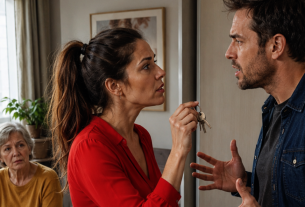
“From now on, you’ll only use the car with my permission,” my husband announced in an even, businesslike tone, looking at me through the mirror. “I’ve already taken the spare key. I’ve started having important meetings, and my position requires mobility. I need the car more than you do. So from now on, you’ll clear it with me first.”
I stared at the empty hook and understood perfectly well what this new arrangement meant. I, a forty-nine-year-old grown woman, was apparently at risk of losing unrestricted access to my own car. I had bought it three years before we were married, registered it in my own name, and it remained my personal property.
Yet with one simple gesture, Oleg had decided to take control of my travel, my work schedule, and my access to the vehicle. At the same time, he now had a fully functioning spare key in his pocket to a car he had decided to use without my consent.
Arguing, wringing my hands, or delivering an early-morning lecture about personal boundaries would have been pointless. It was far more useful to return control of the keys to the actual owner of the car.
“A key that has disappeared from my control is a security issue,” I said calmly, taking out my phone. “I’m booking an appointment with the official service center right now.”
Oleg adjusted his collar.
“Ira, spare me the provincial theatrics. The key is in a safe place. I’m your husband, not a car thief. I told you: the car is under my control now. Don’t make your life more complicated and invent problems where simple family logic works perfectly well.”
He slammed the door behind him, leaving me with the distinct realization that his “family logic” looked remarkably similar to appointing himself manager of somebody else’s vehicle fleet.
I took my main key out of my handbag. Heavy, black, with a silver logo.
My key.
I had no intention of playing the fascinating new game called, “Guess Whose Turn It Is to Travel in Comfort Today.”
I picked up my phone and called the dealership.
The drive to the authorized service center took about an hour. The city was caught in its usual morning traffic, which gave me plenty of time to think about how smoothly and almost imperceptibly Oleg had evolved from a polite passenger into a self-appointed transportation dispatcher.
At first, his requests had seemed perfectly normal. If he had several meetings in different parts of the city, he would ask in advance whether I needed the car.
Then the question gradually became a statement:
“I’m taking yours tomorrow.”
Later still, he started adjusting the seat in advance, changing the multimedia settings, and leaving me his own driving schedule as though it were simply understood that I would organize my life around it.
For a long time, I had treated it as nothing more than the domestic habit of a man who liked organizing everything.
But the spare key in his pocket was no longer organization.
It was an access pass he had issued to himself for someone else’s property.
Oleg was generally the sort of person who expanded into every available space. He liked occupying territory. If he sat down at the kitchen table, his elbows, phone, and planner automatically annexed the territory belonging to the saltshaker, the bread basket, and my coffee cup.
He wasn’t exactly a tyrant in the classical sense of the word. No. He was calculating, intelligent, held a good position at work, and sincerely believed that the world was arranged as a hierarchy—and that, by an astonishingly fortunate coincidence, he happened to be sitting at the top of it.
His invasion of my automotive life had begun almost sweetly.
At first, there had been occasional requests.
“Irochka, I’ve got a complicated route today. Could you lend me your little beauty on Tuesday?”
Then the requests became statements of fact.
“I’m taking yours tomorrow. I have to go to the other side of town.”
I had taken a philosophical attitude toward it. After all, we were a family. Why make unnecessary complications or act possessive?
But gradually, “your little beauty” became simply “the car,” and eventually it became “my transportation.”
Oleg began adjusting the seat for himself with such monumental thoroughness that whenever I got behind the wheel afterward, I felt like a child who had been allowed to sit in the engineer’s cab of a locomotive.
He reprogrammed the radio stations, replacing my favorite jazz with stern business channels where serious people with dispatchers’ voices discussed markets and logistics.
And his comments were an art form all their own.
“Ira, you drive too gently,” he would say when I slowed normally at a traffic light. “A car is a logistics tool, not a place for improvisation. Your sense of the vehicle’s dimensions is occasionally more decorative than functional.”
He always said it in the tone of a family driving instructor nobody had appointed.
His verbal poison was carefully measured—mundane, never openly vulgar, but always carrying the same faint aftertaste of contempt.
He never swore at me. He simply spoke to me as though I were a slightly dim intern who had accidentally been entrusted with a complicated piece of equipment.
And that morning, the intern had apparently been officially suspended from operating it.
The authorized service center greeted me with the smell of rubber and polish. Everything there was calm, polite, and refreshingly pragmatic.
I approached the reception desk.
The service advisor, a young man wearing a badge that said ANTON, looked at me over his monitor.
“Good morning. How can I help you? Scheduled maintenance?”
“Good morning, Anton. No, I have a security issue.”
I placed my main key, vehicle registration certificate, and passport on the spotless white counter.
“I no longer have access to the second key. I don’t know where it is or whose hands it is in, but that person believes he has the right to decide how my car is used. I need the missing key removed from the list of authorized keys, and I want only my current key to remain active.”
Judging by Anton’s reaction, he had probably witnessed more than a few family dramas unfold against the backdrop of body repairs and brake-pad replacements.
He asked no unnecessary questions. He simply checked my documents and confirmed that the car was registered in my name and that I had the functioning key with me.
Oleg’s philosophy of family relationships meant absolutely nothing to the service center. As far as they were concerned, the owner of the vehicle was standing in front of them asking to change the list of electronic credentials authorized to access her car.
“We can do that based on the owner’s documents,” Anton said professionally, typing on his keyboard. “We’ll connect the diagnostic equipment, remove the missing key from the authorized list, and register your existing key again. After that, the buttons on the remote key should no longer provide access to the vehicle, and the engine won’t start with it because the immobilizer won’t authorize ignition. If the fob contains a mechanical key blade, someone may still be able to physically unlock the door. Depending on the system, doing that may trigger the factory alarm. The electronic key can only be restored to the authorized list through a new legitimate registration procedure.”
“That’s exactly what I need,” I nodded.
They drove the car into the service area, while I settled into the customer lounge and opened my work messages.
No magic, secret applications, or spy tricks were required.
I made the decision. The service center was simply performing a technically available procedure using my documents and my remaining key.
I picked up my phone.
Oleg needed to know about the deactivation in advance. If he still chose to test the key after being warned, that would be entirely his decision.
He answered after the third ring.
I could hear voices and clinking dishes in the background. Apparently, he was having lunch with business partners.
“Yes, Irina. Is something urgent? I’m in a meeting right now, so I can’t talk for long.”
“I’ll be very brief, Oleg,” I replied. “I’m at the service center. Right now, they’re removing your spare key from the authorized list. Once the procedure is complete, its buttons won’t unlock the car and it won’t start the engine. If you use the mechanical blade, you may still be able to open the door, but it won’t give you authorization to start the vehicle.”
“Ira, you make everything unnecessarily complicated. You can’t just take a physical key and make it useless.”
“You’ll still have the key fob,” I said. “But it will no longer have electronic authorization to start the car. I’m warning you in advance.”
“Listen to me carefully. I have an important off-site session tomorrow, followed by two more meetings. The car needs to be in our parking space, fueled and ready. Don’t play games with my schedule. This is about my work.”
“Then you have even more reason to arrange alternative transportation in advance.”
“The car will be in my parking space,” I corrected him. “And you’ll have to transport your reputation some other way.”
I ended the call without waiting for an answer.
Forty minutes later, Anton brought my clean, gleaming car around and handed me my one and now completely exclusive key, along with the printed service order.
“Done. The second key has been removed from the authorized list. It won’t start the engine.”
“Thank you, Anton. That’s exactly what I wanted.”
That evening, I parked the car in its usual space beneath the windows of our apartment and went upstairs.
Oleg was already home.
He sat in the living room, radiating the highest possible degree of busyness and condescension toward my supposed “whims.”
He looked up when I entered and gave me a cold stare.
“Did you wash it?” he asked instead of saying hello. “I hope you didn’t actually spend money on that ridiculous trip to the service center. Your stubbornness can be charming when you’re choosing curtains, Irina, but in matters of logistics, it’s simply exhausting.”
“I warned you this afternoon, Oleg. Your key is now a souvenir from the days when you were still a polite passenger.”
“I’m leaving at eight tomorrow morning,” he snapped. “If you need to go somewhere, call a taxi. We’re a family, and resources should be used where they’re needed most.”
“I agree. But first, the resource has to belong to the person trying to control it.”
“Resource optimization usually begins with acquiring the resource,” I continued. “Using somebody else’s car without the owner’s consent isn’t logistics.”
Oleg remained completely convinced that he was right.
A substantial-looking electronic key sat in his pocket, and apparently its physical presence alone was enough to make him feel that he was still in control of the situation.
Wednesday morning started early.
Oleg was fully prepared, dressed in his best dark-blue suit and smelling of expensive cologne and absolute self-confidence.
I checked messages on my phone while he got ready.
“I’ll be home late,” he said, fastening his briefcase. “Don’t wait for me for dinner. I’ve got two more locations after the first meeting.”
“Then you definitely ought to plan your route in advance.”
He checked the spare key fob in his coat pocket and left the apartment.
I didn’t rush to the window. I simply went back to what I was doing.
A few minutes later, a car alarm sounded in the courtyard.
Apparently, the buttons on the remote key hadn’t worked.
So Oleg had used the mechanical blade and unlocked the door manually. The car responded with its factory alarm.
But physically opening a door and receiving electronic authorization to start an engine are two very different things.
A minute later, my phone rang.
Oleg was calling from the courtyard.
“What the hell is going on?!” he roared so loudly that I had to move the phone away from my ear.
There was no trace of his businesslike condescension left in his voice.
Instead, there was pure, undiluted panic—the panic of a man whose supposedly foolproof plan had collapsed.
“It’s screaming! It isn’t responding to the key! The dashboard says ‘Key Not Detected’! What did you do to it?!”
“I did exactly what I warned you yesterday that I was going to do, Oleg. The key has been removed from the authorized list. It can mechanically unlock the door, but it cannot start the engine.”
“I have a contract signing!” he snapped. “I can’t waste time right now. Come downstairs immediately with your key and start the car.”
“Your reputation is your responsibility,” I said softly but firmly. “You appointed yourself dispatcher, so start dispatching. Order a business-class taxi. They can have a car here in five minutes. I’m sure your status will survive the journey.”
“You did this deliberately.”
“No. I warned you in advance. You were the one who created the rule that the car could only be taken with permission. I simply revoked both permissions—permission for today and permission for any future trips without my consent. Good luck with your negotiations.”
I ended the call.
The courtyard became quiet again.
My car remained peacefully in its parking space, guarding its electronic boundaries.
Oleg was not some helpless man incapable of solving transportation problems.
He was perfectly capable of solving them once somebody else’s car stopped being his free default option.
He ordered a business-class taxi, made it to his important meeting on time, and afterward figured out transportation to his remaining appointments all by himself.
He lost no contracts and caused no problems at work.
For the first time in a long while, convenience simply stopped being automatically paid for with my car, my time, and my consent.
When he realized he needed reliable transportation for the following days, he rented a car—exactly the solution he could have chosen from the beginning.
That evening, he returned home late and placed the spare key on the table in front of me.
Now it really did look like nothing more than an ordinary key fob—one that no longer gave him access to start my car.
“Your vindictiveness cost me quite a lot today,” he said dryly. “Business-class taxis there and back, and then I had to rent a car for the rest of the week. Are you happy? None of this needed to happen.”
I picked up the useless key from the table and turned it over in my hands.
“No, Oleg. Your attempt to take control of my car cost your personal budget quite a lot. My car, my nerves, and my schedule stayed exactly where they belonged—with me. You wanted to manage your own routes. Now you have every opportunity to do exactly that.”
He opened his mouth to argue, then looked at the key in my hand and remained silent.
Apparently, his vocabulary had run out at exactly the same point as his ability to travel at somebody else’s expense.
The following morning, I went downstairs to my car.
I sat behind the wheel, moved the seat closer to the pedals with the familiar motion, readjusted the mirrors so I could see the road rather than the rear window, and turned on my jazz.
The engine started immediately, purring softly in response to the touch of my—and only my—key.
Oleg came out of the building five minutes later.
In the rearview mirror, I watched him grimly climb into the rental car that had been delivered for him.
He was solving his own transportation problems now and paying the full, one-hundred-percent cost of doing so.
I lowered the window.
“I won’t be issuing you permission to use taxis,” I said quietly, watching his displeased face in the mirror. “You seem to be handling that perfectly well on your own now.”