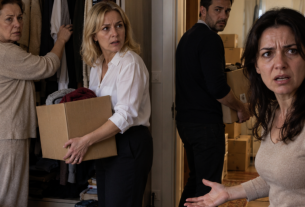
The long table was divided by wooden slats like a sheet of music by bar lines. Veronika pressed the silk down with her palm so the fabric wouldn’t shift and guided a thin piece of chalk along the edge. The work was going well—smoothly, steadily, without interruptions—and that didn’t happen every day.
The door opened without a knock, and two men entered the workshop: Artyom first, walking as though he owned the place, and Ruslan behind him, immediately tilting his head back to inspect the ceiling beams.
“Eight meters,” Ruslan said. “Man, this place is practically a hangar.”
“Eight and a half,” Artyom corrected him. “I told you.”
“Hello, Ruslan.” Veronika straightened and slipped the chalk into her pocket. “Did you need something?”
“We’re just having a look around.” Ruslan walked along the wall and rapped his knuckles against the brick. “Solid. Dry. Freezing, though.”
“It’s supposed to be cool in here,” she replied gently. “Silk doesn’t like stuffy rooms.”
“Silk,” Ruslan repeated with a smirk. “Right, right.”
“Ver, don’t get worked up,” Artyom said. “We’ll only be ten minutes. Ruslan just wants to figure out where to put the shelving.”
She set the ruler down slowly, so she wouldn’t answer with the first words that came to mind.
“What shelving, Artyom?”
“Regular metal shelves. He needs somewhere to store things. His hallway at home is packed, and Alisa’s already losing her mind.”
“Artyom,” Veronika said evenly, “I have an order in here. Three frames and eighteen meters of fabric. Due by the twentieth.”
“So what? There’s space. That corner over there is empty.”
“That corner is the drying area. Nothing is there because nothing is supposed to be there.”
Ruslan slapped the empty wall with his palm as if patting the flank of a horse.
“It’ll go right here,” he told his brother. “Two levels.”
“Ruslan.” Veronika turned toward him. “Are you listening to me? You can’t put it here.”
“I hear you,” he said with a good-natured nod. “Don’t worry, we’ll be careful.”
“It isn’t about being careful. It’s about the fact that this is my premises and my work process.”
“There we go.” Artyom spread his hands. “It starts again. ‘Mine.’ Are we a family or what?”
“We are,” she said. “That’s why I’m speaking calmly instead of throwing you out.”
Ruslan pretended not to hear. He paced across the floor, moving his lips as he counted.
“Twelve by six,” he announced. “Artyom, we can really spread out in here.”
“We?” Veronika asked quietly.
“Ver, don’t pick at words,” Artyom said with a grimace. “The man needs help.”
“The man hasn’t asked for anything. The man is already measuring square footage.”
“You always make everything heavier than it needs to be.”
“I’m not making anything heavier. I’m explaining. I have to work here, not watch someone else’s boxes lean against my slats.”
“Someone else’s!” Ruslan finally turned around. “Veronika, that was insulting. I’m your husband’s brother, and that makes me family to you too, by the way.”
“Family,” she agreed. “And I’m being polite to you. But the answer is still no.”
Artyom walked over to the table, picked up one of the slats, and twirled it between his fingers like a pencil. It had been selected from twelve pieces because it was perfectly straight.
“Please put that down,” Veronika said.
“I’m just holding it.”
“Put it down. It bends from the pressure of your hand.”
He set it back—deliberately slowly, with the smirk he had developed over the last year, the one she had initially mistaken for playfulness.
“All right,” Artyom said. “We’ll talk later. You’re just tired.”
“I’m not tired. I’m working.”
“Exactly,” Ruslan said as he headed toward the door. “You should rest more.”
They left, and she pressed the silk down again with her palm. In the meantime, the fabric had shifted, and she had to erase the line and draw it again.
That evening, Artyom came home in a good mood, carrying a bag of grapes and a plan that he presented as concern for her. Veronika listened while sitting on the arm of a chair, a notebook with calculations for her order resting on her lap.
“So, look,” he said. “Ruslan will put everything near the entrance. You won’t even notice it.”
“Artyom.”
“He’ll come in the evenings. Well, sometimes during the day. His schedule isn’t normal.”
“Artyom.”
“What?”
“I said no yesterday. Today it’s also no. Tomorrow it will still be no.”
He lowered himself into the chair opposite her and interlaced his fingers.
“Do you understand that this makes you look greedy?”
“I understand that it looks like a boundary. But since what you hear is ‘greed,’ let’s be honest. How much did he offer you?”
“He didn’t offer me anything!” Artyom snapped far too quickly. “You always think the worst of people.”
“I think exactly as much of people as they show me.”
“Ver, you’re acting like you suspect us of something.”
“I asked you a question. You answered louder than necessary.”
He drummed his fingers against his knee, then changed his tone, making it warm, almost domestic.
“Listen. Two levels of shelves. One month. He’ll get back on his feet, and that’ll be it.”
“I need twenty square meters of empty floor for cutting,” she said. “Not ‘somewhere in the corner.’ Flat, empty floor. I lie on it when I assemble large pieces.”
“So do it somewhere else.”
“Where?”
“You’ll figure something out. You’re the clever one in this family.”
“Artyom.” She closed the notebook. “I’m not going to ‘figure something out.’ That’s like asking me to write a text without letters.”
“There you go with the grand comparisons again.” He rolled his eyes. “Be simpler.”
“It couldn’t be simpler: no.”
He fell silent.
Then he spoke again, this time in a duller voice, and there was something unpleasantly new in it.
“Do you remember who brought you into this kind of life?”
“What kind of life?”
“A normal one. You were sitting in two rooms with your little wooden slats, and that was it.”
“I was sitting with my wooden slats and bought this workshop myself. After seven years.”
“Yeah. And now you remind me every chance you get.”
“This is the first time I’ve reminded you. Because for the second day in a row, people are explaining to me that what belongs to me doesn’t quite belong to me.”
“No one is explaining anything!”
“Yesterday Ruslan said, ‘We can really spread out in here.’ The word ‘we’ explains plenty.”
Artyom stood up, walked to the door, and turned around from the threshold.
“You simply don’t know how to be accommodating.”
“I don’t,” Veronika agreed. “I wasn’t made for that.”
Two days later, Alisa showed up without calling, carrying two boxes and wearing the expression of someone who had been promised everything long ago.
“Hello, Alisa,” Veronika said, holding the door. “I wasn’t expecting you.”
“I’ll only be a minute.” She came inside and set the boxes directly on the cutting table. “Artyom said it was okay.”
“Artyom said it was okay in my workshop?” Veronika calmly moved the boxes to the floor. “Sorry, but this is a worktable.”
“Oh, what’s going to happen to the table?”
“Nothing to the table. Something might happen to the order.”
Alisa sat on a stool and slowly looked around the room.
“You’ve got it good,” she said. “So much space. Ruslan and I are crammed into three rooms.”
“You’re crammed into three rooms,” Veronika repeated. “I live in two and work here.”
“But why do you need so much space? You’re not a factory.”
“Because the piece I’m assembling is eighteen meters long. You can’t fold it in half like a napkin.”
“That’s exactly what I mean.” Alisa shrugged. “You could fold it if you really tried.”
Veronika looked at her carefully—and suddenly saw not arrogance, but the serene confidence of someone who had already been promised something.
“Alisa,” she said. “Tell me honestly. Did Artyom promise you something?”
“What’s the point in hiding it?” Alisa smiled. “He said that by the end of the month you’d move things around: you’d work from home, and we’d take over this place.”
“‘Move things around’ how?”
“Well, you’ll sew at home. Ruslan will set up here. He’s a man. He needs the space.”
“He needs it,” Veronika repeated softly. “But apparently I don’t.”
“Don’t take offense,” Alisa said as she stood and straightened her jacket. “It’s just that what you do is more like a hobby. We have a real business.”
Veronika rarely shouted, not because she was submissive, but because yelling made her hands tremble—and she earned her living with her hands.
She called her sister.
“Ksyusha, are you free right now?”
“For half an hour,” Ksenia said. “What happened?”
“People are measuring the floor of my workshop for someone else’s shelving and calling my work a hobby.”
“Who is?”
“Ruslan’s wife. With my husband’s permission.”
“Okay.” Ksenia was quiet for a moment. “You remember the agreement, don’t you?”
“I remember.”
“Does he?”
“He never read it. He demanded it.”
“That,” Ksenia said, “is the funniest part of this whole story. And the saddest.”
“Back then he was sure he was protecting himself from me.”
“Back then he was sure that within a year you’d be asking him for money to buy thread.”
That evening, Veronika found Ruslan’s tape measure in the hallway and a note pinned under the keys:
“Measured it. It fits. I’ll bring the first load on Saturday.”
She put the note on the table and waited for Artyom.
“What is this?” she asked when he took off his shoes.
“A note.”
“I can see that. What does ‘I’ll bring it on Saturday’ mean?”
“It means exactly what it says.” He walked past her. “Ver, it’s already settled. Don’t start.”
“Settled by whom?”
“By me.”
“The workshop is mine.”
“We’re married.” He turned and looked at her almost pityingly. “Do you even understand how this works? Everything we have is jointly owned. Your workshop is ours. The car too. And your grandmother’s country house, by the way.”
“My grandmother’s house was registered in my name before we got married.”
“What difference does that make?” His voice rose. “You talk as though you were alone.”
“I am alone, Artyom. I have been for about two weeks. You just haven’t noticed yet.”
“There we go.” He waved a hand. “Drama.”
“Tell me one thing,” she said. “Did Ruslan pay you?”
He froze for a second.
“He gave me a deposit,” Artyom said. “For six months.”
“Six months of what?”
“Rent.”
“You rented out my property?”
“I made an arrangement with my brother! It’s not rent. It’s family.”
“How much?”
“That’s none of your business.”
“HOW MUCH, Artyom?”
“Two hundred and eighty thousand,” he forced out. “And don’t look at me like that. I didn’t waste it. I invested it.”
“In what?”
“A business.”
“Whose business?”
“Ours!” He slashed the air with his hand. “Ruslan’s! He’s buying a shipment, we’re going to make money, and I’ll rent you a new workshop—better than this one!”
“So you took money for property that belongs to me, gave it to your brother, and promised me that you’d rent me another place to replace my own property.”
“You twist everything.”
“I’m just putting the words in the correct order. I didn’t twist anything. You did it that way.”
He sat down on the stool in the hallway and began untying shoelaces he had already untied.
“You know what Ruslan told me?” he said. “He said you don’t even see me as a man. That I have to ask permission in my own home.”
“In my home,” Veronika corrected. “And you didn’t ask anything. You informed me.”
“There! Do you hear yourself? ‘Mine, mine.’ Then what am I?”
“You’re the man I spent seven years telling, ‘This is our home,’ even though the documents said otherwise. And you were the first one to turn it into ‘mine’ and ‘yours’ when you decided that what belongs to me could be used without asking.”
The next morning, Polina, her client, called.
“Good morning, Veronika. I’ll come by Thursday to look at the assembly.”
“Come by.”
“Is everything going according to schedule?”
“According to schedule,” Veronika said, looking at the empty floor where, for now, nothing belonging to anyone else stood. “And it will stay on schedule. I guarantee it.”
On Saturday, Ruslan arrived at half past eight with a truck, two helpers, and the cheerful energy of someone certain that no one would stop him.
Veronika stood in the open workshop gates with her back to the empty floor.
“Good morning, Ruslan,” she said. “You came for nothing.”
“Veronika, don’t start.” He didn’t even slow down. “Artyom knows. Everything’s been agreed.”
“Not with ME.”
“And who are you supposed to be, the president?”
“I’m the owner.”
Ruslan stopped, turned toward the helpers, and motioned to them.
“Unload it.”
“You hear that, guys? She’s the owner.” Then he turned back to her. “Veronika, let’s do this nicely. I’ve already paid.”
“You paid Artyom. Artyom had no right to take the money.”
“He’s your husband!”
“He’s my husband, not my owner.”
Artyom appeared, disheveled, and immediately positioned himself beside his brother instead of beside her.
That said more than words ever could.
“Ver, move,” he said. “Don’t make a scene.”
“You made the scene. I’m just not selling tickets.”
“You’re humiliating me in front of my family!”
“Your family is standing outside my gate with a truck. I didn’t realize humiliation was assigned according to those rules.”
Ruslan laughed and winked at the helpers.
“Artyom, explain it to her.”
“I tried.”
“Not very well.”
Veronika raised her hand.
“All right. Ruslan. One last time, calmly. Turn the truck around. Nothing is being stored here.”
“And I say it is.” Ruslan stepped forward and almost leaned into her with his shoulder. He didn’t shove her, but made it clear that he could. “And I’m going wherever I want right now.”
“No, you’re not.”
“Who’s going to stop me? You?”
“No,” she said calmly. “The gates.”
And she closed them in a single practiced movement, easily, because she had done it a thousand times.
The lock clicked.
From the other side came the sound of a palm slamming against metal, then another.
“Open up!” Artyom shouted. “Veronika! Open this immediately!”
“There’s only one key,” she said through the gate. “And it’s mine.”
“You’ll regret this!”
“Possibly. But not today.”
She stepped away from the gates and sat on a stool in the middle of the empty floor.
By evening, Artyom returned alone. He came inside, sat opposite her, and rubbed his face.
“You made me look like an idiot,” he said. “In front of my brother. In front of his workers.”
“You made yourself look like an idiot. You sold something you didn’t own.”
“I borrowed against the future!”
“Whose future?”
“Ours!”
“Artyom.” She looked him directly in the eyes. “We’re getting divorced.”
He didn’t even look surprised.
He looked delighted.
“Oh,” he drawled. “So that’s how it is. Fine. Divorce me.”
“Fine.”
“And what are you going to do?” He leaned back and began to grin. “Where are you going to go?”
“Home. I’m already home.”
“You’re home as long as I allow it.” He raised one finger. “Listen carefully, because I’ll only say this once. Everything acquired during marriage gets divided. The workshop was renovated during the marriage? Yes. The car was bought during the marriage? Yes. Did I help with the renovation? Yes.”
“You held a stepladder for three hours.”
“I helped!” he roared. “Half the workshop is mine. Half the car too. And I’ll have your country house transferred because you maintained it using family money!”
“Are you sure?”
“Divorce? You’ll walk away with nothing—it’s all mine!” he laughed loudly, slapping his knees. “You’ll leave here with nothing but your coat and handbag, and you’ll sew your little rags in some rented kitchen!”
Veronika stood, walked to the cabinet, took out copies of some documents, and silently placed them on his knees.
“What’s this?”
“The prenuptial agreement. The one you demanded before the wedding. Remember? ‘So nobody can make claims later.’”
“I remember.” He opened it. “So what?”
“Read it. Right now. Apparently your memory is as short as a guppy’s.”
He read for a long time.
The smile faded from his face slowly, as if someone were wiping it away with a wet cloth, stripe by stripe.
“It says here…” He looked up. “It says that everything that belongs to me is mine, and everything that belongs to you is yours.”
“Good boy.”
“And property purchased during the marriage belongs to the person whose money paid for it. And to whoever is named in the payment documents.”
“Yes.”
“But this…” He turned the page. “There’s a separate section about the workshop.”
“A separate one. And one about the country house. And the car. And the fact that you have no right to dispose of my property without my written consent. Clause eight. Look.”
“I didn’t sign this!”
“You did. There’s your signature. There’s the date. And there’s another signature on every single page. You said at the time, ‘Let’s hurry up, I’m waiting in the car.’ It was notarized.”
He flipped through the papers for another five minutes, back and forth, as though some new line might somehow appear between the pages.
“This needs to be annulled,” he finally said. “It’s unfair.”
“You came up with it.”
“I came up with it to protect myself from you!”
“And you got exactly what you wanted,” Veronika said. “You are completely protected from my property. It won’t touch you.”
“I gave you my life!”
“You gave two hundred and eighty thousand to another man in exchange for something that didn’t belong to you. That’s all you gave.”
She picked up her phone and dialed a number.
Not the next day. Not “after we calm down.”
Right then, in front of him.
“Nikita, hello. This is Veronika. I need two locks changed: the workshop gate and the front door of the apartment. Today. Yes, I understand it’s the weekend. How much? Fine. I’ll be waiting in an hour.”
“What are you doing?” Artyom half-rose from his chair.
“Handling things.”
She dialed a second number.
“Ruslan, good evening. This is Veronika. You gave Artyom two hundred and eighty thousand rubles. Those are your financial dealings and they have nothing to do with me.”
“Have you lost your mind?” Artyom hissed.
“Ruslan, one more thing. Nothing belonging to YOU will be stored in my workshop. Not on Saturday, not ever. If YOU come here, the gates will be locked, and that will be the end of the conversation. If you break in, I’ll file a police report, and then we’ll be talking about a criminal offense. Goodbye.”
She lowered the phone and looked at her husband calmly, the way one looks at a piece of furniture that needs to be removed.
“Now you,” she said. “You have two hours. Your things are in the hallway. I packed the bags. Sports gear, tools, your fur-lined coat—it’s all yours.”
“I’m not going anywhere!”
“Yes, you are. You’re not registered here, and this isn’t ‘our’ apartment. It’s my apartment. I bought it four years before I met you.”
“You have no right!”
“I do. And more importantly, I don’t have a minute to waste arguing. My client is coming on Thursday, and the piece has to be assembled.”
“That fabric is more important to you than your family?”
“What matters more to me is the work that fed me while you were ‘investing in a business.’”
He began pacing around the room in tight little circles, and his voice rose higher.
“Fine! Fine! I’ll sign whatever you want, but don’t do this so suddenly. Give me a month.”
“NO.”
“Two weeks!”
“NO.”
“Do you understand that I’ll have to go to my brother? I’ve got nowhere else to go!”
“You were just calling him the business of your life. Go. He’ll be happy to see you.”
“Veronika!” He stopped. “You’re not like this.”
“I am,” she said. “I’ve always been like this. Until today, you just mistook me for someone convenient.”
Ksenia called.
“Well?”
“Locks in an hour, bags in the hallway,” Veronika said. “I’ll file the paperwork Monday morning at nine.”
“That was fast.”
“If you drag things out, you spend the next six months explaining why you didn’t leave sooner.”
“What’s he saying?”
“He’s saying I’m not like this.”
“And what are you saying?”
“That I’m changing the locks.”
Artyom stood in the doorway listening.
“You knew all along,” he said. “All this time, you knew you had that piece of paper.”
“I knew the agreement was fair,” Veronika replied. “And I hoped it would never be needed. You were the one who pulled it out of the cabinet with your own hands—the day you decided that what belonged to me could be taken without asking.”
“I made a mistake.”
“You didn’t make a mistake. A mistake is when you don’t know. You knew, and you assumed I’d stay silent.”
Nikita, the locksmith, arrived even earlier than promised.
While he replaced the cylinder, Artyom carried his bags to the elevator in silence, his face turning crimson. After every trip, he looked back at her as if some miracle were still supposed to happen at the door.
“New key. Two copies,” Nikita said. “The old one won’t work for anyone anymore.”
“Thank you. Let’s do the workshop gate now.”
“Let’s go.”
At the workshop, she switched on the overhead lights and walked across the empty, clean floor from wall to wall—twelve steps and another six.
Then she lay down on it the way she always did when assembling a large piece, her cheek against the cool boards so she could see the entire line from one end to the other.
The line was straight.
Nothing belonging to anyone else stood on it.
On Thursday, Polina arrived at eleven, walked around the assembled frames, touched the edge, and said:
“Veronika, this is better than what I asked for.”
“I know,” she replied. “I’ve had a very free week.”
Ruslan called twice more.
The first time, he spoke almost sweetly.
“Veronika, we’re family. Let’s handle this like human beings. I need storage space.”
“Hello, Ruslan. There is nothing between us. People rent warehouses in other places, and I’m sure they’ll be happy to have you.”
“And where is Artyom supposed to live?”
“You’re his brother. That’s YOUR problem, not mine.”
Artyom wrote to her himself—a long message containing everything: “I was wrong,” “you never respected me,” “let’s start over,” and, buried near the bottom as if in fine print, a request:
“Could you transfer at least half the country house to me? I need something to start with.”
She read it.
Then she dialed his number—because some things deserved a spoken answer.
“Artyom.”
“Ver!” He sounded delighted. “You read it?”
“I did. I’ll answer in order. First: there will be no starting over.”
“You didn’t even think about it!”
“I thought about it for thirteen days. Second: the country house stays mine. All of it. Third: don’t write to me about property again. Not half, not a quarter. That subject is closed.”
“You’re destroying me!”
“I’m letting you go. There’s a huge difference. You’ll notice it eventually.”
“I have nothing to start with!”
“You have hands, a head, and a brother you invested everything you had in. Start there.”
“You’re cold.”
“I’m composed,” she said. “You saw me being soft for almost seven years. The softness ended the day your brother paced across my floor measuring it while you stood beside him and counted with him.”
There was silence on the other end.
Then he asked, this time without arrogance, almost as though he were asking himself:
“So all of this is because of the shelves?”
“No,” Veronika replied. “It’s because of the word ‘we’—a ‘we’ I was never invited into. The shelves were just the cherry on top.”
She ended the call, slipped the phone into the pocket of her apron, and returned to the table.
The silk lay flat.
The chalk moved obediently.
The line went exactly where she guided it.
Ksenia came by that evening and brought grapes—the exact variety Artyom used to bring.
They both noticed.
Neither said anything.
“Any regrets?” Ksenia asked.
“Not for a single minute.”
“And if he comes back with flowers and tears?”
“Then I’ll open the door,” Veronika said, “and show him what’s behind it. And behind it is a smooth, empty floor where I work. He’ll never stand on it again.”
“Harsh.”
“Maybe.” She adjusted the wooden slat. “He thought that document would protect him from me. Instead, it protected me from him. He can call it fate now.”