Ekaterina couldn’t remember the last time she had allowed herself to do absolutely nothing. Three years earlier, after taking out a mortgage on a three-bedroom apartment, she had learned to rely entirely on herself. She dealt with leaking faucets, found repairmen, and handled every negotiation with the bank about making early mortgage payments. Even a short trip outside the city felt less like a vacation and more like another reason to worry: What if something happened at home while she was away?
Her friend Svetlana had spent almost a month persuading her to come to the country house.
“Katya, it’s only two days,” she repeated during yet another phone conversation. “Do you even remember the last time you went somewhere without your laptop and a list of things to do?”
In the end, Ekaterina gave in, although packing proved more difficult for her than the trip itself. Before leaving, she stopped by her mother’s house to leave a spare set of keys—just in case a pipe burst or the alarm went off.
“Marina Pavlovna,” Ekaterina said, handing her the keys, “please use them only if something truly urgent happens. Water the flowers, check on the apartment—and that’s all. Don’t give the keys to anyone else, agreed?”
“Who do you take me for?” her mother replied, waving her hand with mild offense in her voice. “Of course I’ll only keep an eye on the place. Don’t worry.”
The two days at the country house passed with surprising calm. Svetlana had been right: away from the city, Ekaterina truly relaxed. For the first time in ages, she allowed herself to sleep until noon and stopped checking her work email every half hour.
Marina Pavlovna called several times during those two days to ask how the vacation was going. She encouraged Ekaterina not to hurry home and to enjoy nature while she had the chance.
“Katya, just relax,” her mother said during one of the calls, speaking in a gentle voice she hadn’t used with her daughter in years—without the usual criticism or lectures. “Everything is perfectly fine with the apartment. I checked.”
This unexpected display of care touched Ekaterina more deeply than she was willing to admit. Her relationship with her mother had long since become a succession of formal phone calls and occasional holiday visits. The sudden tenderness in Marina Pavlovna’s voice felt almost like a gift.
On the evening of the second day, Ekaterina returned home in an unusually good mood. She was already imagining herself unpacking her bag, making some tea, and spending the rest of the weekend enjoying the peace and quiet of her own apartment.
Something felt wrong even before she reached the door. Voices were coming from inside, and they clearly weren’t from the television. Ekaterina froze with the key in her hand and listened.
A child’s laughter.
A vaguely familiar woman’s voice.
She unlocked the door and froze on the threshold. The entryway, where normally only her own shoes stood, was crowded with unfamiliar children’s boots—small and brightly colored. Toys were scattered across the floor: building blocks, a stuffed rabbit with one ear torn off, and a toy car missing a wheel.
Cardboard boxes sealed with tape were piled against the wall. They had been labeled in marker: “Kitchen,” “Bedroom,” and “Child’s Room.”
Voices and muffled laughter came from the kitchen.
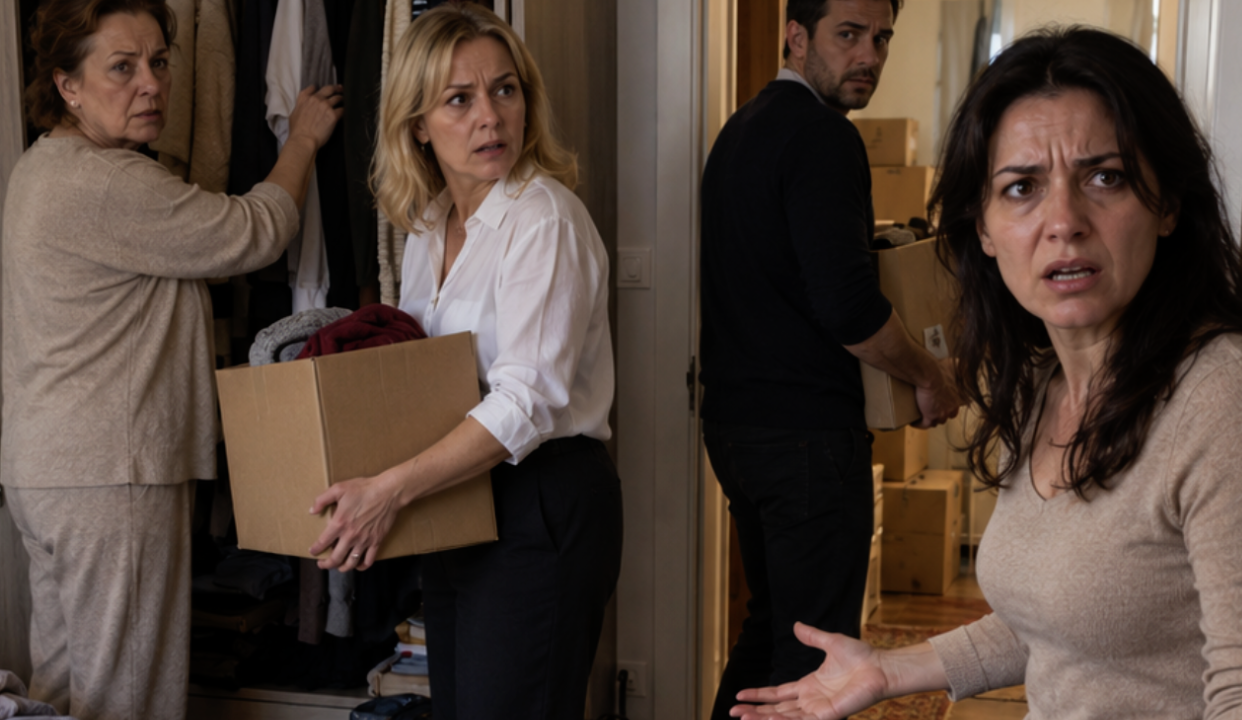
Ekaterina slowly walked farther inside, stepping over the toys. Her own belongings had been placed against the hallway wall, hastily stuffed into black garbage bags and cardboard boxes as though they were trash waiting to be taken away. Her jackets, shoes, and winter boots—everything that had been in its usual place only two days earlier—had been dumped there.
She abruptly opened the bedroom door.
Someone else’s bed linen covered the bed—pink with tiny flowers, nothing like the bedding Ekaterina had left before her trip. The wardrobe stood partly open. Instead of her clothes, unfamiliar garments hung inside: a woman’s dress, a man’s shirt, and a child’s snowsuit.
A wooden crib now stood by the window where her desk had once been.
Boris—whom Ekaterina didn’t recognize immediately because she had seen him only a few times at family gatherings—was calmly unpacking another bag and hanging shirts in the wardrobe as though he had lived there for years.
Her younger sister, Alyona, was arranging children’s books and toys on the shelves while humming quietly to herself.
“Why are your boxes in my bedroom, while my belongings have been dumped in the hallway?” Ekaterina asked from the doorway.
Her voice sounded even, almost casual, although something heavy and icy was already rising inside her.
The room fell silent for a moment. Boris froze with a shirt in his hands. Alyona turned around but didn’t dare to speak.
Marina Pavlovna emerged from the kitchen first, wiping her hands on a towel. She wore the expression of someone who had been pulled away from important household chores over something trivial.
“Katya, why are you getting so worked up?” her mother asked reproachfully, as though her daughter had been wrong from the very beginning. “Nothing terrible has happened.”
“Mom, please explain what’s happening in my apartment.”
“Alyona and her family are having a hard time right now, as you know,” Marina Pavlovna replied calmly and deliberately, as if reciting an explanation she had carefully prepared. “You have three whole rooms and live here alone. Your sister has a young child, and they can’t afford to rent a place right now. So I decided they could stay here for a little while until they get back on their feet.”
“You decided,” Ekaterina repeated slowly, feeling each of her mother’s words send another wave of cold through her. “Who gave you the right to decide anything concerning my apartment?”
Marina Pavlovna’s face flushed instantly, as though her daughter’s question had offended her to the very core.
“Can you hear yourself?” her mother exclaimed, her voice rising an octave. “Your own sister and her child have no roof over their heads, and you’re talking about rights! You’re heartless, Katya—that’s what you are! Normal people help their families instead of counting square feet!”
“I’m not counting square feet, Mom. I’m asking who gave you permission to enter my bedroom, remove my belongings, and move people into my home without asking me.”
“People?” Alyona exclaimed, stepping forward with an offended expression after remaining silent until then. “Katya, I’m your own sister! Do you ever think about anyone but yourself? You can’t even spare one room for your own family!”
“This isn’t about the room, Alyona. It’s about the fact that nobody asked for my permission.”
Boris put down the bag and spoke with the air of a man accustomed to settling matters directly and without unnecessary ceremony.
“Listen, the child needs the largest room. That’s obvious,” he said irritably, as though explaining a simple truth to someone slow-witted. “And why does a single woman like you need such a large bedroom anyway? Move into the smaller room and stop making a scene over nothing.”
Blood rushed to Ekaterina’s face, and she felt her barely restrained fury demanding release.
“This is my apartment, Boris. My property, and I have been paying the mortgage on it by myself for three years. None of you has the right to tell me which room I should live in.”
“Shout all you like,” Boris replied with a demonstratively indifferent shrug. “Our things are already here, and I’m not carrying them all back.”
“Relatives don’t even have the right to enter my bedroom without permission!” Ekaterina shouted for the first time during the conversation. “Let alone touch and remove my personal belongings! Who decided you could simply move into someone else’s apartment without so much as a phone call?”
“I raised you,” Marina Pavlovna shouted over her daughter, refusing to back down, “and I have every right to make decisions for the good of this family! You live alone with plenty of empty rooms, while your own sister is suffering! You should be ashamed, Katya!”
“Mom, you promised only to keep an eye on the apartment! To water the flowers and make sure everything was all right—not move other people in without my knowledge!”
“How can they be other people when this is my daughter and my son-in-law?” her mother exclaimed, throwing up her hands as though Ekaterina’s reasoning were absurd.
Encouraged by their mother’s support, Alyona moved closer and crossed her arms.
“Just leave everything as it is for a few months, Katya. What difference does it make to you? You have plenty of space.”
“Our things are already here,” Boris repeated forcefully. “I’m not taking them anywhere.”
Ekaterina looked at all three of them—her mother, her sister, and her brother-in-law—and, for a moment, felt like a complete stranger in her own home. It was as though the apartment she had purchased and paid for through years of hard work had been taken away from her during the two days she had allowed herself to rest.
“Clear out my bedroom,” Ekaterina said.
Her voice no longer carried the emotion it had before. It was cold, sober, and resolute.
“Put my belongings back where they were, and leave this apartment today.”
“Are you seriously throwing your own sister and her small child out onto the street?” Marina Pavlovna cried, throwing up her hands in theatrical horror. “At this time of night?”
“I am asking you to vacate the apartment that belongs to me—not to you or Alyona.”
“We aren’t going anywhere tonight,” Alyona declared, planting her hands on her hips. “It’s already evening, the child is tired, and where are we supposed to find somewhere to stay now?”
“You should have thought about that before moving your belongings here without permission,” Ekaterina replied, refusing to take a single step back.
Marina Pavlovna again tried to make her daughter feel guilty, listing everything she had supposedly done for her over the years—sleepless nights, exhaustion, and sacrifices made while raising her.
“I raised you and helped you get on your feet, and now you’re throwing your own mother out of the apartment!”
“Mom, you crossed the line when you took it upon yourself to make decisions about someone else’s home,” Ekaterina replied firmly, looking her mother directly in the eyes. “It doesn’t matter who raised me. That does not give you the right to decide who will live in my apartment.”
Amid a constant exchange of accusations, Alyona and Boris finally began gathering the things they had brought. They moved slowly and made a deliberate show of their displeasure, dropping boxes and speaking loudly enough for Ekaterina to hear every word about her selfishness and lack of compassion.
Boris dismantled the crib by the window, repeatedly casting resentful glances toward the apartment’s owner as though she were the one responsible for all the inconvenience.
Marina Pavlovna refused to admit she had done anything wrong. Until the very end, she continued calling her daughter ungrateful and predicting that she would grow old alone, with no grandchildren by her side.
“When you’re old, alone, and unwanted, you’ll remember this conversation,” her mother said while putting on her coat in the hallway. “Nobody will visit you, and nobody will help you. This is the life you chose.”
“Perhaps,” Ekaterina replied calmly, although the tension of the past hour was still vibrating inside her. “But I chose this apartment and paid for it myself, without anyone’s help. And I will decide what happens here.”
It took them approximately an hour to pack.
Alyona carried out bags of children’s clothes while avoiding her sister’s gaze. Boris hauled away the dismantled crib and the boxes, deliberately dropping them loudly by the door. Until the very last minute, Marina Pavlovna continued lecturing her daughter—sometimes muttering under her breath, sometimes raising her voice again.
Ekaterina no longer responded. She simply stood silently by the living-room window, waiting for the door to close behind her relatives.
When the apartment was finally empty, Ekaterina walked through every room, switching on the lights as though checking the boundaries of her home all over again.
In the bedroom, she stripped away the unfamiliar bed linen and stuffed it into a bag to be washed and returned. Then she rehung her own clothes, which took a long time to untangle from the carelessly piled heap inside the wardrobe.
The crib was gone, leaving only faint wheel marks on the parquet floor.
Ekaterina gathered the toys scattered around the entryway and living room and placed them in one large bag. She did it without anger, with the methodical precision of someone restoring order after an invasion.
By midnight, the apartment had begun to resemble itself again—familiar, peaceful, and belonging to just one person.
Her phone rang and buzzed with messages all evening—first from her mother and then from Alyona. The messages varied. In some, Marina Pavlovna tried once again to appeal to her daughter’s conscience. In others, she apologized, only to immediately begin accusing her again. Sometimes she merely asked whether Katya had “calmed down yet.”
Ekaterina read the first few messages before turning off her notifications, deciding that she had endured enough conversations for one day.
The following morning, before her mother could call again, Ekaterina went to a locksmith and arranged to have every lock in the apartment replaced.
She did it not out of revenge, but because she had come to one simple and unmistakable conclusion: she would never again entrust the keys to her home to anyone—not even those closest to her—if they were capable of disregarding her wishes so easily.
Marina Pavlovna called several more times over the following week. Sometimes she apologized, sometimes she tried once again to prove that she had been right, and sometimes she asked how soon her daughter would “get over it” and allow the grandchildren to visit, at least on weekends.
Ekaterina always responded briefly and politely but remained unwavering: no one else would ever have a key, and all future visits would be possible only by prior arrangement and with her personal consent.
Her relationship with Alyona deteriorated seriously. Her sister remained offended for a long time and called what had happened a betrayal. Boris stopped greeting Ekaterina altogether whenever they happened to meet at family gatherings, which both sides continued attending solely for Marina Pavlovna’s sake.
Ekaterina did not try to recreate their former closeness artificially. She simply continued living her life calmly and steadily, as she had done for all those years, relying only on herself.
A month later, she went to Svetlana’s country house again. This time, she didn’t feel the slightest concern about what might be happening at home in her absence.
The apartment greeted her exactly as she had left it: quiet, empty, and belonging entirely to her.
And now, only one person in the entire world possessed its keys.