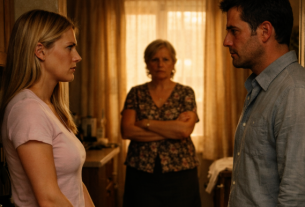
“Stas, this is absolutely outrageous!” the voice on the phone rang with indignation, cutting through the evening silence in the apartment. “Your precious Lenochka just took her card back from me! Snatched it right out of my wallet!”
Stas closed his eyes and rubbed the bridge of his nose. He had just come home after a difficult day, dreaming of quiet and a hot dinner, but his mother, Tamara Ivanovna, as always, had chosen the perfect moment for another scandal.
“Mom, calm down. What happened? Did Lena come by your place?”
“Of course she did! Dropped in for five minutes, acting all businesslike, with a carton of kefir. And while I was putting it in the refrigerator, she just—bam!—pulled the card out of my wallet. She says she’s going to block it and issue herself a new one. What kind of behavior is that?”
Stas sighed. He knew perfectly well that Lena could never have “snatched” anything. His wife was the embodiment of tact and calm, and it took serious effort to push her out of patience. Apparently, his mother had managed it.
“Mom, it’s her card. She has the right to take it back whenever she wants.”
“She has the right?” Tamara Ivanovna flared up. “And according to you, I don’t have the right to a normal life? I had already picked out a fur coat for myself with her bonus! Mink, at ‘The Snow Queen,’ on sale! Don’t I deserve to wear something beautiful at my age? I gave my whole life to you, worked three jobs so you would have everything!”
Stas felt a dull irritation boiling inside him. This conversation was painfully familiar. Any attempt to set boundaries was treated by his mother as a personal insult and black ingratitude.
“Mom, we’ve already discussed this. The bonus is Lena’s money. She earned it. What does your fur coat have to do with it?”
“It has everything to do with it, son, because I am your mother! And who is she? She came into everything ready-made! Into your apartment, the one your father and I earned with blood and sweat! And now she’s tearing the bread right out of my mouth!”
Lena came out of the kitchen. She silently walked up to her husband, put her arms around his shoulders, and rested her head against his back. Her presence had a calming effect. Stas covered her hand with his.
“Mom, let’s end this conversation. Nobody is tearing anything away from you. We help you, and you know that. Goodbye.”
He pressed “end call” without waiting for a new wave of accusations. Silence hung in the apartment, thick and tense.
“She called, didn’t she?” Lena asked quietly.
“Yes. She complained about the card. And the fur coat,” Stas said with a crooked smile.
Lena moved to the window and looked out at the lights of the night city. Her narrow shoulders were tense.
“I couldn’t take it anymore, Stas. I stopped by after work and brought her the medicine she asked for. And she was sitting there with a magazine, circling fur coat models. Then she says to me, as if in passing, ‘Lenochka, you don’t mind if I withdraw about one hundred and fifty thousand from your bonus card, do you? I saw a little fur coat I liked. It will be just enough.’ I was speechless. I said, ‘Tamara Ivanovna, this is my bonus for a huge project. I worked on it for two years. Stas and I were planning to spend that money on renovations.’ And she says, ‘The renovation can wait, but winter is just around the corner. I can’t walk around in an old down jacket like some beggar.’ And she looked at me as if I already owed her.”
Stas came over and hugged his wife. He felt her trembling slightly.
“You did the right thing. It was long overdue. It’s my fault for letting this situation go so far.”
“But I gave her the card with good intentions,” Lena said bitterly. “So she could buy groceries calmly and not worry about prices. I topped it up every month. But I didn’t think she would treat it like her own personal unlimited account. She started buying expensive cosmetics, going to salons, ordering things online… I saw the statements. But I kept quiet. I thought it was awkward somehow, since she’s your mother…”
“Exactly. My mother. And I’m the one who should deal with her. Forgive me for dragging you into this.”
They stood silently for a long time, looking out at the city. Both of them understood that the story with the card was only the beginning. Tamara Ivanovna would not back down so easily.
A week passed. Tamara Ivanovna did not call. That silence was worse than any scandal. Stas knew his mother: she had gone quiet in order to strike from another direction. And he was not mistaken.
On Saturday morning, he received a call from Aunt Galya, his mother’s younger sister.
“Stasik, hello! How are you? You’ve completely forgotten us old folks. Listen, there’s something going on… Tamara has completely fallen apart. Her blood pressure is jumping, her heart is giving her trouble. I stopped by yesterday, and she was lying flat, couldn’t even get up. Maybe you could come visit your mother? She needs help.”
Stas tensed. The “bad heart” scenario was one of his mother’s favorite weapons.
“Is it serious? Did you call an ambulance?”
“Oh, you know her,” Aunt Galya rattled on. “She runs from doctors like from fire. Says they’ll ‘treat her to death.’ What she needs is your attention, a son’s care. She misses you. She says your Lenochka has completely taken you into her hands and won’t even let you see your own mother.”
“Here we go,” Stas thought. His mother had started working on the relatives, presenting herself as the victim and Lena as a cunning homewrecker.
“Aunt Galya, Lena and I work all week. I’ll definitely come see Mom, but a little later. We have plans right now.”
“What kind of plans can there be when your mother is on the verge of death?” A note of condemnation appeared in his aunt’s voice. “You young people have become completely hard-hearted. Nothing sacred left in you.”
Stas restrained himself from hanging up. He said goodbye and looked at Lena, who had heard the whole conversation.
“She’s mobilized the heavy artillery,” Lena said with a sad smile. “Now the whole family will think I’m a monster starving her poor mother-in-law and keeping her only son away from her.”
“Let them think what they want,” Stas said firmly. “We’ll go. But not now. We’ll go this evening. And we’ll go together.”
They arrived at Tamara Ivanovna’s place around eight in the evening. The “dying woman” opened the door herself. She certainly did not look well: pale, with circles under her eyes, dressed in an old terry robe. But she hardly looked like someone who had been “lying flat.”
“Finally,” she mumbled, not looking at Lena and addressing only her son. “I thought I wouldn’t live to see you. Come in. If you’re not too disgusted.”
The apartment smelled of Valocordin and something sour. Dirty dishes stood on the kitchen table. Tamara Ivanovna had always been neat, so the mess was clearly demonstrative.
“Mom, how are you feeling?” Stas asked, looking carefully into her eyes.
“How can I be feeling? Alone as a finger. Needed by no one. Blood pressure one-eighty over one hundred. Dizzy. Stabbing in my chest.”
She theatrically pressed a hand to her heart. Lena silently walked into the kitchen, put on gloves she always carried in her bag for such cases, and began washing the dishes. Tamara Ivanovna watched her with a contemptuous look.
“No need to do me any favors here. I can manage myself. Somehow.”
“Tamara Ivanovna, we brought you groceries,” Lena said calmly without turning around. “And a new automatic blood pressure monitor. Let’s measure your pressure.”
This suggestion clearly had not been part of Tamara Ivanovna’s plan.
“I don’t need anything measured! I know my own body better than any machines!”
She turned to her son.
“Stas, we need to talk. Alone.”
Stas looked at Lena. She gave a barely noticeable nod. He followed his mother into the room. Tamara Ivanovna shut the door tightly behind them.
“Just look at how she behaves!” she hissed. “Acting like the mistress here! Comes in and puts on gloves! So she’s disgusted, is she? What a princess!”
“Mom, she just wants to help. Stop it.”
“That isn’t help, it’s showing off! So she can look good in front of you! But in reality, she’s turning you against me! I can see it! Because of her, you abandoned your own mother!”
“Nobody abandoned you. Mom, let’s be honest. What do you want?”
“What do I want?” Her eyes filled with tears. “I want my son to love and respect me! To remember who raised him! I want that… wife of yours… to know her place! She took the card away from me, do you understand? My only joy and comfort! At least I felt like a human being, able to go and buy what I wanted instead of begging you for every kopeck!”
“Mom, you didn’t need to beg. You had money for groceries and household needs. But you started spending it on completely different things. On a fur coat, for example.”
“And what, I don’t deserve it?” Her voice rose to a scream again. “I spent my whole life in castoffs! And now that little brat is going to tell me what to buy?”
Stas realized the conversation was useless. It was a closed circle of grievances, manipulation, and distorted reality.
“Mom, listen to me carefully,” he said firmly, looking straight into her eyes. “Lena is my wife. I love her. Her money is her money. Our shared money is our shared money. We will keep helping you, as before. We’ll pay your utilities, buy your medicine, bring you groceries. But you will no longer have the card. And there will be no fur coat paid for out of Lena’s bonus. This matter is closed.”
Tamara Ivanovna’s face turned to stone. She looked at her son as if she were seeing him for the first time.
“So you chose her,” she said through clenched teeth. “I see. You may go. And tell your little wife that her foot will never cross my threshold again. Yours either.”
Tamara Ivanovna’s ultimatum lasted exactly three days. Then she went on the offensive again, this time from another flank. She called every relative, from a second cousin in Saratov to a distant nephew in Murmansk, and told them a heartbreaking story about how her son and daughter-in-law had thrown her out into the cold — it was October — after taking away her last means of support.
A couple of days later, Stas received a call from Uncle Kolya, Aunt Galya’s husband, a solid and straightforward man.
“Stas, here’s the thing. Tamara is going completely crazy. She’s worn Galya’s phone out. We talked it over with the family… Anyway, come to our dacha on Sunday. We’ll have some shashlik, talk things through. We need to sort this situation out somehow. We’re not strangers, after all.”
Stas sensed the trap. This was not just shashlik. This was a show trial, where he and Lena would be the defendants.
“Uncle Kolya, what’s the point of this conversation? Mom has already decided everything for herself.”
“What do you mean, what’s the point? We’re family! We need to talk, find a compromise. This can’t go on. You hurt her, she hurt you. You need to make peace. Come. I insist.”
Stas discussed it with Lena. She was against it.
“I’m not going to that tribunal. I don’t want to be lectured by people who have no idea what is really happening. They heard only one side, and now we’re the spawn of hell to them.”
“I understand,” Stas said. “But if we don’t go, it will only get worse. They’ll decide we’re afraid, that we have something to hide. That will be the same as admitting guilt. Let’s go. I’ll be right beside you. We’ll just calmly state our position.”
On Sunday, they arrived at Aunt Galya and Uncle Kolya’s dacha. The entire “support group” for Tamara Ivanovna had already gathered in the yard: the culprit herself, pale and mournful; Aunt Galya, fussing over the table; and a couple of distant female relatives with sympathetic faces. Uncle Kolya, the only man besides Stas, was grimly turning skewers over the grill.
They were greeted coldly. Tamara Ivanovna demonstratively turned away. Aunt Galya pursed her lips.
They sat at the table. For the first half hour, they talked about the weather and dacha chores. The tension could be cut with a knife. Finally, Uncle Kolya poured himself a shot and decided to take the bull by the horns.
“Well, relatives. We didn’t gather here for nothing. We have a problem in the family, and it needs to be solved. Tamara, Stas, Lena. Let’s do this peacefully. What happened between you?”
Tamara Ivanovna immediately staged a coughing fit and grabbed her heart.
Aunt Galya began lamenting:
“Kolya, why are you starting? Can’t you see the poor woman is unwell?”
“And why is she unwell?” Uncle Kolya did not back down. “Because her son and daughter-in-law are offending her! Stas, why are you driving your mother to this? She gave her whole life for you, and you…”
“And what did I do?” Stas asked calmly. “What exactly did I do wrong?”
“You allowed your wife to humiliate your mother!” one of the distant aunts interjected. “You took a card away from the poor woman, a card that at least let her afford something!”
“Something?” Lena entered the conversation for the first time. Her voice was quiet but firm. “You consider a mink coat for one hundred and fifty thousand rubles to be ‘something’?”
Silence fell. The relatives exchanged glances. The amount made an impression.
“What fur coat?” Uncle Kolya frowned.
“Tamara Ivanovna decided that my annual bonus, which I received for a very difficult project, should go toward buying her a fur coat,” Lena continued just as calmly. “She was planning to withdraw the money from my own card, which I had given her for groceries. When I refused and took the card back, I was accused of every mortal sin.”
Tamara Ivanovna realized the situation was slipping out of her control.
“You’re lying about everything!” she shouted, instantly forgetting about her bad heart. “What fur coat? I just wanted to buy myself a warm coat! My old one is completely worn out! And she’s greedy! She begrudges money for her husband’s own mother!”
“Mom, stop lying,” Stas cut her off. “You yourself told me on the phone about the mink coat from ‘The Snow Queen.’ And about one hundred and fifty thousand.”
He looked at Uncle Kolya.
“Uncle Kolya, Lena and I have never refused to help Mom. We pay for her apartment every month. We buy all her medicine. A year ago, we bought her a new refrigerator and washing machine. When she asked for money to install new windows, we gave it to her. This is not about ‘a piece of bread.’ This is about Mom believing that all of Lena’s money is her money. That she has the right to dispose of it however she wants. That is not true. And we are trying to set boundaries.”
Uncle Kolya thoughtfully scratched his chin. He was a down-to-earth man and respected numbers. Stas’s arguments sounded convincing.
“All right, Tamara,” he said, turning to his sister. “Come on, confess. Was there something about a fur coat?”
Tamara Ivanovna understood that she had lost. There was no longer any support in the relatives’ eyes. There was curiosity and slight disapproval. She abruptly stood up from the table.
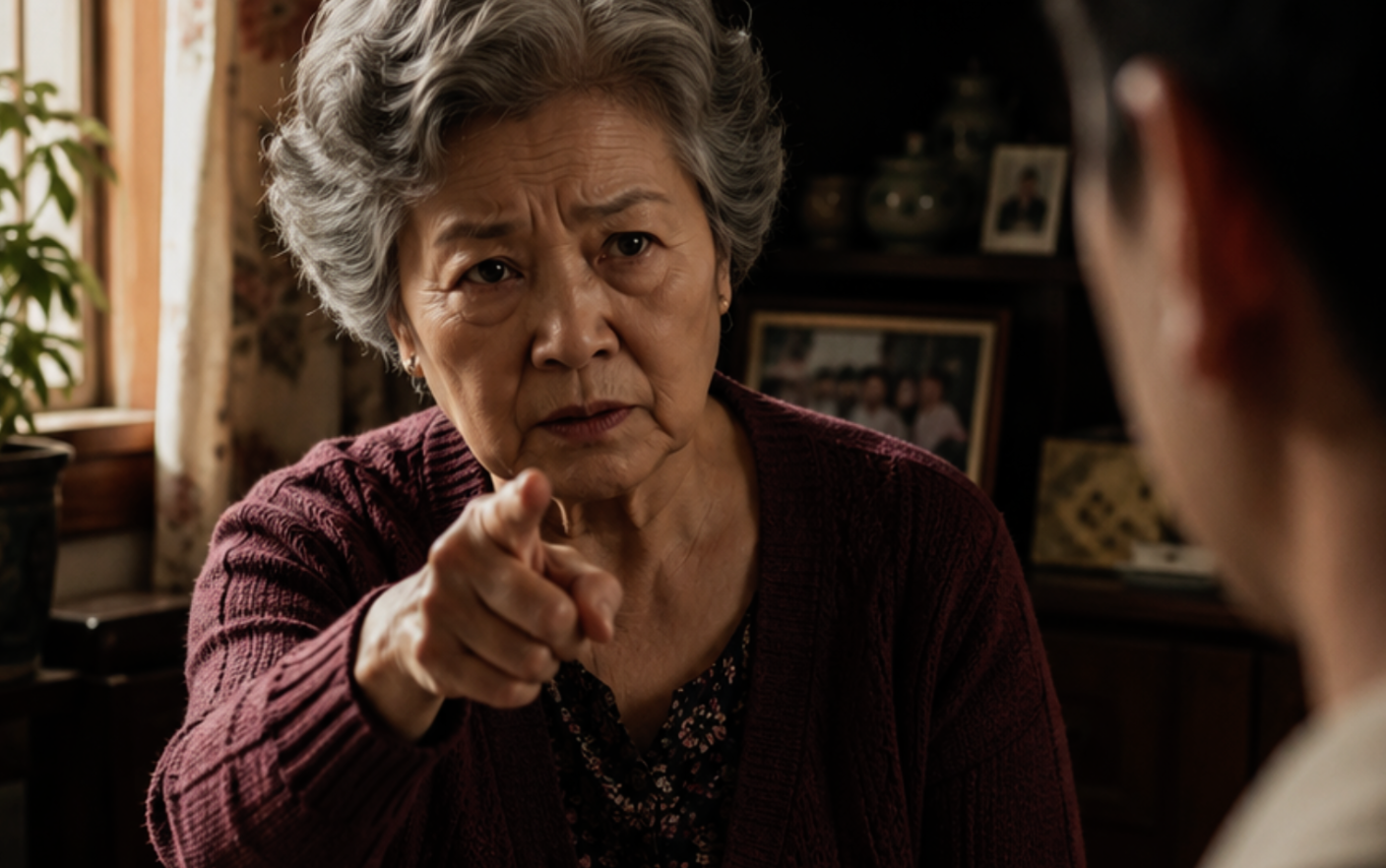
“I am not going to report to any of you! Or to this upstart!” She jabbed a finger toward Lena. “My son betrayed me! Sold his own mother for a skirt! My foot will never be here again!”
She turned around and, with her head held high, marched toward the gate. Aunt Galya looked helplessly from her to the guests. The awkward pause dragged on…
After the failed “family council,” Tamara Ivanovna fell silent for a long time. She did not answer Stas’s calls and would not open the door. He paid her utilities online and ordered groceries for delivery to her door. He knew the courier left the bags at the threshold, and after a while they were taken inside. So she was all right. She had simply chosen a new tactic: total ignoring.
Lena tried not to bring up the subject, seeing how much her husband suffered. She surrounded him with care, tried to distract him. They started the very renovation they had been saving money for. Shared chores brought them closer. It seemed that life was slowly returning to normal.
But one evening, as they were choosing bathroom tiles from a catalog, Stas’s phone rang. An unknown number.
“Hello.”
“Hello, is this Stanislav?” a woman’s voice asked. “I’m your neighbor from the stairwell. From the fifth floor. Your mother, Tamara Ivanovna, is unwell. She opened the door and fell. We called an ambulance. Come quickly.”
Stas’s heart dropped. He silently showed the phone to Lena. She understood everything without words. Fifteen minutes later, they were racing through the night city, breaking every rule.
They ran up to the sixth floor. The door to his mother’s apartment was wide open. Neighbors crowded in the hallway. On the floor, on a blanket someone had placed under her, lay Tamara Ivanovna. Paramedics were working beside her. She was unconscious.
“What happened?” Stas asked the neighbor who had called him.
“We don’t really know ourselves. We heard a crash and ran out. She was lying there. We called the ambulance right away.”
The doctor, an elderly tired man, straightened up.
“A stroke. A massive one. Get ready, we’re going to the hospital. Her chances… well, you understand. Age, blood pressure. We’ll do everything possible.”
The next few weeks turned into one continuous nightmare. Hospital, intensive care, conversations with doctors, sleepless nights. Lena took over all the practical matters, freeing Stas from everything except the hospital. She brought him food, clean clothes, sat with him for hours in the hospital corridor, simply holding his hand.
Tamara Ivanovna survived. But the consequences were severe. The right side of her body was paralyzed, her speech impaired. She could not take care of herself. The doctors could only spread their hands: recovery would be long and most likely incomplete. She needed constant care.
Stas grew gaunt and dark. He rushed between work and the hospital. The relatives who had been so active during the “family council” now called rarely, limiting themselves to routine words of sympathy. No one offered real help. Aunt Galya came to the hospital once, stood by her sister’s bed, cried a little, and left, citing her own bad heart.
When the time came for discharge, Stas faced the most frightening question: what to do next? A caregiver cost an enormous amount of money. He could not bring himself to place his mother in a specialized facility, considering it a betrayal.
One evening, after another difficult day, he sat in the kitchen staring blankly at one spot. Lena sat down across from him.
“Stas, we’ll take her in,” she said quietly.
He looked up at her, his eyes full of torment.
“Lena, no. You don’t understand what you’re signing up for. It’s hell. She… she never loved you. She did everything to separate us. You don’t have to…”
“She is your mother,” Lena interrupted him. “And she is helpless. Everything that happened before doesn’t matter. Right now, she is simply a sick person who needs help. We’ll manage. Together.”
A week later, they moved Tamara Ivanovna into their apartment. They equipped one of the rooms for her needs. Through acquaintances, Lena found a good rehabilitation specialist and arranged massages. She learned to give injections, feed her with a spoon, and change diapers. She did all of it silently, methodically, without a trace of disgust or irritation.
Tamara Ivanovna was silent almost all the time. She lay there looking at the ceiling or out the window. There was no more anger or contempt in her eyes. Only emptiness and a kind of quiet, universal sorrow. Sometimes, when Lena turned her over or changed the bedding, Stas saw a tear slowly roll down his mother’s cheek.
One evening, Stas entered his mother’s room. Lena was sitting by her bed, quietly reading some novel aloud. Tamara Ivanovna was not asleep; she was looking at her daughter-in-law. There was something new in her gaze, something Stas had never seen before. He could not understand what it was — surprise, gratitude, or simply the reflection of the lamp in her faded pupils.
Lena raised her head, smiled at her husband, and returned to the book. Stas left the room and carefully closed the door. He walked over to the window. Outside, soft snow was falling, covering the city with a white blanket.
The conflict had exhausted itself. There were no winners and no losers. There was no reconciliation, no tearful embraces. Life itself, heavy and inexorable, had simply put everything in its place. And in this new, difficult reality, his wife had turned out to be his only support, a silent guardian angel whose strength and generosity he seemed to be truly understanding only now.
The fur coat, the scandals, the grievances — all of it had drifted into the past, becoming insignificant and petty in the face of real misfortune. He looked at the snow and, for the first time in many months, felt not pain and irritation, but a strange, bitter peace.