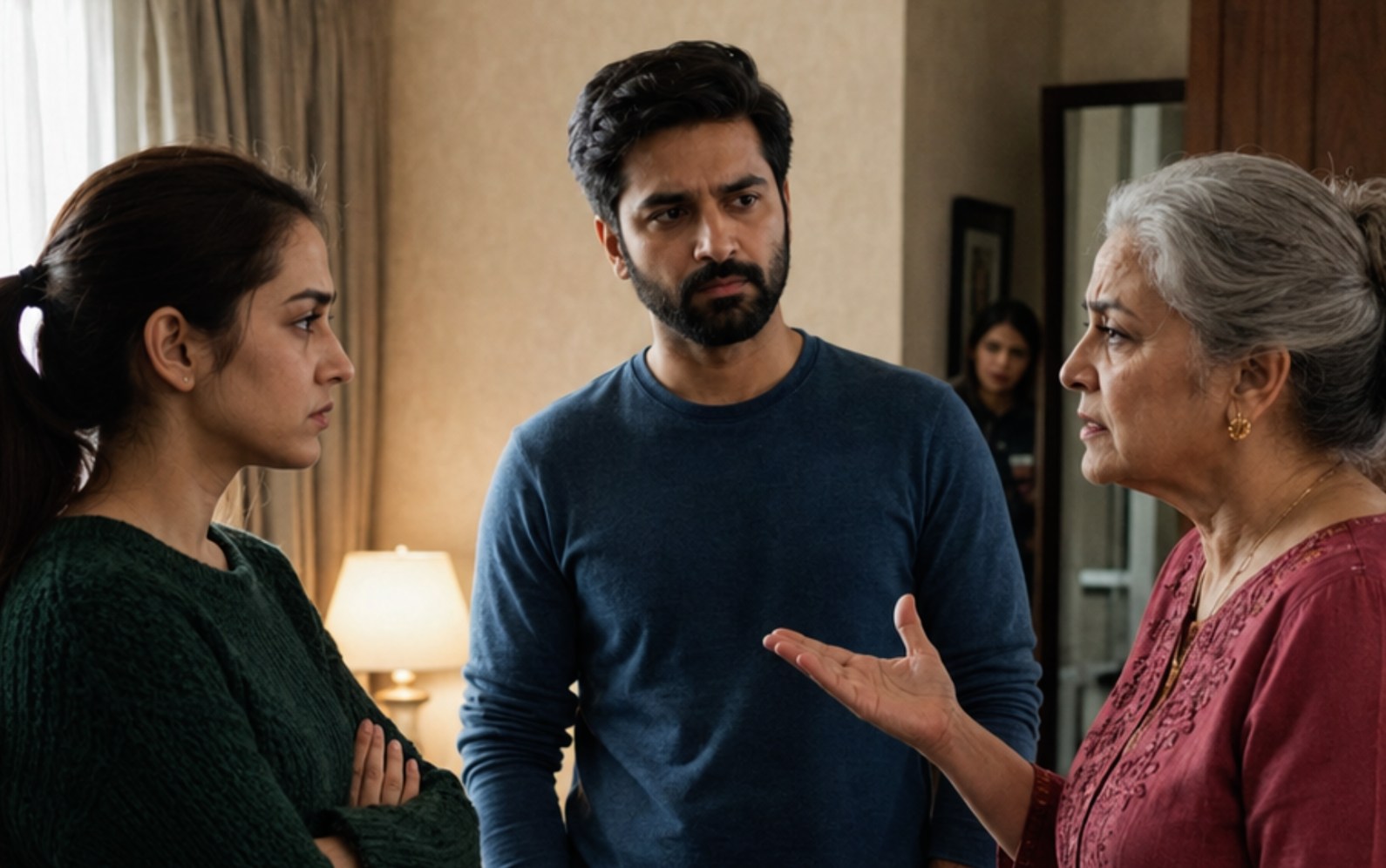
“Are you serious right now? You pretended again that you paid for everything?!”
The phrase flew out of Yulia on its own — sharp, bold, and charged with anger. She didn’t even have time to think that Artyom’s parents were standing barely two meters away and could hear every word. But by then she didn’t care anymore. Something was boiling in her chest, as if someone had put a pot on the highest heat.
Artyom flinched like a schoolboy caught at the scene of a crime.
“Yul, please… don’t make a scene in front of everyone…”
“And when am I supposed to make one?” she snapped. “When your father pours tea and talks about what a ‘fine man’ you are for buying this apartment? Or when your mother tells everyone the car is your achievement?”
Her father-in-law and mother-in-law froze. A thick pause hung over the kitchen — heavy, sticky. Outside, the February grayness pressed against the window, while inside the apartment it was hot from the tension and the radiators.
It hadn’t started like this at all. Not with shouting and anger. It had started with hope that family meant support, not accounting and petty control. Yulia herself was surprised by how everything had turned upside down.
Yulia had worked ever since graduating from university. Marketing, purchasing, negotiations — she knew how to find the right people and build working relationships with them. Her parents owned a network of warehouses and small stores selling finishing materials. It wasn’t luxury, but it was a stable, reliable business. Since childhood, she had watched her mother and father spend days dealing with paperwork, arguing with suppliers, calculating expenses on a calculator whose edges had long since worn off.
And yes — part of that business had been passed on to her. At first, little by little, then with more and more responsibility. At the end of the year, Yulia received dividends — not a fortune, but enough to live calmly, without loans and without constantly chasing money.
She always dressed simply: hoodies, jeans, sneakers. She wasn’t afraid to walk into the sales floor and help the loaders unload a pallet of insulation. And she didn’t really tell anyone that she owned part of the business.
“Why are you so modest?” her friend Sveta laughed. “You’ve got decent income! If I were you, I’d be sparkling all over my stories!”
“Then sparkle yourself,” Yulia shrugged. “I don’t need that.”
It had always seemed to her that if someone needed to know how much she earned, then that person wasn’t right for her.
And then Artyom appeared.
They met in January at a mutual friend’s birthday party. There were still New Year’s garlands hanging around, leftover mandarins on the table, and tired conversations about how “something needs to change in life.”
Artyom sat down beside her when she stepped out onto the stairwell landing to get some air.
“You escaped too?” he asked with a smile.
“Yep. If I hear one more toast ‘to love,’ I’m jumping out the window.”
Artyom laughed. There was something simple and homey about him. A person who didn’t try to pretend to be someone he wasn’t. He worked as a technician at a company — monitored equipment, sometimes went out for repairs. He spoke calmly, without showing off. It never even occurred to Yulia that he might look at her through the lens of money — he never talked about material things at all.
Dates followed, walks along sidewalks half-dissolved by road salt, evenings spent watching TV series together. Artyom didn’t demand expensive gifts, didn’t act like a hero, but he knew how to listen. And that won her over.
Six months later, he proposed — awkwardly, in the car while they were driving back from some friends’ dacha. He took out a ring, blushed, and asked:
“Will you marry me, Yul?”
She said yes. And she truly believed she had found a normal, honest man.
They had a small wedding. Only close friends, parents, and a few colleagues. Artyom’s parents — Galina Sergeyevna and Pyotr Ivanovich — welcomed Yulia warmly. Even too warmly for people who were looking for a catch.
“What a beauty!” her mother-in-law squealed. “Smart and domestic too… Our Artyomka is lucky!”
Yulia was pleased. Though her father-in-law’s gaze sometimes seemed to slide over her as if he were calculating something. But she paid no attention.
At first, they lived in a rented one-room apartment on the outskirts. Modest, but cozy. Yulia paid most of the expenses — that was how things worked out based on their salaries, and she didn’t turn it into a tragedy.
Artyom’s parents visited often. Galina Sergeyevna brought pots of food, advice, and conversations about how a wife should support her husband. Pyotr Ivanovich was quieter, but he watched carefully.
“Yul, where do you work?” her mother-in-law once asked.
“At a construction materials company. I handle purchasing,” Yulia said, giving her usual evasive answer.
“Oh, well done! A woman should work, but she shouldn’t forget that the husband is the head of the family.”
Yulia said nothing. Back then, it seemed like a small thing.
Everything changed when her father offered to help with housing.
“You and Artyom have been married for a year already. How long can you keep renting? I’ll give you money for the down payment, you’ll add yours, and then you can manage the rest yourselves. But register the apartment in your name, understood?” he said calmly.
She understood. In business, her father had seen too many stories where naive people lost everything.
They found an apartment quickly — a two-room place in a new building, warm, bright, with a large balcony. Yulia put in the money and handled the documents. Artyom almost dropped his phone while filming everything, he was so excited.
“Yul, this is… well… we have our own place now! A real one!”
She only smiled.
But when Artyom’s parents came to see the apartment, everything went wrong.
“Artyom, well, you’ve done well, of course,” his mother-in-law declared right from the doorway. “These days, men rarely provide for their families like this!”
Yulia wanted to gently explain, but Artyom jumped to another topic, laughed, and pretended nothing unusual had happened.
Then there was dinner at his parents’ place. Toasts. Boasting. Phone calls to friends. Phrases like “our son bought an apartment.”
Yulia stayed silent then. And that was a mistake.
The second blow was the car. Her money, registered in her name. Artyom was happy — logical, convenient. Her father approved.
But as soon as Artyom’s parents found out, the show began again.
“Our Artyom is such a fine man! And he didn’t buy just any car!” Galina Sergeyevna gushed.
Yulia tried to get a word in.
“The car is actually…”
“Oh, Yulenka, come on! Of course, you did it together! But you have a family hierarchy. Our Artyomka is the provider!”
Yulia felt something unpleasant click inside her. She looked at her husband — he didn’t say a single word in her defense.
At home, the conversation was harsh.
“Why do you keep silent? Why do you let them talk as if you bought everything?” she asked.
“What’s the big deal?” Artyom shrugged. “They’re happy. Why ruin their mood?”
“And mine can be ruined?”
He fell silent. Then he said:
“I’ll explain everything when the right moment comes.”
Yulia understood — he wouldn’t.
The breaking point came unexpectedly.
One weekday evening, her in-laws arrived without calling — “we were just passing by.” At that moment, Yulia was sorting through documents: insurance papers, ownership documents for the apartment, the car registration.
Pyotr Ivanovich, walking past, automatically picked up the folder. Opened it. Looked. And froze.
“What is this?” he breathed quietly.
Galina Sergeyevna immediately jumped up and snatched the documents. She flipped through them, turning red, her eyes darting, her gaze sharp as a needle.
“Artyom!” she almost shouted. “Why is everything registered in her name?!”
Artyom froze like a puppy caught in headlights.
“Well… it was more convenient that way…”
“CONVENIENT?!” his mother-in-law exploded. “Are you a husband or what? Why does your wife own everything?!”
Yulia said calmly and clearly:
“Because I bought it. With my own money. With my father’s money. Who was I supposed to register it under?”
Galina Sergeyevna turned pale, then red, then pale again.
“You… you deceived us?”
“No. I simply didn’t see any reason to discuss personal finances.”
Pyotr Ivanovich frowned.
“Artyom, did you know?”
“Well… yes…” her husband mumbled.
“And you were fine with having NOTHING?” his mother roared.
Yulia couldn’t hold back and said coldly:
“Why are you so worried that he won’t get anything in a divorce? We haven’t even planned children yet.”
“Because anything can happen!” Galina Sergeyevna shouted. “A son must be protected!”
“From whom?” Yulia narrowed her eyes. “From me?”
Her mother-in-law looked away.
A minute later, the in-laws turned around and left. They didn’t say goodbye. The door slammed like a gunshot. Artyom slowly turned to Yulia. She looked at him and no longer saw a husband, but an adult child who would always obey his mother’s commands.
“Why didn’t you tell the truth?” she asked quietly.
“I was ashamed,” he exhaled.
“Ashamed of what? That I earn more?”
He said nothing.
After that, everything collapsed.
Her mother-in-law began making sarcastic remarks at every meeting.
“So, how are your earnings, Yulenka? Poor Artyom is under your thumb, isn’t he?”
Yulia tried to stay calm, but every time she left with trembling hands.
Artyom changed too.
“Let’s register the apartment to both of us? Or at least half of it to me?”
“Why?”
“Because we’re family!”
“Family means support. Not trying to squeeze someone else’s property out of them, Artyom.”
He exploded:
“You’re greedy! You don’t trust me at all!”
Yulia looked at him and understood — there really was nothing to trust.
“I want a divorce,” she said calmly.
He turned pale.
But there was no way back anymore.
The divorce was finalized quickly. There was no jointly owned property — Artyom left with what he had bought himself.
Galina Sergeyevna kept calling and screaming:
“You ruined his life! You took everything from him!”
Yulia answered calmly:
“I didn’t take anything. He never had anything.”
And hung up.
A couple of months later, she breathed freely for the first time. She worked, handled projects, drove to her own apartment in her own car. And for the first time, she realized how drained she had been by the endless pressure from his relatives.
“Do you regret it?” her father asked one evening.
“No. Not for a second.”
She was right.
In spring, Yulia met Mark — an architect, calm and attentive. On the third date, she told him honestly:
“I have my own home and my own car. I don’t transfer property into anyone else’s name.”
Mark only smiled.
“I don’t need your property. I’m interested in you.”
Yulia looked at him for a long time, trying to find a catch. She didn’t.
Now, a year after the divorce, standing on her balcony and looking out at the February city, Yulia felt only one thing — lightness.
Not anger, not regret, not jealousy over the fact that, according to rumors, Artyom was already seeing someone new.
Just lightness.
She had survived a story in which they had tried to turn her into a resource — and she had managed to leave it without losing herself.
She hadn’t allowed herself to be erased. She hadn’t allowed someone else to take credit for what was hers. And now she knew: she would never stay silent again.