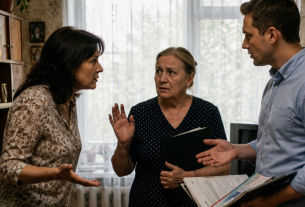
“Have you lost your mind?!” Inna’s voice rang against the kitchen ceiling, mixing with the smell of burned potatoes. “Nikolai, are you serious right now? Do you even understand what you just said?”
She was standing at the stove, clutching a ladle in her hand, while something hopeless sizzled in the frying pan. Outside the window, in the gray light of an October evening, wet snow mixed with rain was slowly falling. The radio in the corner was muttering something about traffic jams, but after her words, even that noise seemed like silence.
Nikolai stood in the doorway, still wearing his jacket, holding a mesh shopping bag with a bottle of vegetable oil sticking out of it. He had just come home from work and had apparently wanted to share the news right from the doorstep, but as usual, the news had landed like a blow to the head.
“Innula, let’s not shout…” he mumbled, lowering his eyes to the tiled floor. “I didn’t mean any harm…”
“Oh really? Then what did you mean?” She threw the ladle into the sink; it clanged as it bounced. “Eleven years, Nikolai. Eleven years!” She jabbed her finger into the air as if planting flags on a map. “We paid that damned mortgage! I worked a second job. Our daughter and I didn’t go on vacations. I didn’t even buy myself a new winter coat for three years! And now you casually tell me the apartment is registered in your mother’s name? How, Nikolasha? Explain it to me. How did that make sense in your head?”
He took a step forward, but Inna sharply raised her hand, stopping him.
“Don’t come closer. Talk from there.”
He sighed and ran his palm over his face.
“It was… for safety. Do you understand? At the time, it seemed logical…”
“Logical?” Inna snorted shortly, as if she had choked on air. “Logical to hide from your wife that all these years she’s been living in someone else’s apartment? Logical to make your mother the owner and turn me into a cash cow who pays for it? You’re a genius of family logic!”
“That’s not what I meant…” he began, but the front door suddenly opened, and Valentina Petrovna, Nikolai’s mother, appeared in the doorway. She was holding a bundle, apparently just back from the store, and wore little boots carefully wiped on the mat.
“Oh, I seem to have come at a bad time?” she said in a sugary voice, but her eyes darted quickly, sharply, appraisingly. “I see you’re having a conversation.”
Inna slowly turned toward her.
“Right on time, Valentina Petrovna. Come into the kitchen. Join our family meeting. The topic is: whose apartment is this?”
The old woman came in, slowly took off her coat, and hung it over the back of a chair.
“What tone is that, Inna? I came to visit my son.”
“And I live here,” Inna said coldly. “As it turns out, on sufferance. Your son has just informed me that the apartment is registered in your name. Is that true?”
Valentina Petrovna sat down, placed her hands on the table, and folded her fingers calmly.
“Well, yes. That’s how it happened. At the time, Kolya asked me, and I didn’t refuse. I thought it was for the good of the family.”
“For the good?” Inna laughed, but the laugh came out dry and prickly. “And what exactly was good about it? That I paid for your property for eleven years?”
“Not mine. The family’s,” the woman corrected her without changing her expression. “And besides, Inna, why are you getting so worked up? You live here, don’t you? Nobody is throwing you out. Everything will remain as it was.”
“As it was?” Inna stared at her. “As it was when I thought this was my home? And now it turns out I’m just a guest here? Or even better, a permanent tenant?”
Nikolai stared gloomily at the floor.
“Mom, I asked you not to start right now…”
“What do you mean, ‘not to start’?” Inna turned to him. “You asked her to keep quiet? Asked her to continue this experiment on me? I wonder, how long have the two of you been laughing at me?”
“Nobody is laughing,” Valentina Petrovna sighed. “Life is complicated. One has to protect oneself. You never know…”
“What do you mean, ‘you never know’?” Inna interrupted, leaning toward her across the table. “You never know, I might run away with a Gypsy camp? Or you never know, I might decide to drink the apartment away? Or maybe, you never know, I might die, and your son won’t get everything?”
A heavy silence settled over the kitchen. Outside, the snow began falling harder, thick white flakes sticking to the glass.
“That is not what I meant,” the old woman finally said, but for the first time, a crack of irritation appeared in her voice. “But since we’ve come to that… yes, the apartment is registered in my name. And it is legal. Your emotions, Inna, are just emotions. They do not replace documents.”
Inna recoiled as if she had been slapped.
“Documents,” she whispered. “So that’s how it is. You planned everything in advance. Strategically. And I, the fool, thought we were a family. That we were in this together.”
She looked at Nikolai. He did not raise his head.
“Kolya, say something. Anything. Explain how you could do this. How could you look me in the eyes all these years, knowing I was living in a home that didn’t belong to me? How could you kiss me, knowing that behind my back your mother’s name was already written on everything?”
He raised his eyes to her — guilty, tired, empty.
“I didn’t know how to tell you… I thought somehow it would…”
“Somehow?” she repeated, and her voice broke. “Nikolai, nothing ever happens ‘somehow.’ Either you’re a man, or you’re a rag. Either you are with me, or you are against me. You made your choice.”
With a sharp movement, she wiped away the tears that had suddenly welled up in her eyes.
“That’s it. This conversation is over. Since your mother is the mistress of this place, let her have dinner with you. I’m leaving.”
“Inna, where are you going?” Nikolai stood up and reached out his hand.
“None of your business,” she threw over her shoulder, already leaving the kitchen. “You two can sort things out with your papers. And I… I’ll think about what I’m supposed to do with all this.”
She went out into the hallway, put on the first coat she could grab, and stepped out onto the stair landing. The door behind her did not slam shut; it remained slightly open, and from inside came a muffled whisper — Valentina Petrovna was saying something quickly to her son.
Inna went down the stairs and out into the street. Wet snow struck her face, turning into cold slush on the pavement. She walked without choosing a direction, just forward, away from the house, away from that warm, cozy, foreign nest.
The words pounded in her head: “Eleven years. Eleven years of life, hopes, exhaustion, mental calculations — how much longer to pay. And all of it was an illusion. All this time, there was not a roof over my head, but someone else’s signature on a document.”
She entered the first park she came across and sat on a bench already covered with wet snow. The cold quickly seeped through her thin coat, but she barely felt it. Something was burning inside her — burning so fiercely it seemed as though all the damp November air around her might evaporate.
“What should I do?” That question throbbed in her temples like a separate pulse. Leave? Pack her things and go to her parents’ two-room apartment on the outskirts? Surrender? Give them this home, this victory, this petty, vile little family trick?
“No,” a thought suddenly came to her, clear and sharp. “No. I won’t give it up. I won’t give away eleven years of my life. I won’t give away those sleepless nights when I calculated interest. I won’t give away my hands, scratched after renovations. I won’t give away my daughter’s childhood, which passed within those walls. This is mine. Earned. Suffered for. And they will not take it from me. Not even with their papers.”
She took out her phone and, with fingers trembling from the cold, began searching online: “lawyer, housing disputes, deception in property registration.” She found several firms and wrote down their numbers.
Then she called her friend Olga.
“Olya,” she said when her friend answered. “I’m in deep trouble. Big family trouble, with documents involved. Can I come to your place tonight? Stay over.”
“What happened?” Olga immediately grew alert.
“I’ll tell you when I get there. The main thing is, Kolya doesn’t know where I am.”
An hour later, she was sitting in Olga’s kitchen, drinking hot sweet tea and laying out the whole story in a monotonous voice, without tears. Olga listened without interrupting, her face growing darker and darker.
“Bastards,” she breathed when Inna finished. “Absolute bastards. And Kolya… I never would have believed he was capable of something like that. You trusted him like you trusted yourself.”
“I don’t trust myself anymore either,” Inna said with a bitter smile. “Because I didn’t see it. Didn’t feel it. I lived like a fool in my little world.”
“What are you going to do?”
“Fight,” Inna said simply. “Tomorrow I’m going to a lawyer. I’ll sue. Even if it takes years. I will win that apartment. Not so I can live in it. But so they understand that you can’t do this. You can’t treat people this way. You can’t do this to someone who trusts you.”
She spent the night on the fold-out sofa in Olga’s living room. She did not sleep. She stared at the ceiling, replaying the same moment over and over in her head: Nikolai standing in the kitchen doorway and saying those words. His face. His guilty, yet so unfamiliar eyes.
In the morning, before dawn, she was already up. First she went to the bank and obtained statements for all accounts for the last eleven years. Then she went to the management company for receipts proving utility payments. She gathered every receipt for construction materials, furniture, even the very paint for the living room walls that they had chosen together while arguing over the shade.
By noon, there was a thick folder in her bag, heavy as a brick. Evidence. Tangible, physical evidence. Every page in it shouted: “I paid! I invested! This is mine!”
The lawyer she ended up seeing was an older, calm man with attentive eyes. He listened, looked through the papers, and nodded.
“Unfortunately, this situation is typical,” he said. “A fictitious registration in a relative’s name to restrict the spouse’s rights. But your position is strong. You are a bona fide purchaser, the factual payer. Courts in such cases often side with the person who actually bore the burden of maintenance. But the process will be stressful. And long. Are you ready?”
“I’m ready,” Inna answered without hesitation. “I’ve been preparing for eleven years without knowing it.”
When she returned to Olga’s place, a message from Nikolai arrived on her phone: “Inna, let’s talk. Properly. Mom has left. I’ll explain everything.”
She stared at the screen for a long time. Her fingers moved on their own, wanting to type a reply, to pour out all her anger and pain. But she stopped. She switched on the cold, calculating logic she used so often at work.
“No,” she thought. “No conversations. No explanations. Now only actions matter.”
She sent a short answer: “Everything I need to say, I’ll say in court. Don’t call. Don’t write.”
Then she blocked his number.
The next day she went home while Nikolai was at work. She needed to collect documents, her belongings, and her computer. She still had the key to the apartment.
When she entered, she felt something strange — as if she had stepped into a museum of her own life. The same wallpaper, the same furniture, the same smell of coffee and laminate flooring. But now all of it was foreign. Filled with deceit and lies.
She quickly packed a suitcase with clothes, took folders with documents and her laptop. In her daughter’s room — her daughter was studying in another city — she took the childhood photo albums, a soft toy, the most precious and irreplaceable things.
As she was leaving, she stopped at the threshold. She looked around the apartment. She remembered how they had moved in — bare walls, emptiness, the smell of construction dust. How happy they had been about every new object. How they had hung those curtains… How they had thought it was forever.
“Goodbye,” she mentally said to the home. “You were mine. And now you are just the subject of a dispute. I will get you back. But I will never be able to live here again.”
The door closed with a quiet click.
The war began. Not loud, not hysterical, but cold, methodical, and paper-based.
A week later, the lawyer filed a lawsuit. Inna demanded recognition of ownership rights to the apartment, arguing that all mortgage and housing maintenance payments had come from her, and that the registration in her mother-in-law’s name had been fictitious, carried out to violate her rights.
At the same time, she filed a police report for fraud, but they merely shrugged — a civil-law dispute, resolve it in court.
For the first few days, Nikolai tried to reach her — calling from unknown numbers, writing on social media, even once standing guard outside Olga’s building. Inna ignored him. She saw him from afar — rumpled, unshaven, looking lost. But inside her, not a single drop of pity stirred. There was only steel now.
Valentina Petrovna, as it turned out, had no intention of giving up. Through her lawyer, she filed counterclaims — demanding that Inna be recognized as a bad-faith occupant and that she pay for living in someone else’s apartment all those years. The amount they calculated was astronomical.
When Inna read it in the statement of claim, she did not become outraged. She only smirked.
“Well then,” she thought. “So we’ll fight dirty. I’m ready.”
The first court hearing was preliminary. Inna came in a strict suit, her hair pinned up, a thick folder in her hands. From the outside, she looked completely calm; only her fingers, gripping a pen, were white from tension.
Valentina Petrovna arrived with her lawyer — a pompous man in an expensive suit. She herself was dressed as if for a celebration, in a new coat and hat. Seeing Inna, she nodded with cold politeness, as if to a casual acquaintance.
Nikolai came alone and sat at the back of the courtroom, away from everyone. He looked at Inna pleadingly, but she did not glance in his direction even once.
The judge, a middle-aged woman with a tired face, read the claim and heard the parties. The mother-in-law’s lawyer immediately went on the attack:
“My client is a bona fide purchaser. The apartment is legally registered in her name. All documents are in order. The plaintiff, while living in the disputed housing, did not challenge this registration for eleven years, which indicates her tacit consent. Moreover, she used someone else’s property without paying…”
“That is a lie,” Inna interrupted calmly but loudly. “I have all the proof of payment. I did not simply use it. I maintained that apartment. And I only learned who it was registered to two weeks ago from my husband. Until that moment, I was deliberately misled.”
The judge looked at her over her glasses.
“Citizen, you will be given the floor. Maintain order.”
The hearing did not last long. The next one was scheduled for the presentation of evidence.
As they left the courtroom, Valentina Petrovna caught up with Inna in the corridor.
“Inna, come to your senses,” she said quietly, but so that only the two of them could hear. “Have you decided to ruin us? Courts, lawyers… The apartment will remain in the family anyway. What is all this circus for?”
Inna stopped and slowly turned to her.
“What family, Valentina Petrovna? Yours and Kolya’s? As it turns out, I was never truly part of that family. To you, I was only a source of money and free labor. So this is not a circus. This is the restoration of justice. And you and your son will have to answer for everything. For every nerve of mine, every ruble, every day I thought this was my home.”
“You won’t prove anything,” the old woman smirked, though anxiety flashed in her eyes. “The documents are on my side.”
“We’ll see,” Inna said shortly and walked away.
Those days blurred into a sequence of visits to offices, meetings with her lawyer, and preparation of documents. Inna took unpaid leave from work. Money was melting away, but she did not stop. Olga supported her as best she could — with words and by letting her stay.
When her daughter found out about everything, she came home for the weekend. The girl cried, hugged her mother, and said she could not believe her father had done such a thing. Inna silently stroked her hair, thinking that they had torn even this thread — her daughter’s trust in her father — with their own hands.
Nikolai sent his daughter a long letter, trying to justify himself. After reading it, she tore it up and said to her mother, “I’m with you, Mom. To the end.”
That was the most precious thing. The most important thing. It gave her strength.
The second hearing was decisive. Evidence was presented. The opposing lawyer pulled out all his trump cards: the purchase agreement listing Valentina Petrovna as the buyer, the ownership certificate, extracts from the Unified State Register of Real Estate. He spoke smoothly and confidently, proving the legality of ownership.
Inna’s lawyer acted differently. He did not argue with the documents. He went around them. He presented the court with an enormous folder of receipts, bank statements, transfers. Every mortgage payment — from Inna’s card. Every utility payment — with her signature. Receipts for renovations, contracts with builders where she was listed as the customer. Testimony from neighbors who had seen Inna spend years setting up the apartment, carrying building materials, painting, wallpapering, cleaning.
“Please note, Your Honor,” the lawyer said calmly and weightily. “All financial burden, all household activity, all investments were borne by my client. The defendant, the formal owner, not only made no contributions, but did not even live in the disputed apartment, having housing of her own. This is a classic case of a fictitious transaction, the purpose of which was to remove property from possible division and deprive the spouse of her lawful rights. The plaintiff’s husband, Nikolai, acted in collusion with his mother, as confirmed by…”
“I object!” Valentina Petrovna’s lawyer jumped up. “There is no proof of collusion! These are baseless accusations!”
The judge stopped him.
“Objection overruled. Continue.”
Inna’s lawyer nodded and placed the final document on the table — a printout of correspondence from an old family laptop that Inna had taken. Among other things, there were emails from Nikolai to his mother in which he discussed in detail how best to register the apartment “so that Inna, if anything happens, cannot make a claim.” With Inna’s permission, the lawyer had found them while preparing the case.
When he read the excerpts aloud, dead silence fell over the courtroom. Nikolai, sitting on the back bench, lowered his head; his shoulders hunched. Valentina Petrovna turned pale and pressed her lips together more tightly.
That was the turning point. Even the judge, usually impassive, frowned and began studying the materials more attentively.
After the hearing, Inna was one of the last to leave the courthouse. Nikolai was waiting for her outside under the awning, smoking. When he saw her, he threw away the unfinished cigarette and stepped into her path.
“Inna… Please. Let’s stop this nightmare. Mom agrees… She’ll give you half. We’ll sell the apartment and split the money. Just stop the trial.”
She looked at him. At the man with whom she had shared a life, argued, made peace, made plans. Now he was a stranger. Completely a stranger.
“Half?” she repeated quietly. “You think this is about money now, Kolya? It’s about what you did. You didn’t just register the apartment in your mother’s name. You looked me in the eyes for eleven years and lied. You allowed me to feel like the mistress of a home that you had long ago given to another woman. You didn’t steal square meters from me. You stole certainty. You stole faith. In you. In family. In justice. Money cannot measure that. And it cannot compensate for it.”
She wanted to walk around him, but he grabbed her hand.
“I’ll fix it! I’ll fix everything! I’ll sign any papers, admit everything in court, just come back! We’ll start over!”
She slowly but firmly freed her hand.
“You can only start over from a clean slate, Kolya. And our slate is covered in your lies. It can no longer be washed clean.”
She walked along the wet asphalt without looking back. Behind her came his choked words: “Inna… forgive me…”
But it was already too late for forgiveness. The train had left. Only the rails of the court remained, leading toward some new, unknown point.
The judge delivered the decision a month later. Valentina Petrovna’s counterclaim for payment for residence was rejected in full. Inna’s main claim was partially satisfied. The court recognized that Inna had been a bona fide purchaser, had in fact borne all expenses, and that the registration of the apartment in the mother-in-law’s name had been fictitious. However, because ownership had formally been registered to Valentina Petrovna, the court could not simply transfer it to Inna. A Solomonic decision was made: the defendant was ordered to pay Inna compensation in the amount of all expenses she had incurred for mortgage repayment, renovations, and apartment maintenance, plus compensation for moral damages. The sum was enormous — almost the market value of most of the apartment.
In effect, this meant that Valentina Petrovna would either have to sell the apartment to pay the money or take out a loan herself. For a pensioner, it was a catastrophe.
As Inna left the courthouse with the decision in her hands, she felt no triumph. There was emptiness. And fatigue. Enormous, all-consuming fatigue.
Her lawyer congratulated her on the victory, said it was an excellent result, that they had achieved the maximum.
She nodded and thanked him.
Valentina Petrovna was waiting for them on the court steps. Alone. Without her lawyer. She suddenly looked very old and small in her festive coat.
“Are you satisfied?” she asked hoarsely. “Have you achieved what you wanted? Now I’ll be left without a roof over my head. On my pension…”
Inna stopped, looking at her.
“You won’t be left without a roof. You have your own apartment, the very one you lived in all these years. And this one should have belonged to Kolya and me. But you preferred to play your games. Now you’re reaping the consequences. I do not feel sorry for you, Valentina Petrovna. You chose all of this yourself.”
“And Kolya?” the old woman suddenly asked, and real, unperformed pain broke through in her voice. “You finished him off. He… he started drinking. Problems at work. He broke.”
For a moment, something pricked Inna’s chest. Old, forgotten pity. But she suppressed it.
“He didn’t break because of me. He broke because of himself. Because of what he did. And because of you, by the way. You pushed him toward it. So solve your problems yourselves. Without me.”
She turned and left.
That same evening, she came to the now-empty apartment. Nikolai, as it turned out, had moved in with his mother right after the final hearing. The apartment was empty, echoing, and very clean. Apparently, he had even tidied up before leaving.
Inna walked through all the rooms. She touched the walls, the windowsills, the doorframes. Everything was dear, familiar to the point of pain. And at the same time — foreign.
She understood that she would not be able to live there. Even if she formally won on appeal and obtained ownership. In every corner, there would be the shadow of deception. The shadow of eleven years of lies.
She sat down on the living room floor, leaned her back against the cold radiator, and finally allowed herself to cry. Quietly, without sobbing. Tears simply flowed down her face, washing away the tension of the past months, the bitterness, anger, disappointment.
She was not crying for the lost apartment. Not even for the ruined marriage. She was crying for the person she used to be. For the Inna who had believed, loved, made plans. That Inna had died on that October evening in the kitchen. And now, here on the floor of someone else’s apartment, sat another woman. Harder. Lonelier. More sober. And perhaps more right. But so tired of being right.
A few days later, she called a realtor. She said she wanted to sell the apartment. Quickly. At a realistic, not inflated price.
After evaluating it, the realtor gave his verdict: it would sell quickly; the neighborhood was good, the renovation fresh.
While preparations for the sale were underway, a letter arrived from Nikolai. A paper letter, by post. He wrote that he would not appeal the court decision. That he was quitting his job and leaving the city. That he understood he had destroyed everything and was asking forgiveness not because he wanted to get anything back, but simply because he could not do otherwise. At the end were the lines:
“I loved you, Inna. In my own way, foolishly, childishly. But I loved you. And now that you are gone, I understand that I did not lose an apartment. I lost you. And that is the only irreplaceable loss in this whole story.”
Inna reread the letter several times. Then she carefully folded it and put it in the far drawer of her desk. She did not throw it away. But she did not answer either.
The apartment sold within a month. The new owners were a young couple, newly married. Their eyes burned with the same light of hope and excitement that she and Nikolai had once had. As Inna handed them the keys, she felt a strange relief. As if she were passing on the baton. Let everything be honest for them. Let everything work out for them.
From the proceeds, she paid the lawyer, reimbursed Olga for all expenses, and put the rest into an account. She gave part of it to her daughter — for studies, for life.
She rented a small but bright apartment in another district. Without history. Without ghosts.
Her first morning in the new place. She woke to bright winter sunlight striking the window. She got up and made coffee. She sat by the window. Outside was an unfamiliar courtyard, unfamiliar cars, unfamiliar faces.
It was quiet. And calm. Not joyful — not yet. But calm.
She picked up her phone and photographed her coffee against the background of the new window. She did not send it to anyone. She simply saved it. As a marker. The beginning of a new chapter. A chapter where everything would be honest. Where the roof over her head would be hers. Where she would not have to trust anyone with dubious documents. Where she could simply live. Carefully. Attentively. But her own life.
She finished her coffee and put the cup away. There was a lot to do today: buy a new chair, hang a shelf, unpack boxes.
Life went on. And perhaps that was the greatest victory. Not the court. But the ability to rise after falling. To wipe the traces of tears from one’s face. And to take the next step. Into silence. Into solitude. Into freedom.