Vera met Nikolai in early October, when the leaves already lay in a thick reddish carpet along the sidewalks and the air smelled of damp earth and the first frosts. They literally bumped into each other — she was leaving a coffee shop, he was coming in, the door swung open right toward her, and her cup of coffee almost ended up on his coat. He didn’t get annoyed. He simply smiled and said, “Good thing you hadn’t bought it yet — that means it’s my treat.”
She laughed.
They sat in that coffee shop for almost three hours, and afterward Vera could never quite explain how it had happened — the conversation had simply flowed on its own, without effort, without pauses, without the feeling that one of them had to invent the next sentence.
Nikolai was six years older than her. He worked as an engineer, lived alone, went to the market on weekends for fresh vegetables, and knew how to cook borscht so well that the whole apartment would be filled all day with a thick, warm aroma. Vera liked that — not the borscht itself, but the fact that he cooked at all. That he was self-sufficient. That he did not wait for someone else to take care of him. With her previous man, everything had been the opposite, and that contrast seemed important to her.
A year later, they began living together. The apartment was hers — a small two-room place in a quiet building, which she had inherited from her grandmother and renovated on her own, slowly, without anyone’s help. Nikolai moved his things in two trips in his car, arranged his books on the shelf, hung his jackets in the hallway, and fit into the space naturally — not like a stranger, not oppressively. During the first months, Vera thought: this is it. Finally, a person who does not try to remake everything for himself.
And he really did not interfere. He did not argue when she bought furniture she liked. He did not insist on his own way when they talked about where to go on vacation. He did not comment on her work or give advice she had not asked for. It was so unusual that at first Vera kept waiting — any moment now, it will begin; any moment now, he will say something. But he stayed silent. Calmly, unobtrusively, respectfully.
Tamara Ivanovna appeared about six months after Nikolai moved in. Vera found her in the kitchen — Nikolai had said his mother would stop by for tea while Vera was at work. When Vera came home, her mother-in-law was sitting at the table with a mug, looking around the kitchen with an expression Vera would later learn to recognize without fail — slightly narrowed eyes, a small tilt of the head, as though the person were taking measurements.
“Oh, there you are,” Tamara Ivanovna said, smiling broadly and hospitably, like a hostess greeting a late guest.
In someone else’s apartment.
Vera smiled back. She put down her bag, washed her hands, and set the kettle on. She tried not to think about that smile.
The first time, everything passed peacefully. Tamara Ivanovna talked about neighbors, about the country house, about how little Kolya, as a child, had eaten only buckwheat with milk and refused to accept any other porridge. Vera nodded. Nikolai laughed. The evening went smoothly.
Things were going well for Vera at work — she was managing a small design project, working from home, and sometimes visiting clients. It was her life, arranged according to her own schedule, without a boss standing over her shoulder and without mandatory meetings at eight in the morning. At first Nikolai said it was convenient — she was home, so he could always come by for lunch.
Vera did not object.
But then it turned out that he was not the only one coming for lunch. Tamara Ivanovna also learned that route — once, then twice, then as if it were something self-evident. She would ring the intercom, come upstairs, and say, “I was just passing by.” Her own home was forty minutes away by tram.
Vera noticed that she worked worse on the days when she expected the bell to ring. She would sit down at the computer and listen from the corner of her ear — was that the intercom? It irritated her. Not her mother-in-law, exactly — but the fact that her own attention had begun drifting somewhere toward someone else’s presence.
Then Tamara Ivanovna began coming more often. First once every two weeks. Then every week. Then she could call on a Saturday morning and say, “I’ll be there in an hour, buy something for tea.”
Not ask.
Say.
At first, Vera bought something. She welcomed her, served tea, smiled, listened. She tried to see her simply as the mother of the man she loved — with her habits, with her attachment to her son, with the awkwardness of a person who did not know how to enter someone else’s space without crowding it.
But Tamara Ivanovna, it seemed, did not notice that she was crowding it.
She began leaving comments — at first light ones, almost joking. That towels were better hung this way, not that way. That there was too much unnecessary food in the refrigerator. That Kolya used to eat soup every day, but apparently soup was not eaten here. That the windows had not been washed in ages — though Vera had washed them two weeks earlier.
Nikolai said nothing in response to these remarks. He either stayed silent or agreed in one syllable:
“Yes, Mom, you’re right.”
At first, Vera talked to him about it in the evenings after Tamara Ivanovna left. Calmly, without accusations. She simply explained that it was unpleasant for her when someone gave orders in her home.
“She doesn’t mean any harm,” Nikolai would say. “She’s just that kind of person. She’s used to taking care of people.”
“There’s a difference between care and instructions.”
“Don’t exaggerate. These are little things.”
Vera would fall silent.
She thought: maybe they really are little things. Maybe she was reacting too sharply. Maybe she simply needed to get used to it. Many people lived with mothers-in-law like that — and nothing, they adjusted. She was not the kind of person who looked for conflict where there was none.
The problem was that the ground was becoming less and less even.
Tamara Ivanovna began calling Nikolai not only on weekends. Now she could call on a Wednesday evening and talk to him for forty minutes — about her health, about the neighbors, about how nephew Seryozha had bought a new car, which was surprising because his salary was not large. Nikolai spoke patiently, attentively, sometimes nodding, sometimes laughing. After those calls, he often said something to Vera like:
“Mom thinks we should replace the sofa in the living room; it’s already old.”
Or:
“Mom says we should go to the country house, the roof needs to be inspected.”
Or:
“Mom thinks you should work late less often.”
Vera remembered that last one especially clearly.
“Your mother thinks I should work less?”
“She’s worried about you.”
“She barely knows me.”
“Well, she sees that you get tired.”
“Kolya,” Vera said evenly, “I am a grown woman. I know how much I should work.”
He shrugged. Not rudely — just the way people shrug when they do not want to continue a conversation. Vera looked at him and thought that she had seen that gesture before. Not from him — from another person, in another life. And back then it had also seemed like a small thing.
Vera had grown up in a family where scandals were rare, but silence could press down no worse than shouting. Her mother never raised her voice — she simply fell silent in such a way that the air in the apartment became dense, and everyone walked carefully, afraid of touching something invisible. Vera had sworn to herself in her youth that her life would be different. That she would speak directly. That she would not collect grievances and wait for everything to resolve itself. That her home would be a place where she herself decided how to live.
She kept that promise to herself for a long time. Longer than she should have. She waited too long for Nikolai to understand on his own. She explained the same thing too patiently, hoping that next time he would hear her.
Now, standing by the closed door, she thought about it without anger — simply as a fact. She had given herself her word to be honest. And she had kept it. Just several months later than she should have.
Vera remembered how, during the first six months, every time after Tamara Ivanovna left, she would wait — now Nikolai will say something. Apologize, joke, say, “Well, my mother has quite the character, forgive me.” Anything that would show he saw what was happening and that it mattered to him.
But he either stayed silent or talked about something unrelated — work, the car, the downstairs neighbors who were drilling something again. At first, it seemed to her like patience — masculine, laconic patience, the kind that did not express itself aloud. Then she realized it was not patience.
It was simply absence.
He was not keeping silent with effort — he simply was not thinking about it. His mother came, talked, left. An ordinary day.
One day she asked him directly:
“Does it matter to you how I feel when she is here?”
He looked at her with sincere bewilderment and answered:
“Of course it matters.”
But there was no concern in his voice — only the tone of a person who had been asked a strange question about something obvious. As if someone had asked, “Are you breathing?” Of course I’m breathing. What kind of question is that?
Vera understood then that the issue was not that it did not matter to him. The issue was that he did not notice — he was not pretending, not dodging, he simply lived in another version of the same apartment, where everything was normal.
The conversations became harsher gradually. As though Tamara Ivanovna were testing how far she could go. A little further each time. A little more confidently each time.
She began commenting that the home lacked “real coziness” — by which, judging from her meaning, she meant lace doilies, a carpet in the living room, and curtains with ruffles. Vera lived perfectly well without any of that. She loved clean lines, a minimum of clutter, light walls without unnecessary details. Tamara Ivanovna looked at it all as if someone had shown her an unfinished renovation.
“It’s somehow bare here,” she said once, entering the living room.
“I like it this way,” Vera replied.
“Well, that’s only while there are no children. Later everything will change anyway.”
Vera said nothing. Not because there was nothing to say. Simply because some phrases are not worth answering — they characterize themselves clearly enough.
Then Tamara Ivanovna began talking about money. At first casually — saying that Kolya spent a lot on gas driving to work every day, perhaps they should reconsider the route. Then more directly — that Vera, apparently, earned quite well, and it would be good to invest something into the common good, for example, repair the country house.
It was not Vera’s country house.
It was Tamara Ivanovna’s.
Nikolai remained silent through all of this. He did not openly support his mother — but he did not stop her either. He simply sat nearby with a neutral expression and listened. Sometimes he nodded. Sometimes he said, “Yes, Mom, that’s an interesting thought.”
Vera looked at him in those moments and thought: where was the man who, two years ago, did not interfere in her decisions? The man who knew how to be silent in a way that felt like respect, not cowardice?
She began to understand that it had not been respect.
It was simply that back then his mother had not yet said how things should be.
There was one conversation Vera remembered for a long time afterward. The three of them were sitting together — Vera, Nikolai, and Tamara Ivanovna — discussing something about vacation. Vera said she wanted to go to the seaside. Tamara Ivanovna said that in August it was better to go to the country house: fresh air, the garden, healthier for the body. Nikolai said, “You know, Mom, you’re probably right, the seaside is expensive now.”
Vera looked at him.
He did not look at her.
That evening, she asked quietly:
“Are we ever going to make decisions ourselves?”
He was surprised by the question.
“We do make them. What does Mom have to do with it?”
Vera did not explain anymore.
Explaining the same thing over and over again is a special kind of exhaustion — the kind sleep does not cure.
She thought about how, at some point, people stop hearing you not out of malice — simply because they do not want to hear. Because if they hear, they will have to change something. And they do not want to change anything; it is more familiar this way.
Tamara Ivanovna knew how to do one thing masterfully — speak in such a way that any objection would seem strange. Not because she was right, but because her tone did not allow for argument. It was the tone of a person stating the obvious — the way people say it is raining outside or water is wet. To object to such a tone means looking unreasonable.
For a long time, Vera fell for it. She fell silent because she was afraid of seeming quarrelsome. Because moderation seemed like a virtue. Because she did not want to become that daughter-in-law people later talk about: a horrible woman, kicked her husband out because his mother came over.
But at some point she understood: moderation works both ways.
One can be moderately silent.
And one can also speak. Or act. Calmly, without shouting, without making a scene. Simply take and do what should have been done long ago.
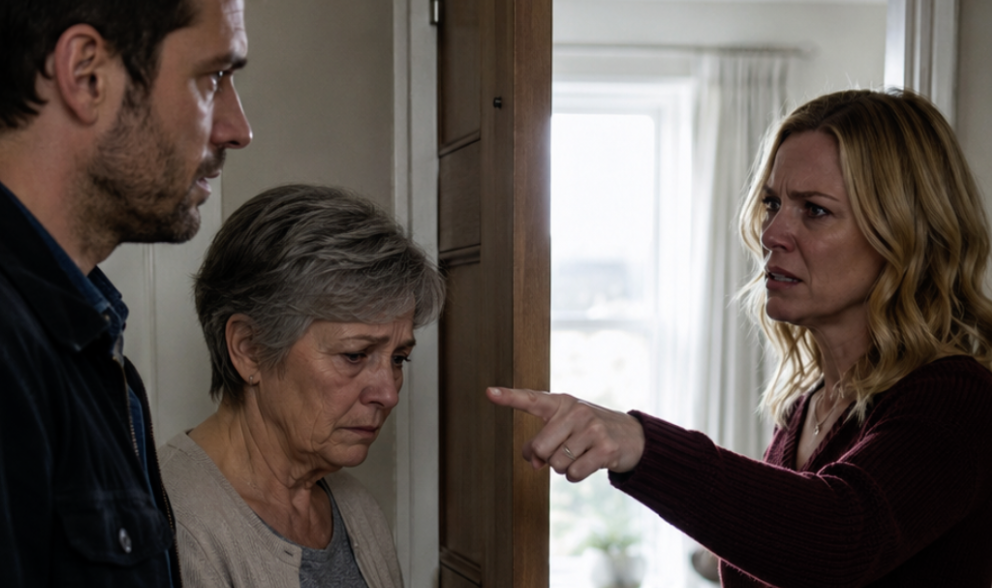
On the evening that became the last one, Tamara Ivanovna arrived around seven. Without calling, as had become usual lately. Nikolai opened the door and was glad to see her — sincerely, almost childishly, the way people rejoice when they truly have a good relationship with their mother. Vera stood in the kitchen and heard them talking in the hallway, heard Tamara Ivanovna take off her coat and say something about the weather and traffic.
Then they went into the living room, and the conversation began.
First — about the renovation. Tamara Ivanovna said the wallpaper in the hallway needed to be replaced because the current one was already outdated. Vera had chosen that wallpaper herself two years earlier. She liked it. She said nothing.
Then — about the routine. Tamara Ivanovna said Kolya looked unwell, apparently went to bed too late, and it would be good to establish some kind of schedule in the house — dinner at the same time, lights out no later than eleven.
Nikolai was forty-one years old.
Vera stood by the table, holding a mug of tea, and listened. Attentively, without interrupting. At some point she realized that Tamara Ivanovna was no longer advising or suggesting — she was simply saying how things would be. As if the decision had already been made and only needed to be announced to the people who would carry it out.
“And there’s one more thing I wanted to say,” Tamara Ivanovna said, looking not at Vera but somewhere past her, toward the window. “The apartment is large, there are rooms. It’s hard for me to travel from the country house in winter, the road is not close. Kolya doesn’t object, I already asked him. So I think I’ll move in with you for the winter. With my things. I won’t be too much of a burden for long.”
The living room became quiet.
Vera shifted her gaze to her husband.
Nikolai was sitting in an armchair, one leg crossed over the other, looking at his phone. Then he raised his eyes, met Vera’s gaze, and gave a barely noticeable nod.
Confirming.
Agreeing.
As if this were a conversation about whether or not to buy a new kettle.
Vera looked at him for several seconds. A long time. The way people look when they are no longer searching for anything new — only confirming what they have known for a long while.
Then she placed her mug on the table. Carefully, without a sound.
And went to the bedroom.
Tamara Ivanovna said something after her — something about how she had simply warned them in advance, so there would be no surprises. Vera did not answer. She opened the wardrobe. Took out the large travel bag — the one Nikolai had arrived with two years earlier. And began packing his things.
Slowly.
Carefully.
Shirts in a stack, trousers folded properly, sweaters without haste. She did not throw the things, did not crumple them. She simply packed them. Methodically, calmly, the way one packs something that no longer needs to be kept close at hand.
Nikolai appeared in the doorway.
“Vera, what are you doing?”
“Packing you.”
“What do you mean?” He did not understand at once. He stood in the doorway looking confused, like a man who had walked out of a movie theater and discovered that the weather outside had changed.
“Exactly what I said,” she replied without turning around.
She took his books from the shelf, placed them on top, zipped the bag shut. Then she lifted it, carried it into the hallway, and placed it by the door.
Tamara Ivanovna stood in the living room, watching what was happening with the expression of a person who did not entirely understand the performance, but suspected it concerned her.
Vera turned to Nikolai. She looked at him calmly — without anger, without tears, without a tremor in her voice.
“You got yourself ready — now go,” she said. “And don’t forget your mother. You two are a team now.”
Nikolai opened his mouth. Closed it. Looked at his mother, then at the bag, then back at Vera — as though searching her face for signs that this was not final yet, that she would step back now, or at least raise her voice so there would be something to argue with.
But her voice was even.
And her face was calm.
And that, it seemed, was the most frightening thing of all.
“Vera, let’s talk,” he finally said.
“I talked,” she answered. “For a long time. You didn’t hear me.”
Tamara Ivanovna muttered something about how young people nowadays had no restraint and did not know how to communicate. Vera did not answer. She opened the front door and stepped aside.
Nikolai stood there a little longer. Then he took the bag. Then his jacket. Then he said something quietly to his mother — Vera did not catch what it was. Tamara Ivanovna pressed her lips together, picked up her handbag from the little hallway cabinet, and went out first. Nikolai lingered on the threshold. He looked at Vera.
“Are you serious?”
“Yes,” she said.
He left.
The door closed.
It did not slam — it simply closed, quietly, the way doors close when everything has already been said and there is nothing left to add.
Vera stood in the hallway for a while. She looked at the coat rack, where now only her coat hung. At the shoe shelf, where now only her shoes stood. At the hallway where there was no longer a bag of spare parts, no charger, no someone else’s keys on the hook.
The silence was different.
Not empty — truly silence.
The kind one hears when no one nearby is dictating conditions.
After that evening, Tamara Ivanovna called several times. Once, she called Vera directly.
“Vera, don’t act rashly. Kolya is upset. You need to talk calmly.”
Vera answered that she was absolutely calm, and that everything she had wanted to say had already been said. Her mother-in-law was silent for a moment, then said something about how young people nowadays did not know how to preserve a family. Vera wished her a good evening and ended the call.
The second time, Nikolai called — three days later. He said they could talk, that he was ready. Vera answered, “Good, let’s talk.” She asked whether he had understood that something needed to change, or whether he wanted to explain to her that she had been wrong.
He was silent.
Then he said:
“Well, Mom is still my close person.”
Vera answered:
“I know. And that is exactly why everything is right.”
The conversation ended.
He did not call again.
She went to the kitchen and put the kettle on. While it boiled, she opened the window — autumn air flowed into the apartment, damp and cold, smelling of leaves. Vera stood there and breathed. Simply breathed.
Then she poured herself tea. Took the mug and went into the living room — the one with bare light walls, no lace doilies, curtains without ruffles, and a sofa she had chosen herself and that did not need to be changed for anyone.
After that evening, Nikolai sent her a message — long, detailed, full of explanations. He wrote that he had not understood how much it hurt her. That he would try. That his mother was his mother, and she did not mean any harm.
Vera read it. She replied briefly:
“I know she didn’t mean any harm. But that does not change what happened.”
He asked to meet.
She answered:
“First, I need time.”
He respected that. A week later, he wrote again, simply:
“How are you?”
She answered:
“Good.”
It was true.
She did not hold anger against him. Anger requires energy, and now that energy went elsewhere — into work, into herself, into that very space she had been reclaiming inch by inch for so long, not noticing that she had been giving it away.
When Vera’s friend found out about everything, she asked:
“Won’t you regret it? You were together for so many years.”
Vera thought honestly and answered:
“I already regret it — that I didn’t do it sooner.”
Not because he was a bad person. Good people can also create bad conditions — not deliberately, not out of malice, but simply because they do not know how, or do not want, to see what is happening to another person. That does not make them villains.
But it does not make it any easier to live with.
She did not talk about it much. She did not spill it all out in conversations, did not analyze it aloud at every opportunity. She simply knew — and that was enough.
The autumn air from the open window smelled the same way it had smelled on the evening when they first drank coffee in that café. Vera smiled to herself — not bitterly, but the way people smile when life suddenly turns out to be surprisingly circular.
It had begun in autumn.
It had ended in autumn.
Something else would begin now, too — in autumn. Or not in autumn.
What difference did it make?
The important thing was that it would begin.
She did not know what would come next. She was not planning anything yet. She simply sat in her apartment, in her silence, in her own space.
And for the first time in a long while — truly in her own.