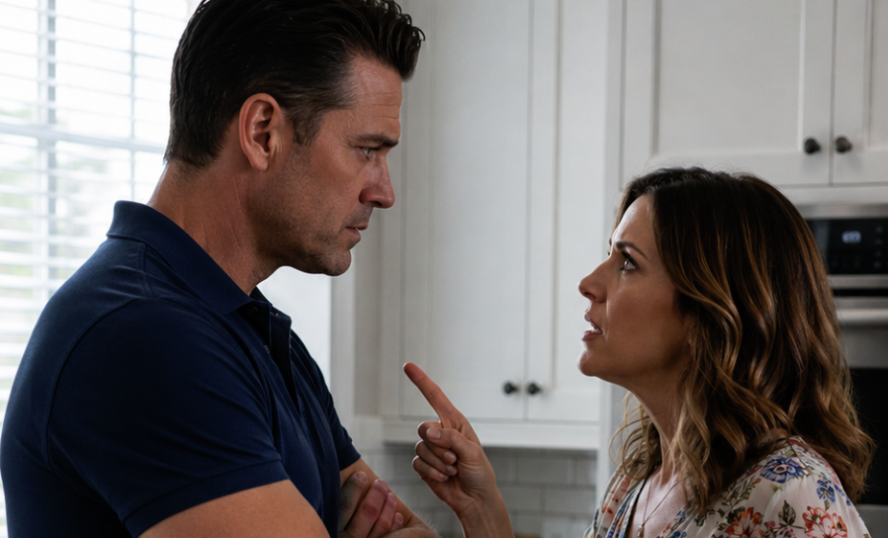
“Shut up, you cow! Where’s the borscht?” Viktor hurled the plate against the wall, and red splashes scattered across the wallpaper.
“Cook it yourself if you don’t like it!” He grabbed me by the shoulder and spun me around to face him.
“Have you completely lost your mind? Forgotten who the master of this house is?”
“No, Vitya. You’re the one who forgot,” I said calmly, pulling documents out of my bag. “Now I’m the mistress here.”
His face went from crimson to deathly pale. His hands began to tremble when he saw the notary’s seal on the will.
I had lived with this man for thirty years. Thirty years of humiliation, insults, and beatings. It had all begun beautifully — flowers, compliments, vows of eternal love. Viktor was eight years older than me and worked as a construction foreman. He seemed so reliable, so solid.
After the wedding, the mask came off quickly. The first slap came a month later — the soup wasn’t salty enough. I cried all night then, and in the morning he brought me a bouquet of daisies, kissed my hands, begged for forgiveness. I believed him, fool that I was.
“Marinka, you know I’m hot-tempered. But I love you, darling. It won’t happen again.”
It happened again a week later. Then again and again. I learned to cover bruises with foundation, and when my friends asked questions, I answered, “I fell down the stairs.” They nodded knowingly — everyone understood everything, but stayed silent. That was how things were back then.
The children were born one after another — Alyonka and Dimka. I thought fatherhood would change him. Naive fool. He didn’t hit me in front of the children — that was the only thing I was grateful for. But he humiliated me constantly.
“Mom, why does Dad talk to you like that?” five-year-old Alyonka once asked.
“Daddy gets tired at work, sweetheart. It’s hard for men.”
“Then why do you cry at night?”
“You dreamed it, my little girl.”
The turning point came three months ago. My cousin from Yekaterinburg called.
“Marin, Aunt Valya died. She left a will in your name.”
“What will? She had nothing except an old Khrushchev-era apartment.”
“She did. She just kept quiet about it. An apartment in central Moscow, a bank account. At least fifteen million.”
I nearly dropped the phone. Aunt Valya had worked her whole life as a cleaner at a research institute and saved on everything. It turned out her husband, Uncle Tolya, had been a prominent engineer and held patents. After his death, she sold all the patents and rented out the apartment. She lived modestly and saved.
“I leave everything to my beloved Marinka. I know how hard it is for her with that bastard. Let her start a new life,” it said in the letter attached to the will.
For three months I handled the paperwork. I didn’t tell Viktor anything. Why would I? He would have taken it all from me, just like he had taken my salary all those years. I hired a lawyer secretly and put everything in my name. Both the Moscow apartment and the money.
“What is this?” Viktor shook the papers, spit flying everywhere. “Where did all this come from?”
“An inheritance from Aunt Valya. Fifteen million and a three-room apartment in Moscow.”
“So… so this is our money! Family money!”
“No, Vitya. It’s my money. Mine alone. See the seal? Everything is in my name.”
He lunged at me, but I stepped back toward the door.
“And one more thing. I’m filing for divorce. The lawyer is already preparing the documents. Alyona recorded you beating me on her phone. Dimka is a witness. The judge will be on my side.”
“You… you wouldn’t dare! I’ll bury you!”
“Try. A police statement has already been written and is with my lawyer. If anything happens to me, it goes straight into the case.”
Viktor sank down onto the stool. His face turned gray, his hands hanging limply.
“Marina… let’s talk… I love you…”
“Love me? I’ve had enough of thirty years of your ‘love.’ Pack your things. I’m giving you three days.”
I couldn’t throw him out of the apartment — it had been privatized in both our names. But I could leave. Easily.
The children supported me.
“Mom, finally!” Alyonka hugged me. “We thought you’d never make up your mind.”
“If Father touches you, call me right away,” Dimka clenched his fists. “I’ll deal with him.”
A week later, I flew to Moscow. I rented an apartment not far from the one I had inherited — I decided to rent that one out. With the first money, I bought myself decent clothes, got my hair done, and had a manicure. Looking in the mirror was frightening — I didn’t recognize myself. A beautiful woman looked back at me, not a beaten-down hen.
I got a job as an administrator at a private clinic. The salary was small, but it was enough for me. The main thing was freedom. No one shouted, humiliated me, or hit me.
Viktor called a hundred times a day during the first month. He threatened me, begged me, cried into the phone. I changed my number. He tried to reach me through the children — they told him where to go.
Six months later, Dimka called.
“Mom, Father’s been drinking. He lost his job. He’s selling the apartment.”
“Let him sell it. I don’t care.”
“He’s asking for money. Says you’re obligated to help.”
“I don’t owe him anything, sweetheart. I spent thirty years paying my debts.”
Three more months later, my former neighbor called.
“Marina, they took your Viktor to the hospital. Cirrhosis of the liver. The doctors say he doesn’t have long.”
“Thank you for letting me know,” I answered, and hung up.
I felt no pity. None at all. It had all burned out of me over the years.
Now two years have passed. I live in my Moscow apartment — I renovated it and furnished it the way I had always dreamed. I still work at the same clinic, now as the senior administrator. I met a man — Igor. Intelligent, calm. He gives me flowers, takes me to the theater. He has never once raised a hand to me, never once raised his voice.
“Marina, what happened to you? Why do you flinch when I move suddenly?” he asked me once.
“It’s a long story, Igor. I’ll tell you someday.”
Viktor died a year ago. I didn’t go to the funeral. The children went and said almost no one was there. Drunken drinking buddies and a couple of relatives.
Alyonka once asked:
“Mom, do you regret that it turned out this way?”
“What is there to regret? That I lost thirty years? Yes. That I left? Never.”
“And if it hadn’t been for the inheritance?”
“I don’t know, my little girl. I probably would have kept enduring it until the end. It’s terrifying to think about.”
Aunt Valya didn’t just leave me money. She gave me life. A new life, where I am a human being, not a punching bag. A life where morning begins not with fear, but with coffee and a smile. A life where it is possible simply to be happy.
Sometimes I think — what would have happened if I had decided to leave earlier? Without money, without support? Maybe I would have managed, maybe not. There is no way to know now.
I know one thing: no woman should endure humiliation and beatings. Not for any amount of money. Not for the sake of any children. We only have one life, and to live it in fear and tears is a crime against oneself.
And that plate, the one Viktor threw on our last day together, remained lying on the floor in shards. I deliberately didn’t clean it up.
Let him clean it himself.
If he can.