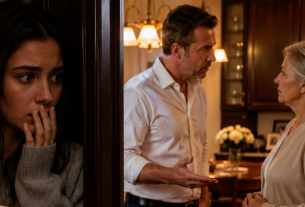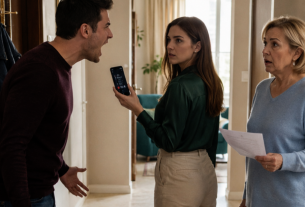
“Svetlana, you can’t sell the apartment. I’m still living here,” Elena declared the moment she stepped through the doorway.
Svetlana did not answer immediately. She merely placed the folder of documents on the table and studied the woman standing in the middle of the entryway with such confidence that one might have thought she had entered her own reception room rather than someone else’s home.
“Did you come here to talk or to give orders?” Svetlana asked.
Elena took off her coat, although no one had invited her to make herself comfortable, ran a hand over her hair, and walked into the kitchen.
“To talk. But I’m warning you right now: I’m not moving out, and I won’t allow you to bring potential buyers here.”
The corner of Svetlana’s mouth curled into a faint smile.
“You won’t allow it?”
“That’s right. I won’t. I’ve lived here for years. My whole life is settled here. And your brother, by the way, promised that I could stay for as long as necessary.”
“My brother hasn’t lived here for two years.”
“That doesn’t change anything.”
“It changes a great deal, Elena.”
Elena sat down at the table and placed her phone in front of her, screen facing upward, as though she intended to record the conversation. There was such certainty on her face that Svetlana was momentarily taken aback. Not by fear, but by the sheer audacity of it.
Two years earlier, this same woman had cried in this very kitchen, smearing mascara across her cheeks with a napkin and saying that she had nowhere to go. Svetlana had brought her a glass of water, opened the cupboard, found clean bed linen, and said:
“You can stay here for now. Give yourself some time to recover, and then you’ll find another place.”
Back then, the words “for now” had been perfectly clear.
Now Elena was pretending they had never been spoken.
Svetlana had not inherited the apartment, nor had anyone given it to her. She had bought it herself, long before her younger brother Pavel married. At the time, Svetlana worked as an administrator at a private clinic, took extra shifts, denied herself many things, and spent several years saving for the down payment. It was a small two-bedroom apartment on the fifth floor of an old but solid building.
Svetlana loved the place. It was where she first understood what it meant to close a door with her own key and not have to ask anyone whether she was allowed to leave a cup on the edge of the table or go to bed at nine in the evening. Later, she married and moved into her husband’s apartment in another district, deciding to keep her own apartment for the time being.
When Pavel married Elena, the newlyweds lived in a rented apartment. Then the problems began. First, their landlords asked them to move out. Then Pavel lost his job. Then Elena had an argument with her mother and refused to stay with her even temporarily.
Pavel came to see his sister one evening. He sat in the kitchen, turning his car keychain over and over in his hands, unable to raise his eyes.
“Svet, help us out. Just for a couple of months. Lena and I will rent something afterward.”
“Only for a couple of months?”
“Of course. I understand that it’s your apartment.”
Svetlana gave him the keys.
Looking back on that evening now, she understood clearly that she should not have simply felt sorry for him. She should have put everything in writing from the beginning. But who thought about written agreements at moments like that, when your own brother sat in front of you with a gray face, begging you not to leave his family without a roof over their heads?
During the first few months, Pavel genuinely tried to find a solution. He responded to listings and viewed apartments. Elena, however, always found a reason to reject them.
“It’s on the ground floor.”
“The children upstairs make too much noise.”
“The kitchen is too small.”
“The neighborhood is unpleasant.”
“The landlady asks too many questions.”
Svetlana did not interfere at the time. She thought they could work it out themselves. But temporary help quietly turned into six months, then a year, and then three years.
Then Pavel and Elena divorced.
The divorce went through the courts because they had a son together, Artyom, who had just turned seven. After the divorce, Pavel moved to Kazan, where he had been offered a job. He took his son during school holidays and helped as much as he could, but he never returned to Svetlana’s apartment.
Elena stayed.
“I still have nowhere to go,” she told Svetlana after the court proceedings. “You understand—there’s the child, his school, his art classes…”
Svetlana did not pressure her. She felt sorry for Artyom. He was a quiet boy with serious eyes who always greeted people first and carefully removed his shoes by the door. For his sake, Svetlana decided to wait a little longer.
That “little longer” stretched into another two years.
The first warning did not come from Elena.
Svetlana received a call from her neighbor, Tamara Semyonovna.
“Hello, Svetochka. Were you planning to sell the apartment?”
“I was, but I haven’t told anyone yet. Why?”
“Oh, nothing. We just had a strange conversation here. Elena said that if you ever decided to sell, she would have the first right to buy it. But apparently she doesn’t intend to buy it because, according to her, ‘everything has already been settled.’”
Svetlana slowly straightened in her chair.
“What exactly has been settled?”
“I didn’t ask. But she spoke so confidently—as though the apartment already practically belonged to her.”
After that conversation, Svetlana went to the apartment without warning for the first time in years.
Elena did not open the door immediately. From behind it, Svetlana heard her say to someone:
“Wait. It’s the owner.”
The word “owner” sounded as though she were referring to an unpleasant but temporary obstacle.
The apartment smelled of fried fish and cheap air freshener. Two boxes of belongings stood in the hallway. Someone’s man’s backpack lay on the floor.
“Do you have guests?” Svetlana asked.
Elena blinked too quickly.
“A friend dropped by.”
A man of about forty-five came out of the room. He was wearing a casual T-shirt, with a towel draped over his shoulder.
“This is Igor,” Elena said quickly. “He’s helping me with my computer.”
Igor nodded as though Svetlana had interrupted his day off.
“I came for some things,” Svetlana said coldly. “I’m taking my documents out of the cupboard.”
Elena immediately became alert.
“What documents?”
“Mine.”
“What for?”
“Because they belong to me.”
While Svetlana was retrieving the folder, she noticed that some of her belongings had disappeared. The old bookcase was gone. A chest of drawers had been moved into another room. On the windowsill lay Elena’s documents, several bills, Artyom’s school notebooks, and a brochure from a real estate agency.
Svetlana picked up the brochure.
“Are you looking at apartments?”
Elena abruptly snatched it from her hand.
“I was just looking.”
“Good. So you haven’t forgotten about moving after all.”
“Svet, let’s not start this.”
“Start what?”
“Pressuring me. You’re not a stranger, after all.”
Svetlana looked at Igor, who was calmly drinking water from her cup. Then she turned her gaze back to Elena.
“No, I’m not a stranger. That’s exactly why you’ve been living here for five years.”
Elena’s face changed immediately. Uneven red blotches appeared on her cheeks, and her fingers squeezed the brochure until the paper crackled.
“So now you’re keeping score?”
“Yes.”
“Wonderful. So all your help was just for show?”
“No. But helping someone does not mean providing them with a home for the rest of their life.”
Elena said nothing then. But two days later, Svetlana learned that her former sister-in-law was already telling the neighbors a different version of events.
According to Elena, Svetlana intended to sell the apartment with a person still living inside it.
Svetlana had not decided to sell the apartment out of greed. Her husband Dmitry needed to expand his musical-instrument repair workshop. He had been self-employed for years and rented a room in the basement of a shopping center, where a pipe constantly leaked and the ventilation system droned without pause. An opportunity had arisen to buy a small commercial space on the ground floor of a residential building.
At first, Dmitry did not want to raise the subject.
“It’s your apartment. I have no claim to it.”
“I want to sell it myself,” Svetlana replied. “For me, it stands empty, but for everyone else, it’s occupied.”
“Will Elena move out?”
Svetlana silently looked at her husband.
Dmitry understood without further explanation.
“So there’s going to be a scandal.”
“It’s already started.”
A buyer appeared unexpectedly quickly. A young woman named Ksenia was looking for an apartment for her mother. The neighborhood suited her, as did the floor and the layout. All they had to do was show her the property.
Svetlana called Elena.
“On Saturday at twelve, some people are coming to view the apartment.”
Silence hung on the other end of the line.
“Who’s coming?”
“A buyer.”
“Are you joking?”
“No.”
“Svetlana, have you lost your mind? I live here.”
“That is why I’m warning you in advance.”
“No. I won’t let anyone in.”
“It’s my apartment.”
“And I have a child living here!”
“Don’t drag Artyom into this.”
Elena hung up.
On Saturday, no one opened the door for the buyers.
Svetlana rang three times—first through the intercom and then by phone. It was quiet behind the door, although Tamara Semyonovna later said she had seen Elena that morning and that she had not gone anywhere.
Ksenia stood beside her mother in the stairwell, clearly uncomfortable.
“I’m sorry,” Svetlana said, struggling to keep her voice calm. “An unpleasant situation has come up.”
Ksenia’s mother studied the closed door.
“Is someone living in there?”
“Temporarily.”
The woman nodded knowingly.
“Then you should resolve that issue first. I know stories like this. You buy an apartment and then spend months trying to get someone out of it.”
The buyers left.
Svetlana remained on the landing, staring at the door behind which someone moved almost inaudibly through the hallway.
She did not knock.
She simply took out her phone and sent Elena a brief message:
“We need to meet. Today.”
The reply arrived a minute later:
“I have nothing to discuss with you.”
Svetlana gave a faint smile. She no longer had anything to ask for, either.
Pavel flew in a week later.
Svetlana had called him herself and briefly explained the situation. At first, her brother sighed. Then he tried to steer the conversation toward a peaceful resolution.
“Svet, you know what Lena is like. She can be harsh, but she isn’t a bad person.”
“Pavel, she refused to open the door for the buyers.”
“Maybe she was frightened.”
“She’s telling everyone that she has the right to decide whether I can sell my apartment.”
“That’s nonsense. She’s only saying it because she’s emotional.”
“Then fly here and explain it to her calmly.”
Pavel arrived on Friday. Svetlana met him outside the building. He had aged noticeably over the past two years. He carried a bag of gifts for his son and kept looking up at the fifth-floor windows.
“Is Artyom home?”
“I don’t know. Elena hasn’t been letting me in lately.”
Pavel frowned.
“What do you mean?”
“Exactly what I said. She doesn’t open the door when she doesn’t want to.”
They went upstairs together.
Elena opened the door almost immediately. When she saw her former husband, she was taken aback at first, but quickly regained her composure.
“Pavel? What are you doing here?”
“I came to see my son. And to talk.”
Artyom peered out of the room.
“Dad!”
The boy rushed toward his father, and for several seconds the entryway was silent. Svetlana even turned her gaze away. The adults could argue as much as they liked, but the child was not responsible for the years of indecision and entitlement that had surrounded him.
Elena let them inside.
The conversation began half an hour later, after Artyom went to his room to assemble the construction set his father had brought him.
“Lena,” Pavel began, “you need to start looking for somewhere else to live.”
Elena slowly turned toward him.
“You too?”
“This is Sveta’s apartment.”
“And where were all of you when I was left alone with a child?”
“I didn’t abandon my son.”
“Of course not. You moved away, and now you’re a hero through video calls.”
Pavel went pale. He wanted to respond sharply, but restrained himself.
“I’m not talking about our relationship. I’m talking about the apartment.”
“And I’m talking about life. I invested years here. I kept everything running. I paid the utilities and made sure nothing fell apart. Am I supposed to be nothing?”
Svetlana calmly opened the folder.
“Utilities were payment for living in the apartment. They were not an investment in its purchase.”
“What about the renovations?”
“What renovations?”
Elena jumped to her feet.
“I replaced the faucet! I repaired an electrical outlet! I bought a shelf!”
“Would you like me to reimburse you for the shelf?”
Pavel unexpectedly snorted, but immediately fell silent under his former wife’s glare.
Elena sat down again.
“Here’s how it is. I’m not moving out. Take me to court if you want.”
Svetlana closed the folder.
“All right.”
Elena blinked.
She had clearly expected shouting, pleading, threats—anything but calm agreement.
“What do you mean, all right?”
“Since you refuse to vacate the apartment voluntarily, I will resolve the matter through legal channels.”
“And how long will that take?” Elena narrowed her eyes. “Six months? A year? I’m in no hurry.”
Svetlana stood up.
“And I’m no longer going to rush you with words.”
After that, Elena seemed determined to prove that the apartment already belonged to her.
First, she put up a notice in the entrance under her own name:
“For all questions concerning water and heating, please contact Elena Viktorovna in Apartment Five.”
Then she ordered the delivery of a large household appliance. The courier called Svetlana because she was listed as the property owner in the paperwork, while Elena refused to sign the delivery form unless it described her as “the responsible party.”
Svetlana came over.
A huge refrigerator stood in the hallway.
“What is this?” she asked.
“I bought it.”
“Why?”
“The old one doesn’t cool properly.”
“The old one belongs to me.”
“Well, now there’ll be a new one.”
Svetlana looked at the box and then at Elena.
“You understand that buying a refrigerator does not establish your right to remain in the apartment?”
“You’re funny, Sveta. I’m simply living normally.”
“In someone else’s apartment.”
Elena lifted her chin.
“In an apartment where I’ve spent more time than you have in recent years.”
Svetlana took out her phone and photographed the box, the hallway, and the old refrigerator.
“What are you doing?”
“Documenting what is happening in my apartment.”
“Don’t you dare photograph me!”
“I’m not photographing you.”
Elena lunged toward her, but Pavel, who had just arrived to visit his son, grabbed his former wife by the elbow.
“Lena, calm down.”
“Don’t touch me!”
She jerked her arm away, struck a bag of tools, and sent screwdrivers spilling across the floor. The sound was so sharp that Artyom came running out of his room.
“Mom?”
Elena immediately changed her tone.
“Everything’s fine, sweetheart. Aunt Svetlana is just starting another argument.”
Svetlana looked at the boy. He stood barefoot on the rug, clutching a piece from his construction set. His eyes were wary and far too adult.
For the first time, Svetlana addressed Elena in an entirely different tone.
“Stop putting on performances in front of the child.”
Elena opened her mouth, but Pavel spoke before she could.
“Artyom, get ready. We’re going for a walk.”
“I didn’t give permission!” Elena said sharply.
Pavel turned toward her.
“I’m his father. Today is my scheduled day with him. We agreed in advance.”
Elena gave a bitter smile.
“Now you remember you’re his father?”
Artyom looked from his mother to his father. Svetlana could see the boy’s fingers trembling around the small plastic piece.
Pavel approached his son and crouched in front of him.
“Get dressed. We’re just going for a walk. No discussions.”
The boy nodded and disappeared into his room.
When the door closed behind Pavel and Artyom, Elena spun toward Svetlana.
“You want to leave me without a home, and now you’re turning my child against me too?”
“No. You’re the one hiding behind your child every time the apartment is mentioned.”
Elena leaned toward her.
“And you’re hiding behind your paperwork.”
“Because the paperwork confirms what you’re trying to claim through words.”
Elena’s face twitched. She clenched her hands so tightly that her knuckles turned white.
“Fine. We’ll see who wins.”
The court proceedings began without any dramatic scenes.
Svetlana gathered the documents confirming her ownership and prepared evidence that Elena was living in the apartment without a contract and refusing to vacate it voluntarily.
Pavel provided a written statement explaining that permission to live there had originally been temporary and that after the divorce he had moved out himself and held no rights to the apartment.
Elena arrived at the first hearing elegantly dressed, carrying a thick folder of papers and wearing a confident expression. She spoke at length.
She spoke about the years she had lived in the apartment.
About her child.
About the effort she had invested.
About the fact that Svetlana had not objected before.
About what she called her “necessity arising from her life circumstances.”
Svetlana listened silently. She raised her eyes only once, when Elena said:
“Svetlana effectively transferred the property to me for permanent residence.”
The judge asked:
“Do you have a deed of gift, purchase agreement, lease, or any other document confirming your right to use the property indefinitely?”
Elena hesitated.
“There is no document. But there were family agreements.”
“Who was present when these agreements were made?”
Elena looked at Pavel.
Pavel lowered his eyes, but eventually answered:
“It was always understood to be temporary assistance.”
Elena turned sharply toward him. Her gaze became so piercing that Pavel shifted away from her in his chair.
After the hearing, she caught up with Svetlana near the exit.
“Are you happy now?”
“No.”
“You’re lying.”
“Elena, I take no pleasure in having to remove someone from my own apartment through the courts.”
“You humiliated me.”
“You chose this path yourself.”
Elena stepped almost nose-to-nose with her.
“I’m still not going to leave quietly.”
Svetlana calmly placed the folder in her bag.
“I already understand that.”
After the court issued its decision, Elena was given a deadline to vacate the apartment.
Svetlana hoped that would be the end of it.
But Elena decided to slam the door so loudly that the entire building would hear it.
A week before the deadline, she organized a “farewell party.” Except there was nothing genuinely farewell-like about it. It was more of a demonstration.
The neighbors later said that Elena’s friends had come, along with Igor and some woman with a teenager. They loudly discussed “greedy relatives,” “apartment queens,” and the fact that “decent people don’t behave like that.”
Svetlana arrived the following morning.
The landing smelled of tobacco and mandarins. A bag of garbage lay beside the door.
She opened it with her own key, having warned Elena in advance that she was coming.
The apartment was dirty.
It had not been destroyed or vandalized. It had simply been left in a deliberately careless state. The kitchen floor was sticky. Empty bottles littered the bathroom. There were marks where furniture had stood, boxes in the rooms, and forgotten children’s drawings on the refrigerator.
Elena sat at the table wearing her coat.
“Have you come to inspect your royal chambers?”
Svetlana looked around.
“Where is Artyom?”
“At my mother’s. Don’t worry, you won’t see the child today.”
“I wasn’t planning to involve him in the move.”
Elena snorted.
“How noble of you.”
Svetlana took out a sheet of paper.
“We’ll inspect the apartment now. Then you’ll hand over the keys.”
“And what if I don’t?”
“Elena.”
For the first time in the entire year, Svetlana said her name without gentleness, exhaustion, or any attempt to negotiate.
Just one short word.
Elena studied her and, for some reason, fell silent.
At that moment, the doorbell rang.
Svetlana opened it. Pavel stood on the threshold.
“You?” Elena flared. “You’re the last person I need here.”
“I came to help collect the rest of Artyom’s things.”
“I’ll take them myself.”
“You’ve been saying that for a week.”
Elena jumped to her feet.
“Wonderful! Everyone’s here! Why don’t you invite the neighbors too?”
“There’s no need,” Svetlana replied. “They’ve already seen enough.”
Pavel went into the room and carried out a school backpack, a box of books, and a bag containing his son’s winter clothes. Elena hurried after him, checking that he had not taken anything extra.
Meanwhile, Svetlana walked through the rooms and stopped beside the window.
On the windowsill lay the same real estate agency brochure she had seen months earlier. Only now, an address in the neighboring building had been circled in pen.
“So you did find somewhere to live,” Svetlana said.
Elena turned sharply.
“That’s none of your business.”
“How long ago did you find it?”
Elena did not answer.
Pavel froze by the door.
“Lena?”
She turned away.
And everything became clear.
She had had another option. Perhaps it was not ideal. Perhaps it was more expensive, farther away, or smaller. But it existed. Living free of charge in someone else’s apartment had simply been more convenient.
Pavel slowly placed the box on the floor.
“Is that why you dragged this out?”
“Don’t start.”
“You could have moved out in the spring?”
Elena grabbed the set of keys from the table.
“What do all of you want from me? Did you expect me to carry everything alone? Did you want everyone to be comfortable except me?”
Svetlana looked at her without anger. Even her previous irritation had disappeared. The woman standing before her was not an unfortunate victim trapped by circumstances, but someone who had spent far too long testing how much she could get away with by appealing to other people’s pity.
“Give me the keys, Elena.”
“Here!”
She threw the keyring onto the table. The keys struck the surface and bounced toward the folder of documents.
Svetlana did not flinch. She simply picked them up and counted them.
“The second set?”
“My mother has it.”
“We’ll collect it now.”
“I’ll bring it later.”
“No. Now.”
Elena straightened.
“You don’t trust me?”
Svetlana looked directly into her eyes.
“Not anymore.”
Pavel silently took out his phone.
“I’ll call your mother. She can bring the set downstairs. We’ll drive over.”
Elena stared at her former husband for several seconds. Then she abruptly grabbed her bag.
“Let’s go, then, since you’ve decided to stage a public eviction.”
“Not an eviction,” Svetlana said calmly. “The return of my apartment.”
They collected the keys from Elena’s mother forty minutes later.
The elderly woman opened the door herself. She looked tired and did not appear surprised.
“I told her this was how it would end,” she said quietly, handing the keyring to Svetlana. “But Lena is stubborn. She always thinks that if she refuses to accept something for long enough, life itself will adjust to suit her.”
Elena stood nearby, her face like stone.
“Mom, don’t.”
“Yes, I will,” the woman snapped. “You could have lived with me for two years while you got back on your feet. But you wanted a separate apartment. It belonged to someone else, but at least it was separate.”
Svetlana did not add anything.
She had already heard enough.
That same day, she called a locksmith and had the locks replaced. No declarations, no unnecessary conversations. After an experience like that, only someone who wanted the story to continue would behave differently.
Then she returned to the apartment alone.
She walked through the rooms for a long time, opened the windows, and gathered the forgotten items into a separate bag. In the child’s room, she found one of Artyom’s drawings: a house, the sun, and three people standing near the entrance. On the back, in uneven handwriting, were the words:
“Dad will come on Satuday.”
Svetlana carefully placed the drawing with the boy’s belongings.
Her anger toward Elena had not disappeared, but she had never stopped feeling sorry for the child.
A few days later, Pavel came to collect the bag.
“Thank you for keeping everything.”
“It belongs to Artyom.”
He nodded, stood by the door for a moment, and quietly said:
“Forgive me.”
“For what exactly?”
Pavel smiled without humor.
“For asking you to help us once and then pretending that it was no longer my problem.”
Svetlana looked at her brother.
“I was angry with Elena. But I was even angrier with you.”
He did not try to defend himself.
“I know.”
“You left, and I stayed behind to deal with the consequences of your family life.”
Pavel rubbed a hand over his face.
“At the time, I thought that if I left it alone, the problem would resolve itself.”
“It didn’t.”
“No.”
They were silent for a moment.
Then Pavel asked:
“Are you still selling the apartment?”
“Yes.”
“Good.”
He wanted to say something else but could not find the words. He took the bag, carefully pressed it against his side, and left.
Ksenia returned to view the apartment two weeks later.
This time, the door opened immediately.
The apartment was empty, bright, and clean. There were no strangers’ boxes, no resentful voices, and no people treating someone else’s property as a convenient extension of their own lives.
Ksenia’s mother walked through the rooms, touched the windowsill, and looked out at the courtyard.
“It’s a good apartment,” she said. “Peaceful.”
Svetlana smiled almost imperceptibly.
If the walls could speak, they probably would not have agreed about the peaceful part. But now it really was quiet there.
The sale was completed a month later.
Before signing the papers, Svetlana visited the apartment one last time. She stood in the entryway where Pavel had once asked for the keys for a couple of months. She walked into the kitchen where Elena had declared that she would not allow the property to be sold. Then she stopped beside the window.
She felt a little sad.
Not because of the apartment.
Because of how easily people sometimes turned help into an obligation and kindness into a reason to demand even more.
Her phone vibrated.
The message came from an unfamiliar number.
“This is Elena. I found your number through Pavel. Artyom asked me to thank you for the drawings and books. And I also… thank you for not throwing away his things.”
Svetlana read the message twice.
Then she replied:
“The child’s belongings had nothing to do with this.”
She put her phone in her bag, closed the window, and left.
On the landing, Tamara Semyonovna was watering flowers in a large plastic pot.
“Well, Svetochka, did you sell it?”
“Almost.”
“And rightly so. The whole building had already begun to think the apartment belonged to no one, considering how everyone kept asserting their rights over it.”
Svetlana laughed for the first time in a long while.
“It was never ownerless.”
“Now everyone will certainly remember that.”
Svetlana went downstairs, stepped into the courtyard, and looked back at the fifth-floor windows.
Elena was no longer there, nor were her grievances or her plans for someone else’s property.
There was simply an apartment.
The same apartment Svetlana had once bought for herself, later allowed someone else to use temporarily out of pity, and eventually reclaimed years later—not through shouting, revenge, or concessions, but through persistence and cold clarity.
And when the new owner received the keys a month later, Svetlana felt no regret.
Only relief.
At last, everyone in the story was where they were supposed to be.
Elena was living in the home she had found for herself.
Pavel was present in his son’s life to the extent that he himself was prepared to make an effort.
And Svetlana was back in her own life, where her decisions no longer depended on another person’s habit of taking advantage of her patience.