Zoya was packing books into boxes before the move. A sheet of paper folded into quarters slipped from between the pages of an old novel. What was written on it overturned everything she thought she knew about her marriage.
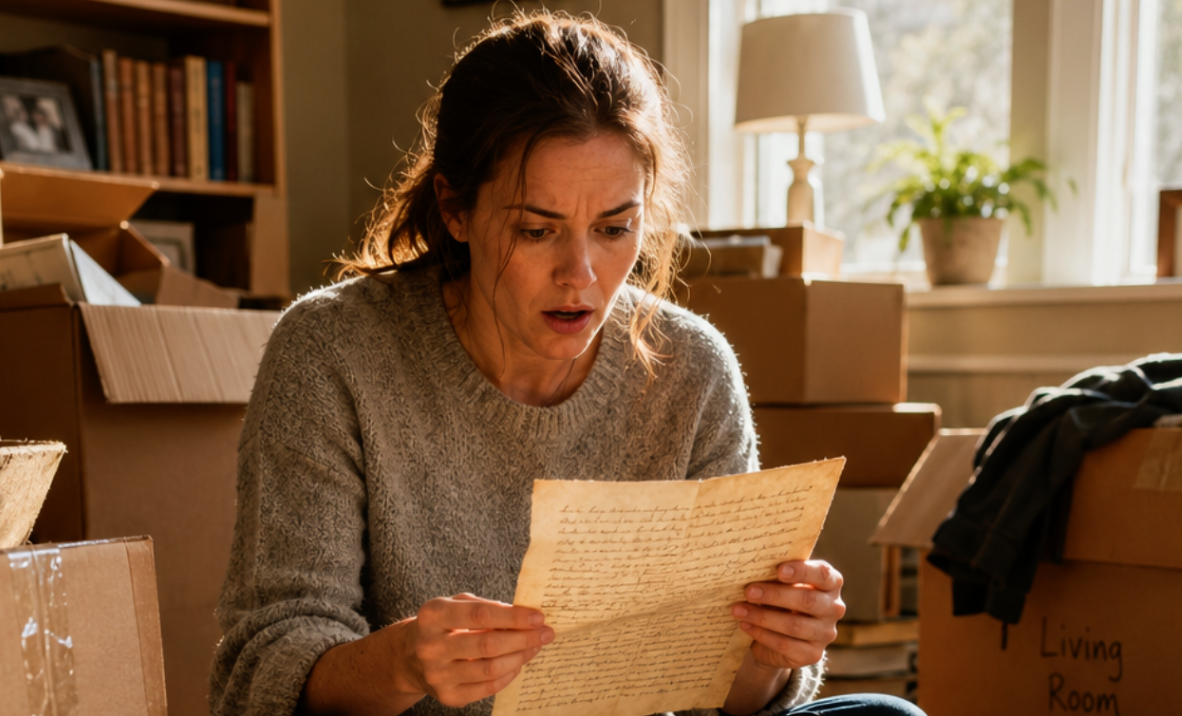
Zoya found the promissory note on Thursday, between pages 143 and 144 of Anna Karenina. The sheet had been folded into quarters, yellowed around the edges, and smelled faintly sweet, like old medicinal herbs.
She was sitting on the floor in a room that no longer looked like their bedroom. They had taken down the curtains the day before, and the light streamed harshly through the windows, making the room feel impersonal and institutional. Boxes stood along the walls, labeled in her handwriting: “kitchen,” “child’s room,” “miscellaneous.” She had left the books until the final day because Gleb always said not to touch them—he would pack them himself.
Gleb had not come.
He had left for work at seven, as usual, kissed the top of her head, and said:
“I’ll help you finish everything tonight.”
She had nodded. The kettle had not even begun to boil before he was gone.
The books smelled of dust and time. Zoya picked up each one, shook it over the box, and checked whether a bookmark or an old postcard had been left inside. A dry-cleaning receipt dated 2019 fell out of a Remarque novel. Nothing came out of Dovlatov. A thick volume of an encyclopedia that no one had ever opened shed tiny flakes of decaying paper.
Then she picked up Anna Karenina. Gleb had bought it from a secondhand bookseller near the subway about eight years earlier, brought it home, and placed it on the shelf. Zoya could not remember ever seeing him read it. The spine was smooth, without a single crease.
The sheet slipped out when she turned the book upside down. It glided to the floor like a dry autumn leaf.
Zoya picked it up and unfolded it.
The handwriting was not Gleb’s.
It was small and neat, with distinctively rounded letters and long tails. A woman’s handwriting. Zoya understood that immediately, even before she read the first word.
“I, Rimma Andreyevna Polivanova, acknowledge receipt from Gleb Sergeyevich Khodyrev of the sum of 2,800,000—two million eight hundred thousand—rubles. I undertake to repay the money by March 1, 2022. Date: September 15, 2021.”
Below it was a signature. Broad and sweeping, with an elaborate flourish.
Zoya read it three times.
The words did not change.
Two million eight hundred thousand rubles. September 2021. Three and a half years ago.
She sat down on the floor, leaned her back against the wall, and stared at the ceiling. There was a water stain up there that they had never gotten around to repairing.
Rimma Polivanova.
Zoya turned the name over in her mind like prayer beads.
Rimma. Polivanova.
She did not know anyone named Rimma. Not among Gleb’s friends, his colleagues, or their neighbors. The name sounded old-fashioned, like something from a Soviet film about workers settling virgin lands.
She took out her phone. Her fingers were cold, even though the room was stifling.
She typed “Polivanova Rimma Andreyevna” into a search engine.
Nothing useful appeared. Several social media profiles, none of which seemed relevant. A sixty-year-old woman from Novosibirsk. A teenage girl from Krasnodar. A private account with two followers.
Zoya put the phone back into her pocket and looked at the note.
It was ordinary graph paper torn from a notebook. The edge was uneven, ripped out by hand. Blue ink from a ballpoint pen. Nothing official. No notary, no witnesses. Just a note between two people.
But two million eight hundred thousand rubles was almost the entire amount of their mortgage.
They had bought this apartment in September 2021.
Zoya remembered it clearly: the heat in August, the endless property viewings. Gleb had said that he would cover the down payment himself. She had not asked where the money came from. He worked as an engineer at a factory and earned a decent salary, and she was accustomed to trusting him with financial matters.
“I have savings,” he had said. “Don’t worry.”
And she had not worried.
She had signed the documents, received the keys, and bought new curtains for the bedroom. The same curtains she had taken down the day before and folded into a bag.
Now it appeared that the down payment had not been his.
Or had not been entirely his.
Or perhaps had not been his at all.
Zoya stood and walked to the window.
The courtyard below was empty. Only the elderly woman from the ground floor was sitting on a bench, feeding pigeons. The pigeons circled around her mechanically, as though wound up like toys.
Gleb called at lunchtime.
“How is it going? Is there much left?”
“I’m packing the books.”
There was a pause.
Brief, almost imperceptible.
But Zoya heard it.
“You can put all the books into one large box,” he said. “Don’t bother sorting them. I’ll organize them later.”
“I’m almost finished already.”
“All right.”
He was silent for another second.
“Zoy, are you okay?”
“I’m fine. Just tired.”
“Okay. I’ll be home by six.”
She placed the phone on the windowsill. The screen went dark.
In its reflection, she saw her face and did not recognize it. Not because it had changed, but because she was looking at it differently.
She could have called her mother.
Her mother lived in Kaluga, worked at the post office, and knew the answers to every question, including those no one had asked her. But Zoya imagined the conversation and felt her jaw tighten.
“Mom, Gleb lent someone almost three million rubles.”
“To whom?”
“A woman.”
“What woman?”
“I don’t know.”
And then there would be an hour of explanations, theories, and advice.
Her mother would say, “I always told you.”
Her mother would say, “Check his phone.”
Her mother would say, “Divorce him.”
Zoya did not want to hear any of those words.
She wanted to understand it herself.
The kettle was still on the kitchen counter. She had not packed it yet. It was old and white, with a crack near the spout.
Zoya filled it with water, placed it on the stove, and waited for it to boil. The gas hissed quietly and evenly. The flame was blue with orange edges.
She took the note from her pocket and placed it on the table. She smoothed it with her palm.
The paper was warm from her body.
The first thing that did not make sense was the repayment date.
March 1, 2022.
It was now June 2025. The debt was more than three years overdue. The note had been lying inside a book no one ever opened.
Had Gleb never reminded her about the debt? Never demanded repayment?
Or had the money already been returned, and he had simply forgotten to destroy the note?
The second problem was the amount.
Two million eight hundred thousand rubles.
Gleb had never had that kind of money. His salary allowed him to save, but not at that rate. They had married in 2020. In one year, he could have saved six hundred thousand at most, and only if he spent almost nothing.
But they had spent money.
There had been the wedding, repairs at his mother’s apartment, and Zoya’s professional training courses.
That meant the money had come from somewhere else.
Or he had possessed it before.
Or perhaps the money had never existed and the note was fraudulent.
But why hide a fraudulent promissory note inside a book?
The kettle began to whistle. Zoya removed it from the stove, burned her finger on the handle, and held it beneath cold running water.
Her skin reddened.
The pain was minor and ordinary, and for some reason it was that small domestic pain that made her want to cry.
She did not cry.
Instead, she took the laptop out of the box marked “miscellaneous,” plugged it in, and opened their shared bank account. They had created it when they took out the mortgage.
Zoya rarely logged in. The payments were deducted automatically, and Gleb monitored the balance.
She opened the transaction history for 2021.
August: a deposit of 3,200,000 rubles into Gleb’s account.
Source: transfer from an individual.
Zoya frowned.
Three million two hundred thousand.
Not two million eight hundred thousand.
The difference was four hundred thousand.
She scrolled farther.
On the same day, August 15, Gleb had transferred 3,200,000 rubles to the property developer.
The down payment for the apartment.
But the promissory note was dated September 15.
One month later.
Zoya leaned back in the chair. Her back ached. She had been sitting on the floor all morning and had only just noticed it.
So, in August, someone had transferred three million two hundred thousand rubles to Gleb. He had immediately paid the money to the property developer.
Then, a month later, a woman named Rimma had written a promissory note for two million eight hundred thousand rubles.
The amounts did not match.
The dates did not match.
Something was wrong.
There were four hours left until six.
Zoya packed the remaining books. Her hands worked automatically: pick one up, shake it, place it in the box.
Her mind worked separately.
Possibility number one: Rimma had lent Gleb the money for the apartment. She had written the document later, after deciding that a verbal agreement was not enough.
But then the promissory note should have been written by Gleb, not Rimma.
The paper stated that Rimma had received money from Gleb.
Not the other way around.
Zoya stopped.
She read the note again, slowly, running her finger beneath the lines.
“I, Rimma Andreyevna Polivanova, acknowledge receipt from Gleb Sergeyevich Khodyrev…”
Rimma had received the money.
Gleb had given it to her.
Gleb had given someone two million eight hundred thousand rubles.
He had not borrowed it.
He had lent it.
That changed everything.
Zoya lowered her hands onto her knees.
Her fingers were trembling, faintly and rapidly, the way her grandmother’s hands had trembled when she drank tea from a saucer.
Zoya clenched them into fists and opened them again.
Then she repeated the motion.
Gleb, who counted every thousand rubles.
Gleb, who had spent three months choosing a washing machine, comparing prices in four different stores.
Gleb, who had refused to take a vacation in 2022 because, as he had said, “We should save more for the mortgage instead.”
That Gleb had given an unknown woman almost three million rubles.
Zoya called Tanya.
Not because Tanya could help, but because Zoya could no longer remain silent. Everything inside her was humming like electrical wires in the wind.
Tanya was the only friend Zoya could speak to without any introduction or explanation. They had worked together at a design bureau before Zoya went on maternity leave.
“Tanya, do you know anyone named Polivanova?”
“Polivanova… No. Why?”
“Rimma Polivanova. Have you ever heard the name?”
“No. Who is she?”
“I don’t know yet.”
Tanya fell silent. She was good at hearing what people did not say.
“Zoy, what happened?”
“I found something. Inside a book. Among our belongings.”
“What did you find?”
“A promissory note. For a large amount of money. With a woman’s name on it.”
Tanya exhaled. Zoya heard her move a chair and sit down.
“A promissory note meaning… he owes someone money?”
“No. He gave someone money.”
“How much?”
Zoya told her the amount.
The line went silent.
Then Tanya said:
“Come over.”
“I can’t. The boxes. And Gleb will be home at six.”
“Then I’ll come to you.”
“No. Don’t. I’ll handle it. I need to think.”
“Zoya.”
“Tanya, really. I’ll call you later.”
She ended the call and realized that her hands had stopped trembling.
The conversation had helped.
Not because of anything Tanya had said, but because Zoya had spoken the truth aloud.
Now it was real.
Mitya returned from kindergarten at three.
Their neighbor, Lyudmila Pavlovna, had brought him home. She picked up her own grandson from the same group.
“Mom!” Mitya rushed into the hallway with his sandals unfastened and threw himself against her legs. “Why are there boxes?”
He was four.
He knew they were moving, but every time he saw the boxes, he seemed surprised all over again.
“We talked about this, remember? A new home. A big room for you.”
“With a giraffe?”
“With a giraffe.”
She had promised him a giraffe on the wall. Not a painting, but a large wall sticker that would cover half the wall.
Mitya thought about that giraffe every day.
Lyudmila Pavlovna looked into the room and surveyed the boxes.
“Oh, Zoya, there is so much. Do you need help?”
“Thank you, but I’m managing.”
“Well, I’m nearby if you need anything.”
Zoya closed the door behind her and leaned against it.
Mitya had already run into the kitchen. She heard him dragging a stool across the tiles and climbing onto it to reach the cookies on the shelf. She heard him grunting with effort and the stool scraping against the floor.
The promissory note was in the pocket of her jeans.
She could feel it through the fabric.
A small rectangle that weighed almost nothing.
While Mitya watched cartoons on his tablet, Zoya returned to the laptop.
She opened Gleb’s email.
They knew each other’s passwords. It had been an unspoken rule between them: no secrets.
Or so she had believed.
There were many emails. Work messages, newsletters, notifications.
She searched for “Polivanova.”
Zero results.
“Rimma.”
Zero results.
Then she tried “promissory note.”
One email appeared.
It was dated October 23, 2021.
Subject: No Subject.
The sender’s address was a string of numbers, as impersonal as a hotel room number.
The message was brief:
“Gleb, keep the promissory note. Don’t destroy it. If anything happens to me, show it to Seryozha. He needs to know that I didn’t do it for nothing. Thank you. R.”
Zoya read the message twice.
Seryozha.
Who was Seryozha?
What did “I didn’t do it for nothing” mean?
And what did she mean by “if anything happens to me”?
Zoya closed the laptop.
On the tablet screen, Mitya was watching something about rescue dogs. The dogs barked bravely and decisively.
Mitya laughed.
Zoya went into the bathroom, turned on the water, and washed her face. The water was ice cold. The pipes in the old building had not had time to warm up.
She looked at herself in the mirror.
Dark circles beneath her eyes. A crease between her eyebrows that had not been there a year earlier.
She was thirty-eight.
Five years of marriage.
One child.
One promissory note.
Gleb arrived at ten past six.
She heard the key turn in the lock, heard him remove his shoes in the hallway, and heard him hang his jacket on the hook that had already been wrapped in tape for the move.
“Dad!” Mitya ran to him.
“Hey there, soldier.” Gleb lifted him with one arm and placed a bag of groceries on the floor with the other. “Is Mom home?”
“She’s in the kitchen!”
He entered the kitchen.
Zoya was standing at the stove, reheating buckwheat and meat patties.
An ordinary dinner.
An ordinary evening.
He approached her and kissed her temple.
“Tired?”
“A little.”
“Is there much left?”
“I packed the books. There are still a few small things.”
He nodded and sat at the table.
He had large hands with short fingers and a permanent line of machine oil beneath his nails that no soap could remove.
Zoya knew those hands by heart.
She knew how they held a fork, how the fingers drummed against the table when he was thinking, and how they rested on her shoulders before they fell asleep.
She placed a plate in front of him.
“Gleb.”
“Mm?”
“Who is Rimma Polivanova?”
He did not drop his fork.
He did not turn pale.
He did not freeze.
He simply stopped chewing.
For half a second, perhaps less.
Then he continued.
“Where did you hear that name?”
His voice was steady.
Not frightened.
Not angry.
Steady.
“I found the promissory note. Inside Anna Karenina.”
Now he put down the fork.
Carefully, parallel to the edge of the plate.
“Zoy…”
“I’m not shouting. I’m not causing a scene. I’m asking you a question.”
Mitya laughed at something in the cartoon in the next room.
The sound reached the kitchen, cheerful and completely inappropriate.
Gleb rubbed his face with both hands.
Zoya knew that gesture.
He did it when gathering his thoughts before a difficult conversation.
When his partner at work had been dismissed.
When his mother had been diagnosed with a cyst.
When Zoya had lost her first pregnancy.
“Rimma,” he said, “is my father’s sister.”
Zoya blinked.
Gleb did not have a father.
Of course, biologically, he had one, but Gleb had grown up with a stepfather. He spoke little and reluctantly about his biological father.
The man had left when Gleb was two.
He had never returned.
Gleb’s mother did not discuss him.
The subject was sealed shut, like a hatch leading into a basement.
“Your father’s sister,” Zoya repeated.
“Yes. My aunt. I learned about her by accident. In 2021. She found me herself.”
He spoke slowly, choosing his words the way someone selects stones while crossing a stream.
“She was sixty-two. She lived alone in Oryol. Her son, Seryozha, worked in Moscow, but they barely spoke. She was diagnosed with… Anyway, she needed surgery. Expensive surgery. In Germany.”
“And you gave her three million rubles.”
“Two million eight hundred thousand.”
“For the operation.”
“Yes.”
Zoya sat opposite him.
The stool was hard and uncomfortable.
She did not notice.
“And the three million two hundred thousand that appeared in your account? Where did that come from?”
“My father. My biological father. He died in 2020. He left me the money. I didn’t know he had been keeping track of me. A notary found me six months after the funeral.”
Zoya looked at him.
Gleb looked down at his plate.
“You inherited money from a father you never knew. And you gave almost all of it to his sister for an operation.”
“Not almost all of it. All of it. I received three million two hundred thousand. I kept four hundred thousand for the apartment deposit and gave her the rest.”
“Four hundred thousand? The deposit was three million two hundred.”
“I added my own money. I had been saving for two years. I wanted to buy a car.”
Zoya opened her mouth and closed it.
Then she opened it again.
“Why didn’t you tell me?”
He raised his eyes.
They were gray, with yellow flecks around the pupils.
She had looked into those eyes every morning for five years and had never seen in them what she saw now.
Shame.
Not for what he had done.
For having kept silent.
“Because then I would have had to tell you about my father. About the inheritance. About the fact that he knew where I was all those years and never came to see me once. I couldn’t. I didn’t want to. I didn’t know how to say it aloud.”
Mitya ran into the kitchen and pulled Gleb’s sleeve.
“Dad, come with me. I want to show you something. The dog saved a cat.”
“In a minute, soldier. Give me five minutes.”
“Daaad.”
“Mitya,” Zoya said quietly, but he heard her. “Go back. Dad will come in a moment.”
He left, his bare feet slapping against the linoleum.
His heels were pink and round, like the heels of every four-year-old.
Zoya turned back to Gleb.
“The operation. Did it help?”
He nodded.
“Is Rimma alive?”
“Yes. She lives in Oryol. She made peace with Seryozha. He moved in with her last year.”
“She didn’t repay the money.”
“No. And I never asked her to.”
“Then why did she write the promissory note?”
“She wrote it herself. She insisted. She said that if anything happened to her, Seryozha should know that she hadn’t simply taken the money. That it wasn’t a gift but a debt. It mattered to her.”
Zoya looked at the note lying on the table between the plate of buckwheat and the saltshaker.
Graph paper.
Blue ink.
Rounded letters.
An elderly woman in Oryol had probably written it while sitting at a kitchen table just like theirs. She had taken her time, forming every letter carefully.
So that her son would not think his mother had begged for charity.
They remained silent for a minute.
Perhaps two.
The buckwheat cooled on the stove.
Outside, a car horn sounded once, then again, and the car drove away.
In the next room, Mitya was talking to the tablet, explaining to the rescue dogs how they should save the cats properly.
“Gleb.”
“Yes.”
“You saved money for a car for two years. Then you gave everything to a woman you had met only once in your life.”
“Twice. I visited her before the operation. In Oryol.”
“When?”
“September 2021. I told you I had a business trip to Tula.”
Zoya remembered.
A two-day business trip to Tula.
He had returned tired and quiet.
She had asked, “How was the trip?”
He had answered, “Fine.”
And she had not asked anything else.
“You lied to me.”
“Yes.”
“For more than three years.”
“Yes.”
He did not justify himself.
He did not explain.
He simply said yes.
Zoya felt something shift inside her.
Not anger.
Not resentment.
Something else for which she had no word.
She stood, walked to the sink, and turned on the tap.
Water rushed out forcefully, striking the metal basin.
Zoya held her palms beneath the stream.
The water was warm, almost hot.
The old building had finally warmed up.
“I don’t know what to do with this,” she said without turning around.
“With what?”
“With the fact that you did something good and lied at the same time.”
Gleb remained silent.
“Are those not separate things?” she asked. “Can someone be generous and dishonest at the same time?”
“I don’t know, Zoy. I honestly don’t know.”
She turned off the water and dried her hands on a towel.
The towel had already been packed for the move. She had taken it out of a bag and now did not know where to put it back.
“Tell me about your father.”
He looked at her for a long time.
Then he nodded.
“His name was Sergei. The same as my grandfather. And Rimma’s son. Everyone in our family is named Sergei.”
“You’re Gleb.”
“My mother chose it out of spite.”
He smiled bitterly, with one corner of his mouth.
“He left when I was two. My mother said he had gone away and never returned. I grew up with Uncle Lyosha. Uncle Lyosha was all right. Quiet, but all right. I thought my father was dead. Or an alcoholic. Or in prison. My mother never explained, and I never asked.”
He stopped.
Then he continued more quietly.
“But he was simply living his life. In Voronezh. He worked in construction. Married a second time, then divorced. He never had any more children. He died of a stroke at sixty-one. And he left me the money. Everything he had saved. As though he were trying to buy forgiveness. After his death.”
Zoya listened and felt something rearranging itself inside her.
Not quickly.
Slowly, like moving furniture in a room: first you shift a wardrobe and discover a stain on the wallpaper that you had never seen before.
Gleb spoke for half an hour.
He told her about the notary who called in the winter of 2021.
About the feeling of discovering that a stranger had been watching him from a distance his entire life.
About the money he initially refused to accept.
Then accepted.
Then did not know what to do with.
“And Rimma?”
“Rimma found me through the same notary’s office. She called in July. She said, ‘I’m your father’s sister. He asked me to take care of you if anything happened. But now I’m the one who…’ Then she stopped. She didn’t ask for anything. She simply told me what was happening.”
“And you went to see her.”
“Not immediately. I thought about it for a month. Then I went.”
Zoya pictured Gleb on a train to Oryol.
In an open sleeping carriage, because he always traveled that way and said private compartments were for people with money to waste.
Bed linen sealed inside a plastic bag.
Tea in a glass held by a metal cup holder.
Fields passing outside the window.
“Does she look like him? Like your father?”
“The eyes. The same eyes. And the hands. Short fingers, wide palms. I looked at her hands and finally understood where mine came from.”
He spread his fingers.
Those same fingers: short and strong, with machine oil beneath the nails.
Zoya saw them every day and had never thought about where they came from.
Mitya fell asleep at eight, directly on the floor among the boxes, hugging a stuffed bear that was missing one eye.
Gleb lifted him, carried him to bed, and covered him with a blanket.
Zoya stood in the doorway of the child’s room and watched.
When he came out, she said:
“I need time.”
“I know.”
“Don’t go anywhere.”
“I’m not going anywhere.”
They sat in the kitchen.
The tea had gone cold.
Zoya wrapped both hands around the mug even though she did not need the warmth.
It was her own habit: holding a mug like an anchor.
“I haven’t forgiven you,” she said. “But I understand. Those are different things.”
“Yes.”
“You should have told me.”
“I should have.”
“About your father. About Rimma. About the money. Everything.”
“Yes.”
“And you didn’t tell me because you were ashamed. Not of the money. Of the fact that he abandoned you.”
He did not answer.
But she saw the muscle twitch in his jaw.
She saw him turn toward the window.
She saw his fingers grip the edge of the table.
The move was two days later.
The movers arrived at nine in the morning. They carried boxes, swore on the staircase, and smoked on the landing.
Zoya stood in the empty apartment and watched their life disappear.
One chair after another.
One box after another.
The water stain remained on the ceiling.
The scratch Mitya’s scooter had made remained on the floor.
And the smell remained—the smell she had stopped noticing but could now sense sharply: dust, geraniums, and something indefinably their own.
Gleb carried the final box.
It was heavy.
Books.
“Be careful,” she said.
“I know.”
He passed her, and she saw the small mole on his neck, just beneath his ear.
She had kissed that mole a thousand times and had never wondered whether it had come from his father.
Or not.
Or perhaps it had.
She did not know.
Now she wanted to know.
The new apartment smelled of fresh plaster and plastic windows.
Mitya ran through the empty rooms, his voice bouncing off the bare walls.
“Mom! There’s an echo! Mom, listen!”
She listened.
The echo was loud and hollow.
The space was waiting to be filled.
That evening, after Mitya had fallen asleep on a mattress directly on the floor because they had not assembled his bed yet, Zoya took the promissory note from her pocket.
She had carried it with her for two days.
The paper had become crumpled and soft, almost like cloth.
“Do you want it back?” she asked Gleb.
He was sitting on the windowsill, looking down into the courtyard of their new building.
The courtyard was unfamiliar: different benches, different trees, perhaps even a different elderly woman.
“No. You keep it.”
“Why?”
“So that you know. Everything.”
She looked at the note.
Rounded letters, long tails, a broad sweeping signature.
An elderly woman in Oryol whose son was now beside her.
A woman with a nephew she had perhaps met only twice.
But a nephew to whom she owed her life.
Zoya folded the paper and placed it in her pocket.
Then she changed her mind.
She removed it and placed it on the windowsill beside Gleb.
“No,” she said. “Let it stay between us.”
He looked at her.
She did not smile.
Neither did he.
The empty room was quiet.
Behind the wall, a neighbor turned on the television, and muffled voices seeped through the thin partition.
Mitya sighed in his sleep and rolled onto his other side.
The promissory note lay on the windowsill, white against white.
Beside it, Gleb sat with his legs dangling, like a boy.
Zoya stood near the wall and looked at his back.
A broad back beneath an old T-shirt worn thin across the shoulder blades.
She knew that back.
She had thought she knew that man.
Now she would have to get to know him again.
A week later, Zoya wrote to Rimma.
She found the number in Gleb’s phone, which he handed to her without a word.
She spent a long time composing the message, deleting it, and starting again.
“Hello, Rimma Andreyevna. This is Zoya, Gleb’s wife. I found the promissory note. He told me everything. Thank you for being there.”
The reply arrived an hour later.
“Zoya, my dear girl. Thank you. For taking care of him. He is a good man. Just like his brother.”
Zoya read it three times.
“Just like his brother.”
Like his father.
The man who had left but had left money behind.
The man who had not known how to remain close but had known how to remember.
She put away her phone and went to attach the giraffe sticker to the wall in Mitya’s room.
The sticker was enormous, covering half the wall, bright yellow with brown spots.
Mitya stood beside her, giving instructions.
“Higher! No, farther to the left! Mom, it’s crooked!”
“It isn’t crooked. It has character.”
“What does ‘has character’ mean?”
“It means being different from everyone else. Doing things in your own way.”
He thought about it.
“Like Dad?”
“Yes,” Zoya said. “Like Dad.”
She smoothed the sticker with her palm.
The giraffe looked at her with one round brown eye.
Sunlight streamed through the windows of the new apartment, and the shadows of the window frame formed a cross on the floor.
In her pocket was the phone with Rimma’s message.
On the bedroom windowsill was the promissory note.
Inside a box on the upper shelf was Anna Karenina, with an empty space between pages 143 and 144.
An empty space in which the truth had been hidden for three and a half years.
Now it was out in the light.