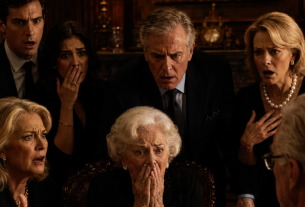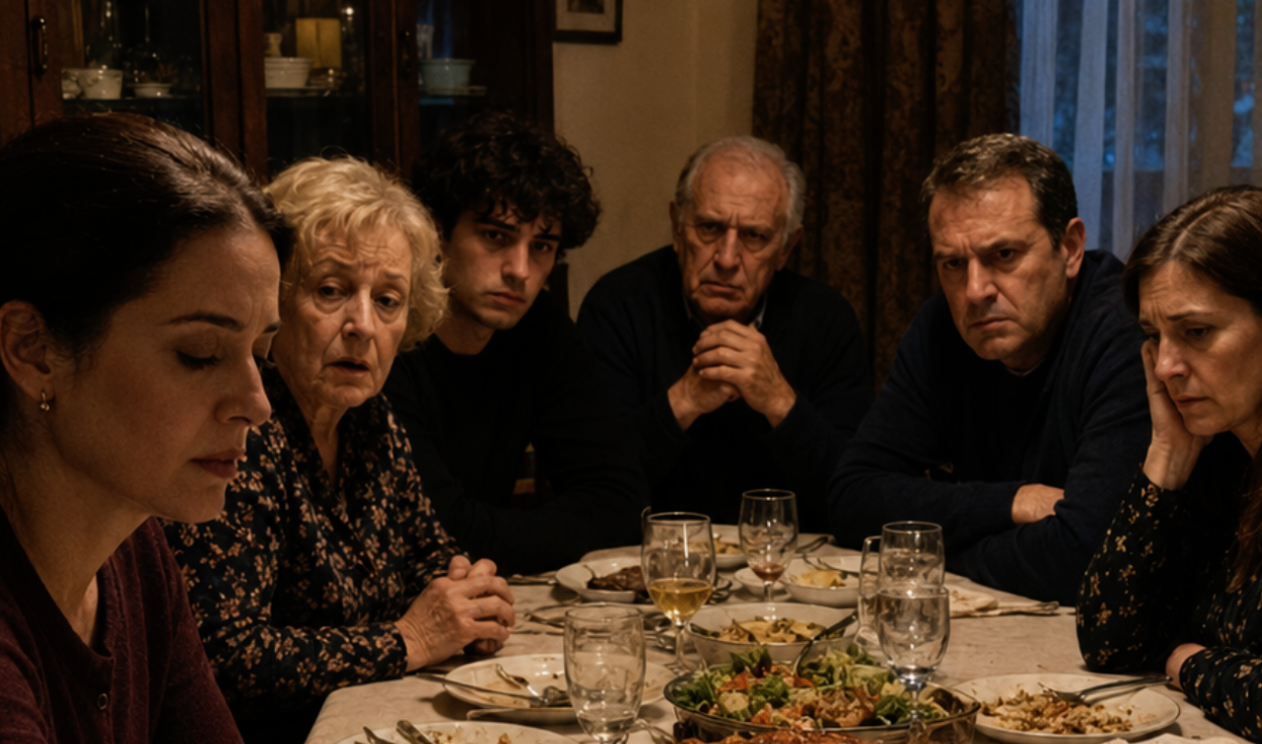
Olga had spent three days preparing this dinner. She had gathered everyone around one table, just as she had dreamed. But when the guests fell silent and she pressed “record” on her phone, it became clear that some things were better left unsaid.
She had been chopping the salad since four in the morning. Not because she was running out of time, but because she could not sleep.
Olga stood at the cutting board, feeling the cold tiles beneath her bare feet and listening to Viktor snore behind the wall. Steady, with a faint whistle on every exhale. Fourteen years of that sound. She could have reproduced it with her eyes closed.
The knife tapped against the board. Cucumbers, tomatoes, peppers. The smell of dill tickled her nose, and Olga squinted even though the kitchen light was dim. One of the three bulbs had burned out back in March. Viktor had promised to replace it.
The idea of the dinner had come to her two weeks earlier. It was not even a holiday or an anniversary. She simply wanted to bring everyone together: her mother, her mother-in-law, Viktor’s sister, her nephew, and Dasha, her friend from school, who had last visited them for their housewarming seven years ago.
Olga wrote to each of them separately. She chose her words as though she were inviting them not to dinner, but to something important.
Perhaps she was.
Her mother replied with a four-minute voice message: half of it about her blood pressure, the other half about how the potatoes would be better baked than boiled. Her mother-in-law wrote curtly, “I’ll be there at six.” No period at the end, no emoji. Galina Petrovna did not approve of emojis.
There were very few things she approved of in general.
Dasha sent three exclamation marks and a heart.
Viktor was the last to find out.
“Why?” he asked without looking up from his phone.
“Because I want to.”
“Well, if you want to, go ahead.”
He rolled over onto his other side. Olga stood in the bedroom doorway and looked at his back beneath his gray T-shirt. His vertebrae protruded under the fabric like a miniature mountain range. She remembered a time when she used to touch them with her lips.
She could not remember when she had stopped.
The morning before the dinner smelled of dough and vanilla. Olga kneaded, rolled, and shaped little pies with cabbage and egg, making two separate batches because her mother-in-law did not eat eggs. An allergy. Or a matter of principle. After fourteen years, Olga still had not figured out which.
Alisa, their daughter, crawled out of her room at half past ten. Twelve years old, long legs in pajama pants covered with cactus prints, tangled hair, eyes narrowed to slits.
“Mom, why are you making so much noise this early?”
“It’s half past ten.”
“It’s Saturday.”
Alisa dropped onto a stool and propped her cheek on her fist. Olga put a mug of cocoa in front of her. A white mug with a chipped rim. Her daughter would drink only from that one.
“Who’s coming?”
“Everyone.”
“Grandma Galya too?”
“Her too.”
Alisa grimaced. Not maliciously, more like a reflex. Like someone who knew what was coming and could do nothing to prevent it.
“She’s going to say I’m slouching again.”
“Maybe she won’t.”
“Mom.”
“All right. She will. But you’ll survive.”
Alisa took a sip of cocoa. A brown line remained on her upper lip. Olga nearly told her to wipe it off, but kept quiet.
It was Saturday, after all.
Viktor woke up around one. He came into the kitchen and looked at the table covered with sliced food, the three bowls of salad, and the pies beneath a towel.
“Feeding an army?”
“The family.”
He grunted. He poured himself coffee from the cezve Olga had made an hour and a half earlier. The coffee was cold. Viktor drank it without flinching.
He was not tall, about five foot eight, with a receding hairline above his temples and hands that always seemed too large for his body. A craftsman’s hands, his mother used to say. Viktor worked in logistics and did nothing with his hands except scroll through his phone.
“Need any help?” he asked.
“Iron the tablecloth.”
“Which one?”
“The white one. In the cupboard, second shelf.”
He left. Ten minutes later, he returned without the tablecloth.
“Where’s the iron?”
“Where it always is.”
“And where is that?”
Olga wiped her hands on her apron. Flour spilled onto the floor. She could feel every grain beneath her feet.
“On top of the cupboard, in a shoebox. Left side.”
Viktor left again. He returned twenty minutes later carrying the wrinkled tablecloth and the iron.
“It isn’t heating up.”
“Press the button. The red one.”
Olga said it calmly. That was how she had said everything for the past few years: calmly, evenly, without pressure. As though raising her voice required strength she no longer had.
Her mother arrived first.
Zinaida Arkadyevna was sixty-three, a large woman with short hair dyed copper. She came in, took off her boots at the door, and looked around the hallway.
“Still the same wallpaper?”
“Still the same, Mom.”
“Five years now.”
“Six.”
Zinaida Arkadyevna walked into the kitchen. She sniffed the air. Olga knew what was coming: an inspection.
“What’s the meat with?”
“Prunes.”
“And the potatoes?”
“I baked them.”
Her mother nodded. Approval was expressed through the absence of criticism. Olga had grown used to it long ago. As a child, it had hurt her. Then she stopped caring.
Then she started caring again.
Now she simply counted the nods.
“Where’s Viktor?”
“Ironing the tablecloth.”
Zinaida Arkadyevna raised an eyebrow. The left one, which naturally sat slightly higher than the right. Olga knew that expression: We’ll see about that.
“Need help?”
“Slice the bread.”
Her mother picked up the knife. She cut the slices thin and even, as though using a ruler. A habit from her youth, when bread had to be rationed. Olga watched her hands: broad, with tiny cracks around the knuckles and a wedding ring that had not come off in years.
Her father had died nine years earlier.
The ring remained.
Galina Petrovna rang the doorbell at exactly six. Not a minute earlier, not a minute later.
She stood on the doorstep in a dark-blue dress with a white collar, as though she had come to a formal meeting rather than dinner. Her hair was pulled into a bun. Her lips were pressed together. She was holding a bag.
“I brought aspic.”
“Thank you, Galina Petrovna.”
“Homemade. Not store-bought.”
Olga took the bag. The aspic was heavy, packed inside a glass jar wrapped in newspaper. Her fingers grew cold when she touched it.
Her mother-in-law walked into the living room and inspected the table. White tablecloth, plates, napkins. Viktor had managed to iron it after all.
“Beautiful,” Galina Petrovna said.
It was a word she used perhaps once every six months.
Olga mentally placed a check mark beside it.
Then Marina arrived, Viktor’s sister, accompanied by her sixteen-year-old son Kostya. He was wearing headphones and holding his phone. Marina kissed Olga on the cheek. She smelled of perfume—sweet, thick, with something floral beneath it.
“Kostya, say hello.”
“Hello.”
He removed one earbud. The other remained in place.
Dasha was twenty minutes late. She burst into the hallway in an unbuttoned coat, carrying a bottle of wine and a bag of tangerines.
“The traffic was a nightmare. Olya, you look gorgeous. And this table—wow.”
She hugged Olga tightly with both arms. Olga closed her eyes for a moment. Dasha smelled of cold air and tangerine peel.
It was the smell of another life, one in which people were late because they were busy living, not because they did not want to come.
They sat down at the table. Seven people, including Alisa.
Olga arranged the plates and felt something humming inside her. It was not anxiety. It was not joy. It was something in between, like the sound of a refrigerator: you get used to it and stop noticing until it switches off.
The first fifteen minutes went well. Zinaida Arkadyevna praised the meat. Dasha told them about her vacation in Kaliningrad. Kostya ate quickly and silently. Marina poured herself more wine.
Viktor sat at the head of the table, poking at his salad with a fork.
“It’s good, Olya,” he said.
She nodded.
That had become their language over the past few years: as few words as possible, as much politeness as possible. Like people sharing a hotel room. Everything clean, everything orderly, nothing unnecessary.
Galina Petrovna ate her own aspic. Carefully, with a spoon, dabbing her lips with a napkin after every second bite.
“Alisa, sit up straight.”
There it was.
Olga did not even turn her head. Alisa sighed but straightened her back.
“Grandma Galya, I am sitting straight.”
“No, you’re not. Your shoulder blades are sticking out.”
“That’s normal, Mom,” Viktor said.
Galina Petrovna gave her son a quick glance, sharp as a stitch, then looked away again.
“I’m not saying anything. I’m only concerned about her health.”
Marina reached for the bottle.
“Can we not do this? It’s a nice evening.”
Silence.
One second, two, three.
Olga could hear the clock ticking on the wall. An old cuckoo clock whose cuckoo had not worked in years. Viktor had promised to repair it.
The conversation resumed, but somehow sideways. Zinaida Arkadyevna asked Marina about work. Marina answered briefly, “Fine.” Dasha tried to tell a funny story about a colleague, but no one laughed, and she stopped halfway through.
Olga caught everything as it happened. Every glance, every pause. The way Viktor pushed his plate away even though he had not finished eating. The way Galina Petrovna adjusted her napkin. The way her mother stared out the window even though it was dark outside and there was nothing to see.
They were all there, gathered around one table.
And every one of them was inside a private capsule, sealed so tightly that no sound could pass through.
“Maybe some tea?” Olga suggested.
“Sure,” Dasha said.
The others remained silent.
Their silence was an answer.
Olga stood and went into the kitchen. The kettle began to hiss. She leaned against the counter and watched the steam rise from the spout. It twisted, changed shape, and disappeared.
Beautiful, meaningless movement.
Fragments of conversation drifted in from the other room. Marina’s voice, something about Kostya’s school. Her mother’s voice, something about a neighbor. Two parallel monologues that never intersected.
Olga took her phone from her apron pocket and looked at the screen.
Seven twenty-three in the evening.
Saturday.
She had spent three days preparing this dinner.
She returned with the tea and pies. She arranged the cups. Alisa was already looking at her phone, and so was Kostya.
Two teenagers in parallel universes.
Galina Petrovna picked up a pie and took a bite.
“Cabbage?”
“Cabbage.”
“Good. The dough rose properly.”
Her second compliment of the evening.
Olga thought she should write down the date.
Viktor drank his tea in silence. He knew how to remain silent in a way that filled the entire room. It was not aggressive or deliberate. His silence was simply dense, like cotton wool, and other people’s words died inside it.
Zinaida Arkadyevna tried one of the egg pies.
“A little too salty.”
“Really?”
“Just a little. Barely noticeable.”
Barely noticeable.
Olga knew her mother would mention it again on the phone tomorrow and add, “I’m not criticizing. I’m just saying.”
Dasha looked at Olga. Long and carefully, the way people look when they have known you since first grade and can see what your relatives cannot.
“Olya, how are you doing?”
A simple question.
Four words.
Olga opened her mouth. Closed it. Opened it again.
“Fine.”
“Are you sure?”
“I’m sure.”
Dasha did not believe her. Olga could tell by the way she set down her fork: carefully, parallel to the edge of the plate, like a bookmark in a book she intended to return to.
At half past seven, Olga realized she could not take any more.
She could not shout, could not cry, could not walk away.
She could no longer pretend that this table, these people, this evening were what she had wanted.
She had wanted something else.
Exactly what, Olga could not put into words.
But not this.
Everyone was eating, drinking, and speaking. And at the same time, everyone was silent.
Each about something different.
Viktor was silent about the layoffs at work and the possibility that his name might be on the list. Olga knew because she had seen the email when she was searching his inbox for the electricity bill. He had not told her.
She had not asked.
Galina Petrovna was silent about the doctor she had visited the previous week and the test results she was waiting for. Marina had let it slip during a phone call. Olga had pretended not to know.
Zinaida Arkadyevna was silent about having sold the country house. Olga had found out accidentally from a neighbor. Her mother had never explained why.
Marina was silent about the divorce proceedings that had already dragged on for six months. Kostya knew. Everyone else pretended they did not.
They were all silent.
And that silence hung over the table like a chandelier: familiar, heavy, unnoticed until it came crashing down.
Olga sat there counting the silences.
One, two, three, four, five.
Five people.
Five secrets.
One tablecloth.
Then this happened.
Olga took out her phone and placed it on the table, screen facing upward, beside her plate, between the saltshaker and the bread basket.
“I want to record this,” she said.
Everyone looked at her.
“Record what?” Viktor asked.
“Us. This dinner. The way we’re sitting here.”
Silence.
A different kind of silence from the one before. The earlier silence had been familiar. This one was tense, like a live wire.
“Why?” Galina Petrovna asked.
“Because we’re all silent. Every one of us. Each about something different. And I want it recorded. I want a record of what a family looks like when it gets together and says nothing.”
Her mother put down her fork.
“Olya, what’s wrong with you?”
“Nothing. Everything’s fine. Like always.”
She pressed “record.”
A red circle appeared on the screen. The phone lay on the white tablecloth. Its microphone captured every sound: the scrape of a chair, the clink of a cup, someone breathing.
Marina was the first to break.
“What is this, some kind of experiment?”
“No. Just honesty.”
“What does that mean?”
“Exactly what it sounds like. We’ve been sitting here for two hours. I cooked for three days. And not one person at this table has said anything real.”
Viktor put down his cup. The sound was hollow and sharp. Tea splashed onto the tablecloth.
“Olya, that’s enough.”
“No. It isn’t.”
She spoke quietly. Her voice did not tremble. Her palms were cold, and she pressed them against her knees beneath the table.
“Vitya, you might lose your job. You didn’t tell me.”
His face went pale in patches: his neck, behind his ears.
“How did you…”
“It doesn’t matter. Galina Petrovna, you went to the doctor. When are the results coming?”
Her mother-in-law straightened her back. It became even straighter, though that had seemed impossible.
“That is none of your business.”
“Maybe not. Mom, you sold the country house.”
Zinaida Arkadyevna pressed her lips together. Her face became motionless, like a mask.
“Who told you?”
“Marina,” Olga said, turning to her sister-in-law. “You’re getting divorced. Kostya knows. We all know.”
Kostya removed his second earbud.
For the first time that evening, both of his ears were uncovered. He looked at his mother, and something shifted in his face, deep beneath the mask of teenage boredom.
Marina turned red. Slowly, from her neck upward, as though someone were filling in a watercolor painting.
“Olya, why are you doing this?”
“Because I can’t take it anymore.”
Dasha sat quietly. She was not family. She was a witness.
And Olga knew that was why she had invited her.
Not for the tangerines or the wine. So that at least one person at the table could see what was happening from the outside.
Dasha looked at her friend. Her fingers were wrapped around her cup. The tea had long since gone cold.
“Olya,” she said softly. “Maybe you should turn it off.”
“No.”
The phone lay on the table.
The red circle glowed.
Alisa was the first to stand. Quietly, without scraping her chair. She went to her room. Her door closed softly, almost without a sound.
It was worse than a slam.
A slammed door could be blamed on a draft.
“Are you satisfied?” Viktor asked.
“No. I’m not satisfied. I want us to talk. Really talk. At least once.”
He looked at her.
His eyes were gray, with yellow flecks around the pupils. Olga had noticed them on their third date and remembered them for some reason. Fourteen years with those eyes.
They expressed nothing.
“I talk.”
“No. You say words. That’s different.”
Galina Petrovna was the first to get up. She dabbed her lips with her napkin, folded it into quarters, and placed it beside her plate.
“Thank you for dinner. It was delicious.”
She went to put on her coat. Every movement measured: coat, scarf, boots. Not one unnecessary gesture.
“Galina Petrovna,” Olga called from the table.
Her mother-in-law turned in the doorway.
“When will you get the results?”
A pause.
Two seconds.
Three.
“Tuesday.”
Then she left.
Marina gathered up Kostya. He followed her obediently, almost like a little boy, even though he was a head taller than she was. Marina stopped at the door.
“You were wrong, Olya.”
“Maybe.”
“Not maybe. You were wrong. Not everything needs to be said aloud.”
“And if we don’t say it, then what? Stay silent until we burst?”
Marina did not answer.
The door closed.
Zinaida Arkadyevna remained at the table. She did not move. Her hands lay on either side of her plate, her fingers slightly bent, as though she had just let go of something.
“Mom.”
“I heard you.”
“Why did you sell it?”
“Because of the taxes. Because of the roof. Because I’m alone. Because your father is dead and I don’t need that country house anymore.”
Her voice was steady. Not a tear, not a crack. But the final word dipped slightly, as though the floor beneath it had tilted.
Olga stood, walked over to her mother, and placed a hand on her shoulder. Her shoulder was warm through the fabric of her sweater.
“You could have told me.”
“I could have. I didn’t want to.”
“Why?”
“Because you already have enough to deal with.”
They stood like that for half a minute.
Or perhaps a full minute.
The clock ticked.
The cuckoo remained silent.
Zinaida Arkadyevna left in a taxi. Olga had called it for her. She walked her to the car and watched the red taillights dissolve into the darkness of the November courtyard.
When she came back, Dasha was washing the dishes.
“You don’t have to. I’ll do it.”
“Be quiet. I’m doing them.”
They stood together by the sink. Running water. Foam. The glassy clink of plates. The smell of dishwashing liquid, lemony and far too bright for an evening like this.
“Did you plan this?” Dasha asked.
“No. I don’t know. Maybe.”
“Why the recording?”
“I don’t know. So no one could say later that I imagined it. That I made it up. That everything had been fine.”
Dasha placed a plate in the drying rack and wiped her hands on a towel. Then she turned around.
“You didn’t imagine it.”
“I know.”
“But you scared everyone.”
“Maybe they needed to be scared.”
Dasha hugged her for the second time that evening. Olga buried her face in her shoulder. Her coat no longer smelled of frost. Now it smelled of the kitchen: onions, dough, tea.
Olga stood there breathing, each breath like a small gulp of air after a long time underwater.
Dasha left at nine.
Olga closed the door and leaned against it. The hallway was dark. She did not turn on the light.
A blue glow from a screen seeped out from Alisa’s room.
The bedroom was silent.
Whether Viktor was there or not, she did not know.
Olga went into the kitchen. The table was empty and clean. She had removed the tablecloth and thrown it into the washing machine. The stain from Viktor’s tea might come out if she soaked it.
Or it might not.
Her phone lay on the counter. The recording had stopped.
Forty-seven minutes and twenty-three seconds.
She did not listen to it.
She sat on the stool where Alisa had drunk cocoa that morning. The tiles beneath her feet were warm from the radiator.
Viktor appeared in the doorway. Barefoot. Wearing the same gray sweatpants he had slept in.
“Alisa’s crying,” he said.
Olga closed her eyes.
“I know.”
“Are you going to her?”
“I will. In a minute.”
He did not leave. He stood there. She could feel his presence against her skin, with the sixth sense developed by people who have lived together for more than ten years.
“I didn’t want you to find out about work,” he said.
The first real sentence he had spoken all evening.
Olga opened her eyes.
“Why?”
“I didn’t want you to worry.”
“I worry more when I don’t know.”
He walked over and sat across from her. There was nothing between them: no plates, no napkins, no tablecloth. Only the bare table, pale wood with a ring left by a hot mug that would not come off.
“Maybe they won’t fire me.”
“Maybe.”
“And maybe they will.”
“Then we’ll deal with it.”
He looked at his hands. Large, as always. He placed them on the table.
“Do you really think I’m a stranger?”
“No. I think you’re a person who stopped talking to me.”
A pause.
“I didn’t stop.”
“Vitya, ‘It’s good, Olya’ is not a conversation. ‘Need any help?’ is not a conversation. You ask out of politeness. The way you would ask a neighbor.”
He rubbed the bridge of his nose. A habit he had developed about five years earlier, when he started wearing glasses at the computer.
“And you? You were silent too. About my mother. About the country house.”
“Yes. I was.”
“And about my mother going to the doctor.”
“Yes.”
“Then why did you attack everyone?”
“Because someone had to.”
Olga went to Alisa’s room. She knocked.
Silence, then a rustle.
“Mom, don’t.”
“I’ll just sit with you.”
She opened the door. Alisa lay curled up on the bed. Her phone was on the pillow, the screen dark. The room smelled like a teenager: chewing gum, deodorant, dust from books she did not read but kept on the shelf.
Olga sat on the edge of the bed. She did not touch her daughter.
She simply sat there.
“You drove everyone away,” Alisa said into the pillow.
“I didn’t drive them away. They left.”
“That’s the same thing.”
“No.”
Alisa rolled over. Her face was wet. Her nose was red. Twelve years old, her entire life ahead of her, and that whole evening already inside her.
“Why did you record it?”
“I wanted proof.”
“Proof of what?”
“That we don’t know how to be together. Not until we start talking.”
“That’s stupid.”
“Maybe.”
“Grandma Galya is upset.”
“Grandma Galya went to the doctor and didn’t tell anyone. That isn’t anger. It’s fear.”
Alisa blinked.
“Is she sick?”
“I don’t know. The results come on Tuesday.”
Alisa sat up and pulled her knees to her chest. The cactus prints on her pajama pants stretched across them.
“And will Dad get fired?”
“Maybe not. But he’ll tell us. He will now.”
“Are you sure?”
“No.”
They sat beside each other. Through the wall, they could hear Viktor moving around the kitchen. Footsteps, the tap of a cup, the creak of a cupboard door.
Sounds Olga knew by heart.
“Mom.”
“What?”
“The pies were good.”
Olga smiled.
For the first time that day, she truly smiled—not merely with her lips, but somewhere deeper.
“Thank you.”
Night.
Viktor lay on his side of the bed. He was not asleep. Olga knew from his breathing: steady, but too steady. When he slept, it became uneven, with a faint whistle on every exhale.
She lay down beside him. She did not touch him.
The ceiling was white, with a crack in the corner that spread a little farther every year and was ignored every year.
“Olya.”
“Yes?”
“I’m scared.”
She did not turn toward him.
There was no need.
The word scared coming from his mouth felt like an event. In fourteen years, she had heard him say it only twice: when Alisa was hospitalized with appendicitis, and now.
“I’m scared too,” she said.
“What do we do?”
“I don’t know. Talk.”
“We’re talking now.”
“Yes. But this is the first time in a long while.”
Silence.
But a different kind.
Not the silence from the table, stuffed with secrets and politeness. This silence was thin and transparent. You could see something through it.
Viktor reached out his hand. He did not embrace her. He simply placed his palm beside hers.
Two centimeters separated their fingers.
Olga closed her eyes.
Morning.
Sunday.
Olga woke at seven. Out of habit, without an alarm.
Viktor was asleep, whistling faintly on every exhale.
As usual.
She got up and went into the kitchen. The floor was cold. One of the three bulbs still did not work.
The phone lay on the counter. She picked it up and looked at the recording.
Forty-seven minutes and twenty-three seconds.
Her finger hovered over the “delete” button.
She did not delete it.
She put on the kettle and took out some bread. A paper napkin with a greasy stain fell from the pocket of her apron.
Yesterday’s napkin.
Olga spread it across the table and smoothed it with her palm.
Her mother had written something on it in pencil. Small letters, slanting to the right.
“Call me tonight.”
Olga turned the napkin over.
On the other side, in different handwriting—large and childish—were the words:
“Mom, buy milk.”
Alisa.
She had probably grabbed whatever was available.
Two messages on one napkin. One on the front, one on the back.
Both saying the same thing:
I am here.
Do not forget me.
The kettle boiled.
Olga poured water into a mug. The white one with the chipped rim.
Alisa’s.
She held it in her hands for a moment, then put it back.
She took out her own.
Marina called at ten.
“Kostya wants to know if he can come over after school on Monday.”
“Of course.”
A pause.
“Olya.”
“Yes?”
“I filed for divorce. In October.”
“I know.”
“I know you know. But I’m telling you. There. I said it.”
Olga leaned against the doorframe. Outside, snow was falling, the first of the year. Wet and lazy, melting before it reached the ground.
“Do you need help?”
“Not yet. Maybe later.”
“All right.”
“And one more thing. Mom said the results might come earlier. She’ll call back.”
“Okay.”
Marina hung up.
Olga stood watching the snow. Wet flakes stuck to the glass and slid downward, leaving crooked trails.
She called her mother.
“Mom, it’s me.”
“I know. Caller ID.”
“How are you?”
“Fine. Blood pressure is one-forty.”
“Mom.”
“What?”
“I’ll call you tonight.”
“I wrote it on the napkin.”
“I saw it.”
A pause.
Brief, but warm.
Like a hand on a shoulder.
“The potatoes were good yesterday,” her mother said.
“You said they were too salty.”
“The pies were too salty. The potatoes were good.”
Olga laughed softly into the phone, holding it against her ear with both hands.
Viktor came out around noon. He looked at the empty table, the clean kitchen, and Olga sitting by the window with her phone.
“Should I change the light bulb?”
“Yes.”
He climbed up to the cupboard, took down the box, found a bulb, and screwed it in.
The kitchen grew brighter.
All three bulbs were burning.
Olga looked at the ceiling, then at him.
“Thank you.”
“You’re welcome.”
He stood on the stool holding the old bulb, wearing a wrinkled T-shirt. Receding hairline, large hands, gray eyes with yellow flecks.
“Olya.”
“What?”
“I’m going to call Mom today. Ask about the results.”
“Okay.”
“And I’ll write to work. Find out about the layoff list.”
“Okay.”
He climbed down from the stool and stood there for a moment.
“Yesterday was hard.”
“I know.”
“But maybe it needed to happen.”
“Maybe.”
He went into the other room. A minute later, he came back.
“Olya, did the stain come out of the tablecloth?”
“I haven’t checked.”
She opened the washing machine and pulled out the tablecloth. White, wrinkled, wet.
The tea stain remained: pale, almost transparent, but visible if you knew where to look.
Olga spread the tablecloth over the drying rack.
The stain was there.
And so be it.
Some marks are not meant to be removed.
Some are meant to remind you that something happened here. Someone sat here.
Something was spilled here.
That evening, Alisa came out of her room wearing her cactus pajamas, her hair pulled back into a ponytail.
“Mom, let’s make pancakes tomorrow.”
“Let’s.”
“And invite Dasha.”
“Why?”
“She’s fun.”
Olga looked at her daughter. Twelve years old, long-legged, with something adult already beginning to emerge in her face. Her cheekbones had become more defined. Her gaze was different.
“I’ll invite her.”
Alisa walked away, then came back.
“Mom.”
“What?”
“Did you delete the recording?”
“No.”
“Don’t delete it.”
“Why?”
“Just don’t.”
Her door closed.
Olga stood in the hallway.
The light was on.
All three bulbs.