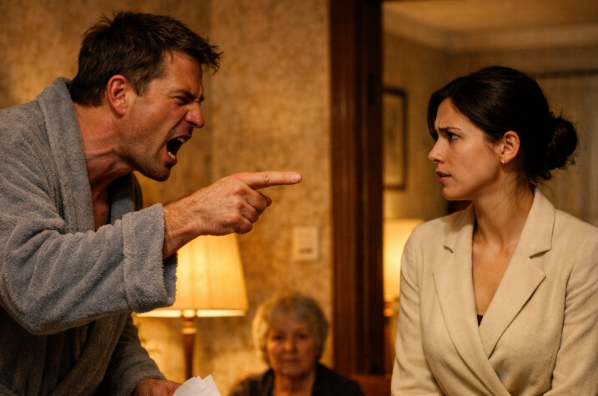
“You’re not a wife, you’re a burden! Move out right now!” her husband declared, not knowing the surprise waiting for him in the morning.
The quiet evening in the apartment on the outskirts of the city had been thoroughly ruined. The air was thick with the smell of fried potatoes with mushrooms, which Anna had generously served, as if for a holiday, to the unexpected guests, and with her father-in-law’s sharp cologne. The guests—her husband’s mother and sister, Lidia Petrovna and Olga—sat comfortably in the living room on the sofa that Anna had covered with a fresh slipcover just a couple of hours earlier.
Plates, crumbs, tea stains on the table—all of that remained Anna’s responsibility. She stood at the sink, and the monotonous sound of running water mixed with fragments of conversation drifting in from the living room.
“I told you, Maxim,” her mother-in-law’s commanding voice rang out, “the floor in the entryway needs to be redone. This linoleum is a disgrace. Other people have rugs from IKEA, and you…”
“Mom, don’t start,” came her husband’s tired voice.
“What do you mean, ‘don’t start’? I’m talking about your well-being. Olga, hand me that little box on the side table.”
Anna flinched but did not turn around. She knew that old wooden box. Lidia Petrovna carried it with her like some kind of mobile command center and loved rummaging through it while making important pronouncements.
The lid clinked. A pause.
“There,” said her mother-in-law. “I was at Sberbank today. The interest rate on my deposit has dropped again. There’s practically nothing to live on. We need to think about how to redistribute the assets.”
Anna turned off the water. In the silence, with her back still turned to the living room, she could feel three pairs of eyes on her.
“Anna, come here,” Lidia Petrovna called quietly, but in a tone impossible to ignore.
Anna slowly dried her hands on a towel already damp from dozens of such wipings and walked out of the kitchen. She did not sit down, stopping instead in the doorway.
“We had a little family discussion,” her mother-in-law began, shuffling some papers. “Olya needs to move out from her neighbors—they’re unbearable. And paying rent for an apartment is expensive. So we think she could stay here. In this room.”
She pointed with a short-trimmed fingernail toward the small bedroom where Anna’s bookcase stood, along with the desk and laptop where she sometimes tried to draw late at night.
Something inside Anna’s chest snapped and dropped into darkness.
“A-and where would I go?” she asked softly, looking not at her mother-in-law, but at Maxim.
Her husband was staring at his phone screen, sprawled heavily in an armchair.
“You?” Olga repeated, adjusting her expensive silk scarf. “You only sleep here anyway. You don’t take up much space. You can just unfold the sofa in the living room. Or… Mom says you have that cottage from your grandmother. There’s a little house there, right? You could settle there. Fresh air.”
Anna shifted her gaze to Maxim. He looked up, met her eyes, and immediately looked away. In his eyes she saw neither support nor protest. Only irritation at being dragged into an unpleasant conversation.
“Max?” was all Anna managed to say.
“What do you mean, ‘Max’?” he finally tore himself away from his phone. “Mom’s speaking logically. Olga needs help. And your cottage is just sitting there unused. We all have to help family. What, are you against that?”
His voice was cold, detached. In that word “family,” there was no place for her.
“That’s my room,” Anna said, and even to herself her voice sounded weak, чужим. “And the cottage is mine. My grandmother left it to me.”
A heavy silence hung over the living room. Lidia Petrovna slowly closed the box. The click sounded like a gunshot.
“‘Mine, mine,’” she mimicked venomously. “And who paid for the renovation of that ‘your’ room? Maxim. Who pays for this apartment? Maxim. Have you bought anything here yourself? Your job brings in pennies. So don’t stand there making noise about your rights. You live off your husband’s neck and imagine things.”
Every word landed exactly where it was meant to, like a strike honed over years. Anna felt her face burn, and treacherous tears rose in her eyes.
“I cook, I clean, I do the laundry,” she whispered.
“That’s your direct duty!” Olga flared up. “In return for being supported! And you can’t even give birth properly to continue the family line.”
A blow below the belt. An old wound that had never healed. Anna grabbed the doorframe so she would not fall. She saw Maxim darken, but once again he said nothing. This subject was his pain too, but now he let his sister use it like a club.
“All right, enough,” he muttered at last, looking at no one. “We’ll talk tomorrow. Are you leaving now?”
That was the signal. Her mother-in-law, having achieved her goal—sowing discord and demonstrating her power—rose majestically. Olga, smiling with satisfaction, pulled on her coat. They left, tossing a few careless housekeeping tips over their shoulders.
The door closed. A hollow, oppressive silence settled over the apartment, broken only by the ticking of the clock. Anna stood frozen in the same place. She could hear Maxim moving around in the bedroom, taking off his shoes.
She began mechanically gathering the dirty cups and plates from the table. The clatter of porcelain seemed unbearably loud.
“Stop rattling things around!” he shouted sharply from the room.
Anna froze. Then, clenching her teeth, she put the cups in the sink. She turned on the water to wash them, to keep her hands busy, to keep from thinking.
Suddenly the kitchen light went out. Maxim had switched off the breaker in the hallway.
“I said stop making noise. Go to bed.”
The darkness was absolute. Anna stood at the sink, damp and sticky, feeling the last drops of her patience, dignity, and strength slowly and irreversibly drain into the black hole of that night. She stepped out of the kitchen.
He stood in the bedroom doorway, a silhouette against the light from the window.
“Maxim, let’s talk,” her voice cracked. “How could you stay silent? They—”
“What about them? They’re my family!” he cut her off. His voice was hoarse with anger. “They’re telling the truth! You’ve been living off me for years. You bring nothing to this house—no money, no children, not even a normal mood. Just endless gloom. I’m tired.”
He took a step forward, and the light from the window fell across his face. She saw not love, not regret, but pure, unfeigned disgust.
“You’re not a wife, you’re a burden!” he shouted, and the words hung in the air like a sentence. “Move out right now! Get out to your cottage, to that little shack of yours. I don’t even want to look at you.”
Anna recoiled as if struck. The whole world narrowed to that dark hallway and the distorted face of the man she had once loved.
And then something strange happened. Inside her, everything broke off and went still. Panic, pain, fear—all of it drained away somewhere. What remained was emptiness, cold and soundless. She was no longer trembling.
She looked at him straight on with an absolutely calm gaze. A look he had never expected from her.
“All right,” Anna said quietly but very clearly. “I’ll move out. In the morning.”
She turned, walked into the living room, and sat down on the edge of that same sofa where her accusers had just been sitting. She sat in the dark without moving, staring at the black square of the window, where the ghostly reflection of herself stared back.
Maxim, stunned by her reaction, stood there for a minute, muttered something under his breath, and, slamming the bedroom door, disappeared inside.
Soon snoring came from behind the door. Anna did not move. She sat and looked at her reflection in the window, which was gradually beginning to pale, heralding the dawn. A morning that would bring a surprise. Not for her. For him.
Maxim’s heavy, troubled sleep broke at six in the morning. He had tossed and turned all night, his brain, agitated by yesterday’s scandal, unable to shut off. The words “I’ll move out. In the morning” echoed in his ears. There had been no hysteria in them, no pleading—exactly what he had subconsciously expected and been prepared to meet with a fresh outburst of anger. There had only been a cold, calm statement. That unsettled him.
He rolled onto his side and reached toward the edge of the bed. The space was empty and cold. Anna had never come to bed. A feeling of annoyance mixed with a drop of vague anxiety stirred somewhere beneath his ribs. “Good riddance. I was sick of her,” he muttered to reassure himself, but for some reason he got out of bed more quietly than usual.
He stepped into the hallway. The apartment was unusually silent. There was no familiar noise from the kitchen, no smell of coffee, no creak of the floor mat.
“Anna?” he called softly, more out of habit than anything else.
Silence answered him. He looked into the living room. The sofa was empty, the throw blanket neatly folded in the corner. He went into the kitchen. Clean. Too clean. The table had been wiped until it shone, and on the rail hung a single dry dishcloth. The sink was empty. Not a single cup. His gaze fell on the refrigerator. No familiar note with a grocery list was attached to its white surface by a magnet.
His тревога grew, turning into real unease. He hurried into the small bedroom that had been Anna’s personal corner. The door stood wide open.
The room was empty. Completely. The narrow bookcase was gone, leaving behind a strip of dirty wallpaper on the wall. The laptop, lamp, little boxes of pencils and brushes had disappeared from the desk. Even the rug from under the chair had been taken away. The room had turned into a faceless, dusty space, like a rental shown during a viewing. Not a single trace of Anna remained. Only the faint, fading scent of her perfume—soft notes of lavender and wood.
Maxim froze in the doorway. For some reason he had thought “I’ll move out” meant a couple of bags and hours of arguing. Not this swift, total disappearance. As if she had never existed there at all.
He returned to the living room and dropped heavily onto the sofa. He had to think. Call her? Ask “Where are you?” That would look weak. It would mean admitting that her absence had affected him. No, he couldn’t do that.
His fingers reached for the phone on their own. But not for Anna’s number. He called his mother.
“Mom,” he said when he heard her sleepy but instantly alert voice. “You need to get ready. Come over.”
“What happened? Is something wrong with her?”
“She left.”
“What do you mean, she left? Where to?”
“I don’t know. Her things are gone. She cleared out her whole room.”
“We’re coming right now. Wait for us. Don’t call Olya, she’s asleep. I’ll call her myself.”
Forty minutes later they burst into the apartment like a storm wind. Lidia Petrovna, dressed despite the early hour in a strict suit and wearing a flawless hairstyle, and Olga, who had thrown a coat over her pajamas and still had yesterday’s makeup on.
Without even taking off her galoshes, Lidia Petrovna walked through the apartment like an investigator at a crime scene. She peered into the empty room, into the wardrobe in the bedroom where only Maxim’s clothes now hung, even into the bathroom.
“She’s gone,” she declared, returning to the living room. There was no concern in her voice, only contemptuous satisfaction. “Well then. Her own fault. Couldn’t handle a little criticism. Hysterical woman.”
“Mom, she said, ‘I’ll move out in the morning,’ and then… that was it. It’s like she vanished into thin air,” Maxim still could not process how quickly it had happened.
“And that’s wonderful!” Olga exclaimed, her eyes lighting up. “So she finally understood her place. Freed up the space. Mom, can I start moving in tomorrow? I could put my corner sofa in that room, and—”
“Wait, Olya, don’t rush,” her mother cut in authoritatively. She sat down in the armchair, assuming the posture of someone chairing a meeting. “We need to use our heads. She won’t give up that easily. She has that cottage. She could’ve gone there. That’s her only valuable asset.”
“But the cottage is hers,” Maxim said darkly. “Her grandmother left it to her.”
“On paper, it’s hers,” Lidia Petrovna said with an icy smirk. “But who paid the property taxes on it for the last three years? You brought me the receipts, and I paid from my card. Remember? I said, ‘Let that be our shared contribution, Maxim.’ We have proof of financial investment. That’s already an argument.”
Maxim looked at his mother with growing surprise. He vaguely remembered those receipts—his mother had indeed asked him to give them to her, saying she had payment discounts. He had not paid attention.
“Second,” his mother-in-law continued, counting points off on her fingers. “The apartment. Is she registered here?”
“No,” Maxim answered. “She was registered with her grandmother, in the same village where the cottage is. After her death, I don’t think she ever changed it.”
“Perfect,” Lidia Petrovna exhaled. “That means she has no rights to this home. Only to what was bought during the marriage. And what did you buy during the marriage, Maxim?”
He shrugged uncertainly.
“Well… the refrigerator. The washing machine. The TV.”
“Do you have the receipts?”
“I don’t know… Probably not.”
“Everything bought with your salary is yours,” she declared confidently, though the legal basis of that claim was dubious. “She barely worked. So she can’t claim anything. And the fact that she took her things—good. Less clutter.”
Meanwhile Olga was already pacing through the emptied room, gesturing animatedly.
“We’ll knock down this wall and make an arch! Mom, this will be my living room! And the wardrobe can go into this niche. It’s nice and bright here.”
She was already living in the future, where the apartment had been divided and claimed…
Continuation just below in the first comment.