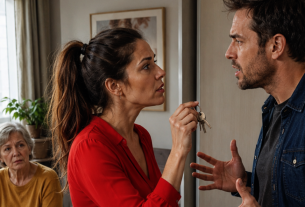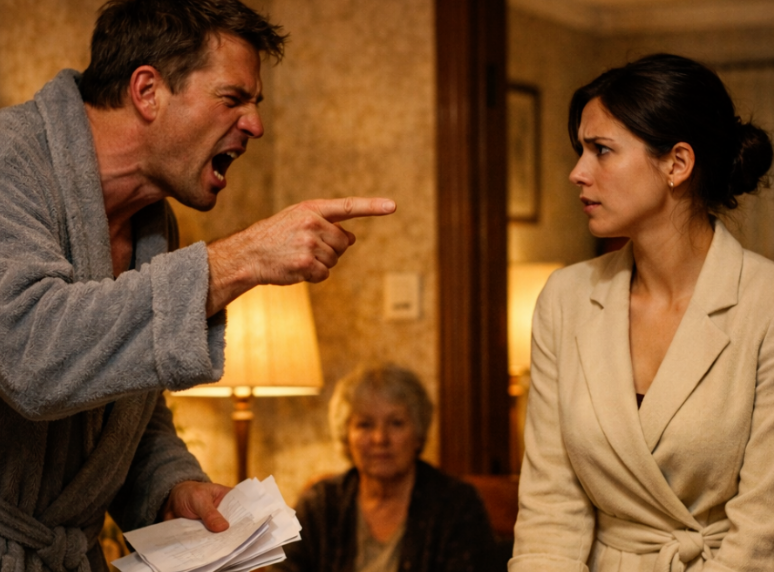
The quiet evening in the apartment on the outskirts of town had been thoroughly ruined. The air was thick with the smell of fried potatoes and mushrooms, which Anna had generously served to the unexpected guests as if it were a holiday, and with the sharp cologne of her father-in-law. The guests—her husband’s mother and sister, Lidiya Petrovna and Olga—sat in the living room, comfortably settled on the sofa that Anna had covered with a fresh slipcover just a couple of hours earlier.
The plates, crumbs, tea stains on the table—all of it remained Anna’s responsibility. She stood by the sink, and the monotonous sound of running water mixed with fragments of conversation drifting in from the hall.
“I told you, Maksim,” her mother-in-law’s commanding voice rang out, “the floor in the entryway needs to be redone. This linoleum is a disgrace. People have rugs from IKEA, and you have…”
“Mom, don’t start,” her husband said tiredly.
“What do you mean, ‘don’t start’? I’m talking about your well-being. Olga, hand me that little box on the cabinet.”
Anna flinched but did not turn around. She knew that old wooden box. Lidiya Petrovna carried it with her like a field command post and loved rummaging through it while making important pronouncements.
The lid clinked. A pause.
“Here,” her mother-in-law said. “I was at Sberbank today. The interest on deposits has dropped again. There’s practically nothing to live on. We need to think about how to redistribute assets.”
Anna turned off the water. In the silence, with her back to the living room, she could feel three pairs of eyes on her.
“Anna, come here,” Lidiya Petrovna called softly, but in such a tone that it was impossible not to obey.
Anna slowly dried her hands on a towel already damp from dozens of such wipe-downs and walked out of the kitchen. She did not sit down, stopping at the doorway instead.
“We’ve discussed it with the children,” her mother-in-law began, toying with some papers. “Olya needs to move out from her roommates—they’re unbearable. And paying for a rental apartment is expensive. We think she could live here. In this room.” She pointed with her short-trimmed nail toward the small bedroom where Anna’s bookcase stood, along with the desk and laptop where she sometimes tried to draw at night.
Something inside Anna’s chest snapped and dropped into darkness.
“And… where would I go?” she asked quietly, looking not at her mother-in-law, but at Maksim.
Her husband was staring at his phone screen, sprawled heavily in an armchair.
“You?” Olga repeated, adjusting her expensive silk scarf. “You only sleep here anyway. You don’t take up much space. You could unfold the sofa in the living room. Or… Mom says you have that dacha from your grandmother. There’s a little house there, right? You could settle there. Fresh air.”
Anna shifted her gaze to Maksim. He raised his eyes, met hers, and immediately looked away. In his eyes she read neither support nor protest. Only irritation at being dragged into an unpleasant conversation.
“Maks?” was all Anna managed to say.
“What do you mean, ‘Maks’?” he finally tore himself away from his phone. “Mom’s being logical. Olga needs help. And your dacha is just sitting there unused. We all have to help family. What, are you against that?”
His voice was cold, detached. In that word “family,” there was no place for her.
“That’s my room,” Anna said, and her own voice sounded weak and чужой to her. “And the dacha is mine. My grandmother left it to me.”
A heavy silence fell over the living room. Lidiya Petrovna slowly closed the box. The click sounded like a gunshot.
“‘Mine, mine,’” she mocked venomously. “And who paid for the renovations in that ‘your’ room? Maksim. Who pays for this apartment? Maksim. Did you buy anything here with your own money? Your job pays pennies. So stop making noise about your rights. You live off your husband’s neck and imagine things.”
Every word struck true, like a blow trained over years. Anna felt her face burning and treacherous moisture rising in her eyes.
“I cook, I clean, I do the laundry,” she whispered.
“That’s your direct duty!” Olga snapped. “Since you’re being supported! And you can’t even give birth properly to continue the family line!”
A blow below the belt. An old wound that had never healed. Anna grabbed the doorframe so she would not fall. She saw Maksim darken, but once again he said nothing. That subject was his pain too, but now he allowed his sister to use it as a club.
“All right, enough,” he muttered at last, without looking at anyone. “We’ll talk tomorrow. Are you leaving now or not?”
It was a signal. Having achieved her goal—sowing discord and demonstrating power—her mother-in-law rose majestically. Olga, smiling with satisfaction, put on her coat. They left, tossing out a few careless cleaning tips on their way out.
The door closed. A hollow, oppressive silence settled over the apartment, broken only by the ticking of the clock. Anna stood motionless in the same spot. She heard Maksim moving around in the bedroom, taking off his shoes.
She automatically began gathering the dirty cups and plates from the table. The clink of porcelain seemed unbearably loud.
“Stop making that noise!” he shouted sharply from the room.
Anna froze. Then, gritting her teeth, she set the cups in the sink. She turned on the water to wash them, to keep her hands busy, to keep from thinking.
Suddenly the kitchen light went out. Maksim had flipped the switch in the hallway.
“I said stop clattering around. Go to sleep.”
The darkness was absolute. Anna stood at the sink, wet and sticky, feeling the last drops of her patience, dignity, and strength slowly and irreversibly draining into the black hole of that night. She left the kitchen.
He stood in the bedroom doorway, a silhouette against the light from the window.
“Maksim, let’s talk,” her voice cracked. “How could you stay silent? They…”
“What about them? They’re my family!” he cut her off. His voice was hoarse with anger. “They’re telling the truth! For years you’ve been living off me. You bring nothing into this house—no money, no children, not even a decent mood. Just endless gloom. I’m tired of it.”
He stepped forward, and the window light fell on his face. She saw not love, not regret, but pure, genuine disgust.
“You’re not a wife, you’re a burden!” he shouted, and the words hung in the air like a sentence. “Move out right now! Get out to your dacha, to your little shack. I don’t want to see your face.”
Anna recoiled as if struck. The whole world narrowed to that dark hallway and the twisted face of the man she had once loved.
And then something strange happened. Inside her, everything broke off and went still. The panic, the pain, the fear—all of it drained away somewhere. Emptiness came instead, cold and soundless. She was no longer trembling.
She looked at him directly, with an absolutely calm gaze. A gaze he had never expected from her.
“All right,” Anna said quietly but very clearly. “I’ll move out. In the morning.”
She turned, walked into the living room, and sat down on the edge of the very sofa where her accusers had just been sitting. She sat there in the dark, motionless, staring into the black square of the window, where the ghostly shadow of her own reflection was visible.
Stunned by her reaction, Maksim stood there for a minute, muttered something under his breath, and, slamming the bedroom door, disappeared inside.
Soon snoring came from behind the door. Anna did not move. She sat and looked at her reflection in the window, which was slowly beginning to turn gray with the approach of dawn. Morning, which would bring a surprise. Not for her. For him.
Maksim’s heavy, restless sleep broke at six in the morning. He had tossed and turned all night, his mind, still agitated by yesterday’s scandal, unable to switch off. The phrase “I’ll move out. In the morning” echoed in his ears with obsessive insistence. There had been neither hysterics nor pleading in it—the things he had subconsciously expected and had been prepared to answer with another burst of anger. There had only been a cold, calm statement. It threw him off balance.
He rolled onto his side and reached a hand toward the edge of the bed. The space was empty and cold. Anna had never come to bed. A feeling of annoyance mixed with a drop of vague anxiety rose somewhere beneath his ribs. “Fine. I’m sick of her anyway,” he muttered to reassure himself, but for some reason he got out of bed more quietly than usual.
He stepped into the hallway. The apartment was unusually quiet. No familiar sounds from the kitchen, no smell of coffee, no squeak of the floor mat.
“Anna?” he called softly, more out of habit than anything else.
Silence answered him. He looked into the living room. The sofa was empty, the throw neatly folded in the corner. He went into the kitchen. Clean. Too clean. The table had been wiped until it shone, and a single dry rag hung on the rail. The sink was empty. Not a single cup. His eyes fell on the refrigerator. There was not one of the usual shopping-list notes attached to it with magnets.
His anxiety grew, turning into real unease. He hurried to the small bedroom that had been Anna’s private corner. The door stood wide open.
The room had been emptied completely. The narrow bookcase was gone, leaving a strip of dirty wallpaper exposed on the wall. The laptop, lamp, and little boxes of pencils and brushes had disappeared from the desk. Even the rug from under the chair had been taken. The room had turned into a faceless, dusty space, like an empty rental viewing. Not a single trace of Anna remained. Only the faint, fading scent of her perfume—soft notes of lavender and wood.
Maksim froze in the doorway. For some reason he had thought “I’ll move out” meant a couple of bags and long arguments. Not this swift, total disappearance. As if she had never existed.
He returned to the living room and sank heavily onto the sofa. He needed to think. Call her? Ask “Where are you?” That would look weak. It would mean admitting that her absence had affected him. No, he could not do that.
His fingers automatically reached for his phone. But not for Anna’s number. He dialed his mother.
“Mom,” he said when he heard her sleepy but instantly alert voice on the other end. “You need to come over. To my place.”
“What happened? Is something wrong with her?”
“She left.”
“How did she leave? Where?”
“I don’t know. Her things are gone. She cleared out her whole room.”
“We’re coming right now. Wait for us. Don’t call Olya, she’s asleep. I’ll call her myself.”
Forty minutes later they burst into the apartment like a storm wind. Lidiya Petrovna, dressed despite the early hour in a strict suit with a flawless hairstyle, and Olga, wearing a coat over her pajamas and yesterday’s makeup still on her face.
Without even taking off her overshoes, Lidiya Petrovna walked through the apartment like an investigator at a crime scene. She looked into the empty room, into the closet in the bedroom where only Maksim’s clothes were hanging, even into the bathroom.
“She vanished,” she declared, returning to the living room. There was no concern in her voice, only contemptuous satisfaction. “Well then. Her own fault. Couldn’t handle simple criticism. Hysterical woman.”
“Mom, she said, ‘I’ll move out in the morning,’ and… that was it. It’s like she vanished into thin air,” Maksim still could not process the speed of what had happened.
“And excellent!” Olga exclaimed, her eyes lighting up. “So she finally understood her place. Freed up the space. Mom, can I start moving in tomorrow? I could put my corner sofa in that room, and…”
“Wait, Olya, don’t rush,” her mother cut her off in an authoritative tone. She sat down in the armchair, assuming the posture of someone presiding over a meeting. “We need to think with our heads. She won’t give up that easily. She has that dacha. She could have run off there. That’s her only real asset.”
“But the dacha is hers!” Maksim said gloomily. “Her grandmother left it to her.”
“On paper, it’s hers,” Lidiya Petrovna said with an icy smile. “But who paid the taxes on it for the last three years? You brought me the bills, and I paid them from my card. Remember? I told you, ‘Let this be our shared contribution, Maksim.’ We have proof of financial investment. That’s already an argument.”
Maksim looked at his mother with growing surprise. He vaguely remembered those bills that his mother had indeed asked him to give her, saying she had discounts for payment. He had never looked into it.
“Second,” his mother-in-law continued, counting points off on her fingers. “The apartment. Is she registered here?”
“No,” Maksim replied. “She was registered at her grandmother’s place, in the same village where the dacha is. After her grandmother died, I don’t think she ever changed it.”
“Perfect,” Lidiya Petrovna exhaled. “Then she has no rights to this home. Only to what was bought during the marriage. And what did you buy during the marriage, Maksim?”
He shrugged uncertainly.
“Well… the refrigerator. The washing machine. The TV.”
“Do you have the receipts?”
“I don’t know… Probably not.”
“Everything bought with your salary is yours,” she declared confidently, though the legal basis for that claim was doubtful. “She didn’t work properly anyway. So she has no right to claim anything. And it’s good that she took her things. Less junk.”
Meanwhile Olga was already pacing around the emptied room, gesturing.
“We’ll knock this wall down and make an arch! Mom, this will be my living room! And the wardrobe can go into this niche. It’s so bright in here.”
She was already living in a future where the apartment had been divided up.
“But what if she… comes back?” Maksim asked, voicing the question that would not leave him alone.
“Comes back?” Lidiya Petrovna snorted. “Where? To the doorstep? We won’t let her in. Does she have a key?”
“No. I always carried one, and the second one was in the bedside table… It’s gone.”
“So she took it with her. No matter. We’ll change the locks. Tomorrow. At our expense, Olya, since you’ll be living here.”
The plan was taking shape quickly and cruelly, like an attack. Maksim felt not like a strategist, but like a pawn being moved by stronger players. He should have felt relieved. His mother was taking everything into her own hands. But inside, an unpleasant residue remained. Something was wrong. Too quiet. Too easy.
“We need to act first,” Lidiya Petrovna said, and in her eyes flashed the familiar spark of combat Maksim had known since childhood. “Maksim, you’ll go to that dacha today. See if she’s there. Don’t try to make peace—just scout the situation. And I… I’ll prepare some papers.”
“What papers?” Olga asked, perching on the arm of the chair with interest.
“A statement. That Anna voluntarily waives any claims to the dacha in exchange for us not demanding compensation from her for… for the renovations in this apartment, for example. We’ll have her sign it when she comes crawling back with her tail between her legs. And she will come back. She has no money. She has nothing to live on.”
She spoke with such certainty, as if she could already see that moment. See humiliated Anna standing at the door begging for everything back. And at that moment they would hand her a paper and a pen.
Maksim stared out the window. Dawn was breaking outside. A cold, gray morning. Without coffee. He suddenly realized with painful clarity that Anna had bought the coffee machine. And made coffee every morning. Now there would be no more of that.
“All right,” he said hoarsely. “I’ll go have a look.”
“And be firm, son,” his mother said, standing up and adjusting her jacket. “You’re a man. The master of the house. She was a burden, and now you’re free. And your family will support you. Everything will work out.”
She put an arm around his shoulders, and it should have been a warm maternal gesture. But Maksim felt cold. He watched as Olga took out her phone and began photographing the empty room, probably to send the pictures to friends or choose wallpaper.
They left, leaving him alone in the empty, unnaturally clean apartment. The echo of their voices, planning his life for him, still hung in the air. Maksim walked to the living room window, the same one Anna had stared into the night before. There was not a speck of dust on the windowsill. And then he noticed something he had not seen before.
On the perfectly clean surface lay a small, plain white envelope. No writing on it. It must have been there all along, but the back of the sofa had hidden it, or maybe he simply had not noticed.
Maksim’s heart gave a sharp jolt against his ribs. He reached for the envelope and picked it up. It was unsealed. Inside was a single sheet of paper, folded into thirds.
It was not a letter. It was a printout. A screenshot of an old messenger conversation. His conversation. With a woman from his department, with whom he had had a fleeting, meaningless flirtation three years earlier. A few innocent but suggestive lines from him. And underneath the screenshot, in Anna’s clear, calm handwriting, were the words:
“For your mother, if you decide to smear me. I think she’ll appreciate it.”
Maksim dropped the sheet as if it had burned him. Heat rushed over him. She had known. All this time she had known. And had kept silent. And saved it. And left it here as the first, quiet swallow of that “surprise” he had thought about so carelessly the night before.
He slowly picked up the sheet. His hand was trembling. He looked at the clean kitchen table. And for the first time in years he felt not anger, but a gnawing, icy fear. Fear of the fact that this quiet, obedient woman he had thought of as an open book had in fact been an absolute mystery to him.
And that mystery was only beginning to unfold.
The sheet with the printout lay in Maksim’s hand like a live coal. This trace of an old, forgotten unfaithfulness that she had kept was worse than shouting, worse than a scandal. It was silent, undeniable proof of his guilt. And she had left it not for him, but “for his mother.” Like a sniper shot aimed at the most vulnerable point in his defense—Lidiya Petrovna’s pride and authority.
He hurriedly shoved the paper back into the envelope and hid it in the inside pocket of the jacket hanging on the chair. His hands were shaking slightly. He needed to think, to act. His mother’s plan now seemed fragile and naive. Anna had not simply run away. She had made the first move.
He forced himself to go into the kitchen and turn on the kettle. Mechanical actions helped him gather himself. He opened the cupboard—the tea box was in its usual place. He reached for it and froze. Beside it, propped against the inside wall of the cabinet, stood another envelope. Larger than the first, thicker, more official-looking. It had no name or markings on it.
His heart sank. He took it out. The envelope was sealed. Cutting it open with a butter knife, Maksim pulled out several sheets of paper.
The top one was on official letterhead. Logo, details. “Management Company Comfort-Service. Official Notice.”
He began to read, and at first the words refused to form any meaning. Legal language, references to housing code articles. Then the phrases began to stand out clearly, like nails:
“…as a result of an unscheduled on-site inspection dated [date three days earlier]… following visual inspection and instrumental measurements… an unauthorized alteration to the structure of a load-bearing wall between premises was established… an opening 1.8 meters wide… absence of design documentation and approvals… creates a safety threat…”
What followed was a demand that within thirty days the owner must provide permits or restore the wall to its original state at their own expense. Otherwise the matter would be transferred to the housing inspectorate and to court with a request for compulsory restoration at the owner’s expense.
The owner. That was Maksim.
The air rushed out of his lungs in a harsh burst. He grabbed the table to keep from falling. The memory came back with terrifying clarity. Three years ago. His mother had insisted that Anna’s little room be “improved,” turned into part of the living room “so the space could breathe.” It was she who found the cheap handyman, she who insisted on having a wide arched opening cut through. Back then Anna had timidly objected: “Isn’t that dangerous? That wall is thick.” Lidiya Petrovna had waved her off. “What do you understand about design? Everyone does it!” Maksim, unwilling to argue with his mother, had kept quiet. The handyman, a sullen man with a rotary hammer, had mumbled something about a lintel, but in the end did what he was told. The dust had hung in the air for a week.
And for all three of those years they had lived with that arch. It really had made the apartment look brighter. And for all three of those years quiet, hesitant Anna had remembered. And waited.
He frantically turned the page over. Attached to the notice was a copy of the inspection report with the signatures of the building management representative and some expert engineer from a private firm. And again—Anna’s neat familiar handwriting on a small sticky note attached with a paperclip:
“I think Lidiya Petrovna will also be interested in evaluating the results of her design project. Copies have also been sent to the housing inspectorate and to the neighbors downstairs (they complained about cracks in their ceiling). For your information.”
Everything had been thought through to the smallest detail. Like clockwork. She had not simply left. She had started a war. And with the very first strike she had hit his main fortress—the apartment. Now it was no longer an asset but a problem. An enormous, expensive problem. Restoring a load-bearing wall was not a renovation; it was a catastrophe. Dust, debris, thousands—tens of thousands—of rubles. And if it went to court? Fines? And the neighbors… Now they would know where their cracks had come from.
The phone ringing made him flinch. Mom.
“Maksim, are you still home? When are you going to that dacha?” Her voice was brisk and businesslike.
“Mom,” his own voice sounded hoarse and strange. “Come over. Urgently. And bring Olya. Not… not to the dacha. There’s a problem.”
“What is it? Did she come back?”
“Worse. Just come.”
He hung up, unable to explain. He looked again at the official papers. His eyes fell on the signature of the complainant who had initiated the inspection. A clear signature: “A.S. Morozova” (Anna’s maiden name). And the date. The complaint had been filed a week ago. Right in the middle of what he had thought was Anna’s quiet despair. She had decided everything even then.
Twenty minutes later there was a sharp, demanding ring at the door. Maksim opened it. On the threshold stood Lidiya Petrovna, already in a different but no less severe suit, and Olga, this time in full makeup.
“Well, what is this panic about?” his mother-in-law asked as she entered, scanning the apartment as though looking for signs of an intrusion.
“This,” Maksim said, silently holding out the envelope from the management company.
Lidiya Petrovna frowned, put on her glasses at the tip of her nose, and began to read. Her face, usually so impassive, began to change. Her eyebrows lifted. Her lips pressed tightly together, turning pale. She read slowly, absorbing every word.
“What is it? What does it say?” Olga asked anxiously, trying to look over her mother’s shoulder.
Lidiya Petrovna did not answer. She finished reading, lowered the papers, and took off her glasses. Her fingers gripped the frames so hard that her knuckles turned white.
“That vile creature,” she breathed, quietly but with such concentrated hatred that Maksim felt uneasy. “Quiet, gray… And how dare she?”
“What is it, Mom?!” Olga squealed.
“An act on illegal redevelopment,” her mother-in-law said coldly. “That very arch you praised so much, Olya. She filed a complaint. Stirred everyone up.”
“So that means… they have to build the wall back?” Olga’s voice filled with genuine horror. “But that’s my future opening! That’s my arch! No, you can’t! That’s impossible!”
“It’s possible,” Maksim said darkly. “They’re demanding it. Otherwise court, and all at my expense.”
“But we won’t allow it!” Olga burst out, turning to her mother. “Mom, you’ll sort it out! You know people!”
“Be quiet!” Lidiya Petrovna barked, and Olga fell silent as if a switch had been flipped. The mother-in-law put her glasses back on and reread the report, now studying the details. “Private expert report… copies to the neighbors… housing inspectorate…” she murmured, calculating weak points. Then she looked up sharply at Maksim. “The first envelope? You said there was a first envelope.”
Reluctantly, Maksim pulled the first sheet out of his pocket and handed it to his mother. She snatched it, read the screenshot and the note. Her face twisted into an expression of deep, icy contempt.
“Blackmail. Primitive female blackmail,” she hissed. “She’s afraid we’ll paint her in a bad light, so she’s trying to intimidate us. Our task is not to give in. Olya, calm down. It’s paperwork. We’ll deal with it. Maksim, you’re going to the dacha. You need to talk to her. Harshly. Explain that such games end badly. That she’ll be left with nothing.”
“Mom, after this?” Maksim waved a hand toward the inspection report. “Will she listen?”
“She has to get scared!” Lidiya Petrovna’s voice rang with steel. “She’s alone. She has no money, no support. She thinks we’ll panic and make concessions. We’ll show her she’s mistaken. We’ll show strength. Olya, come with me. I have a friend in the administration—I need to find out how serious this is. Maksim, act.”
They left again, leaving him in silence, but now the silence was different. It rang with unspoken threats and was thick with fear. His mother’s plan—a forceful push—now seemed suddenly outdated and helpless, like a tank against a drone. Anna had struck accurately, from a distance, at the most painful point. And he had the feeling that this was only the first shot.
Maksim looked at the clock. It was still early. He had to go. But now the trip to the dacha seemed less like reconnaissance and more like capitulation. He would be going to ask, even though his mother’s script said he should be dictating terms. He took the car keys, but felt not like the master of the situation, but like a pawn that had been moved onto dangerous ground.
Before leaving, he let his gaze sweep once more over the living room, over the ill-fated arch, which now looked not like a design feature but like evidence of a crime. His eyes fell on the socket near the baseboard. Beside it lay a small, black, dusty object. He bent down. It was a microSD memory card, the kind used in phones or voice recorders. A piece of white tape was stuck to it, and on it was written in the same handwriting: “Part 1. For the record.”
He picked up the card. It was light, almost weightless, but in his hand it seemed as heavy as lead. What was on it? More screenshots? Documents? A diary?
He could not check now. He had no adapter at hand. He clenched the card in his fist and slipped it into the same pocket as the first envelope. Now he had two shells planted by his wife in his pocket. And he was carrying a third, unexploded one with him.
He stepped out of the apartment and locked the door. A familiar sound. But now it sounded like the click of a safety catch. The drive to the dacha was long. The road gave him time to think. And the more he thought, the more clearly he understood: he did not know the woman he had lived with for so many years. He had lived beside a quiet, patient opponent who had been compiling a dossier all this time. And now that dossier was beginning to open.
He shook his head, trying to throw off the feeling. “Strength,” he repeated to himself, echoing his mother’s command. “I need to show strength.” But the words lost their meaning, shattering against the cold, iron logic of the management company’s report and the silent reproach of the tiny memory card in his pocket.
The drive to the dacha took more than two hours. The last twenty kilometers were a ruined dirt road winding through bleak, bare winter fields. Maksim hardly remembered driving. His thoughts darted feverishly between the file from the management company, the tiny memory card in his pocket, and his mother’s face twisted with rage. He kept repeating the instruction to himself: “Harsh. Show strength. She has to be scared.” But the words crumbled like sand.
The little house Anna had inherited from her grandmother stood on the edge of the village, at the end of a rutted street. Small, log-built, with carved window trims he had once mockingly called “provincial kitsch” back in the early days of their marriage. Now a thin, almost transparent thread of smoke curled from the chimney. She was here.
He killed the engine and sat in silence for several minutes, staring at the locked gate. Suddenly it seemed humiliating to get out, knock, and ask to be let in. He had always simply walked in. But now this was her territory. Literally and figuratively.
At last he got out of the car. The frosty air burned his lungs. He pushed the gate—it was unlocked. The yard was orderly: a narrow path to the porch had been cleared, and several logs were stacked neatly under the awning. Nothing extra. Her style too.
He climbed the three steps and knocked. The sound came out dull and lonely. Silence stretched in response. He was about to knock harder when he heard the bolt slide back.
The door opened only a little. Anna stood in the doorway. She was wearing simple warm sweatpants and an oversized sweater, her hair pulled into a careless ponytail. No makeup. She looked… calm. Not crushed, not crying, but composed and incredibly calm. That calmness was more frightening than any hysteria.
“So, did you come to scout things out? Or to throw me out?” she asked first. Her voice was even, without a trace of challenge or fear. A simple statement of fact.
“Let me in,” Maksim muttered, trying to put authority into his voice.
“I don’t think we have anything to talk about. You said everything last night.”
“Anna, let me in. This isn’t a joke. What have you done with that inspection?”
She sighed silently, stepped back a little, and let him in. The house was clean and warm. It smelled of wood and baked potatoes. The furnishings were modest: old wooden furniture, books on shelves, a laptop on the table. Her fortress.
He did not take off his coat. He remained standing in the middle of the room.
“Well?” he said, trying to seize the initiative. “Care to explain? What is this, kindergarten? You went to complain?”
“Yes, Maksim,” she nodded, looking him straight in the eyes. “I went to complain. To every office I could reach. And this is only the beginning.”
He had not expected such a direct attack.
“Have you lost your mind? Do you understand what the damages are? It’s my apartment! They have to rebuild the wall!”
“Yours?” she repeated softly. “The apartment you bought before the marriage—yes. But the repairs, utilities, the life inside it—that was our money. Or rather, the money I put into it. Or do you think your salary covered everything?”
She walked over to the table, opened a folder lying next to the laptop, and pulled out a stack of papers.
“Here. Printouts of my bank transfers for the last five years. From my card to yours. Marked: ‘utilities,’ ‘building materials,’ ‘groceries,’ ‘bathroom renovation.’ Small sums, yes. Five, seven, ten thousand at a time. But add them up. And multiply by sixty months.”
She held out the top sheet to him. He took it automatically. Columns of figures, dates. His card. His address. He vaguely remembered that sometimes she had asked for his card “to pay for something online.” He had never looked into it.
“That’s… that’s nothing,” he muttered, but there was no longer the same certainty in his voice.
“For you, it’s nothing. For me, it was half my tutoring salary. The same salary you and your mother sneered at as ‘pennies.’ Those ‘pennies’ are what we lived on, Maksim. And I have a right to them. A legally documented right.”
She laid the next stack in front of him.
“And this is more interesting. An audio diary. Or rather, transcripts of it. I started recording our conversations—more precisely, your family’s conversations—nine months ago. After your mother first suggested ‘temporarily’ relocating me to the dacha so Olga could live in my room. I have everything. Your silence when I was insulted. The discussions about how to divide my property. Last night’s conversation, where you called me a burden. And this morning’s ‘family council’ too. Voices, names, dates.”
Maksim’s hands went cold. The memory card in his pocket suddenly seemed to burn.
“That… that’s illegal! The court won’t accept it!”
“It will,” Anna replied calmly. “If the recording was made by me in my own home, and it contains no information classified as state or otherwise specially protected secrets. And discussions about how to evict a wife and divide up her dacha don’t count as secrets. It’s evidence of moral harm and collusion. Especially your mother’s remarks. She has a very… recognizable voice.”
He fell silent, crushed by the avalanche of facts. His “show of force” had collapsed before it had even begun.
“Why?” he finally managed. “Why did you stay silent? Why didn’t you say anything?”
“Because you wouldn’t have heard me, Maksim,” she said, and for the first time there was fatigue in her voice—not weakness, but a deep, ancient weariness. “You stopped hearing me three years ago. Your only authority became your mother. My words were background noise to you, like the hum of the refrigerator. I needed to gather evidence. Not for you. For court. So that when you decided I was a burden who could be thrown out into the street penniless, I would have a substantial answer.”
She picked up another paper from the table.
“The inspection of the load-bearing wall is part of that answer. The management company is acting according to the law. Your mother, who hired an unlicensed handyman without a project, was not. The damage is being measured not only in the cost of restoring the wall. The neighbors downstairs have already filed a claim for compensation for damage to their finishing work caused by the cracks. I gave them the contact information of that very ‘handyman’ and… your mother, as the person who ordered the work.”
Maksim closed his eyes. A vivid picture came to mind: his mother talking to sharp-eyed neighbors demanding money.
“What do you want?” he asked dully, understanding that this was no longer his question, but the beginning of surrender negotiations.
“I want a divorce,” Anna said clearly. “Through the court. With a division of whatever the law considers jointly acquired. With compensation for moral harm, supported by the recordings. With reimbursement of my financial contributions to the apartment. And with an official, notarized renunciation by you and your relatives of any claims to this house and land. My grandmother’s dacha.”
“Mom will never agree…”
“Your mother,” Anna interrupted, and for the first time steel appeared in her voice, “will agree. Because the alternative is court, where not only these financial documents and the inspection report will appear, but also the audio recordings in which she discusses how to circumvent the law, and admission of the fact that damage was caused to the building. And also the screenshots of your messages, which, if necessary, I can send not only to her, but, say, to the HR department at your workplace. You have a strict ethics code there, don’t you?”
She was not threatening. She was simply laying out the balance of power. And that balance was catastrophic.
“You… were pretending all this time?” he forced out with difficulty.
“I was surviving all this time, Maksim,” she corrected him. “In a house where I was not respected. Next to a husband who betrayed me. Surrounded by people who saw me as household staff. I’m not your wife—you’re right. I was your quiet nightmare. One that put up with too much for too long. But now that nightmare is over. Wake up.”
She walked to the door and opened it. Frosty air rushed into the house.
“That’s all. The conversation is over. Discuss the terms with your family. You have three days. Then I file everything in court and begin the official process. Don’t try to pressure me, threaten me, or come here with your mother. Our next conversation will only be in the presence of my lawyer.”
Maksim stood there, unable to move. He looked at this woman and did not recognize her. There was nothing left in her of the submissive, exhausted Anna. In front of him stood a strategist, cold-blooded and merciless.
He walked silently out onto the porch. The door closed behind him softly but firmly. The click of the bolt sounded loud, like a verdict.
He made it to the car and sat behind the wheel. His hands were trembling so badly he could barely get the key into the ignition. He looked in the rearview mirror. His own face, pale, with panic in his eyes, seemed foreign to him.
He pulled the memory card from his pocket. “Part 1. For the record.” Now he understood what that meant. It was not just a storage device. It was a symbol. A symbol that what he held in his hand was only a tiny part of the information. And that the main archive—the full power of the evidence she had collected against him—was here, in this log house, protected by the woman he had considered weak.
He started the car and slowly drove back. Back to the city, to his apartment with the illegal redevelopment, to his mother, who thought they were on the offensive. He was bringing her not victory, but an ultimatum. And for the first time in many years he felt not like a son and not like the master of the house, but like a defeated man who had not even understood when he had lost the war.
The drive back to the city blurred into one agonizing smear. Maksim heard neither the engine nor the radio announcer’s voice. Silence rang in his ears—the same silence that had filled Anna’s house after the door closed. A silence full of indifference and finality. He replayed her words in his head, her calm, relentless voice listing the articles of his defeat: audio diary, transfers, inspection report, court.
He drove into the courtyard of his apartment building but could not bring himself to get out of the car. He needed to go upstairs and tell his mother. Hand over the ultimatum. Imagine the way her always confident face would twist with anger and helplessness. The thought brought not malicious satisfaction, but animal fear. He was more afraid of her reaction than of Anna’s threats. Because with Anna everything was clear: war, terms, deadlines. With his mother, there would be an unpredictable storm.
The mobile phone vibrated in his pocket. Lidiya Petrovna. He stared at the screen until the call ended. A second later it started again. Insistent, like an alarm.
Maksim let out a stream of vapor and answered.
“Where are you? Why aren’t you answering?” His mother’s voice was wound tight like a spring.
“I’m in the courtyard. I’m coming up now.”
“So? Was she there? What did she say?”
“Everything. I’ll tell you everything now.”
He hung up, unable to explain it over the phone. He took the elevator up. The apartment door was ajar. Voices drifted out from inside. Not only his mother’s and Olga’s. There was another one too—a shrill, unfamiliar female voice.
Maksim stepped in. In the hallway, still in her sheepskin coat, stood a heavyset woman in her fifties with a face red from anger. Lidiya Petrovna, pale and with tightly pressed lips, was trying to explain something to her. Olga stood pressed against the wall, staring fearfully at the stranger.
“And here is your son!” the woman barked, spotting Maksim. “What a perfect family man! You destroyed your whole apartment, and now we, the neighbors, are supposed to split at the seams!”
“Nina Stepanovna, please calm down, we’ll resolve everything,” Lidiya Petrovna was saying, but her voice no longer held its former authority—only sticky, false persuasion.
“What do you mean, ‘resolve everything’? There’s a crack running across my entire living room ceiling! Plaster is falling down! The wallpaper has split! I only had a full renovation done last year! Do you understand that?”
The downstairs neighbor. The very one. Anna had acted quickly. She had not merely “provided contact information.” Apparently she had personally gone downstairs and shown her the inspection report.
“I… I didn’t know,” Maksim said stupidly.
“And who did know? Me?” the woman jabbed a finger in Lidiya Petrovna’s direction. “This… this designer knew! She brought those demolition workers in here! The hammer drill was pounding so hard our chandelier was dancing! And you told me, ‘It’s just a minor renovation, nothing serious.’ Well now it’s serious!”
She pulled a crumpled sheet of paper from her bag and threw it onto the hallway cabinet.
“An estimate! From a construction company. Restoring the ceiling, leveling, painting, replacing wallpaper. The amount is right there, in bold. Either you get all this done within a week, or I’ll take this paper along with that inspection report from the management company to court and demand compensation for damages and moral harm! And I’ll make sure they order you to put your wall back in place immediately! Is that clear?”
Without waiting for an answer, she huffed, turned, and left, slamming the door loudly behind her.
A deathly silence settled over the apartment. Lidiya Petrovna slowly approached the cabinet and picked up the estimate. Her hand was trembling. She looked at the numbers, and her face turned gray.
“Mom?” Olga called quietly. “What does it say?”
“Sixty… seventy thousand,” Lidiya Petrovna whispered. She raised her eyes to Maksim, and panic sloshed in them, disguised as fury. “Well? What happened there? What did that… your wife say?”
Maksim took off his coat, went into the living room, and sank heavily onto the sofa. He felt mortally tired.
“She said she’s filing for divorce. Through the court. With division of everything acquired during the marriage. With compensation for moral harm based on audio recordings. With a demand that all her money she transferred to my card be repaid. And with all of us renouncing any claim to the dacha.”
“What audio recordings?” Olga asked sharply, suddenly alert.
“She recorded us. For nine months. All our conversations. About the dacha, about the room, last night’s scandal… and this morning’s family meeting too.”
Lidiya Petrovna went still. Rapid understanding passed over her face. She grasped it faster than anyone.
“A provocation! A vile, petty provocation!” she shouted, but there was a crack in the shout. “She wouldn’t dare! The court won’t accept that nonsense!”
“It will,” Maksim repeated Anna’s words wearily. “It will, if there are no state secrets involved. And she has more than just the recordings. She has printouts of every transfer she made to me over five years. And the management company’s report. And now this,” he nodded toward the hallway, where the estimate lay, “an estimate from the neighbor downstairs. She’s already informed everyone.”
Olga slowly slid down the wall onto the floor, staring into space.
“So… so my room…” she began.
“There is no your room!” Lidiya Petrovna exploded, directing all her accumulated rage at her daughter. “Because of your constant whining—‘I want, I want, I want’! If not for you, we would never have started talking about this! She wouldn’t have recorded anything!”
“Me?!” Olga squealed, springing to her feet. “You started all of it! You wanted to steal her dacha! You found those idiot builders who broke the wall! This is all your fault! Now because of you I won’t get any apartment, and that bitch downstairs will start demanding money from me too!”
“Shut up, you fool! You’ve always been a fool! Sitting on my neck just like she was!” Lidiya Petrovna stepped toward her, and Olga instinctively recoiled.
Maksim watched them—those two women who just minutes earlier had been a united front, and were now tearing each other apart. Anna’s words flashed through his mind: “Your family council.” Here it was, in all its glory.
“Enough!” he shouted unexpectedly loudly. Both women fell silent and stared at him. “Stop screaming! We need to decide what to do. We have three days. After that she goes to court.”
“She’s not going anywhere,” Lidiya Petrovna hissed through her teeth, but no longer with the same confidence. “We need to pressure her. Frighten her. I know someone…”
“Mom, what people?!” Maksim shouted, jumping up. “Don’t you get it? She’s not afraid! She’s already calculated all her moves! She’s already beaten us! The neighbors, the management company, the housing inspectorate, the court… She built the whole chain! Frighten her? She’s the one who’s frightened us on every front!”
For the first time in his life he was shouting at his mother. And instead of relief, he felt only a sickening emptiness.
Lidiya Petrovna took a step back, staring at him wide-eyed. She no longer saw her son, but another person. Broken, desperate and… accusing.
“So… what do you suggest?” she asked in an icy tone.
“I think,” Maksim said, sitting down again and dropping his head into his hands, “we have to agree to her terms.”
“What terms?” Olga cried.
“The divorce. Renouncing the dacha. Paying her back her money. And… paying for the restoration of that damn wall and the damage to the neighbor downstairs.”
“That’s impossible!” Olga wailed. “I don’t have that kind of money!”
“And do I?” Maksim asked darkly. “I have zero savings. My whole salary went on living expenses. And you, Mom? You were going to pay for changing the locks yourself. Where’s the money?”
Lidiya Petrovna was silent. Her proud posture broke. Suddenly she looked old and vulnerable.
“I… have some savings. For my funeral,” she said quietly.
“For your funeral…” Maksim repeated with a bitter smile. “That’ll probably just about cover patching the neighbor’s ceiling. And the wall? And Anna? Where does that come from?”
He looked around. His gaze landed on the car keys he had tossed onto the cabinet.
“The car,” he whispered. “I’ll have to sell the car.”
It sounded like a sentence. His foreign car—not new, but well-kept—had been his last symbolic badge of success, of masculine independence. The last thing left.
“No!” Olga pleaded. “How am I supposed to get around then? I need it for work!”
“By bus,” Maksim said mercilessly. “Like everyone else. Or find yourself another cash cow. Your brother isn’t one anymore.”
He stood up and went into the bedroom, leaving them in the living room. He needed to be alone. Behind the closed door he could hear the muffled sounds of their argument: Olga’s sobbing, his mother’s low angry voice saying something to her.
He lay down on the bed, the same bed where he had slept alone the night before. The realization of total collapse washed over him with renewed force. He had lost the wife who turned out to be a foreign, dangerous person. He was losing respect and control in his mother’s eyes. He was losing his sister, who saw in him only a resource. He was losing the car. He might lose the apartment too, buried under debts from repairs and lawsuits.
And the worst part was that he understood he deserved it. Every one of Anna’s silent retreats, every one of her unspoken grievances, every indifferent nod of his in response to his mother’s mockery—everything had returned like a boomerang. Not thunder from the heavens, but the quiet, methodical, relentless work of a woman he had stopped noticing.
His hand found the memory card in the pocket of his trousers. “Part 1. For the record.” He imagined what could be on it. His mother’s voice: “We need to evict her.” His own voice: “You’re not a wife, you’re a burden.” Olga’s laughter. Their cynical calculations.
He took the card out, clenched it in his fist, then hurled it hard at the wall. The plastic bounced off and rolled under the bed. A useless gesture. The real evidence was safe with her. That was only a physical symbol of his defeat.
There was a knock at the door. Not insistent, like his mother’s usual knock, but hesitant.
“Maksim?” It was her voice, but without its old steel. “Come out. We need… we need to decide.”
He understood that this was the moment of capitulation. His mother was ready to talk. Not as a commander, but as the losing side. But that victory brought him no satisfaction. Only bitterness and an icy fear of the future, in which there awaited him an empty apartment with a wall rebuilt through the middle, debts, and the quiet, indifferent hatred of those he had once considered his support.
Two days passed. Forty-eight hours of torturous inactivity and draining circles of conversation. The apartment had turned into the headquarters of a defeated army. The air was stale, heavy with the smell of old food, disorder, and fear.
Maksim barely slept. He wandered from room to room, trying to measure the scale of the catastrophe. The wall, of course, had to be restored. He called several construction companies. The prices ranged from dreadful to outrageous. Even selling the car would cover only part of the cost: the wall itself and maybe the neighbor’s share. And he still had to repay Anna her money. He sat down with a calculator and his own bank statements, which he painstakingly downloaded from the app. He matched dates against her printouts. The figures aligned. Over five years, the total became impressive. He had never thought of it as a whole, only as occasional insignificant transactions. Now it formed a mountain that could collapse on top of him.
Lidiya Petrovna sat in the living room, staring at one point. Her unshakable confidence had cracked. She no longer spoke of connections or made plans. She was silent, and that silence was more frightening than any hysteria. She turned that same wooden box over in her hands, but no longer as a symbol of power—rather as some kind of talisman, as though searching for an answer in it.
Olga, after whining for the first twenty-four hours, suddenly gathered up the things she had scattered around the apartment and announced that she was leaving for a friend’s place.
“I can’t stay here! You dragged me into this pit!” she shouted, throwing cosmetics into a bag. “Let her sue you, not me! I have nothing to do with this!”
“You had nothing to do with it when you were dividing up her room?” Maksim muttered darkly without looking at his sister.
“This is all your fault! You couldn’t keep your wife under control!” Olga slammed the door, and her heels clattered down the stairwell.
That left only him and his mother. In silence, broken only by the ticking clock and the hum of the refrigerator.
On the third day, closer to evening, when twilight was thickening outside the window, there came a careful, quiet knock at the door. Not sharp like the neighbor’s, not insistent like the postman’s. More polite.
Maksim and Lidiya Petrovna exchanged looks. Who could it be? Anna? No, she had said only through her lawyer. The neighbor? She had promised to come back with workers in a week. Maybe someone from the management company?
Maksim walked slowly to the door and peered through the peephole. On the landing stood an elderly woman, the neighbor from downstairs, the one everyone called Aunt Tanya. But not the one who had come to shout. She stood there alone, in an ordinary housecoat and slippers, holding a small pot covered with a towel.
Surprised, Maksim opened the door.
“Hello,” Aunt Tanya said, not trying to come in. “Sorry to bother you. May I have just a minute?”
She spoke quietly, without her former aggression.
“Come in,” Maksim muttered, stepping aside.
Lidiya Petrovna rose from the chair warily.
“Forgive the intrusion,” the neighbor began, stepping onto the hallway floor. “I actually… about that incident. I’ve been thinking. And I remembered my late husband. He was hot-tempered too, could say too much.” She looked directly at Maksim. “Your Anna, she’s a good woman. Quiet, unhappy. I heard everything from downstairs. The way you all trampled on her.”
Maksim felt the blood rush to his face with shame.
“What do you want?” Lidiya Petrovna asked coldly, standing up. “If it’s about the estimate, we…”
“It’s not about the estimate!” Aunt Tanya waved a hand. “Though of course the repairs need doing—my ceiling matters to me. I’m here about something else. I went to see Anna after your scandal. At the dacha. Took her some pies. My conscience started eating at me. I sit under you all, hear everything, and keep quiet. And there she is all alone, without a soul.”
She set the pot down on the cabinet in the hallway.
“This is for you. Soup. I figured no one’s in the mood to cook right now.” Then she pulled a folded sheet of paper from the pocket of her robe. “And this… I gave it to her. But she said you might need it more.”
Maksim took the paper. It was a printout. Not an official document, but something from the internet. An article. The title read: “Audio recordings as evidence in civil proceedings. Court positions.” Several key phrases were highlighted in yellow marker: “…admissible if they do not violate the rights of third parties…”, “…may confirm the fact of insults and threats…”, “…of special significance if the recording was made in the claimant’s home…”
In the margin, in Anna’s familiar handwriting, was written: “Nina Stepanovna, thank you for your concern. But this is no longer necessary. I already have copies of everything. I think it would be useful for them to familiarize themselves with court practice. So they don’t hope in vain.”
Maksim handed the paper to his mother. She scanned the text, and the hand holding it dropped.
“Why did you bring us this?” Lidiya Petrovna asked, and there was no anger in her voice anymore, only tired bewilderment.
“Well… I wanted to warn you,” Aunt Tanya sighed. “Anna isn’t cruel. But you clearly pushed her all the way to the bottom. And she prepared everything. They say she found a good lawyer. Collected all the documents. And she gave me…” the neighbor hesitated, “a copy of another paper. Not the one from the management company. A different one.”
She pulled out another scrap of paper, clearly torn from a form. It was a copy of a payment receipt. The amount was small. Purpose of payment: “Initial consultation and document review for preparation of a statement of claim for divorce with division of property and recovery of moral damages.” The lawyer’s surname. And the date. Two weeks earlier.
“She didn’t do this in the heat of the moment,” Aunt Tanya said quietly. “She had been preparing for a long time. That’s what I understood. And I thought: now you’ll probably be running around, trying to figure out how to outmaneuver her. But you won’t. She’s outplayed you by three moves. My late husband was a chess player. I know what that looks like.”
Lidiya Petrovna was silent, staring at the receipt. Her whole theory about “female hysteria,” about a “quiet breakdown,” fell apart completely. This was a planned, paid-for, carefully executed operation.
“Why are you telling us all this?” Maksim finally asked. “You’re on her side.”
“On the side of the truth, son,” the neighbor shook her head. “And the truth is, you drove her to this. All of you. You, your mother, your sister. I heard everything from downstairs. How you all bullied her. She never complained. Kept quiet. And you thought that meant she was weak. Weak people don’t do this. Weak people cry and run. Strong people keep quiet, gather their strength, and strike exactly. That’s what she turned out to be.”
She adjusted her robe.
“And about my ceiling… I don’t need you to patch it up. The whole thing needs replacing. But… I’ll wait. Until you sort your own affairs out. After that, we’ll see. Just, for God’s sake, put that wall back in order. It really is frightening.”
With that, Aunt Tanya turned and left, quietly closing the door behind her.
Silence filled the hallway again. But now it was different. There was no panic in it. There was realization. Total and unconditional.
Maksim looked at his mother. She stood leaning against the wall, the receipt in her hand. In her eyes, once always sharp and alive, there was emptiness.
“She’s right,” Lidiya Petrovna said hoarsely. “We drove her to this. I… I drove her to this.”
That was the worst part. The admission. Not just of defeat in battle, but of being wrong. For a woman who had always been certain of her own rightness, that was equal to the collapse of her world.
“What do we do now, Mom?” Maksim asked, and in his voice there was no anger, only the despair of a child.
“What she said,” his mother replied lifelessly. “Agree to everything. Sell the car. Take my… my funeral money too. Give her everything she asks for. I’ll sign the renunciation of the dacha. And the neighbor… we’ll deal with the neighbor somehow later. We just need this to end.”
She lifted her eyes to him. There was not a trace of her former strength in them.
“Maksim, forgive me. I… I ruined everything.”
She slowly walked into the living room, lowered herself into the armchair, and closed her eyes like a very old, very tired woman.
Maksim remained alone in the hallway. He looked at the pot of soup, at the sheet about court practice. The neighbor’s unexpected sympathy—which was more bitter than any gloating revenge—laid bare the essence of what had happened. This had not been a war between equals. This had been retribution. Retribution for years of humiliation, neglect, selfishness, and blindness.
He, his mother, and Olga—they were not the victims of some cunning schemer, but executioners who had pushed a quiet person to the point where she had no other choice but to become cold and calculating.
He took the pot to the kitchen and lifted the lid. It smelled of homemade chicken broth and bay leaf. Simple, cheap food. The kind he had once loved, back in the beginning of his life with Anna. Later his tastes had grown “more refined.” Or maybe he had simply stopped valuing simple things.
He poured the soup into a bowl and set it on the table. Sitting and eating alone in that empty, crumbling apartment felt unbearable. But he sat down. He lifted the spoon to his mouth. The soup was delicious. Warm. Human.
And in that moment he understood what he had lost forever. Not just a wife, not just money or peace. He had lost that warmth, that simple humanity, which he himself had crushed underfoot without ever noticing its value. And that was a loss no money, no walls, and no courts could ever compensate for.
Outside the window, darkness had fully fallen. Tomorrow he would have to call Anna. Or her lawyer. Begin the humiliating but necessary process of capitulation. The process of paying the bill.
The fourth day began with a phone call. Maksim, dozing on the sofa fully dressed, jerked awake and dropped the empty glass that had been resting on his chest. He looked at the screen. Unknown number. A landline.
His heart started pounding. He cleared his throat, trying to make his voice sound firm, and answered.
“Hello?”
“Good morning. This is the law office Legal Standard. I’m calling on behalf of attorney Marina Sergeyevna Kareva’s office. I’m contacting you on behalf of our client, Anna Morozova. Would you be able to come in today at eleven a.m. for a preliminary discussion of the draft settlement agreement? The address is 42 Sovetskaya Street, office 305.”
The young woman’s voice was polite, impersonal, and did not allow for objections. Not “would you like to,” but “would you be able to.” The formal tone finished off the last remnants of Maksim’s illusion that anything could still be changed or bargained over.
“Yes… yes, I can,” he answered.
“Excellent. We will expect you at eleven. Goodbye.”
The call ended. Maksim lowered the phone. Preliminary discussion. Draft. Settlement agreement. Every word sounded like a nail in the coffin of their marriage. And the coffin of his former life.
He got up unsteadily and went to the bathroom. In the mirror, a stranger stared back at him—a gaunt, unshaven face with red veins in his eyes. He tried to shave, but his hand shook and the blade left a thin cut on his cheek. A drop of blood welled up and slowly ran downward. He did not wipe it away.
Lidiya Petrovna came out of the bedroom. She was dressed and groomed, but looked like an empty shell. Silently she watched as he pulled on his only decent jacket.
“You’re going?” she asked quietly.
“Yes. To the lawyer.”
“Tell her…” his mother stopped, her lips trembling. “Tell her I’ll sign anything she wants. And that I’m sorry… if she can forgive me.”
Maksim merely nodded. Words had lost all meaning.
The Legal Standard office turned out to be in a modern business center. Glass, chrome, the quiet hum of air conditioning. In his wrinkled jacket, Maksim felt like a stranger there. At reception he was met by the same woman whose voice he had heard on the phone, and she led him into a small, austere office. Behind the desk sat a woman of about forty-five in a dark business suit—attorney Kareva. And against the wall, in a visitor’s chair, sat Anna.
At the sight of her, Maksim tightened inwardly. She was dressed in a simple dark turtleneck and trousers. No jewelry. Her hair was smoothly combed back. She looked at him not with hostility, but with cold, detached attention, as if he were a stranger with whom some business matter had to be resolved. That was worse than hatred.
“Maksim Viktorovich? Please come in, have a seat,” the lawyer said, indicating the empty chair opposite Anna. “As agreed, we have prepared a draft settlement agreement to submit to the court as part of the divorce case. The idea is to avoid a prolonged procedure and mutual claims. Let’s go over it.”
She slid a stack of papers toward him. Maksim automatically took the top sheet. “Settlement Agreement.” In the preamble—their full names, passport details.
“Clause one,” the lawyer’s voice was even, like dictation. “The parties mutually agree to dissolve the marriage without application of a reconciliation period. Clause two. Party Two—that is, you, Maksim Viktorovich—undertakes to make a one-time payment to Party One, Anna Sergeyevna, in an amount equivalent to the total of all her documented financial contributions to your joint household for the period from [date] to [date]. The exact amount is set out in Appendix One, based on the submitted bank statements. Deadline for payment: ten business days from the date the court approves the agreement.”
Maksim looked up. The number in the appendix made his breathing catch. It was more than he had expected.
“I… I need to sell the car,” he said dully.
“That is your personal matter of organizing payment,” the lawyer replied. “What matters is compliance with the deadline. Clause three. Party Two, as well as his mother, Lidiya Petrovna Vorontsova, and his sister, Olga Viktorovna Vorontsova, renounce any property or other claims to the land plot and residential house belonging to Anna Sergeyevna by right of ownership—the dacha. The renunciations by Lidiya Petrovna and Olga Viktorovna must be notarized. The forms are attached.”
He nodded, staring at the table.
“Clause four. As to the apartment in your ownership, the parties agree that they have no mutual claims concerning division of the property inside it. You undertake, at your own expense and within thirty days, to eliminate the violations resulting from the unauthorized alteration of the load-bearing wall and to compensate the damage caused to the neighbors downstairs, as evidenced by the relevant reports. In return, Anna Sergeyevna waives any further claims on this matter and undertakes to withdraw her complaint from the housing inspectorate after you fulfill your obligations.”
Maksim nodded again. Everything was clear, ironclad, and left no loopholes.
“Clause five. The parties waive mutual claims for compensation for moral harm in connection with reaching this agreement,” the lawyer paused slightly and looked at Anna. Anna gave a small nod. “This was Anna Sergeyevna’s personal request. On condition of strict compliance with all previous clauses.”
That clause struck Maksim harder than the others. Waiving moral damages was not just a gesture. It was proof that her goal was not revenge, not squeezing the maximum out of him, but a clean, businesslike resolution. Even in this she was rational and ruthlessly fair. She did not need his suffering for its own sake. She needed the matter closed.
“Is everything clear?” the lawyer asked.
“Yes,” he whispered.
“Then, if you have no objections as to substance, you may sign the agreement here, and we will then file it together with the court for approval. Anna Sergeyevna has already signed.”
The lawyer held out a pen. Maksim took it. The plastic was cold. He looked at Anna.
“Anna… may I say just one word?”
She silently glanced at the lawyer.
The lawyer gave the slightest shrug: your choice.
“I’m listening,” Anna said.
Her tone made it clear that this was not a conversation, but a permitted opportunity to speak that would change nothing.
“I… I understand everything now. I was wrong. Mom was wrong. We all…” he faltered under the unchanging expression on her face. “Forgive me… if you can. Not because I’m signing. But for everything. For all of it.”
He waited for an outburst, a reproach, at least a flicker of emotion in her eyes. But their expression did not change.
“Maksim, it doesn’t matter,” Anna said quietly but very clearly. “‘I was wrong,’ ‘forgive me’—those words carry no meaningful weight now. They do not undo the receipts, the inspection reports, or the recordings. They do not restore those years. Let’s simply finish this process in a civilized way. Please sign the documents.”
Her words were like a scalpel, cold and precise, cutting away everything unnecessary—every attempt of his to find even a drop of humanity in this nightmare, some thread he could still grasp. Her forgiveness was not what he needed. What he needed was forgiveness from himself, and she denied him even that.
He lowered his head and began to sign. Page after page. In the “Party Two” lines, his signature seemed foreign, capitulatory. He signed the notarized renunciation forms for his mother and sister as well. The lawyer certified all the copies with a stamp.
“Excellent,” Kareva said, gathering the papers. “We will file them today. You will be notified of the hearing date. It should be formal. The main thing is to begin fulfilling the obligations regarding the compensation and the repairs. That will speed up the process.”
It was done. Maksim got to his feet. Anna stood as well.
“I’m going,” she said to the lawyer. “Thank you.”
“Goodbye, Anna Sergeyevna.”
She walked past Maksim toward the door without looking at him. And in that moment, for reasons he did not understand, he said:
“The memory card… It said ‘For the record.’”
Anna stopped, hand on the doorknob, but did not turn around.
“It wasn’t a memory card, Maksim. It was an old dictaphone flash card. Empty. I left it there on purpose. So you would have time to imagine what might be on it. So you would understand that any next word you said, any next step you took, could just as easily be recorded and used. It was a psychological anchor. And judging by everything, it worked.”
She opened the door and left, closing it softly behind her.
Maksim remained standing in the middle of the office, feeling like a complete fool. An empty flash card. A theatrical gesture. And he, like a boy, had taken the bait, carried it around in his pocket, feared it. She had outplayed him even in the little things. A hundred moves ahead.
“Maksim Viktorovich, do you need any other document?” the lawyer asked politely.
“No… no, that’s all. I’m leaving.”
He walked out into the corridor, then outside. The bright daylight hurt his eyes. He stood on the steps of the business center, trembling all over. He had signed everything. Agreed to everything. Lost everything. And the last thing he had just lost was the final ghost of a chance to see something familiar in her eyes, something human. She had walked away without looking back. Cold, clean, free. And he was left here. With a bundle of humiliating papers in his hands, with debts he now had to pay, with an empty apartment he would have to tear apart and rebuild, and with an icy void inside him that nothing could fill anymore.
He descended the steps and wandered toward the parking lot where his car stood—his last valuable possession, which now urgently had to be turned into money to pay her. To pay the woman who had become the most expensive lesson of his life. A lesson whose true cost he was only just beginning to understand.
Chapter 8. Finale. Silence After the Storm
A month passed. Thirty days that Maksim lived as though in a thick, sticky fog. Every morning he woke with the heavy, unbearable feeling that something urgently needed to be done, and yet there was nothing to do except reap the consequences.
He sold the car. Quickly, for almost nothing, to the first dealer who showed up and counted out a wad of cash. That money, together with his mother’s “funeral savings,” went into a special account opened at attorney Kareva’s demand. The compensation owed to Anna was secured.
The court hearing to approve the settlement lasted exactly seven minutes. The judge, a tired woman in a robe, mechanically read out the terms, asked whether the parties had changed their minds, and issued the ruling. The marriage was dissolved. The former spouses left the courthouse through different doors.
Lidiya Petrovna, subdued and powerless, went to a notary and signed the renunciation of any claims to the dacha. She handed the document to Maksim without meeting his eyes.
“Here. Everything exactly as she wanted. I can do nothing more.”
She left to stay with her sister in another city, saying she needed “to come to her senses.” The apartment became completely empty.
Then came the wall.
On one overcast day, workers entered the apartment—not unlicensed handymen this time, but a proper crew from a real company, with a contract and an estimate. Maksim watched them seal off the opening with plastic, carry his sofa and armchair out of the living room, and begin dismantling the elegant arch. The sound of the hammer drill, which he hated, was now the sound of his own punishment. Dust filled the air, seeping into every crack. He slept at a friend’s place and during the day came back to watch as, brick by brick, a rough gray wall slowly rose where the opening had been. It returned the apartment to its original cramped layout, destroying the illusion of light and space. It was the perfect metaphor for his life: everything was going back to how it had been, but now it was dead, dusty, and bleak.
The workers were quiet and professional. After a week, the wall was finished. All that remained was plastering and wallpapering. By then the money was almost gone. Maksim took out a small bank loan. It was approved easily—his credit history was clean and he still had a job. Now he had not only emptiness, but debt.
One evening, after the workers had left and he was trying to brush a layer of white dust off the kitchen table, the doorbell rang. He thought it was Nina Stepanovna from downstairs. But on the threshold stood Olga.
She looked no better than he did. Thinner, without her usual bright makeup.
“Mom left,” she said without preamble.
“I know.”
“I have nowhere to go. That friend… threw me out.”
Maksim silently stepped aside and let her in. She walked into the living room and stared in horror at the fresh, unplastered wall cutting through the space.
“My God… it looks like a prison now.”
“That’s how it was,” he corrected. “We just forgot.”
Olga turned to him. There were tears in her eyes—not manipulative tears, but real ones, from hopelessness.
“Maks, what do we do now? Everything’s gone. Mom has fallen apart. You…” She gestured helplessly around.
“Live,” he answered dully. “Like everyone else. Work. Pay the bills. You can stay here until you find a job and rent a room. But not for long. And no demands. You’ll have to help.”
Olga nodded, unable to speak. Her queenly ambitions had blown away like dust from the drill.
That same evening, when Olga, after crying herself out, had fallen asleep on the fold-out sofa in the living room, Maksim stepped out onto the balcony. A fine cold rain was falling. He looked at the lights in other people’s windows, behind which life was going on, and thought of Anna. Not with hatred or resentment, but with a kind of stunned, chilling respect. She had calculated everything. Even his present state. She knew she would leave behind not merely ruins, but a school. A harsh, merciless school in which he had been the only student.
At that same time, more than a hundred kilometers from the city, it was quiet at the dacha. The same autumn rain was falling here too, but here it was not irritating—it was soothing. It tapped on the iron roof and ran down the drainpipe.
Inside the house it was warm. The stove was lit. Anna sat at the table, finishing tea from an old faceted mug. In front of her lay a letter from the lawyer’s office. Short, informative. “We hereby notify you that the monetary compensation has been credited to your account in full. The court ruling dissolving the marriage has entered into legal force. From a legal standpoint, the matter is closed.”
She set the letter aside. In the soft light of the desk lamp, her face was calm. There was no triumph of a victor on it, no gloating. There was deep, bottomless exhaustion, as after long, draining work. And beneath that exhaustion—a firm, cold foundation of peace.
She stood up and walked to the window. In the black glass reflected her own shadow and the glow of the lamp. Exactly one month earlier she had sat like this too, staring into the dark window of his apartment, listening to her husband snore, feeling something inside her die completely and at the same time be born again—something hard, determined, cold.
The plan had worked. Every stage: the quiet collection of evidence, the consultation with a lawyer paid for with her last money, the complaint to the management company, the visit to the neighbors, the “surprises” she had arranged—the empty flash card, the envelope with the screenshot, the folder with the report. All of it had led to the needed result. She had gotten her money back, kept her grandmother’s house, rid herself of toxic people and a humiliating marriage.
But she felt no joy. She felt emptiness. The very same emptiness that now had to be filled with something. Not revenge, not struggle—that part was over. But with something of her own, something new, something quiet.
She exhaled, and her breath left a small cloud on the cold glass. She lifted a finger and drew a straight, even line through it. Then another. Then she wiped it all away with her palm.
The phone rang on the table. An unfamiliar number. For a moment she tensed—was it him?—but she answered.
“Anna Sergeyevna? Hello. This is Marina Sergeyevna Kareva, reminding you about our meeting tomorrow. I’m sending you by email the draft contract for handling your next matter. About registration of title to the house. We’ll be preparing the documents for submission to Rosreestr.”
The lawyer’s voice was businesslike and energetic.
“All right, Marina Sergeyevna, thank you. I’ll review it,” Anna replied.
“Excellent. And congratulations once again on the successful conclusion of the previous stage. You handled it brilliantly.”
“Thank you. See you tomorrow.”
She ended the call. The next case. Registering the house. Then, perhaps, she would need to think about work. Maybe go back to tutoring, but here in the district. Or find something remote. The world had not collapsed. It had simply become different. Clear, understandable and… quiet.
She listened. Beyond the sound of the rain there was nothing else. No footsteps overhead, no muffled television through the wall, no demanding call, no cutting remarks from her mother-in-law. Nothing.
Silence.
That same silence which in the first days she had taken for loneliness and frightening uncertainty had now acquired a different meaning. It was not the dead silence of an abandoned place. It was the living, full silence of a space that at last belonged only to her. There was no aggression in it, no tension, no expectation of the next blow. In it, she could breathe deeply. Think her own thoughts. Be herself.
Anna went to the stove and threw in another log. The fire crackled cheerfully, casting warm, dancing shadows on the walls. She sat down in the old armchair by the fire and drew a blanket over her shoulders.
Outside, the rain kept falling. Somewhere out there in the city was a man who now had to live with a crude new wall, with debts, and with the awareness of his own defeat. But that was no longer her concern. Her war was over. Not with a loud victory, but with a quiet, confident peace.
She closed her eyes. For the first time in many, many years, there were no urgent tasks in her life, no unresolved problems, no expectation of yet another humiliating scene. There was only this quiet, deep, healing night.
And it was not just silence. It was music. Solemn, a little sad, but infinitely beautiful—the music of freedom.