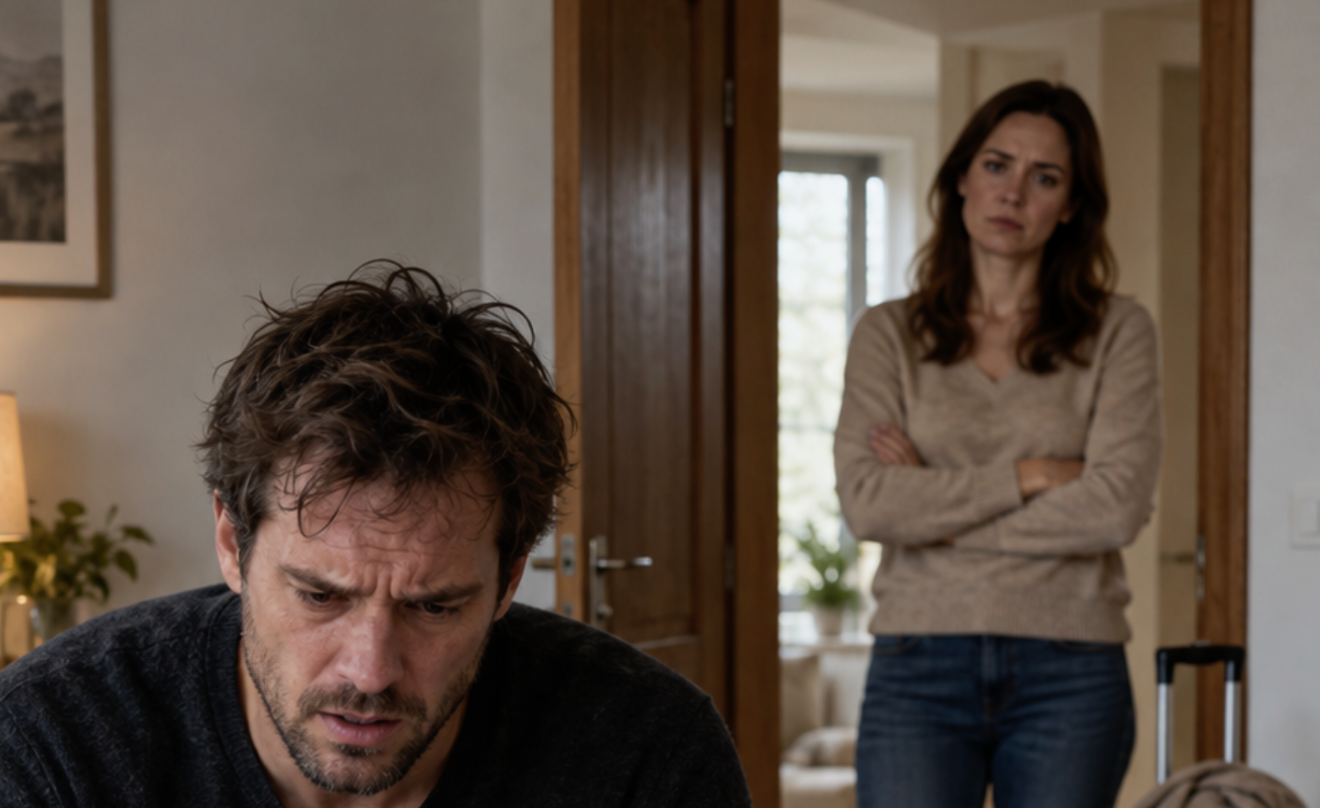
He stood on the threshold of my apartment—older now, his face gray, carrying that particular smell of someone who hadn’t slept properly in a very long time. I looked at him and couldn’t understand why I felt none of the things I was supposed to feel. No hatred. No spiteful satisfaction. Not even surprise. Only exhaustion, as if someone had opened an invisible valve inside me and drained every last drop of emotion.
“May I come in?” he asked.
I didn’t answer. I simply stepped aside because I didn’t want to make a scene on the landing, where behind every door lived people who remembered him carrying his suitcases out of this apartment three years ago.
He entered the hallway and stopped, unsure what to do with his hands. He took off his jacket and hung it on the hook—the very place where his own jacket used to hang. The gesture was automatic, and I noticed him flinch at the familiarity of the habit.
“You look good,” he said.
“What do you want?”
He was silent for a moment. Then he went into the kitchen and sat down at the table without asking permission. That was when I noticed his fingers trembling. He had always sat in that chair with his back to the window because he disliked having the light on his face. I remained in the doorway and waited.
“I need help,” he finally said.
“What kind of help?”
“Money. And… possibly somewhere to stay for a while. Until I sort everything out.”
I nearly laughed. But it would have been a bitter, dry laugh, like a twig snapping beneath someone’s foot. Instead, I went to the stove and put the kettle on—just to give my hands something to do, just so I wouldn’t have to look at him.
“You have an apartment,” I said. “That apartment. The one overlooking the park, with all the new furniture.”
“They’re going to take it. I owe the bank almost three million.”
The kettle began to rumble. I watched the stream of steam rising toward the ceiling and thought about how, three years earlier, he had walked out of here carrying a single gym bag and wearing an astonishingly carefree expression.
“I’m sorry. This will be better for everyone,” he had said, as though he were merely rescheduling a business meeting.
“And where is your… woman?” I asked.
“Lena left.”
“She left?”
“Six months ago. She said this wasn’t what she had signed up for.”
I turned off the stove and sat across from him, looking directly into his eyes for the first time since he arrived. He couldn’t bear it and turned toward the window, even though there was nothing beyond it except darkness and the scattered lights of neighboring buildings.
“And what did you sign up for when you left?” I asked.
He didn’t answer.
“When you abandoned me with our three-month-old son,” I continued, “without a job and with maternity payments that barely covered diapers and baby cereal—what did you tell yourself then?”
“I didn’t know what else to do.”
“Did you ever try to find another way?”
Silence.
He clasped his hands together so tightly that his knuckles turned white. I looked at those hands—beautiful hands with long fingers. Those hands had once held our son on his first day home from the maternity hospital. Three months later, those same hands had signed the purchase agreement for an apartment intended for another woman.
“You did pay child support,” I said. “At least there was that.”
“I tried.”
“Five thousand a month. The last payment was in September. It’s February now.”
He lowered his head. It suddenly occurred to me that he resembled someone who had been running across ice for a long time and had finally fallen into freezing water. Now he was sitting in my kitchen, hoping I would be the rope he could grab.
But I wasn’t a rope. I was the very water he had once escaped from, believing it would be warmer on the shore.
—
We met in 2015. I was twenty-five, and he was twenty-eight. We both worked for the same large company—I was in marketing, and he was in sales. At first, everything felt like a movie: coffee in the office café, late-night messages, our first weekend trip, our first argument, and our first reconciliation.
He was charming and easygoing. He knew how to speak to people in a way that made everyone—from couriers to company directors—begin to smile. I fell in love quickly, the way people do at twenty-five, when they have few doubts of their own and other people’s words still sound like the truth.
A year later, we rented an apartment together. Two years after that, we got married. At our wedding, his mother raised her glass and said, “At last, my son has become a responsible man.”
I didn’t attach any importance to that remark at the time. I should have.
For him, responsibility was not a state of being but a suit—something he put on when necessary and removed when he grew tired. It wasn’t exactly that he lied. He was simply very skilled at adapting himself to circumstances. To me. To his mother. To his boss. To the woman who, several years later, withdrew money from her own account for him and said, “Let’s buy an apartment before prices go up.”
Lena appeared six months before our son was born. They met at some corporate event, and at first I saw nothing unusual about it. He had always connected with people easily.
Lena worked in logistics for an affiliated company. She was bright and loud, wore expensive perfume, and had a habit of touching people on the shoulder whenever she laughed.
I learned that their relationship was serious one month before I gave birth. He came home later than usual, sat on the edge of the bed, and said he was confused. I lay there with my enormous belly, struggling to breathe, while listening to his disjointed explanations about feelings, freedom, and his fear of becoming a father.
That night, for the first time, I caught myself thinking that my husband was an inexperienced boy who had stumbled upon something far bigger than himself and had no idea what to do with it.
“I’m not going to leave you,” he told me. “Just give me some time.”
I did.
First a week, then a month, and then another month. We pretended everything was fine. We bought a crib together, chose a stroller together, and went to ultrasound appointments together. But inside me, along with my child, grew a cold, sticky anxiety that I suppressed for the sake of peace.
I shouldn’t have.
Our son was born in March. Two weeks after we returned from the hospital, he announced that he was moving out. I sat on the sofa with the baby in my arms and watched him carefully fold his shirts into a bag.
“Where are you going?”
“To Lena’s.”
“What about us?”
“I’m not abandoning you. I’ll help.”
“What does ‘help’ mean?”
“I’ll give you money. I’ll visit. I won’t disappear.”
He didn’t disappear completely. He came once every two weeks, bringing a package of diapers or a bag of groceries. He stayed for twenty minutes, took pictures of his son on his phone, and then left.
He probably believed he was fulfilling his responsibilities as a father.
Meanwhile, I was learning how to live alone with a baby: staying awake at night, treating his first cold, dealing with thrush, colic, vaccinations, a shortage of money, and my own mother, who visited on weekends and said every single time, “I warned you.”
One month after leaving, he bought Lena an apartment. I learned about it accidentally from a mutual acquaintance who let it slip during a conversation.
There was no mortgage. He paid cash. His mother sold her old country house and supplied the remaining amount. Apparently, her son had finally become a responsible man—just not for me.
I spent the first six months in a fog. I remember only isolated scenes: standing in line at the children’s clinic with the stroller, unable to hold back my tears; counting coins at the checkout to see if I could afford bread; sitting on the bathroom floor one night with the water running to muffle the sound of my crying because my son had finally fallen asleep, and I was more afraid of waking him than of admitting to myself that I couldn’t cope.
Then it became easier. Not in a single day, of course.
First, I found a job I could do from home. An auditor I knew gave me a contract to manage some documentation. Then I found several more clients and began earning a steady income. I enrolled my son in a private daycare for half the day, and fortunately, my mother helped with the first payment.
After that, I started going to the gym—not to improve my figure, but simply to spend time among adults, to hear the sound of my own breathing in a silence that was different from a baby’s crying.
A year and a half later, I rented another apartment, slightly larger and in a better neighborhood. After two years, I bought a car—old but reliable. After two and a half years, I went on a date for the first time in ages. It wasn’t anything serious, just dinner at a café and a conversation about films.
I returned home at midnight and realized that, for the first time in three years, I had not thought about him all evening.
Throughout that time, he was living his own life. At first, everything went well for him: a new position, a new woman, and a new apartment with high ceilings and panoramic windows. I saw the photographs on social media until I finally blocked him.
He traveled, bought expensive things, and posted stories from restaurants. His life appeared so complete that I sometimes began to doubt myself. Perhaps he really had made the right decision. Perhaps he was simply better off without me.
Then the fall began—slowly, like a crack spreading across a pane of glass.
First, he left his previous job “of his own accord,” as he later put it. Then he started a business with a partner, took out a loan, invested the money, and lost everything.
Lena had grown accustomed to a certain standard of living, but the amount of money available to them began to shrink. First, they stopped traveling abroad. Then they stopped going to restaurants. Eventually, they began arguing over utility bills.
He told me all of this now, sitting in my kitchen, using sparse, broken phrases as though he had to force every word out of himself.
I listened and realized that the old version of me—the woman he had left holding a newborn—might have felt satisfied.
The new version of me felt nothing except the mild pity one might feel for a stranger who had slipped on the ice.
“Do you know what I remember most clearly?” I asked.
He looked up.
“You were leaving, and I was standing in the hallway holding our son. He started hiccupping and made these funny little jerking movements. I thought, ‘Any second now, he’ll say it was all a joke.’ But you zipped up your bag, looked at me, and said, ‘Well, that’s it. I’m leaving.’”
He lowered his head, and I saw his Adam’s apple twitch.
“I didn’t want to hurt you.”
“Of course you did,” I replied calmly. “You simply assumed I would survive it. But to walk away knowing that you are leaving your wife alone with a nursing infant and no money, you have to consciously choose not to see her pain. You made that choice. It was your decision.”
“I was a fool.”
“That isn’t an explanation,” I said, shaking my head. “You weren’t a fool. You understood everything. You simply decided that my pain was an acceptable price to pay for your happiness.”
He fell silent.
The kettle had gone cold long ago. I noticed that snow had begun to fall outside—tiny, sparse flakes that melted almost immediately upon touching the pavement.
The bed creaked in our son’s room. I listened, but no—he had merely turned over in his sleep.
“Do you have anywhere to spend the night?” I asked.
“My mother’s place. But she doesn’t know about the debts.”
“What about Lena?”
“She rented a room. She’s working. She lives with some man who is older than she is. I saw them at a bus stop recently.”
“Does it hurt?”
“I don’t know,” he said with a shrug. “Mostly, I just feel empty.”
I stood up, walked to the window, and pressed my forehead against the glass. It was icy, and the cold helped me think.
Somewhere beyond this kitchen lived a man who had once been my husband and then had become a stranger. Now he sat at my table, waiting for me to give him a chance to put everything right.
But what did “put everything right” mean?
Go back three years and stay? Not buy that apartment? Not leave? Not lie?
That was impossible. And if it was impossible, then nothing could be fixed. All anyone could do was continue living—with the consequences.
“I’ll help you with money,” I said.
He raised his head. Hope flashed in his eyes, as brief as sunlight reflecting on water.
“But not in the way you’re asking,” I continued. “I won’t let you live here, and I won’t pay off your debt. I can lend you a small amount so you can rent a room for the first few weeks. But only if you sign an acknowledgment of the debt and agree to a repayment schedule.”
“You don’t trust me?”
“Of course I don’t. Why would I?”
He pressed his lips together. I watched the emotions battling inside him: resentment, anger, shame, and exhaustion. He wanted to object, but he couldn’t find the words because he had no argument to make.
“You’ve changed a lot,” he finally said.
“Yes,” I replied with a nod. “So have you.”
He left at around two in the morning. I heard the apartment door close softly behind him, his footsteps echo down the stairs, and the engine of his old car rumble to life outside—the same car we had once bought together, back when we still believed we had a shared future ahead of us.
I sat in the kitchen, poured myself some tea, and stared at my phone’s dark screen for a long time. Then I went into my son’s room, adjusted his blanket, and kissed him on the forehead.
He was already three and a half. He barely remembered his father.
Sometimes he asked why other children had fathers and he didn’t. I would answer, “You do have a father. He just lives somewhere else.”
My son would think about that for a second and then return to his toy cars. He possessed an amazing ability not to get stuck on questions that adults could not answer simply.
One week after that late-night conversation, his mother called me. Her voice was tense, carrying that particular tone people use when they have prepared all their arguments in advance.
“Was he at your place?” she asked without greeting me.
“Yes.”
“And what did you decide?”
“What was I supposed to decide?”
She exhaled into the phone. I imagined her sitting in her kitchen in that same old apartment with the green wallpaper, turning her glasses over in her hands.
“You know he’s going through a difficult time. He isn’t a bad person. He simply became confused.”
“He became confused three years ago,” I replied. “I didn’t throw him out. He chose to leave.”
“But he’s the father of your child!”
“That is precisely why I should not have to carry his debts. I am already raising our son alone. I cannot do more than I am already doing.”
“Have you thought about your son?” my mother-in-law continued, her voice rising. “How is he supposed to live with a bankrupt father? People will say his father is a failure!”
“What did people say three years ago when his father left us for another woman?” I asked.
Silence.
“Exactly,” I said. “People will always say something. I no longer care.”
She continued talking about family, duty, and how “people used to know how to forgive.”
I listened while studying a picture my son had brought home from daycare the day before. It showed three figures: a large yellow one, a small green one, and a tiny red one. It was the two of us out for a walk. There was a sun in the corner and a dog—the dog he dreamed of having someday.
“I don’t owe your son anything,” I finally said. “Do you understand? Nothing. My only obligations are to myself and my child.”
She hung up.
I sat there for a little while longer, looking at the drawing, and then called him myself. He answered after the third ring.
“I’ve changed my mind about the money,” I said.
He remained silent.
“I’m not going to lend it to you. Not because I’m being greedy, but because it won’t change anything. You have to get yourself out of this. Any other solution would merely postpone the inevitable.”
“I understand,” he replied quietly.
“I genuinely hope you manage it.”
“Thank you.”
He didn’t call again.
Mutual acquaintances told me that he sold his car, moved into a small rented room on the outskirts of the city, found a job as a manager at a construction company, and began paying off his debts in installments.
That winter, I ran into him at a shopping mall. He was standing in line for coffee, dressed in a plain gray jacket. He had lost weight and cut his hair short.
He saw me and nodded. I approached him.
“Hello.”
“Hello.”
There was an awkward pause. Someone nearby laughed, and somewhere else a child was crying.
“How are you?” I asked.
“I’m all right. Working. I’ve rented a room. That’s how things are for now.”
“And the bank?”
“I negotiated a restructuring agreement. I’m paying it back little by little. I sold the apartment, so now I owe less than half of the original amount.”
“That’s good.”
He studied me closely, as if he were searching for something in my face.
“What did this experience teach you?” he suddenly asked.
I thought about it. It was a strange question, but I understood that it wasn’t directed only at me.
“That you can start over,” I answered. “But only if you don’t drag the past along with you.”
He nodded. It was his turn at the counter. He collected his cup and looked back at me.
“Give my regards to our son.”
“I will.”
He walked away and disappeared into the crowd. I stood there for a little longer, watching him leave, before heading toward the escalator.
My phone vibrated inside my handbag. It was a message from the nanny: “He ate and is sleeping. Everything is fine.”
Two years later, I moved into a new apartment—small but bright, with a wide windowsill where I could sit in the morning with a cup of coffee.
My son started first grade. That old drawing with the three figures hung on the wall in his room. Beneath it was a new picture in which the two of us were riding bicycles.
He was growing older and asking more questions, and I was learning to answer them honestly.
Yes, his father lived separately. Yes, he had experienced problems. No, we were not together. But his father loved him—simply in his own way.
His father visited once every two weeks. He arrived on time, took our son for walks in the park, bought him ice cream, and told him stories about construction sites and cars.
Once, I watched them from the window. They were sitting on a bench, and our son was laughing as he fed the pigeons. His father watched him with a bewildered, almost reverent expression.
I thought that perhaps he had finally understood what he had lost—or had at least begun to understand.
Then, one cool Sunday evening in the autumn, I sat on that wide windowsill wrapped in a blanket and watched the season’s first snowflakes swirl outside.
My phone lay on the table. It began to ring. The number was unfamiliar. I hesitated before answering.
“It’s me again,” his voice said through the receiver.
I remained silent.
“I just wanted to tell you that I’ve paid off the last of my debt.”
“Congratulations.”
“You know, three years ago, I thought I would be ruined if you refused to take me back.”
“And?”
“It turned out to be the opposite. Refusing me was the best thing you could have done for me.”
He fell silent for a moment.
“How are you?” he asked.
“I’m well,” I replied. “We’re both doing well.”
“I’m glad.”
I didn’t answer. I simply watched the snow, the lights in the neighboring buildings, and the dark sky.
I thought about how life is not a sequence of events but a sequence of decisions. Every time we choose one path, we reject all the others.
Back then, he chose another woman, another apartment, and another life. I chose my son, peace, and the slow process of rebuilding myself.
And now, years later, standing by the window with a cup of cold tea, I finally felt certain that my decision had been the right one.
Not because he was a bad person and I was a good one.
But because I had remained true to myself.
The phone screen went dark. I placed my cup on the windowsill, walked to the front door, and checked the lock.
A radio was playing quietly in my son’s room—he had forgotten to switch it off. I adjusted his blanket, sat beside him, and listened to his steady breathing.
Outside, the snow continued to fall—the same kind of snow that had fallen on the night his father stood on my doorstep and asked me to take him back.
But now it was simply snow.
Ordinary snow.
Without a past.
Without pain.
Without expectations.