Ira turned off the engine but kept her hands on the wheel. Through the fogged-up window, she watched him by the entrance of the restaurant, holding another woman’s elbow. Not her waist—her elbow. That’s how you hold someone when you’re helping them step over a puddle or making sure they don’t slip.
The woman threw back her head and laughed. Her hair was light, shining under the streetlamp, and Ira automatically noted it wasn’t dyed. Or, if it was, it was very good—hair like that doesn’t just come out of a salon, it grows that way.
He bent down and whispered something in the woman’s ear. She nodded. There was no kiss between them. They just stood under the awning until the coat check attendant brought out her coat. Then he opened the taxi door for her. She got in, waved goodbye. He stayed on the sidewalk, stuffed his hands in his pockets. The taxi drove off.
Ira exhaled, letting her forehead rest against the cold glass. She didn’t come here to spy. She came to pick him up because Valera’s phone was dead, mom had been in the hospital for two days and wasn’t answering calls, and they had to decide whether to go there at night or wait until morning. She only knew the restaurant’s number from his own text sent four hours ago: ‘Dinner with partners, I’ll be late.’
Partners, huh.
She leaned back in her seat. Her body felt light and empty, like a cardboard shoebox. Somewhere inside, there was a nail stuck. Ira sat there, counting the flashes of the hazard lights—seventeen, eighteen—until she realized he was heading toward the car. His car. She’d left hers fifty meters away, around the corner.
He walked right past. Didn’t look back. Got into his car, started it, and drove off.
Ira watched the red taillights fade into the distance, thinking she should probably start the engine too. But she didn’t. Instead, she opened her door, stepped out into the drizzling rain, and took such a deep breath it made her ribs ache.
Home greeted her with the smell of yesterday’s cutlets and the sound of the TV still on. He was already in the bedroom. The door was slightly open, a sliver of light spilling onto the hallway floor. Ira took off her coat and hung it up. Then she took it down and moved it—she’d put it on the wrong hook.
‘Why aren’t you sleeping?’ he asked from somewhere deep in the room.
Ira froze. His voice was exactly the same as always, the same tone he’d used every night for eleven years. No guilt, no caution, no hesitation before replying.
‘Mom called,’ she replied.
Not quite true. Mom hadn’t called—it was Ira’s aunt from Voronezh who called, saying mom was down again, and the doctors were saying something about her heart, but mom had forbidden Ira from worrying her, said there was no need to bother her.
‘So how is she?’
‘She’s all right. Blood pressure.’
‘Are you going?’
‘I’ll decide in the morning.’
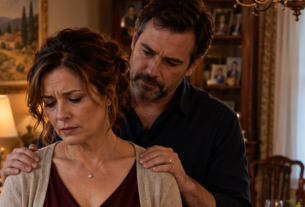
Silence. Then the bed creaked. He got up, came over behind her, and put his hands on her shoulders. He smelled of mint gum and someone else’s perfume—sweet, with a citrus note. Ira pulled her shoulder blades together.
‘Tired?’ she asked, not turning around.
‘A little. Dinner dragged on.’
‘And how are the partners?’
‘Forget them. They want a price below market, and the volume is laughable.’
He let go of her and went to the bathroom. Irina heard the sound of running water. She stood in the hallway, staring at the coat rack, watching drops from her own coat fall onto the floor. A small, dark, puddle was forming right by the doorway, uneven and spreading. Irina didn’t move. Then, she went to the kitchen, grabbed a rag, and wiped it up. She took her coat and hung it on the bathroom door.
That night, she couldn’t sleep. She lay on her back, listening to Valera breathe — steady, with a familiar slight wheeze as he exhaled, a sound she knew so well it made her sick. She wanted to turn and ask, “Who is she?” But the question didn’t matter anymore. What mattered was something else — him standing on the sidewalk, holding her by the elbow, unbearably calm. That’s not how people say goodbye after a business dinner. That’s how you close the door behind someone you’ve just lived a tiny, separate lifetime with.
In the morning, Irina got up at six. She put the kettle on, then turned it off — she didn’t want the noise. She put on a tracksuit and packed her bag. Valera came out of the bedroom, sleepy, in wrinkled house pants. He stood by the doorframe and stretched.
«Where are you going?»
«To Voronezh. To Mom.»
«So early?»
«Traffic jams.»
He nodded and scratched his cheek. He walked to the kitchen and poured himself a glass of tap water. Irina stood by the door with her bag, watching him drink, watching his Adam’s apple move. She knew him so well, she knew exactly what he’d say next: «Be careful on the road. There are speed cameras after the turn to Yelets.» He always said that when she left on her own.
«Be careful on the road. There are speed cameras after the turn to Yelets.»
«I know.»
She closed the door without kissing him. It was the first thing she had done on purpose.
The drive took five hours. Irina didn’t turn on any music or the radio. The window was cracked, wind hitting her cheek and cooling her skin. Right before entering the city, she stopped at a gas station, bought some oranges for her mother and a bottle with green pills — the same ones her mother had asked her to get on her last visit. Valera’s phone was silent. So was hers.
Her aunt met her at the entrance, lips pursed:
«Finally. I keep telling her, call your daughter, and she goes: Irina has her own life. What life, Ira? Have you looked at yourself in the mirror?»
Irina didn’t answer. Her mother was lying in a four-person hospital room, by the window. Her cheeks were even more sunken, but her gaze was sharp and piercing. When she saw Irina, she didn’t smile, just squinted her eyes:
«Someone chased you here. Spill it.»
Irina sat on the edge of the bed, placed the bag of oranges on the nightstand. On the nightstand were glasses, an empty glass, and a prayer book with a worn cover. Irina picked it up and flipped through it aimlessly.
«No one chased me. I just missed you.»
«You’re a terrible liar, Ira. Always have been. Even as a kid, when you tried to hide a bad grade, your ears turned red.»
Irina closed the prayer book and put it back. Her mother looked at her, not with sympathy, but with annoyance — that her daughter had come again without figuring herself out, and now would just sit by her side.
«Valera?» her mother asked.
«Why does it have to be Valera right away?»
«Because he’s all you’ve got. And thank God for that.»
Irina smirked. Thank God. That’s the truth.
«Mom, how did you know Dad was cheating?»
Her mother turned her gaze to the window. Outside, the branches of the lime trees were dark, still wet from the night’s rain. A nurse walked by with an IV stand.
— There was no way. He confessed on his own. He came in, sat down on a stool, and just told me. I was in the middle of making dumplings, my hands covered in flour, and he sat there and said, «Nina, I can’t do this anymore.»
— And what did you do?
— I finished making the dumplings. Then I went to the bedroom and stayed there until morning. He sat on that stool all night, too scared to come in.
— And in the morning?
— In the morning, I packed his things for him.
Ira fell silent. The bag of oranges was slipping off the nightstand, so she adjusted it.
— Did you love him?
— I did. I loved him right up until he died. But I just couldn’t live with him anymore. That’s different, Ira.
Her mother turned toward the wall. Ira thought the conversation was over, but then her mother added quietly:
— He ate away at my heart. Piece by piece. Until there was nothing left but pain.
Ira stayed in Voronezh for four days. Her mother was getting better, grumbling that she was bored, that her aunt had brought the wrong kind of kefir again. Valera called twice. The first time, he asked how her mother was doing. Ira said, Fine. The second time, he asked when she would be back. Ira said, I don’t know. He paused and asked:
— Are you okay?
— Yes. And you?
— Me too.
And that was it.
On the fifth day, Ira got in the car and headed back. As she approached home, she noticed the light was on in the kitchen window. Valera was waiting for her. Not by the door – by the window. He was standing there, hands pressed on the windowsill, staring out into the yard. Ira didn’t get out of the car right away. Rain was drizzling again, drops gathered on the windshield, and Valera’s shape behind the glass blurred, like a reflection in dark water.
On the table—two plates, napkins, a bottle of wine still unopened. Valera was at the stove, stirring something in a frying pan. Ira took off her coat, never taking her eyes off him.
— Dinner? she asked.
— Yeah. You’ve just come from the road.
He turned, and Ira could tell he was making an effort. He was trying too hard—just like he always did when he felt a bit guilty: forgotten mother-in-law’s birthday, lost his temper, bought the wrong thing. That’s when he’d cook and open a bottle of wine, too.
Ira sat down. She didn’t really feel like eating, but she picked up a fork. Buckwheat with fried mushrooms. It used to be their Sunday ritual—before he stopped being home on Sundays.
— How’s your mother? Valera asked, sitting opposite her.
— She’s improving. My aunt will stay with her for a while.
— That’s good.
He poured the wine. Their glasses clinked. Ira lifted hers to her lips but didn’t take a sip. She watched him drink—quickly, hungrily, as if he needed to oil his throat before saying something difficult.
— Ira, I wanted to…
— Don’t, she said.
He froze with his glass in hand.
— You don’t even know what I’m going to say.
— I know. And don’t.
He set the glass down. His hand went up toward his face, but he stopped himself. Ira noticed. That same gesture—he would have rubbed the bridge of his nose, if he didn’t know she always picked up when he lied.
— Ira, listen…
— I saw you by the restaurant. On Thursday.
Silence. The buckwheat cooled on their plates. The radiator clicked, and Ira flinched.
— Were you following me? he asked, and his voice wasn’t angry but relieved. Like he’d been waiting for this talk and was scared she wouldn’t bring it up.
— I came to pick you up. Wanted you to call mom. Your phone wasn’t answering.
Valera nodded. His fingers rested on the table, relaxed, palms down. He looked completely calm—the same calmness he’d shown on the sidewalk when he closed the door behind that woman.
“Her name is Asya,” he said.
Ira felt something cold spreading in her chest—not pain, but more like indifference. She watched his lips as he pronounced the name: short, silly, girlish.
«She’s from Smolensk. We met at a conference. It only started recently.»
«Recently»—as if that explained everything. Ira caught herself counting the syllables: re-cent-ly. Three syllables. She stayed silent, and Valera started speaking faster, filling the pause:
«I don’t know what to do about this. I didn’t want you to find out. I’m not planning on leaving.»
«Why?»
«What do you mean, why?»
«Why aren’t you planning to leave?»
He stopped short. Picked up his glass, took a sip, set it down. Ira could see a vein pulsing at his temple. All of this was so predictable it was boring. Boring to watch a man she’d known for eleven years try to balance between two lives, not committing to either.
«Because I love you,» he finally said.
«And her?»
«I don’t know. It’s different.»
«It’s different.» Ira suddenly remembered that trip to Crimea two years ago, the morning Valera stepped out onto the balcony in just his swim trunks, and the elderly neighbor below yelled, «Man, show some shame!» He had laughed and said, «I’m at home.» Ira had laughed too. Now she wanted to ask: where is your home, Valera? Which life is it in?
She stood up and walked to the window. On the windowsill lay her crocheted doily, made by her mother about ten years ago—with a burn hole in the corner from the iron. Ira had never thrown it out or really noticed it. But now, the hole was all she could see.
«So that’s my gift,» Ira said, gazing into the glass where there was no rain, just darkness and their reflections.
«What?»
«You asked what I wanted for my birthday, remember? I said I didn’t know. Well, there’s my gift. You and your Smolensk woman. You, sitting here lying to my face instead of leaving.»
He stood up too. Moved behind her, but didn’t touch her. Ira could see his reflection—taller than her by a head, hunched over, arms by his sides. He never knew what to do with his hands when he felt guilty.
«I’m not lying.»
«Of course. You ‘love differently.’ How convenient. You can love as much as you want, as long as the words sound pretty.»
«Ira…»
«Call me Ir, like always. Don’t get all formal on me.»
He fell silent. Walked back to the table and sat down. Ira stayed at the window. The silence between them felt like leftover buckwheat—cold and sticky.
Five minutes passed. Ira thought about work tomorrow, how her yearly planning wasn’t done, how there was milk in the fridge that would go sour. She thought about her mother in Voronezh, probably asleep already. Her aunt would call in the morning to check if she got home safely. She’d need to answer cheerfully.
«When was the last time you wanted me?» she asked, without turning around.
«What?»
«When. Was. The last. Time. You wanted. Me.»
He didn’t answer. Ira turned to look at him. He stared at the table, turning a fork in his fingers. The fork slipped and clattered against the plate.
«I don’t remember,» he said.
Ira nodded. She took the napkin from the windowsill, folded it neatly, and placed it on the table. Then she stepped into the hallway and put on her coat.
«Where are you going?»
«Just out for some air.»
«At night? Ira, let’s talk.»
«We already talked. You said everything you wanted. I heard you.»
She opened the door and paused on the threshold, hand on the handle. Valera stood in the kitchen doorway, the side light casting shadows on his face, making him look older. Ira stared at him, realizing: this is her husband, the man she shared eleven years of sheets and debts with, and she knows everything about him – how he rubs his eyes in the morning, curses in traffic, dreads the dentist. But that knowledge feels weightless. Like dust on the windowsill – it’s there, but it doesn’t hold anything together.
«You held her by the elbow,» Ira said. «I knew immediately. Holding someone by the elbow—it isn’t about the bedroom. It’s about tenderness. And about being afraid to let her fall.»
He flinched. Opened his mouth, but couldn’t find any words.
Ira closed the door behind her. She walked down the stairs, out into the courtyard. The rain had stopped; the air was damp and warm. She got in her car and started the engine. Her hands rested on the steering wheel, but she didn’t move. She looked up at the windows of her apartment. The kitchen light was on, and Valera stood by the window, just like before she arrived. He stared down. She could see his silhouette, unmoving, like a target.
Then he stepped away. The light went out.
Ira put the car in gear and drove out of the courtyard. Ahead stretched the night highway, empty and shining after the rain—and it didn’t lead to Voronezh or Smolensk. It just led somewhere. Ira didn’t know where she was headed. The only thing she knew was that she wasn’t going back.
A crocheted napkin with a hole stayed on the apartment windowsill. Ira didn’t go back for it. Maybe Valera will throw it away in the morning. Maybe he’ll leave it and just keep glancing at it whenever he passes. It didn’t matter anymore. Objects have their own lives. Ira’s was just beginning a new one.