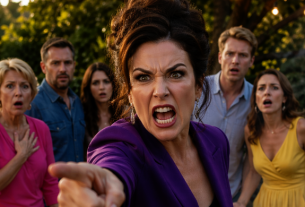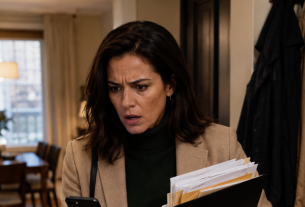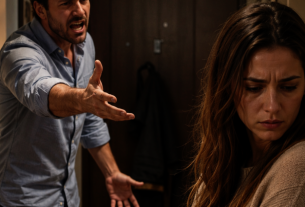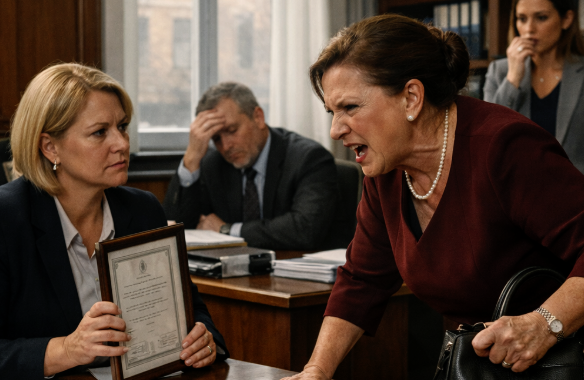
“My mother-in-law secretly transferred my share of the business to my sister-in-law, but one visit to the notary quickly nullified the fraud.
The latte washed over my phone in a warm, sticky wave. I watched the white foam slowly seep into the speaker and did not move. Beneath the layer of coffee on the screen was a notification from my tax account: ‘Changes have been made to the information on the list of founders of Eco-Tara LLC.’
My forty percent had turned into zero. Bella Markovna’s share remained the same, but her daughter, Inna, had suddenly become the owner of nearly half of my company.
I slowly wiped the screen with a napkin. My hands were not trembling—they had become heavy, чужими. I threw the napkin out the car window, straight into a gray Samara puddle. Only one thought kept spinning in my head: how? The documents for my share were in the safe, and only Roman and I had the keys. But Roma has been gone for six months now. And Bella Markovna… Bella Markovna had come to the apartment three times during that period—‘to remember her son’ and ‘to water the cacti’ while I was at the workshop.
She found the keys. Or she knew the code. Roma had never known how to keep secrets from his mommy.
I started the car. The wipers scraped across the glass, smearing the autumn gloom. I needed to go to the office, but I already understood: they were no longer waiting for me there. If the changes had already been entered into the Unified State Register of Legal Entities, then the electronic signatures must already be in the Diadoc system.
Bella Markovna had always considered me ‘a hanger-on with an education.’ Even back when Roma and I took out our first loan for a cardboard recycling machine. She had given us fifty thousand rubles then—‘for good luck’—and demanded a twenty percent share in return. So she could ‘keep an eye on things.’ I had only laughed at the time. For five years I built the certification process, fought for contracts with retail chains, and practically lived in that workshop. Bella Markovna, meanwhile, appeared only once a month—to check whether I was greeting her with enough respect.
I parked outside the office. Inna’s bright red Mazda was standing in my spot.
Fast. She had probably already adjusted the chair for herself too.
The reception area smelled of unfamiliar perfume—heavy and cloying. Marina, our secretary, was avoiding my eyes, pretending to study her monitor intently.
‘Tamara Ilyinichna, good morning…’ she muttered without lifting her head. ‘Bella Markovna is in there. And Inna Yuryevna. They said you had the day off.’
‘I don’t have days off, Marina.’ I walked past her desk. My fingers found the flash drive in my pocket. The leather case felt familiarly rough. It was my anchor.
The office was noisy. Inna was sitting in my chair, twirling my favorite pen in her hands—the very one I had used to sign the first contract with Magnit. Bella Markovna was settled on the guest sofa, her bags spread out around her like she owned the place.
‘Oh, Tommy, we weren’t expecting you,’ my mother-in-law sang out. She did not even stand up. ‘You should go and get some rest. So much grief has fallen on you, so much work… We decided to make your life easier.’
Continued in the comments.”
The latte washed over the phone in a warm, sticky wave. I watched the white foam slowly seep into the speaker and didn’t move. On the screen, beneath the layer of coffee, a notification from my tax account was still visible: “Changes have been made to the information on the list of founders of Eco-Tara LLC.”
My forty percent had turned into zero. Bella Markovna’s share remained the same, but her daughter, Inna, had suddenly become the owner of nearly half of my production business.
I slowly wiped the screen with a napkin. My hands weren’t shaking—they had become heavy, чужими. I tossed the napkin out the car window, straight into a gray Samara puddle. Only one thought kept spinning in my head: how? The documents for my share were in the safe, and only Roman and I had the keys. But Roma had been gone for six months. And Bella Markovna… Bella Markovna had visited the apartment three times since then—“to remember her son” and “to water the cacti” while I was at the workshop.
She had found the keys. Or known the code. Roma had never known how to keep secrets from Mommy.
I started the car. The windshield wipers scraped across the glass, smearing the autumn murk. I needed to go to the office, but I already understood: they weren’t waiting for me there anymore. If the changes had already been entered into the Unified State Register of Legal Entities, then the electronic signatures were already in place in the Diadoc system.
Bella Markovna had always considered me “an educated freeloader.” Even back when Roma and I took out our first loan for a cardboard recycling machine. She had given us fifty thousand rubles “for luck” and demanded a twenty-percent share in return. So she could “keep an eye on things.” At the time, I had only laughed. For five years, I built the certification process, fought for contracts with retail chains, and practically lived in that workshop. Bella Markovna, meanwhile, showed up once a month only to check whether I greeted her respectfully enough.
I parked outside the office. Inna’s bright red Mazda was sitting in my spot.
Fast. She had probably already adjusted the chair to fit herself.
The reception area smelled of unfamiliar perfume—heavy and cloying. Marina, our secretary, avoided my eyes, studying her monitor with excessive concentration.
“Tamara Ilyinichna, good morning…” she mumbled without looking up. “Bella Markovna is here. And Inna Yuryevna. They said you had the day off.”
“I don’t have days off, Marina.” I walked past her desk. My fingers found the flash drive in my pocket. The leather case felt rough and familiar. It was my anchor.
It was noisy in the office. Inna was sitting in my chair, twirling my favorite pen in her hands—the very one I had used to sign our first contract with Magnit. Bella Markovna had made herself comfortable on the guest sofa, her bags spread out around her like she owned the place.
“Oh, Tomochka, we weren’t expecting you,” my mother-in-law sang. She didn’t even stand up. “You should go get some rest. So much grief has fallen on you, and so much work… We decided to make your life easier.”
“Easier?” I stepped up to the desk. “You stole my share. That’s what you call making life easier?”
Inna snorted and leaned back in the chair.
“Mom, just look at her. So aggressive. Toma, everything is legal. You signed a power of attorney back in March giving authority to manage the business. Remember? When poor Roma was in the hospital. You had bigger things to worry about than the company.”
I froze. March. Roma had been in intensive care then, and I really had signed a pile of papers Bella Markovna shoved in front of me. “This is for the hospital,” “this is for the insurance,” “this is to transfer Roma to Moscow.” I trusted her. I was sure we were one family.
“That was a power of attorney to represent my interests in medical institutions,” I said quietly, my voice almost colorless.
“And tucked between those pages was another one,” Bella Markovna replied with a sugary smile. “A notarized one. Giving the right to dispose of company shares. We finalized everything this morning with notary Savchenko. He’s an old friend of the family, Tomochka. He checked everything. Confirmed everything.”
I stared at Inna. She was sorting through folders on my desk.
“So, Tom, clear out the office. We’ve decided to change the business profile a little. Why bother with cardboard? We’re going to import cosmetics from China. I’ve already got connections.”
I felt something inside me freeze solid. Cosmetics from China. They would destroy the production line in a week. Three hundred people would lose their jobs. The machines I had calibrated with my own hands would be sold for scrap metal.
“Savchenko, then?” I asked, looking at Bella Markovna.
“That’s right. A very respectable man. Said everything was clean.”
I nodded and sat down on the edge of the visitor’s chair.
They think I’m broken. They see a widow who has lost everything.
“All right,” I said. Nothing was all right. “But you do understand that production is not just authorized capital. There are licenses. Compliance certificates.”
“We’ll figure it out!” Inna waved dismissively. “Just leave us the passwords to the client database and you’re free to go.”
I pulled the flash drive from my pocket and placed it on the desk. Inna reached for it immediately, but I covered it with my hand.
“This doesn’t just contain the database. It contains the keys to the ISO certification system. Without them, you won’t ship a single batch. All the contracts will be blocked by tomorrow morning.”
Bella Markovna narrowed her eyes.
“Are you threatening us?”
“No. I just want to make sure everything was done correctly. Let’s go to your notary. Right now. I want to see that power of attorney with my own eyes. If it’s real, I’ll hand over all the codes.”
My mother-in-law exchanged a glance with her daughter. Greed flickered in Inna’s eyes.
“Let’s go,” Bella Markovna said, standing up. “We have nothing to hide. Savchenko will confirm it: the signature is yours.”
I stood up. My legs were still heavy, but my mind had cleared. As we walked to the exit, I counted my steps. One, two, three… By the tenth step, I realized they had made one mistake. A small, technical, boring mistake—one an “old family friend” would never notice, but one that a person who had spent five years living by quality-control regulations would see immediately.
Notary Savchenko’s office was located in an old mansion on Kuibyshev Street. High ceilings, heavy drapes, and the smell of old paper—everything here was designed to inspire trust. Savchenko himself, a man with the face of a purebred bulldog, greeted us with pointed courtesy.
“Bella Markovna, Inna Yuryevna, good afternoon. Tamara Ilyinichna…” He nodded to me, but worry flickered in his eyes. “What brings you here? We finished everything this morning.”
“Our Tamara wants to be sure it’s all fair,” Bella Markovna said, settling into a leather chair. “Show her the power of attorney, Stepan Andreyevich. Let her calm down.”
Savchenko took a folder from the safe and laid a sheet with an official seal on the desk.
I picked up the document. My hands were icy, but I forced myself to read carefully. Fifth paragraph from the bottom: “…with the right to dispose of shares in the authorized capital, sign contracts of sale, donation…” And there was my signature. That same sweeping signature I had carelessly scribbled in March on the hood of a car outside the intensive care unit.
They had really slipped that page under a stack of others. Neatly. Skillfully.
“Is that your signature?” Savchenko asked, peering at me over his glasses.
“It is,” I said quietly.
Inna gave a triumphant snort.
“Well then, that’s it. Hand over the flash drive and let’s all go.”
I kept my eyes on the document.
“Stepan Andreyevich, did you check the charter of Eco-Tara LLC before certifying the gift transfer of the share to Inna Yuryevna?”
The notary frowned.
“Of course. A standard charter. There’s no direct prohibition on gifting shares to relatives of founders.”
“A standard charter?” I smiled faintly. Inside, everything in me was trembling. “Bella Markovna, do you remember when we registered the company? You insisted everything had to be done ‘properly.’”
My mother-in-law gave a vague shrug. She didn’t remember. She had never cared about “paperwork,” considering it the servants’ business.
“Well then, Stepan Andreyevich. Five years ago, when we underwent international certification in order to work with European raw-material suppliers, I made one small amendment to the charter. A compliance requirement.”
I pulled out my tablet and opened the file.
“Article 14, clause 8: ‘Any transactions involving the transfer of a share to third parties, including close relatives of other participants, require mandatory prior audit and the written consent of all participants of the company, notarized three working days before the transaction takes place.’”
Savchenko snatched the tablet from my hands. He read it, and his face slowly turned the color of gray chalk.
“But… you are a participant… you signed the power of attorney…” he muttered.
“A power of attorney gives the right to act,” I began speaking more slowly, emphasizing every word, “but it does not replace the procedure for prior consent. Under the charter, I first had to sign a document stating that I agreed to the transfer of the share, wait three days, and only then could the power of attorney be used. This is a material violation of the procedure established by the company charter.”
Bella Markovna leaned forward.
“What nonsense are you talking about? What consent? Stepan, you said everything was fine!”
“Wait, Bella Markovna…” Savchenko was already pulling up the charter in the registry on his computer. The keys rattled like fine shot. “Tamara Ilyinichna… it says here… clause 8.2… ‘If the notification and prior-consent procedure is not observed, the transaction is considered null and void from the moment it is concluded.’”
The room fell so silent that the ticking wall clock became audible. Inna looked from her mother to the notary and back.
“And what does that mean?” my sister-in-law’s voice shot up into a shriek. “What do you mean, null and void? Mom!”
“It means, Inna Yuryevna, that you wasted your time on state fees this morning,” I said, slipping the tablet back into my bag. “Stepan Andreyevich, what do you think the Chamber of Notaries would say if it found out you certified a transaction that directly contradicted the действующий charter of the company? Especially one carried out under a power of attorney issued during the severe illness of the principal’s spouse?”
Savchenko wiped his forehead with a handkerchief. He was not just an old family friend. He was a man who valued his license very highly.
“I… I need to check. Perhaps there has been a technical mistake. The registry doesn’t update instantly…”
“It already has,” I cut in. “And I’ve already filed an objection through my online account against the внесенные changes, attaching a screenshot of that exact clause from the charter.”
Bella Markovna jumped to her feet. Her face, usually polished and calm, was twisted.
“You little… snake!” She swung her handbag, but Inna grabbed her arm.
“Mom, stop! Stepan, do something! We paid!”
“Paid?” I looked at the notary. “That’s a very interesting detail.”
Savchenko went even paler.
“Tamara Ilyinichna, let’s not make any sudden moves. I will annul the transaction entry in the notarial register immediately as erroneous. It’s… it’s a technical failure. My assistant overlooked it.”
I looked at him and felt only disgust. Five years ago, he had drunk tea with us at the dacha and praised Roma’s shashlik. Today, for money, he had helped rob Roma’s widow.
“You have ten minutes,” I said. “Before the entry is fully archived.”
Savchenko rushed to the terminal. Inna stood by the window, biting her lips until they bled. Bella Markovna sank back into the chair, breathing heavily.
She remembered that I drank tea without sugar. She always brought me Belochka chocolates to the office, even though I hated them. She pretended to love me while her son was alive. And now I had become nothing more than an obstacle on the road to “Chinese cosmetics.”
“Tamara,” Bella Markovna spoke again, but in a different voice now—hoarse, stripped of its usual syrup. “You do understand that you’re not family to us anymore? We’ll run you out of this city. Roma had debts… Did you not know about them? Oh, there’s a lot you didn’t know about your husband.”
I said nothing. I watched Savchenko frantically typing, canceling the morning fraud. Her words didn’t hurt me. The pain had stayed behind in the parking lot, along with the spilled coffee. Now there was only work.
“Roman’s debts are my problem,” I said at last. “But the factory is my business. And I will never give it to you.”
“Done!” Savchenko shouted. “The entry has been annulled. The notification of cancellation has been sent to the tax office. By tomorrow everything in the Unified State Register will be back to its original state. Tamara Ilyinichna, you… you’re not going to pursue this further, are you?”
I took my flash drive from the desk and stroked the leather case.
“That depends on how quickly Bella Markovna and Inna leave my office. And whether they take their bags and their Mazda with them.”
Inna sprang up, snatching her coat.
“Mom, let’s get out of here! It stinks like cardboard! I hate all of this!”
Bella Markovna stood slowly. She adjusted the pearl necklace her son had once given her for her fiftieth birthday. She looked at me with such hatred that the air itself seemed as if it should curdle.
“You’ll regret this, Toma. We’ll meet again.”
“Absolutely,” I nodded. “In court, over the theft of documents from my safe. I’ve already called the police to the office. They’re taking fingerprints from the safe door right now.”
My mother-in-law jerked as if struck. She had not expected me to go all the way. She had thought “family” was a shield behind which any cruelty could be hidden.
The rain had stopped, but the sky over Samara was still leaden. I returned to the office an hour later. The red Mazda was already gone from the parking lot. Marina sat pale at the reception desk, buried in reports.
“They left?” I asked, taking off my wet coat.
“They ran, Tamara Ilyinichna. Bella Markovna was shouting so much… said she would curse me and everyone here. The police came. They… they really opened the safe?”
“They did, Marinochka.” I walked into my office.
It was quiet inside. The smell of чужих perfume still hung in the air, mixing with the scent of printing ink and cardboard. My pen lay on the floor by the desk leg. I picked it up. The cap was scratched—Inna must have chewed on it from nerves.
I sat down in the chair. The backrest was still tilted to fit Inna’s height. I pressed the lever, returning it to its usual firmness.
You know what was strangest? I felt no triumph. None of that feeling of “I beat them.” There was only endless, strength-draining exhaustion.
The internal phone rang on the desk.
“Tamara Ilyinichna, the workshop supervisor is asking you to come down. We’ve got a snag with the batch for Auchan—the calibration is off on the second machine.”
I closed my eyes for a second. The second machine. My favorite one. It always got temperamental before the weather changed.
“I’m coming, Stepanych. Five minutes.”
I opened the safe. The door gave way easily—the lock really had been damaged, and deep screwdriver scratches were visible in the plastic. Inside, in the farthest corner beneath a stack of contracts, lay a small velvet box. I opened it. Roma’s gold cufflinks. The same ones he had lost a year earlier and that we had searched for so long.
Bella Markovna had found them. Found them and hidden them in my safe to take later. Or simply so I wouldn’t get them.
I slipped the cufflinks into my pocket.
The workshop was loud. The steady hum of the exhaust system, the rhythmic chopping of blades slicing cardboard strips. Three hundred people. Three hundred families who could have been left without a future that morning because one woman had decided she wanted to import lipstick from Shanghai.
Stepanych was waiting for me by the control panel.
“See, Toma?” he said, pointing to the edge of a sheet. “It’s fraying. Either the blades are dull or the gap shifted.”
I ran my finger along the edge of the cardboard. Rough. Wrong.
“The gap, Stepanych. Adjust it half a millimeter to the left. And check the pressure on the rollers.”
I stood there watching as a worker in blue coveralls took the wrench with practiced ease. Metal clinked against metal.
The machine shuddered, choked for a moment, then began to hum again—steady, clean. The first sheet of the new batch slid into the receiver perfectly even, its edges sharp and precise.
“Beautiful,” Stepanych breathed out. “So? Are we working?”
“We’re working,” I said.
I stepped out of the workshop onto the loading dock. Cold air hit my face. Below, by the gates, a truck was being loaded. The driver in an orange vest was waving to the warehouseman. Life was continuing as usual.
I pulled out my phone. In the contact list, “Bella Markovna” glowed with missed calls. One, two, three. She probably wanted to say something else important about debts or about what a terrible wife I was.
I pressed “Block.”
The share documents would now be kept in a bank deposit box. Not tomorrow—today. Right now.
I touched Roman’s cufflinks in my pocket. The metal had already warmed from the heat of my hand.
It wasn’t a victory. It was simply a return to normal.
I went back to the office. Marina brought me tea—in my old mug, without sugar.
“Tamara Ilyinichna, the tax office called. They asked whether we confirm the withdrawal of the changes.”
“We confirm,” I said, sipping the hot liquid. “Everything stays as it was.”
I walked over to the window. Down below, in a puddle, floated the very napkin I had used to wipe coffee off the screen. A dirty wad of paper that had lost its shape.
I sat down at my desk and placed a clean sheet of paper before me. I needed to draw up the maintenance schedule for the next quarter.
My hand firmly wrote the first number.