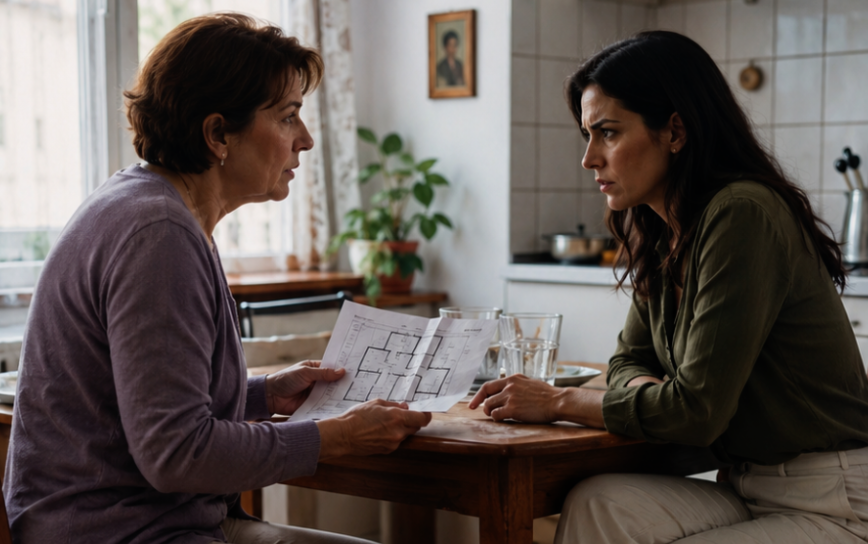
“We’re taking the study, and you’ll move into the small room,” Alyona said, placing a sheet of paper with a drawn house plan in front of Zoya Pavlovna. “And no hard feelings. You’re busy with the housework here anyway, so keep doing that. Young people need space.”
The table immediately grew uncomfortable. Kirill buried his face in his plate, Viktor Pavlovich stopped cutting his meat, and niece Lida put her fork down on her napkin. Zoya Pavlovna stood by the stove with a ladle in her hand, staring at the paper. Written there in neat handwriting were the words: “Guest room — ours. Study — work area. Large bedroom — to be discussed. Zoya Pavlovna — small room.”
“So you’ve just divided up my house?” Zoya Pavlovna asked.
Alyona was not even embarrassed. She leaned back in her chair and adjusted the strap of her expensive sandals, as if they were discussing nothing more serious than rearranging furniture.
“Kirill and I have discussed everything. You don’t need this much space alone. You cook, wash dishes, run back and forth between the kitchen and the table. Basically, you’re just a servant here, only you get offended by the truth. So shut your mouth and stop getting in the way of the young people settling in.”
Kirill raised his head but said nothing. That silence struck Zoya Pavlovna harder than Alyona’s words. Her son had heard everything. Heard it in front of his uncle, in front of Lida, at her table, in her house. And still, he chose his plate.
“Mom,” he finally mumbled, “Alyona said it sharply, but she didn’t mean it maliciously.”
“I said it exactly as it is,” Alyona snapped. “Stop pretending everyone has to dance around your old habits. We’re family. Kirill grew up here. This house isn’t a museum.”
Zoya Pavlovna slowly placed the ladle on a saucer. She had been preparing dinner since morning: salads, a hot dish, berry drink, and Lida had brought strawberries. She had wanted to gather everyone calmly and tell her son and daughter-in-law that their two weeks as guests were over, that it was time for them to return to their own apartment or find some other temporary place to stay while repairs were being done. But Alyona had not come to the table to talk. She had come to announce new rules.
Two weeks earlier, it had all started almost innocently. Kirill called and asked to stay “for a few days” because repairs were being done in their rented apartment. Zoya Pavlovna opened the gate, made up the bed in the guest room, and cleared a shelf in the wardrobe. Alyona arrived with three suitcases and immediately looked around the entryway as if she were inspecting work done by hired laborers.
“It’s a bit dark here, but it’s all right,” she said back then. “We’ll freshen it up.”
On the second day, Alyona moved an armchair from the study into the guest room because “the light is better there.” On the third day, she removed Zoya’s jar of dried mint from the kitchen and replaced it with her own box of coffee-machine capsules. By the fifth day, she had a second set of keys. Kirill had given her his, then taken the spare set from the hook in the hallway for himself.
“Mom, don’t be greedy,” he said when Zoya Pavlovna noticed the missing keys. “We’re not strangers.”
Back then, she stayed silent. Not because she agreed, but because she did not want to start a scandal over keys in front of her son, who looked tired. Now that second set was lying in Alyona’s patent-leather handbag, and on the table in front of Zoya Pavlovna lay the plan of her own house.
“Kirill,” Zoya Pavlovna said without raising her voice. “Did you see this sheet?”
Her son ran a hand over his cheek.
“Mom, well, it’s just a sketch. Alyona likes order.”
“That is not order,” Viktor Pavlovich intervened. “That is dividing up someone else’s rooms.”
Alyona turned sharply toward him.
“Who asked you anything? You’re a guest here.”
“Correct,” Viktor Pavlovich replied. “A guest. Which is why I’m not drawing where my bedroom will be.”
Lida quietly lowered her eyes. Alyona noticed and immediately found a new target.
“Of course, it’s convenient for all of you. You came, ate, and left. But Kirill and I have to live somewhere. We’re a young family; we need a proper base. Are we supposed to drag ourselves from one rented corner to another while his mother has an entire house standing idle?”
“The house is not standing idle,” Zoya Pavlovna said. “I live in it.”
“Exactly. Alone. And there are two of us. You are his mother, Zoya Pavlovna. A mother should help her son, not cling to rooms as if they were her last pieces of gold.”
Kirill lowered his gaze again. He did not argue with his wife, but he did not support her out loud either. As always, he wanted to wait it out. For his mother to give in by herself, for Alyona to calm down by herself, and for the unpleasant conversation to dissolve without his involvement.
Zoya Pavlovna picked up the paper from the table. Alyona tried to press it down with her palm, but Zoya Pavlovna calmly pulled it toward herself.
“Don’t touch it. That’s my plan,” her daughter-in-law said.
“A plan of my house,” Zoya Pavlovna replied, folding the sheet in half. “Which means it stays with me now.”
Alyona smirked.
“Go ahead, hide it. The piece of paper doesn’t change anything.”
“We’ll see about that.”
Zoya Pavlovna went into the hallway and returned with a brown folder. She did not keep documents in plain sight, did not like waving them in front of relatives, and had never thought that one day she would take them out at her own dinner table. But after the words about being a servant, the conversation was no longer an ordinary family dispute. It was an attempt to corner her and force her to serve people who had already started dividing up her rooms.
She placed the folder beside Alyona’s plan and opened it.
“The house was registered in my name on August fourteenth, two thousand seven. In my name, Kirill. Not a single room here is transferred by family decision over dinner.”
Alyona twisted her mouth.
“Documents again. Do you really think a normal mother talks to her son like that?”
“A normal mother talks to her son honestly,” Zoya Pavlovna said. “And a normal daughter-in-law does not come into someone else’s house with three suitcases and a relocation plan for the owner.”
Kirill said quietly:
“Mom, we didn’t want to relocate you.”
Zoya Pavlovna turned to him.
“Then why does the sheet say ‘small room’?”
He did not answer. Alyona answered for him, as she always did.
“Because it’s more convenient for everyone. You find it hard to understand one simple thing: you are no longer the main woman in Kirill’s life. He has a wife. If you are truly a mother and not some greedy owner clutching her keys, you will give way.”
Viktor Pavlovich rose heavily from the table, but Zoya Pavlovna stopped him with a look. She did not want her brother to quarrel on her behalf. For too long, other people had already spoken for her: her son explained why she had to endure things, her daughter-in-law explained where to put furniture, relatives advised her not to ruin relationships. Enough.
“Alyona,” Zoya Pavlovna said, “in one hour your things will be by the gate. Kirill, both sets of keys go on the table in the hallway.”
Alyona laughed, but the laugh came out short and vicious.
“Are you serious? Kirill, did you hear that? Your mother is throwing us out.”
“Not you,” Zoya Pavlovna said. “Her. Kirill can decide for himself where he sleeps. But you will no longer give orders in my house.”
“I am your son’s wife!”
“And I am the owner of the house in which you called me a servant.”
Kirill pushed back his chair. Alyona immediately turned to him, expecting support, but he did not go to her. He stood beside the table, looking at the folded plan, as if for the first time he saw not a drawing of rooms, but what his wife had already managed to do to his mother.
“Alyona, pack your things,” he said dully.
“What?” She straightened. “Are you taking her side now?”
“I’m taking the side where my mother is not called a servant.”
“She put herself in that position!” Alyona pointed at the stove, the plates, Zoya Pavlovna’s apron. “Running around since morning, serving everyone, pouring drinks for everyone. I simply said out loud what was obvious.”
Zoya Pavlovna removed her apron and hung it over the back of a chair.
“You confused care with obligation. I was setting the table for family. I am correcting that mistake right now.”
Alyona grabbed her handbag and went sharply into the guest room. Wardrobe doors slammed one after another. A cosmetic bag, a shoe bag, and a dress cover flew into the hallway. She deliberately threw things loudly, so every thud sounded like an accusation.
“You can carry them yourselves!” she shouted from the room. “Since you’ve arranged this public eviction, enjoy it.”
Kirill stepped toward the door, but Zoya Pavlovna stopped him.
“Keys first.”
He looked at his mother, then took a key ring from his pocket and placed it on the table in the hallway. The second set had to be demanded from Alyona. She came out with a suitcase, opened her bag, and threw the keys beside the first set.
“Choke on your precious house.”
“The house will remain a house,” Zoya Pavlovna replied. “But your words will not remain here.”
Viktor Pavlovich opened the low window of the guest room, which faced the front garden. It was not far to the grass below. He looked at Kirill.
“It’s awkward to drag everything through the door. Hand it here; I’ll take it from outside.”
Alyona stood in the hallway with the expression of an offended mistress, but she did not touch the suitcases herself. Kirill picked up the first suitcase, carried it to the window, and handed it to his uncle. Viktor Pavlovich lowered it onto the grass by the gate. Then the second went the same way, then the third. The things were carried out quickly and calmly, the way unnecessary items are removed from a house after a repair that has dragged on too long.
When the last suitcase was outside the window, Alyona marched toward the gate. Lida carried out the bag with cosmetics and placed it beside the others without saying a word. Zoya Pavlovna stood in the hallway, holding Alyona’s folded plan in her hand. The things by the gate, the keys on the table, the rooms once again free of other people’s orders — all of it happened less than an hour after the phrase about being a servant.
“Kirill, we’re going to my mother’s,” Alyona said from outside. “At least there they understand that young people need help.”
Kirill stood on the porch.
“Go. I’ll just get my jacket.”
“So you’re not coming with me?”
“I’m not staying here overnight,” he said. “But I can no longer pretend you were right.”
Alyona looked at him as though he had betrayed not his wife, but an entire dynasty.
“She turned you against me.”
“You said everything yourself at the table.”
The gate slammed. Alyona went out to the road, where her suitcases stood on the grass. Viktor Pavlovich helped Kirill carry out a box of shoes, and with that, the move was finished. There were no police, no threats, no nighttime showdowns. The person who had come into someone else’s house with a plan to relocate the owner ended up on the other side of the gate along with her belongings.
The house still smelled of dinner. Unfinished salads, berry drink, and a plate of strawberries remained on the table. Zoya Pavlovna took Alyona’s sheet, tore it into four pieces, and threw it into the trash bin. Then she put the documents back into the folder and carried it to her room.
“Zoya, I’ll stay if you need me to,” Viktor Pavlovich said when she returned.
“No need. Just help me clear the table, since dinner turned out like this.”
Lida silently gathered the plates. Viktor Pavlovich took out the trash. Kirill spent another ten minutes walking from the hallway to the guest room, packing his own things into a bag. Zoya Pavlovna did not hurry him and did not pity him. He was a grown man, and for the first time in a long while, he had to see for himself the price of his silence.
Before leaving, he stopped at the door.
“Mom, I’ll come by later for my tools.”
“Alone,” Zoya Pavlovna said.
He nodded.
“Alone.”
“And without any talk about who needs my house more.”
“I understand.”
The next day, Kirill came closer to noon. He rang at the gate and waited until his mother came out onto the porch. It was unusual, and Zoya Pavlovna noticed it right away. He picked up his drill, work jacket, box of fasteners, and Alyona’s mug with the words “queen of the house” written on it. Zoya Pavlovna had wrapped the mug in newspaper beforehand and placed it on top.
Kirill took the bundle and smiled crookedly.
“She was looking for that.”
“Now she’s found it.”
He stood at the threshold, clearly about to say something important, but he took a long time choosing the words. Before, Zoya Pavlovna would have helped him herself: asked whether he was tired, served him food, offered him a seat. Now she waited. Not angrily, not demonstratively — she simply waited for an adult answer from her adult son.
“Mom, forgive me,” he finally said. “I saw that Alyona was going too far. I just thought it would sort itself out.”
“In my house, nothing sorts itself out on its own, Kirill. Either a person respects the rules, or they go beyond the gate.”
“I understand.”
“Good. Then one more rule: you come here as my son. Alyona enters only after a proper apology. Not ‘if you were offended,’ not ‘you misunderstood me,’ but directly: ‘I was wrong.’”
Kirill looked toward the guest room, where there were no longer any of Alyona’s bags, her blanket, or foreign cosmetics on the shelf.
“She won’t say that.”
“Then she doesn’t enter.”
He nodded. He did not argue. He left with the bags and closed the gate carefully, without the old owner-like slam. Zoya Pavlovna returned to the house and first opened the study door. She put the armchair back by the desk, moved Kirill’s boxes into the hallway for his next visit, and reclaimed the shelf in the wardrobe with her own things. The house had not become bigger. It had simply lost someone else’s command.
A week later, Alyona sent a message from an unfamiliar number: “You destroyed our family. I hope you enjoy living alone.”
Zoya Pavlovna read it in the kitchen while Viktor Pavlovich was fixing the pantry handle. She showed the phone to her brother. He snorted and asked whether she was going to answer.
“I am,” Zoya Pavlovna said, and typed briefly: “A gate does not destroy a family. A family is destroyed by a person who comes into someone else’s house and calls the owner a servant.”
She wrote nothing else. Alyona could be angry at her mother’s place, complain to her friends, and explain to Kirill that he had been “pulled away.” In Zoya Pavlovna’s house, none of that changed anything anymore. Alyona had no keys. She had no rooms. She had no house plan.
That evening, Zoya Pavlovna set the kitchen table for herself alone. She put out a plate of potatoes, cucumbers, and strawberries in a small bowl. She sat not by the stove, where Alyona had tried to assign her a place, but at the head of the table. The linen apron hung on the hook by the door, and now there was nothing humiliating about it. It was her thing, in her house.
Outside the window, the front garden was growing dark. No traces of the suitcases remained on the grass. The gate closed more firmly than usual, and for the first time in two weeks, Zoya Pavlovna was no longer listening for someone else’s footsteps in the hallway.