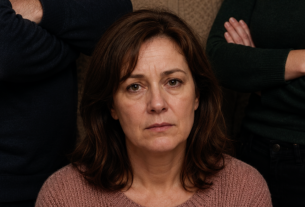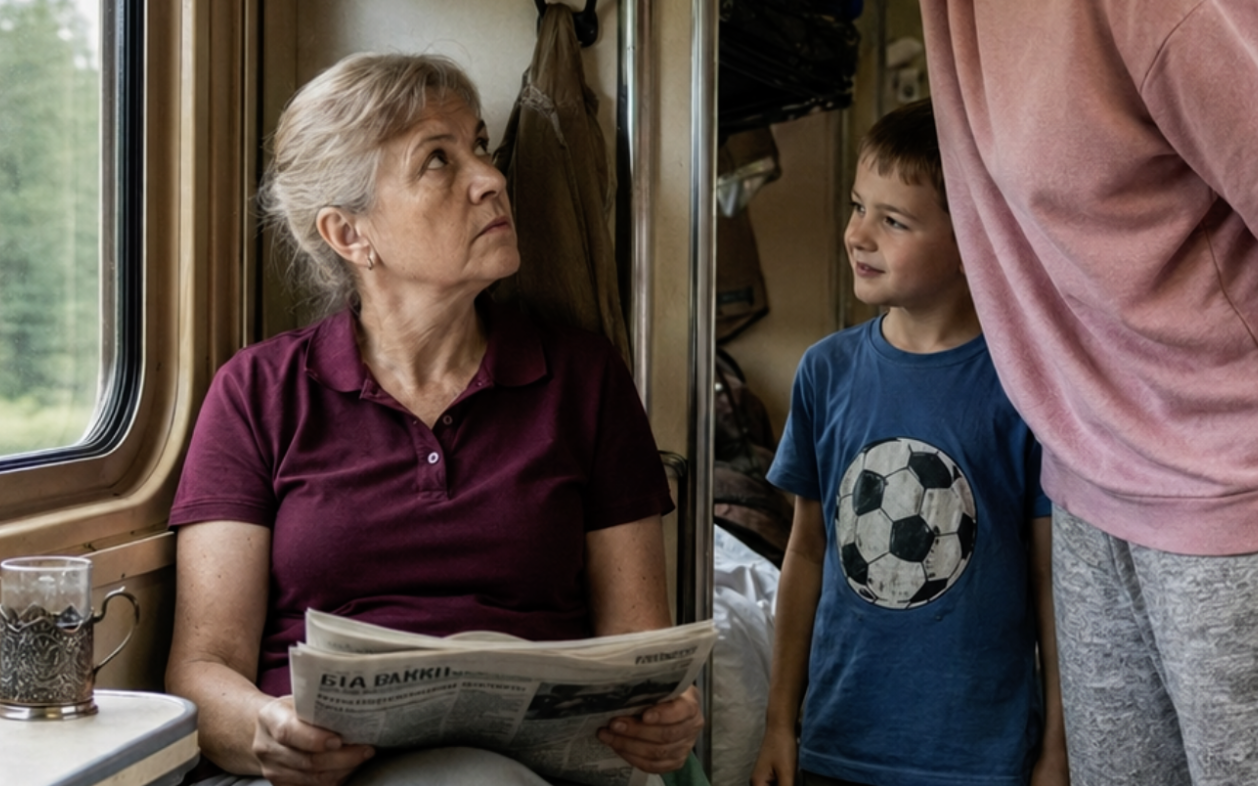
Lyubov Ivanovna was sitting on her rightful lower berth, carefully smoothing the creases in her thick linen trousers. She was fifty-eight years old, thirty of which she had spent working as a senior goods specialist. That profession had taught her two things: how to tell the freshness of bologna at first glance, and how to recognize, from half a phrase, people who wanted to travel at someone else’s expense.
The Saint Petersburg–Samara train gave a soft metallic clank of its buffers and started moving. The gray platform drifted past the window, and equally gray, heavy thoughts about her family began drifting through Lyubov Ivanovna’s soul. She was returning from her daughter’s place.
The trip to Dasha, which had been planned as “helping with the grandson for a week,” had turned into a month of servitude. Lyubov Ivanovna remembered the sink in her daughter’s apartment, forever clogged with plates covered in dried buckwheat. She remembered her son-in-law Slavka, who, after coming home from his “very promising but currently unpaid” internship, would first scatter his socks all over the hallway. Lyubov Ivanovna found those gray little lumps, twisted into the shape of depressive snails, even behind the sofa.
But the main thing was money. Dasha and Slava lived with the extravagance of people who sincerely believed that electricity was born inside outlets all by itself, and groceries teleported into the refrigerator through sheer force of will. They had a huge loan for a television with a screen the size of a small football field, their utility debt had passed forty thousand, and just the other day Dasha, fluttering her eyelash extensions, had announced:
“Mom, we really should buy a robot vacuum. My back is falling apart from walking around with a broom. You’ll chip in from your pension, won’t you? You don’t buy anything for yourself anyway.”
And Lyubov Ivanovna had chipped in. She had given them the savings she had set aside for a sanatorium, bought herself a second-class sleeper ticket to save money, and was now traveling home feeling like a squeezed lemon. Her back ached. The lower berth was her only consolation — she had bought the ticket forty-five days in advance, exactly at eight in the morning, to guarantee herself a comfortable trip.
The compartment door slid open with a crash.
In the doorway stood a woman of uncertain age, packed into a leopard-print velour tracksuit. In one hand she held an enormous duffel bag; with the other, she held a plump boy of about seven, whose face was generously smeared with chocolate.
“All right, Yelisey, come on in, this is our stop,” the woman loudly announced, barging into the compartment and striking Lyubov Ivanovna’s knee with her duffel bag along the way.
Lyubov Ivanovna silently tucked in her legs. The woman threw the bag onto the table, making the glasses in their nickel-silver holders clink anxiously.
“Hello,” Lyubov Ivanovna said with restraint.
“Yeah, hello,” the woman replied, giving her an assessing look. “You’re on the lower berth, I take it? I’ve got the upper one, number thirty-eight. Actually, I had a side berth, but I worked it out with the conductor. He let us in here, there’s more room. So here’s how it’s going to be. Give up the lower berth. We’re with a little child, and you can sleep on the third one,” she commanded, pointing with a finger tipped in chipped gel polish toward the luggage shelf under the ceiling.
Lyubov Ivanovna blinked. She had expected a request to swap for an upper berth — that was a classic of the genre. But the suggestion that she relocate to the luggage rack was something new.
“On the third one?” she repeated, emphasizing every word with her intonation. “Are you suggesting that I, a woman almost sixty years old, curl up beside the mattresses and travel there for an entire day?”
“Well, what’s the big deal?” the leopard-print lady asked, genuinely surprised. “You’re a thin woman, compact. You’ll fit! And that way Yelisey and I will have plenty of room down below. We’ll put our bags on the second berth; we have a lot of things. Come on, collect your little bags. We need to settle in. Yelisey wants to eat!”
Lyubov Ivanovna looked at her the way an experienced goods specialist looks at expired sprats in tomato sauce.
“Young lady,” Lyubov Ivanovna began sweetly, but with metallic notes in her voice, “my seat is number thirty-seven. Lower berth. I bought it a month and a half ago. My back is worth more than your audacity. I will not climb onto the third shelf. Nor the second. Settle in according to the tickets you purchased.”
The woman’s face broke out in red blotches.
“Don’t you understand?! I am a MOTHER! The child is tired from the road! He needs to lie down! How am I supposed to throw him up there? He tosses and turns in his sleep!”
“You should have bought a lower berth,” Lyubov Ivanovna replied, taking crossword puzzles out of her bag.
“There weren’t any lower berths! And we have circumstances! We’re going to his father. He owes us six months of child support, and we’re going to squeeze it out of him! Money is tight! You’re a woman, you should understand! You probably have grandchildren yourself!”
The mention of grandchildren and debts struck Lyubov Ivanovna in her sorest spot. Before her eyes appeared Dasha again, with her endless demands, and Slavka playing video games against the backdrop of unpaid electricity bills.
“You should understand…”
The words echoed through her head.
All her life she had understood everyone. Put herself in everyone’s position. Endured.
“Here’s how it is,” Lyubov Ivanovna said, removing her glasses and placing them on top of the crossword. “Give my fiery greetings to your father. Wish Yelisey a pleasant appetite on the upper berth. And give me silence. The matter is closed.”
The woman exhaled noisily, grabbed Yelisey by the hand, and rushed out into the corridor. Five minutes later she returned with the conductor — a scrawny student whose badge read Denis.
“This citizen refuses to show understanding!” Yelisey’s mother declared. As became clear from her shouting throughout the entire carriage, her name was Snezhana. “Do something about her!”
Denis looked guiltily at Lyubov Ivanovna.
“Um… Ma’am, maybe you could give it up? You know, as a human being? Otherwise they’ll turn the whole carriage upside down.”
“Denis,” Lyubov Ivanovna said, smiling so sweetly that the student’s jaw must have cramped. “As a human being means following passenger transportation rules. If you try to move me now, I will write a complaint to the train chief, and then I’ll call the Russian Railways hotline and report that you are arbitrarily transferring passengers from side berths into compartment sections. Snezhana’s tickets are registered for side berths, correct?”
Denis turned pale, swallowed, muttered, “Sort it out yourselves,” and hastily retreated.
Snezhana realized that the blitzkrieg had failed. She angrily threw her duffel bag onto the second berth and sat Yelisey on the edge of Lyubov Ivanovna’s berth.
“Sit here, son. The auntie is mean, but surely she won’t throw out a child,” she said loudly.
Lyubov Ivanovna said nothing.
Dinner time came. She took her provisions out of her insulated bag. Nothing fancy — chicken baked in foil, fragrant with a bit of garlic; firm garden tomatoes at two hundred rubles a kilo; rye bread; and a piece of good hard cheese. Simple food, but under train conditions, truly royal.
Yelisey, who until then had been enthusiastically picking at the seat upholstery, instantly froze. His nose twitched.
“Mom, I want meat,” he announced demandingly, staring at the chicken leg in Lyubov Ivanovna’s hand.
Snezhana immediately perked up.
“Oh, ma’am, treat the little child! All we have to eat is instant noodles, and they make his tummy hurt. Are you really too stingy to give a little piece to a child?”
Lyubov Ivanovna slowly bit into a tomato, chewed, and dabbed her lips with a paper napkin.
She remembered how Dasha had ordered two thousand rubles’ worth of sushi rolls the previous week and told her mother:
“Mom, there are discount sausages in the fridge. Boil yourself some pasta.”
“Am I too stingy to give a little piece?” Lyubov Ivanovna drawled thoughtfully. “No, I’m not. A chicken leg costs one hundred fifty rubles. Cheese is two hundred rubles per serving. Tomatoes are fifty rubles each. I can make your son a full dinner set for four hundred rubles. I accept transfers by phone number.”
Snezhana opened her mouth. Closed it. Opened it again.
“Are you… are you out of your mind?! Selling food to a child?! Profiteer! In the Soviet Union they would have jailed you!”
“In the Soviet Union, darling, people bought tickets in advance, and children were raised, not used as battering rams to obtain privileges,” Lyubov Ivanovna replied. “No money? Eat noodles. We live under capitalism now.”
She turned toward the window and continued her meal. Yelisey, realizing the chicken was canceled, threw a tantrum. He began kicking his legs, striking Lyubov Ivanovna’s suitcase, which was tucked under the berth. Snezhana demonstratively prepared her noodles, sighing loudly and lamenting that “the world has gone mad, not a drop of compassion left.”
The evening stopped being languid when the main lights in the carriage were turned off.
Snezhana needed to put Yelisey to bed. She categorically did not want to climb onto the second berth.
“Here’s what’s going to happen,” she declared in a tone that allowed no objections. “Yelisey will sleep with you down below. Move closer to the wall. He’s a quiet boy. And I’ll climb up top, so be it.”
It was said in such a tone that Snezhana might as well have been doing all of humanity the greatest favor.
Lyubov Ivanovna took wet wipes from her purse and carefully wiped her hands.
“Snezhana. Listen to me carefully. If your child ends up on my berth, I will call the transport police at the next station. I will state that a strange woman is trying to dump a minor child on me. And believe me, you will have such problems with child services that your husband’s child support will seem like pocket change for ice cream.”
The pensioner’s voice was quiet, even, without a single hysterical note. That was exactly how, back in her working days, she had shut down suppliers who tried to unload rotten potatoes on her under premium-grade invoices.
Snezhana recoiled. In Lyubov Ivanovna’s eyes, she read absolute, reinforced-concrete certainty. Realizing that the bluff had failed, the mother of the year grabbed her son in her arms and, groaning, climbed onto the upper berth. For a long time after that, hissing, rustling, and complaints about “heartless old hags” could be heard from above.
Lyubov Ivanovna lay down, covered herself with the scratchy state-issued blanket, and closed her eyes. The clatter of the wheels measured out the kilometers, carrying her farther and farther away from her daughter.
Suddenly, the phone in her bag vibrated. A message from Dasha.
“Mommy, are you asleep? Listen, Slavik and I were thinking… The vacuum is great, of course, but Slava’s car broke down. Repairs are expensive. Could you transfer us thirty thousand to the credit card? We’ll pay you back from the advance, honest, honest!”
Lyubov Ivanovna stared at the glowing screen in the darkness of the carriage.
From the advance.
They always promised to pay her back from the advance. And then it turned out that Slavka had been fined, Dasha urgently needed a manicure — she couldn’t go to work with bare nails, could she? — and the electricity bill had gone unpaid again.
She shifted her gaze upward. There, with one leopard-print sleeve dangling into the aisle, Snezhana was snoring.
And suddenly Lyubov Ivanovna understood something frighteningly simple. Snezhana from the train and her own daughter Dasha were the same person. Snezhana demanded someone else’s lower berth while hiding behind a child, and Dasha demanded someone else’s life and money while hiding behind the status of daughter. And both sincerely believed that they were OWED. Simply by virtue of their existence.
Lyubov Ivanovna herself had raised that monster of consumption. She herself had given up her “lower berths” all her life. She had denied herself a new winter coat to pay for Dasha’s tutors. She had given up a seaside vacation to pay off their first credit card. She had cooked, cleaned up the scattered socks, carried the whole burden herself, afraid of being a “bad mother.”
Her fingers moved quickly across the screen.
“Dasha. There is no money. And there won’t be any more. My pension is my pension. The credit card is your problem. Learn to live within your means. Kisses, Mom.”
She pressed “Send,” then went into her bank settings and blocked the quick transfer function. Her heart was pounding like mad, but suddenly her soul felt incredibly light. As if she had thrown that very leopard-print duffel bag off her shoulders.
Morning began with Snezhana’s phone giving a pitiful beep and dying.
“Oh, the battery’s dead!” she exclaimed, hanging her head down. “Woman, you’re sitting by the outlet! Plug my phone in!”
The only working outlet in their section really was directly under the table, on Lyubov Ivanovna’s side.
The pensioner calmly stirred her tea with a spoon.
“I can plug it in. One hundred rubles an hour.”
“Are you mocking me?!” Snezhana squealed, nearly falling off the berth. “It’s a public outlet! State property!”
“The outlet is state property,” Lyubov Ivanovna agreed. “But access to it is blocked by my luggage and my legs. In order to give it up to you, I need to stand up, go out into the corridor, and stand there. My standing in the corridor costs one hundred rubles per hour. Market economy, Snezhana. Or wait until the restroom is free. There’s a free outlet there. True, it’s next to the trash bin and it stinks.”
Snezhana looked at the pensioner with hatred. But she needed the phone — the child-support father might not meet them. She rummaged in her wallet, pulled out a crumpled hundred-ruble note, and threw it onto the table.
“Choke on it.”
“Thank you,” Lyubov Ivanovna said. She carefully smoothed the bill, put it into her wallet, and plugged the charger into the outlet.
Those were the first hundred rubles in her life earned from someone else’s audacity. And they warmed her soul far more than the gratitude she had never received from her own family.
The rest of the journey passed in blessed silence. Snezhana sulked, Yelisey chewed dry noodles and played on a tablet with the sound off. Lyubov Ivanovna had warned in advance that sound from the speakers would cost them another two hundred rubles as compensation for moral damages.
When the train arrived at the station, Lyubov Ivanovna slowly gathered her things. She put on her light raincoat and fixed her hair.
“Well, good luck staying here,” she tossed to the family floundering with their bags in the aisle.
Stepping onto the platform, she took a deep breath of fresh morning air. Her phone showed ten missed calls from Dasha and a pile of angry messages along the lines of: “Mom, how could you?! We’re family!”
Lyubov Ivanovna smiled. She went into the station café, where it smelled of fresh pastries and good coffee.
“A large cappuccino, please, and that raspberry pastry over there,” she told the barista.
She took that same crumpled hundred-ruble bill from her wallet, added some of her own money, paid, and sat down at a table by the window.
A whole life lay ahead of her.
And now she knew for certain: the lower berth in that life belonged only to her.
But three days later, when Lyubov Ivanovna opened the door of her apartment, Dasha was standing on the threshold.
With a suitcase.
With tear-filled eyes.
And with Yelisey in her arms.
Yes, yes — the very same Yelisey from the train.
“Mom,” her daughter whispered. “We have nowhere else to go.”