The phone vibrated in the pocket of my cardigan at 11:14 p.m. I was drinking cold tea from a paper cup and staring at the peeling tile on the wall opposite me. I took out my phone automatically — and froze.
The screen said: “Seryozha.”
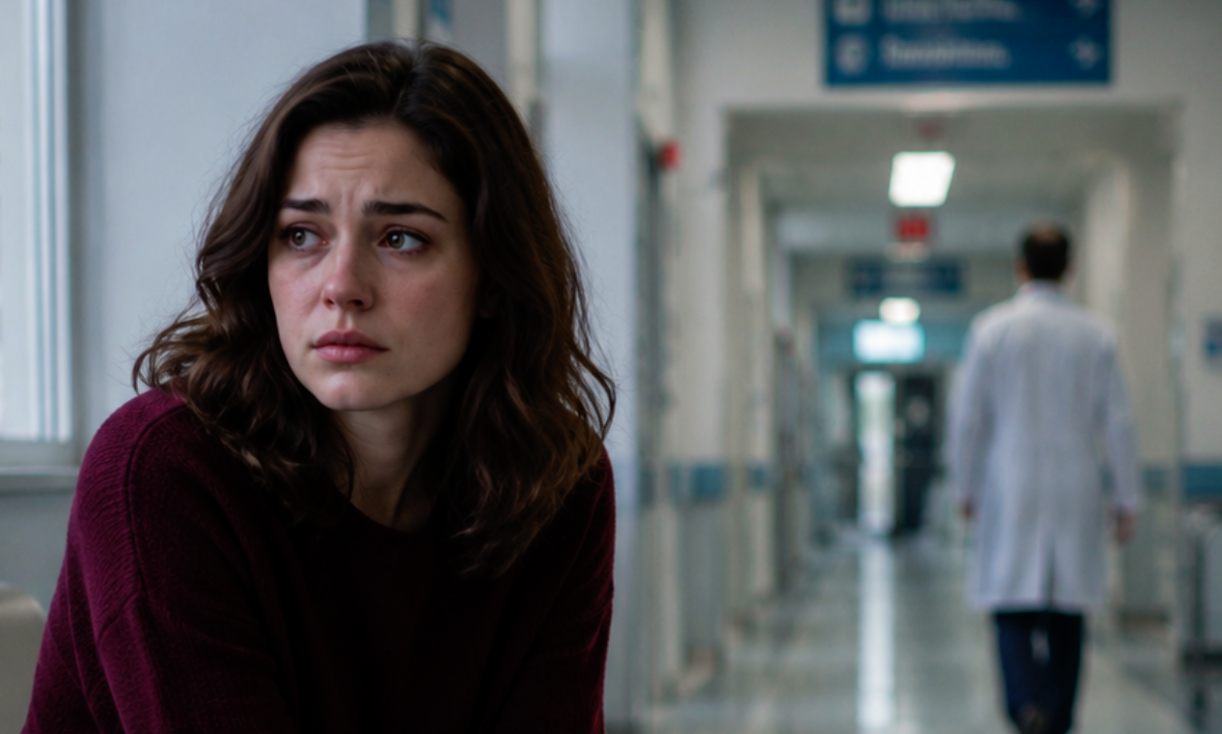
I looked at the door to intensive care. It was closed. Behind it lay my husband — with a tube in his throat, an IV in his arm, unconscious. That was what they had told me three hours earlier. The neurosurgeon, wearing blue shoe covers, had said without looking up, “His condition is serious, stable but serious. Wait.”
So I waited. I did not go anywhere. I did not take off my cardigan, because the corridor was cold.
The phone kept vibrating.
I pressed the green button.
“Hello?” I said. My voice sounded like someone else’s.
There was silence on the line. Then something like breathing. Or interference. Or maybe I imagined it.
“Seryozha?”
Silence.
I pulled the phone away from my ear and looked at the screen. The call was still going. Twenty-three seconds, twenty-four.
“Seryozha, is that you?”
Nothing.
I ended the call. My hands were not shaking — I checked on purpose. I just sat there and stared at the phone. Then I dialed his number myself. Long rings. No one picked up.
The corridor was quiet. Somewhere far away, in another wing, a child was crying. A nurse’s aide in a blue robe pushed a gurney past. Its wheels squeaked.
I stood up and went over to the nurses’ station.
“Excuse me,” I said. “My husband is in intensive care — Lebedev Sergey Mikhailovich. He was admitted today at eight in the evening. Could you please tell me, does he have his phone with him?”
The nurse — young, with tired eyes — looked at me over her glasses.
“Patients’ belongings are taken for safekeeping when they’re admitted. Phones too.”
“I understand. So his phone is not with him?”
“Of course not.”
“Thank you.”
I went back to the bench.
**
They brought Seryozha in by ambulance at 7:40 p.m. I had been at home, frying cutlets. Our downstairs neighbor, Lyudmila Ivanovna, called me — she had seen them carrying him out on a stretcher. He had collapsed right in the stairwell, between the first and second floors. He had been coming home from work.
I turned off the stove and went.
They kept me in the emergency department for forty minutes before the doctor on duty came out. A young man, almost a boy, with dark circles under his eyes.
“Your husband?”
“Yes.”
“Hemorrhagic stroke. Bleeding in the brain. We operated for two hours. He’s now in intensive care, on a ventilator. His condition is serious.”
I nodded. For some reason, I did not cry. I simply nodded and asked:
“Will he live?”
The doctor looked away.
“We’ll do everything possible.”
That was not an answer. I knew that. But I did not ask anything else.
At 11:40 p.m., I took out my phone again and opened the call log. There it was — incoming call at 11:14 p.m., duration thirty-one seconds. Seryozha’s number. His personal number, the one I knew by heart.
I called his sister, Tanya. She lived in Krasnoyarsk and already knew — I had told her earlier.
“Tanya, do you have access to his phone? Can you check whether he called anyone today after eight in the evening?”
“How can I check if he’s in the hospital?”
“Through the operator’s online account. I think you two used to be on the same family plan.”
“No, we separated those a long time ago. Lena, are you all right? Have you eaten anything at all?”
“I ate. Everything’s fine.”
“Do you want me to fly in? I can get a ticket for tomorrow.”
“Not yet. Wait.”
I put the phone away. At the other end of the corridor, a man appeared — around fifty, wearing a jacket and holding a bag. He went to the nurses’ station, spoke quietly about something, then sat on the bench opposite me. We did not look at each other. People do not do that here. Here, everyone waits for their own.
At 12:15 a.m., I dozed off. My head dropped onto my shoulder, and I saw Seryozha — standing in the kitchen, eating cutlets straight from the frying pan, the way he always did when he thought I could not see him.
I saw him. I just kept quiet.
My phone woke me up.
2:07 a.m. Incoming call. Seryozha’s number.
I pressed the green button so quickly I almost dropped the phone.
“Seryozha!”
Silence. The same thing again — breathing or noise, impossible to tell. Then — I’m ready to swear to it — something like a word. Very quiet. One syllable.
“What? Seryozha, speak louder. I can hear you. Speak.”
Nothing.
The call ended.
I stood up and walked quickly to the nurses’ station. This time the nurse was different — older, stern.
“I need to go into intensive care,” I said. “Please.”
“Visits are only from nine in the morning, with permission from the head doctor.”
“I need to go right now. You don’t understand — he is calling me.”
The nurse looked at me with such tired kindness that my throat tightened.
“My dear,” she said, “your husband cannot call you. He is unconscious. He has a tube in his trachea. You are simply exhausted. Sit down.”
“I know he’s unconscious. But I have two incoming calls from his number on my phone.”
“Someone is calling from his phone. Or it’s a technical error. That happens.”
“His phone is in your storage.”
“The storage room is in another building,” she said — not as an explanation, but as the end of the discussion. “Sit down. Talk to the doctor in the morning.”
I went back to the bench.
The man with the bag opposite me, as it turned out, had not been asleep. He was looking at me.
“Your wife?” he asked quietly.
“Yes. And you?”
“My mother.” He paused. “Seventy-eight. Heart attack.”
“I’m sorry.”
“You too.” Another pause. “I heard what you told the nurse. About the calls.”
I did not answer.
“That happened to me,” he said. “When my father was dying. Two years ago. I was sitting in a hospital just like this. And I got a call from his number. I picked up — silence.”
“And what was it?”
“I don’t know.” He shrugged. “My father’s phone was in my jacket. Maybe a button got pressed. Maybe something else. Maybe nothing.”
“And did he… survive?”
The man looked down at the bag by his feet.
“No.”
We fell silent. Somewhere at the end of the corridor, the elevator hummed.
“But he was a good man,” the man said. “Right to the end.”
“Mine too,” I said, unexpectedly even to myself. “He ate cutlets straight from the pan. In secret. Thought I didn’t know.”
The man gave a short smile.
“My father hid candy in his toolbox. Diabetes. My mother scolded him.”
We fell silent again. But now the silence was different.
At 4:20 a.m., I could not stand it anymore and went to the restroom to wash my face. I looked at myself in the mirror. The face was unfamiliar — gray, with red streaks around the eyes. I had tied my hair back before leaving home, and now it was sticking out in all directions. I wet my wrists with cold water and stood there for a while with my eyes closed.
Twenty-two years.
Seryozha and I had been married for twenty-two years. We married when I was twenty-six and he was twenty-nine. Back then, I worked in a library and thought I would work there my whole life. He had just opened his first small company — three people and a laptop in a rented room. We rented an apartment on Nagornaya Street, with a view of factory pipes. He said it had atmosphere.
I used to get angry at him for all kinds of things. For not closing the toothpaste tube. For putting his phone on the kitchen table during dinner. For promising to do something “tomorrow” and doing it the day after tomorrow. For sometimes looking out the window with an expression as if he were not really there, as if he were thinking about something important, something I would never reach.
Trifles. I was angry over trifles.
I opened my eyes and looked at myself in the mirror.
“Sergey Mikhailovich,” I said out loud. “You have no right to die. Do you hear me?”
The mirror did not answer.
The phone in my pocket was silent.
I returned to the corridor.
At 6:30 a.m., the day shift arrived. The corridor came to life — people began appearing, gurneys rolled by, sounds multiplied. The man with the bag had gone somewhere; I had not noticed when. In his place sat a young woman with a baby in her arms. Both of them were asleep.
At 8:15, the neurosurgeon arrived — a different one, not the doctor from yesterday. An older man, with heavy hands and a rumpled white coat.
“Lebedeva?”
“That’s me.”
“Come with me.”
We went into a small office. He sat down. I remained standing.
“The night was stable,” he said. “The dynamics are neutral. We are controlling the brain swelling. It’s still too early to say anything definite.”
“Is he conscious?”
“No. Deep sedation, plus his own coma.”
“When will that change?”
“Hard to say. Maybe in a day. Maybe in a week. Maybe longer.”
I was silent for a moment.
“Doctor, I have a strange question. During the night, I got two calls from my husband’s number. I know that’s impossible. The nurse said his phone is in storage. Could we check?”
He looked at me without surprise.
“The storage room opens at nine. You can ask the administrator to check.”
“Thank you.”
“Any other questions?”
“No. I mean — is he scared? Is he in pain there?”
For the first time, the doctor really looked at me.
“With sedation that deep, no. He doesn’t feel anything. If you like, you could call it mercy.”
I nodded.
“May I see him?”
“Five minutes. Mask and shoe covers only.”
The intensive care unit was smaller than I expected. Six beds, almost all occupied. Monitors, tubes, the smell — that specific hospital smell that makes you want to breathe shallowly.
Seryozha was lying by the window. I recognized him by his hands — large hands, broad wrists, the scar on the index finger of his right hand from falling off a bicycle as a child, a story he had told a thousand times. His face looked different — pale, with a tube and tape. But the hands were his.
I took his hand and squeezed it.
“Hi,” I said quietly. “It’s me. Lena.”
The monitor beeped steadily. Nothing changed.
“I was here all night. You called me. Twice. I don’t know how you did it, but I’m not surprised — you always did things you weren’t supposed to do. Cutlets straight from the pan. Candy in the drawer.”
I realized the last part was not about him and fell silent for a second.
“Anyway, I’m here. I’m not going anywhere.”
His hand did not squeeze mine back. The monitors kept beeping.
“We need to talk about something,” I said. “Remember last November? You wanted to go to Portugal, and I said it was expensive and pointless. And you said you just wanted to show me the ocean. I answered sharply then. I don’t even remember what I said. Something about money and common sense.”
I looked at his face.
“So. Let’s go. As soon as you get better — we’ll go right away. I’ll buy the tickets myself. Just tell me what month is best there. You know I don’t understand these things.”
The nurse by the entrance said softly:
“Time.”
I let go of his hand. Then I took it again — just for a second.
“Call me again,” I whispered. “All right? I’ll answer.”
At 9:10, the administrator opened the storage room and brought me the bag with Seryozha’s belongings. I asked him to check the phone in front of me.
The screen was cracked — apparently it had fallen in the stairwell with him. The phone barely turned on, but it did. The administrator, a young guy with a name badge that said Alexey, opened the call log.
The last outgoing call was to me, at 7:22 p.m. Before the ambulance arrived. Probably when he felt bad and wanted to call.
Incoming calls after 7:30 — zero. Outgoing calls — zero.
No calls at 11:14 p.m. or 2:07 a.m.
I looked at the screen. Then at my own phone. In my call log — there they were, both of them, from his number. Both around thirty seconds.
“That’s impossible,” Alexey said, confused. “Maybe a technical glitch with the operator? Duplication?”
“Maybe,” I said.
I took the bag with his things. I left the phone in storage — the screen was broken, and it would die soon anyway.
I went out into the corridor.
Sat down on the bench.
I took out my phone and opened the call log. I looked at the two incoming calls from his number. Thirty-one seconds. Thirty seconds.
Something like a word. One syllable.
Lena.
Maybe I imagined it. I probably imagined it.
But I put the phone in my pocket and did not delete those calls.
Tanya arrived on the third day — she had bought a ticket after all, without asking me. She looked like Seryozha — the same large build, the same hands, only her voice was different, higher.
We sat in the same hospital cafeteria, drinking the same disgusting tea.
“Tell me something about him that I don’t know,” I asked.
Tanya was surprised.
“Why?”
“I just want to know.”
She thought for a moment.
“He was afraid of the dark as a child. Until he was about twelve. He never told anyone, but I knew — he always left his bedroom door slightly open so the light from the corridor would come in. Then he stopped. Or got used to it. Or just stopped showing it.”
I imagined Seryozha — twelve years old, with the door left ajar. Seryozha — fifty-one years old, with a tube in his throat, in the darkness of intensive care, where the light is always dim.
“Is there light on there at night?” I asked. “In intensive care?”
“I don’t know,” Tanya said. “Probably. The nurses work there.”
“Good.”
We were silent.
“Lena,” Tanya said. “He’ll pull through. I know it.”
“You don’t know.”
“No. But I believe it.”
That was different. I accepted that.
On the fifth day, Seryozha opened his eyes.
They called me at 11:40 a.m. I had just reached home to change clothes and feed the cat. The hospital number appeared on the screen.
“Elena Pavlovna Lebedeva? Your husband has regained consciousness. The doctor is asking you to come.”
I do not remember how I got there. I only remember that the cat was left unfed, and I kept thinking about it for three days afterward.
They let me into intensive care for ten minutes. Seryozha was lying the same way — the tube had already been removed, but the oxygen cannula was still there. His eyes were open. He was looking at the ceiling.
I came up and took his hand.
“Hi,” I said.
He slowly turned his head. His eyes found me. Something in them changed — not joy, no, it was too early for joy. Just recognition.
“Hi,” he said. His voice was hoarse, almost inaudible.
“How are you?”
He moved his head a tiny bit, barely a millimeter. I don’t know. Or: don’t ask.
“I was here the whole time,” I said. “Five days.”
He looked at me again. For a long time.
“I know,” he said.
It was strange. He could not know — he had been unconscious.
“How?” I asked.
He closed his eyes. I thought he was falling asleep. But then he said, very quietly, so quietly that I guessed more from his lips than from the sound:
“I heard you.”
The monitors beeped. Outside the window, the November sun was shining — pale and stubborn.
“Seryozha,” I said. “You called me. Twice. At night.”
He opened his eyes again. He looked at me with an expression — tired, quiet — like people who have been very far away and returned.
“I don’t remember,” he said.
“I know you don’t.”
“But if I called,” he paused, drew in air, “then I must have wanted to say something.”
“What?”
He was silent for a moment.
“Don’t leave.”
I squeezed his hand. Harder than the first time.
“I won’t,” I said.
He was transferred to a regular ward two weeks later. Three weeks after that, he came home — with a pile of pills, a referral to a rehabilitation center, and instructions to “avoid stress,” which, for Seryozha, who had once started four companies, sounded like a joke. But we both pretended it did not.
On his first evening home, he sat on the sofa and looked out the window. I brought tea.
“Do you want cutlets?” I asked.
He looked at me.
“You knew?”
“Always.”
He laughed. For the first time in a month and a half. The laugh was quiet, not like before — before, he used to laugh loudly enough for the whole corridor to hear. But it was his laugh.
“I want cutlets,” he said.
I went to the kitchen.
“Lena,” he called.
“What?”
“I want to go to Portugal in March.”
I stopped in the doorway.
“It’s still cool there in March,” he said. “But there aren’t many people. And the ocean is good.”
“All right,” I said. “In March.”
“You won’t say anything about money?”
“No.”
“Are you sure?”
“Seryozha,” I said. “I’ll buy the tickets tomorrow. Just tell me which airport is better.”
He was silent. Then he said:
“Sheremetyevo. There’s a direct flight.”
“All right.”
I went to fry the cutlets. He kept talking from the living room — about the hotel, about how they had good pastéis de nata there, about how in Lisbon you absolutely had to ride the tram. I listened to his voice and turned the cutlets over.
The phone lay on the windowsill. I still had not deleted those two calls. Sometimes I open the call log and look at them.
Thirty-one seconds. Thirty seconds.
I do not know what it was. A technical glitch. A coincidence. Or something for which I have no word.
But I know one thing: when the phone vibrated at 11:14 p.m. in that hospital corridor and the screen lit up with “Seryozha” — I answered.
And that was the right thing to do.
In March, we went to Lisbon.
Seryozha walked more slowly than before, and sometimes he stopped to rest. We did not hurry. We drank tiny cups of coffee in small cafés. We ate pastéis de nata — warm, with cinnamon. We rode Tram 28 and watched the city climb up the hills.
On the last day, we went to the cape. It was not far from Lisbon; Seryozha had checked the route in advance. Cabo da Roca — the westernmost point of Europe. Beyond it, only the ocean.
We stood by the railing. The wind was strong, salt on our lips. Seryozha took my hand.
“Well?” he asked.
I looked at the water. It was enormous, dark blue, endless.
“It’s big,” I said.
“I told you.”
We were silent for a while.
“Seryozha,” I said. “Do you really not remember? Anything from there?”
He knew what I meant. He thought about it — long and seriously.
“It was dark,” he said at last. “And cold. And then — your voice. ‘I’m not going anywhere.’ And it became warmer.”
I said nothing.
“Maybe it was a dream,” he added.
“Maybe.”
The ocean roared. Seryozha did not let go of my hand.
“Lena.”
“What?”
“Thank you for answering.”
I looked at him. Then at the ocean. Then back at him.
“You were the one calling,” I said.
“Yes. But you answered.”
That was true.
I answered.
I do not know why. I simply did.
And maybe that is the most important thing — not who is calling or from where, but that you answer. That you are there. That you wait.
That you are not going anywhere.