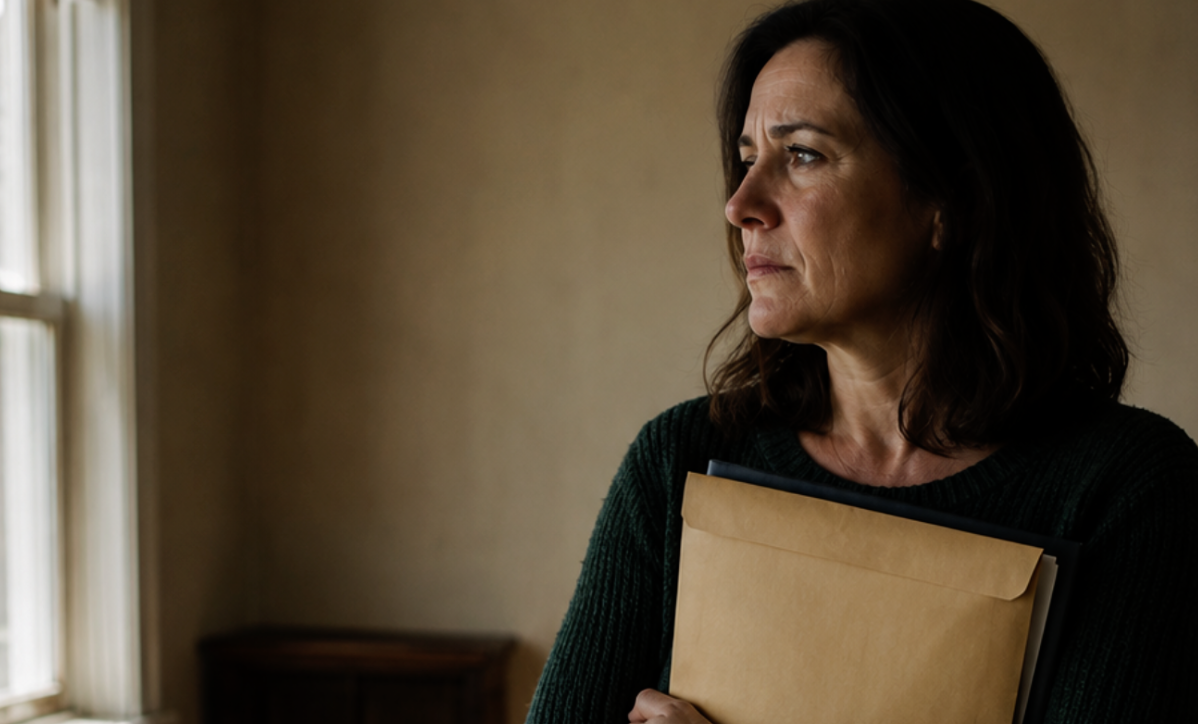
Vera opened the door with her key and immediately understood: something was wrong. The sound was different. Not the click of the lock into the familiar silence of the apartment, but a hollow echo, the kind that belongs to empty rooms.
She stepped into the entryway and stopped. The coat rack was gone. The shoe shelf, the mirror with the crack in the corner, the worn little rug. Nothing.
The corridor stretched out before her, bare and unfamiliar, as if she had walked not into her own apartment but into someone else’s, one that had long ago been put up for sale. Dark rectangles remained on the wallpaper where the frames had hung. Five of them. She knew each one. Their wedding. Their vacation in Anapa. Polinka at her kindergarten graduation. Polinka on her first day of school. A family photo from her mother-in-law’s anniversary.
Vera walked farther in. The kitchen. The table where they had eaten dinner for fourteen years was gone. The stools, the refrigerator, the microwave. Even the sunflower curtains she had sewn herself from fabric bought at the market near Tekstilshchiki metro station. Only the windowsill remained, with a scratch from a flowerpot, and a lonely glass by the sink.
She picked up the glass. It was clean. Dry. Someone had washed it and left it there.
There was no bed in the bedroom. No wardrobe. No nightstand where Igor left his watch and phone every evening. A charging cable stuck out of the socket, and for some reason Vera stared at that cable for two full minutes without blinking.
Then she checked the child’s room. Polinka’s bed was still there, but the dresser drawers were pulled out and empty. Toys, clothes, books with bent pages. He had taken them. The plush rabbit with the torn ear, which her daughter had carried around since she was three, had disappeared too.
Vera sat down on the floor in the hallway. The linoleum was cold, and she felt that cold through her jeans, through her tights, through everything. Her fingers found the phone in her jacket pocket on their own.
Six missed calls from her mother. Two from Igor. One message.
“Polina is with me. Don’t call. We’ll talk through a lawyer.”
The letters blurred. Not from tears, just because the screen was shaking in her hands. She reread it three times before she understood every word.
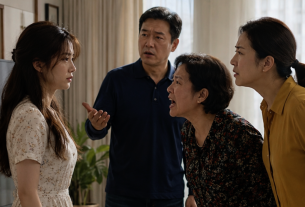
Her mother arrived forty minutes later. Zinaida Pavlovna came in without taking off her shoes, walked through the apartment in silence, looked into every room, and returned to the entryway.
“Bastard,” she said quietly.
Vera was sitting in the same place. Her back against the wall, her legs stretched out.
“Mom, he took Polinka.”
“I heard. You told me three times on the phone.”
“I talked on the phone?”
“You did. That’s why I came.”
Zinaida Pavlovna sat down beside her. Her knees cracked. She was sixty-two and weighed ninety kilograms, but she lowered herself to the floor as if she did it every day.
“Vera, listen to me. This isn’t the time to sit. This is the time to think.”
“I can’t think.”
“You can. You just don’t want to, because you’re scared.”
They sat side by side. Outside the window, the avenue rumbled; somewhere below, the entrance door slammed. Zinaida Pavlovna smelled of Corvalol and bread, a smell Vera remembered from childhood, and it became a little easier to breathe.
“Mom, he took everything. Absolutely everything. While I was on shift.”
“Did he have keys?”
“Of course he had keys. He lived here.”
“You need to change the locks. Tomorrow.”
“And today?”
“Today you’re coming to my place. You’ll sleep. In the morning we’ll sort it out.”
Vera wanted to stand up and realized her knees would not bend. They had frozen. Her mother held out a hand, pulled her up, and they stood in the empty corridor, two women in the autumn half-light of an apartment with no furniture, no curtains, no light in the chandelier, because he had unscrewed the bulbs too.
In the morning, Vera returned alone. Her mother wanted to go with her, but Vera asked her not to. She needed to walk through the apartment in silence, without someone else’s grief beside her.
Light fell from the windows onto the bare walls. Without furniture, the rooms seemed huge and foreign. Vera walked slowly, touching the wallpaper with her fingertips, like a blind woman trying to remember the way.
On the kitchen windowsill she found a folder.
Burgundy, with ties, worn along the edges. The kind used by people who do not trust computer files and clouds. Vera knew that folder exactly. It had stood on the top shelf of the wardrobe in the bedroom, behind the box of New Year’s ornaments, and Igor had never allowed her to touch it.
“It’s work stuff,” he used to say. “Don’t get into it.”
She had not gotten into it. For fourteen years, she had not gotten into it.
The folder lay on the windowsill, and the sun lit up the scratches on the cardboard. The ties were undone, as if someone had opened it, checked the contents, and decided it was not worth taking.
Vera pulled at the edge.
Inside were papers. Many of them. Neatly folded, some in plastic sleeves, some simply stacked. She pulled out the first sheet.
Purchase and sale agreement. Apartment. Not this one. Another one. A one-room apartment, 8 Akademika Korolyova Street, apartment 41. Date: March 2019. Buyer: Igor Dmitrievich Samoilov.
Vera reread it. Buyer. Not tenant, not renter. Buyer.
She sank to the floor and leaned her back against the radiator. The radiator was warm, and the heat passed through her sweater, but her hands remained icy.
She had not known about this apartment. In the six years since the purchase, Igor had never mentioned it. Not once. Not a word. Not a hint.
The next document. A bank account statement. Not from the account where his salary was deposited, but from another one, which she also knew nothing about. Balance on the latest statement: two million four hundred thousand rubles. Date: August 2025.
And then another paper, one that made Vera’s breath catch.
Certificate of registration for Stroylain LLC. Founder: Samoilov I.D. Date of registration: November 2020. Authorized capital: five hundred thousand rubles.
Igor worked as a foreman. That was what he said. A salary of sixty thousand, sometimes seventy if there was overtime. Vera herself earned thirty-eight at the clinic reception desk and counted every thousand, saving for Polina’s summer camp.
And he had an LLC. An apartment. A bank account.
Vera sat on the floor in the empty kitchen and spread the papers around herself like cards. Contracts, statements, certificates. There were also documents for a car registered in his mother’s name. And a promissory note for seven hundred thousand, which he had lent to someone named Rustam. Interest-free. Just like that.
Seven hundred thousand just like that. And in August, she had not been able to buy her daughter a winter jacket and had waited three weeks for payday.
The first call she made was not to her mother. She called Natasha.
Natalya Arkadyevna Gromova worked as a lawyer at a legal center on Proletarskaya. Vera had known her since school. They were not close friends, but they crossed paths sometimes in the parents’ chat because their daughters were in the same class.
“Natasha, hi. Can I come see you today? I have a situation.”
“Vera, I’m at work until six. Come at four, I’ll have a window.”
“Thank you.”
“Vera. Your voice sounds like I can already guess.”
“It’s worse than you think.”
There was a pause. Then Natasha said:
“Bring the folders and documents with you. All of them. Whatever you have.”
“How do you know about the folder?”
“I don’t. But stories like this always have a folder.”
Natalya’s office smelled of coffee and something slightly sour, like old books. On the desk stood a mug that read “Best Lawyer According to Mom,” and Vera’s gaze caught on it as if it were something normal in a world that had become abnormal in a single day.
Natasha read the documents for a long time. She took off her glasses, wiped them, put them on again. Her fingers were long and dry; she moved the papers with the careful precision of a surgeon.
“All right,” she said at last. “The apartment on Korolyova was bought during the marriage.”
“And what does that mean?”
“It means it doesn’t matter whose name it’s registered under. It is jointly acquired property. Half of it is legally yours.”
“But I didn’t know about it.”
“That’s his problem, not yours. He had no right to hide it. The court will take that into account during the division of property.”
Vera listened and did not listen at the same time. The words reached her as if through cotton.
“And the company?”
“The LLC was registered during the marriage. The share in the authorized capital is also jointly acquired property. You have the right to half the value of that share.”
“And the money in the account?”
“The account was opened during the marriage and funded during the marriage. Jointly acquired.”
Natasha took off her glasses and looked at Vera.
“Vera, he robbed you. Not when he took the furniture. He robbed you when he spent years hiding assets. The furniture is pennies. But here we have an apartment, a business, money.”
“But he said through a lawyer.”
“Good. Through a lawyer, then. Only now you have in your hands something his lawyer most likely doesn’t know about. Or knows about and hoped you wouldn’t find.”
Vera looked at the burgundy folder lying on the desk between them.
“Why didn’t he take it?”
Natasha shrugged.
“Maybe he was in a hurry. Maybe he thought you wouldn’t open it. Maybe he simply didn’t think. People who lie for years get used to being believed. They stop being careful.”
That evening, Vera sat in her mother’s kitchen. Zinaida Pavlovna was frying potatoes. Oil spat onto the stove, and she leaned back without letting go of the spatula.
“Mom, he had another apartment. For six years.”
“I knew.”
Vera turned so sharply that the chair scraped across the floor.
“What do you mean, you knew?”
“Not that I knew the address. But I felt it. A man who earns sixty thousand doesn’t drive halfway across the city to get gas. Once I saw him driving away from Korolyova. I didn’t tell you.”
“Why?”
“Because you wouldn’t have believed me. You would have said, ‘Mom, don’t make things up. He has a site there. Or a friend.’”
“I would have said exactly that.”
“That’s why I didn’t say anything.”
The potatoes hissed. Zinaida Pavlovna turned the pieces over, salted them, and covered the pan with a lid.
“Vera, what about Polinka?”
“He won’t give her back.”
“What do you mean he won’t? A child should be with her mother.”
“He says he has better conditions. The apartment, apparently. That one.”
“What conditions? He’s a foreman.”
“He’s the owner of an LLC, Mom.”
Zinaida Pavlovna slowly lowered the spatula onto the table. Then she sat across from Vera and folded her hands on the oilcloth. Her hands were red, hardworking, with short nails.
“All right,” she said quietly. “Then we’ll fight.”
Igor called three days later. His voice was calm and businesslike, as if he were calling not his former wife, but a contractor.
“Vera, I’ve filed for divorce. I don’t advise filing a counterclaim for property. There’s nothing to divide. The apartment is rented, and I bought the furniture before the marriage.”
“The furniture before the marriage? We bought the refrigerator the year before last. We went to Eldorado together.”
“The receipt is in my name.”
“Igor, I found the folder.”
Silence. It lasted four seconds. Vera counted.
“What folder?”
“The burgundy one. With ties. The one you didn’t allow me to touch.”
He was silent. She could hear him breathing. His inhale became shorter.
“There’s nothing important there.”
“The apartment on Korolyova is nothing important?”
Silence again.
“Vera, don’t do anything stupid.”
“I did stupid things for fourteen years. Now I’m doing smart things.”
“We can come to an agreement.”
“Through a lawyer. That’s what you wanted.”
She ended the call. Her fingers trembled, but not from fear. From something else, something unfamiliar, like anger, but harder.
Natasha worked quickly. Within a week, she had prepared requests to Rosreestr, the tax service, and the bank. She filed a motion for interim measures: a ban on alienating the apartment on Korolyova and a freeze on the account.
“He’ll try to re-register it,” she told Vera over the phone. “Sell it, gift it to his mother, transfer it to the company. We need to get ahead of him.”
“And if we don’t?”
“We will. The court reviews interim measures quickly. With luck, in three days.”
They were lucky. Two days later, the court ruling arrived: a ban on registration actions with the apartment and the seizure of the account.
Igor apparently learned about it when he tried to withdraw money, because that same evening Vera received a call from an unfamiliar man.
“Vera Nikolaevna? My name is Artyom Vyacheslavovich. I am Igor Dmitrievich’s lawyer. We would like to discuss a settlement agreement.”
“Discuss it with my lawyer. Natalya Arkadyevna Gromova.”
“Vera Nikolaevna, you understand that a court process is long and expensive?”
“I understand. And do you understand that your client hid marital property from his wife for fourteen years?”
The lawyer coughed.
“We are offering you the apartment where you live and compensation in the amount of three hundred thousand rubles.”
“No.”
“That is a generous offer.”
“No. Contact Natalya Arkadyevna.”
She hung up and realized her hands were no longer trembling.
Polina came back ten days later. Not because Igor allowed it, but because Polina called herself.
“Mom, I want to come home.”
“My darling, the apartment is empty right now. Dad took the furniture.”
“I don’t care. I want to be with you.”
“Come.”
Igor brought her that evening. He stood by the entrance, without coming upstairs. Polina got out of the car with a backpack, turned around, waved to him, and walked to the door. She was eleven years old, and she carried the backpack on one shoulder like an adult.
Vera met her on the landing. Polina pressed her face into Vera’s sweater and stood that way for a long time without saying a word. She smelled of someone else’s shampoo and chips.
“Mom, there’s an aunt living at Dad’s place.”
Vera did not move. Only the hand on Polinka’s head froze.
“What aunt?”
“Svetlana. She says she’s Dad’s friend. But she lives there. She has her own slippers and toothbrush.”
Vera slowly exhaled. The air came out thinly, like from a punctured balloon.
“All right,” she said. “Let’s go. Grandma brought a folding bed, so there’s somewhere to sleep. And she made borscht.”
“Grandma’s borscht?”
“Grandma’s.”
Polina almost smiled.
Natasha called the next morning.
“Vera, I have news. I checked this Svetlana. Svetlana Olegovna Kravtsova has been registered at the apartment on Korolyova since January of this year.”
“Registered?”
“Yes. And you know what else? Stroylain LLC has been paying her a salary since 2022. She is listed as a manager. Only there’s no office at the company’s registered address. It’s an apartment building.”
“So?”
“So he was putting her on the payroll to withdraw money from the company. Or supporting her however he wanted. Maybe both.”
Vera pressed the phone to her ear and looked out the window. In the courtyard, a boy in a red jacket was kicking a ball, and the ball hit the wall of the five-story building with a dull, rhythmic sound.
“Natasha, how much can I get?”
“If the court divides everything in half: half of the apartment on Korolyova or monetary compensation for half of its market value, half of the share in the LLC, half of the funds in the account. Plus the apartment you live in, if we prove that he removed common property without permission.”
“And child support?”
“Child support for Polina is separate. Twenty-five percent of all income, including profit from the LLC. And that’s where things get interesting, because his official salary and his real income are, to put it mildly, different figures.”
Vera smiled. For the first time in two weeks.
The hearing was scheduled for December. A cold Tuesday, eleven in the morning. Vera put on a gray coat that her mother had brought from her own wardrobe, because Igor had taken Vera’s coat too.
The courthouse smelled of wet boots and paper. A long corridor, with wooden benches along the walls. Igor was sitting on one of them.
She had not seen him for a month and a half. He had lost weight. Or maybe it only seemed that way. Beside him sat a man in a dark suit with a briefcase. The lawyer.
Igor lifted his head. Their eyes met. He did not look away, and neither did she.
It was a strange feeling: to look at a person with whom she had slept in the same bed for fourteen years and see a stranger. Not hostile, not frightening. Simply someone else. Like a fellow passenger on a train whose face you forget at the next station.
“Vera, let’s go,” Natasha touched her elbow. “They’re calling us.”
The courtroom was small. The judge, a woman of about fifty with short hair and tired eyes, was leafing through the case file. On the desk in front of her stood a label-less bottle of water.
Igor’s lawyer spoke first. Artyom Vyacheslavovich turned out to be younger than Vera had imagined from the phone: about thirty, smooth-chinned, with a scent of cologne that she could smell even from two rows away.
“Your Honor, my client does not object to the dissolution of the marriage and is prepared to pay compensation in the amount of five hundred thousand rubles. There is no jointly acquired property. The apartment in which the defendant resides is municipally owned. The movable property was purchased by my client personally.”
“With what funds?” the judge asked.
“With personal savings.”
“During the marriage?”
“Uh… yes, but…”
“Continue.”
Natasha stood up.
“Your Honor, we ask to attach the following documents to the case.”
She laid them out one by one. The apartment contract. The account statement. The LLC registration certificate. The Rosreestr certificate. The extract from the Unified State Register of Legal Entities. The market value assessment of the apartment on Korolyova, prepared by an independent appraiser: four million eight hundred thousand rubles.
The judge looked at the documents. Then at Igor. He sat upright, but Vera could see his left hand gripping the edge of the chair. His knuckles had turned white.
“Plaintiff, were you aware that you had a registered legal entity?”
The lawyer began to speak, but the judge raised her hand.
“I am asking the plaintiff.”
Igor cleared his throat.
“Yes.”
“You stated in your claim that there was no jointly acquired property. How do you explain the existence of an apartment purchased during the marriage and a share in an LLC?”
“It was bought with my money.”
“During the marriage?”
“Yes.”
“Then by law it is jointly acquired property, regardless of whose money it was purchased with and whose name it was registered under.”
Vera looked at the judge. She spoke evenly, without intonation, like a metronome. Every word fell separately.
During the break, Igor approached her in the corridor. His lawyer stayed on the bench, and that already said something.
“Vera, let’s talk.”
“Talk.”
“I didn’t want it this way. My lawyer said it was possible…”
“That it was possible to take everything out of the apartment while your wife was at work?”
“He said the property was in my name.”
“He was wrong.”
Igor ran a hand over his face. A gesture she had seen a thousand times: he did that when he did not know what to say.
“Vera, I’m not against Polina living with you.”
“She already lives with me.”
“I know. I just want you to know: I wasn’t going to take her away. I just… got scared.”
“Of what?”
“That you wouldn’t let go.”
“Of you?”
He nodded.
Vera looked at him for a long time, the way people look at something they are about to throw away while deciding whether there is anything useful left in it.
“Igor, I would have let you go. You could have simply said so.”
“I don’t know how to simply say things.”
“I noticed. I noticed over fourteen years.”
He turned away. She saw that the collar of his shirt was wrinkled at the back, as if he had spent a long time sitting with his head thrown back against the chair. And she thought: before, she would have straightened that collar. Automatically, without thinking.
Now she did not.
The hearing continued. Natasha spoke clearly, laying out the facts like a surgeon placing instruments: each one in its place, each one at the right moment.
The bank account, funded during the marriage from income earned through business activity. The apartment, purchased with money earned during the marriage. The share in the LLC, registered during the marriage. The fictitious employment of a third party to withdraw funds from the company.
At the last point, Igor jerked. The lawyer placed a hand on his forearm.
“Your Honor, we object. Svetlana Olegovna is an employee of the company and performs…”
“What functions?” the judge asked.
“Managerial ones.”
“At the registered address of the legal entity there is a residential apartment building. No office premises are registered at that address. Where does this manager perform her work duties?”
Silence.
The judge made a note in her notebook.
The decision was issued two weeks later. Vera learned about it from Natasha, who called in the evening.
“Vera, listen. The apartment on Korolyova: you have been awarded compensation in the amount of half its market value, two million four hundred thousand. The LLC share: compensation in the amount of half its value, two hundred fifty thousand. The funds in the account: half, one million two hundred. Child support: twenty-five percent of all confirmed income, including profit from business activity.”
Vera was silent.
“Vera? Do you hear me?”
“I hear you. How much in total?”
“About four million in compensation, plus child support.”
“And the apartment where I live?”
“It remains municipally owned, so it is not divided. But the court stated that the removal of property from the apartment was carried out without the consent of the second spouse and ordered Igor to return the jointly acquired movable property or compensate its value.”
Vera put the phone on the table. Polina was doing homework on the folding bed, using a book under her notebook. Her mother stood at the stove, stirring something in a pot.
“Mom.”
“What?”
“We won.”
Zinaida Pavlovna did not turn around. Only the hand holding the ladle froze for a second, then continued stirring.
“I knew it,” she said.
A month later, the money began to arrive. Igor did not appeal the decision. His lawyer had apparently explained to him that an appeal would only make things worse.
Vera bought a bed. Then a table. Then a wardrobe. She chose every item herself, slowly, touching the surfaces with her palms. For the first time in her life, she furnished an apartment according to her own choice, not someone else’s. Polina helped. She chose a bookshelf for herself, bright green, the kind Igor would never have approved of.
Vera did not sew curtains. She bought ready-made ones. White, without a pattern. Light passed through them softly, and the rooms looked different than before. More spacious. Quieter.
One evening, Polina asked:
“Mom, do you still have that folder?”
“What folder?”
“The burgundy one. The one that was lying on the windowsill.”
“Yes. In the wardrobe.”
“Can I look at it?”
“Why?”
“Just because. I’m curious.”
Vera took out the folder. Burgundy cardboard, worn edges, ties. She placed it on the new table, and Polina opened it.
“It’s papers,” she said, disappointed.
“Yes. Papers.”
“And all of it happened because of them?”
“Because of them.”
Polina looked at her mother. Seriously, not like a child.
“Mom, what if Dad had taken it?”
Vera thought. She ran her finger along the edge of the cardboard.
“I don’t know,” she said honestly. “But he didn’t take it.”
In the spring, Vera changed the lock on the front door. The locksmith came, installed a new cylinder, and gave her three keys. She hung one on the hook in the entryway, gave one to her mother, and put one in her pocket.
On the kitchen windowsill stood a new flower. A violet. Polina had brought it from school and said the teacher had been giving them out.
Vera watered it every morning. Just a little, so as not to drown it. The soil was dark and moist, and it smelled of something alive.
The folder lay in the wardrobe, on the bottom shelf, behind the box with winter shoes. Vera knew it was there. Sometimes, when passing by, she lowered her hand and touched the edge of the cardboard through the slightly open door.
Not to remember.
To not forget.
The water in the kettle began to boil. The violet stood on the windowsill, and the morning sun lit its leaves from below. Vera poured tea into a new mug, white, without a pattern, without cracks, and sat down at the table.
The chair did not creak. The table did not wobble. The silence in the apartment was different.
Not empty.
Hers.