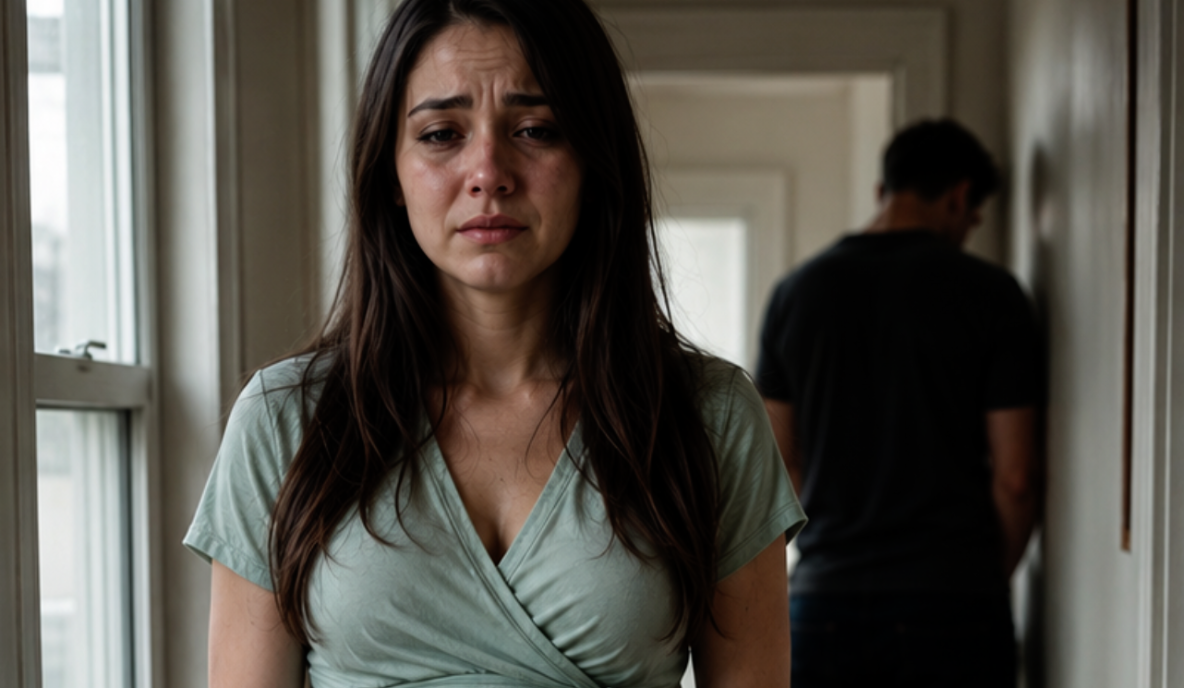
“I’m pregnant,” I said, and a smile spread across my face all by itself.
Kirill, who was standing by the window, froze. He didn’t even turn around, but in the glass I saw his shoulders tense.
I was waiting for hugs, happy shouts, anything—just not that strange, frozen posture.
“I am too,” Lena’s quiet voice came.
My sister came out of our bedroom. She was wearing Kirill’s T-shirt—the very one, my favorite, the one he slept in.
She fixed her hair, and the gesture was so ordinary, so domestic, that for a second my head went foggy.
Flashes of memories I had never attached importance to before began flickering through my mind.
Kirill staying late “at a meeting,” while Lena, who had dropped by “just to chat,” kept glancing anxiously at her phone.
The two of them laughing at some joke only they understood, while I stood nearby, feeling like an outsider at my own celebration of life.
“You have a key, right, Lena?” he had asked her when we were leaving for vacation. “Please water the flowers. There’s no one else I can trust.”
And I had been happy, thinking what a close-knit family we had.
“What?” I asked again, even though I had heard everything perfectly well. My voice sounded strange, wooden.
“Anya, I’ll explain everything,” Kirill finally turned around. His face was white, like a hospital wall. “It’s not what you think. It’s… a mistake.”
Lena looked straight at me. There was no remorse in her eyes. Only exhaustion and some angry, stubborn determination.
“It’s not a mistake,” she cut in, looking at Kirill. “Stop lying. At least now.”
He shot her a furious look.
“Shut up!”
I looked from my husband to my sister. At the man with whom I had been building a future for five years, and at the woman with whom I had shared childhood secrets.
They were standing two meters away from me, but it felt as if an abyss separated us.
And in that abyss, all of my “we” was drowning. Our plans. Our tenderness. Our future nursery.
“A mistake, then,” I repeated, and my lips twisted into a smirk. “Will the two of you have one mistake? Or one each?”
Kirill stepped toward me, holding out his hands.
“Anyechka, darling, let’s talk. Just not now. Lena, leave.”
“I’m not going anywhere,” my sister replied calmly, folding her arms across her chest. “We’re expecting a child. And I won’t let you pretend I don’t exist again.”
I stepped away from Kirill until my back hit the cold hallway wall.
“Get out,” I whispered.
“What?”
“Get out. Both of you.”
They didn’t leave. My word, which had still carried weight five minutes earlier, had turned into an empty sound.
“Anya, don’t act rashly,” Kirill began in the conciliatory tone I hated. The tone he used whenever he wanted me to “be understanding.”
“You’re a smart woman. We’re both adults. Yes, I’m guilty. But right now we need to think not about emotions, but about the children. About our children.”
He emphasized the last word, trying to bind us together again, to create the illusion of a shared future.
“What ‘our’ children are you talking about?” I asked venomously. “The one who will grow up with a single mother, or the one who will be born to his father’s mistress?”
Lena flinched and sobbed quietly.
“Don’t call me that. You don’t know anything.”
“Really?” I turned to her. Cold fury was pushing out the shock. “Then enlighten me. What should I know? That you slept with my husband in my bed? Is that not enough?”
“It wasn’t like that!” Her voice grew stronger. “We love each other. It’s not just some fling.”
Kirill grabbed his head.
“Lena, I asked you!”
“And I’m tired of keeping quiet!” she shouted. “I’m tired of being a secret, a mistake that needs to be fixed! Anya, you always got everything. The perfect husband, the perfect home. And me? I was always second best. Just ‘Anya’s sister.’”
Her monologue was so saturated with old resentment that I was stunned. She wasn’t justifying herself. She was accusing me.
I remembered how, when we were children, Mom always used to say, “Our Anyechka is the clever one, and Lenochka is the pretty one. Everyone has their own gift.” It seemed Lena had never been able to make peace with that “gift” of hers.
“So you decided to take mine?” I asked quietly.
“I took what belonged to no one!” she snapped. “He wasn’t happy with you. You just didn’t want to notice.”
I looked at Kirill. He avoided my eyes. And in that moment, I realized Lena was telling the truth. Not about love, no. But about the fact that he had allowed her to think that way. He had complained to her about me, creating a corrupt bond between them, fed by his weakness and her envy.
“Fine,” I said, and my calmness made them both tense. “Let’s say that’s true. What are you proposing? That we live as three? Or will you make a schedule?”
Kirill lifted his head sharply.
“Stop it! This isn’t constructive. I’m suggesting that for now… we live separately. I’ll rent Lena an apartment. I’ll help both of you. We need time to think everything through.”
He spoke as if he were discussing a business project. Asset division. Risk management.
“So you want me to sit here, pregnant, and wait while you ‘think through’ which of your pregnant women you want to return to?” I laughed. The laugh came out frightening, scraping.
“Anya, you’re making this more complicated.”
“No, Kirill. You simplified everything as much as possible. Down to the level of an animal. Leave. And take her with you. You can collect your things later, when I’m not home.”
I took out my phone and dialed a number.
“Hello, security? There are strangers in my apartment. Yes, they are refusing to leave.”
Lena looked at me with hatred. Kirill looked at me in astonishment. He hadn’t expected that from me. He was used to “good girl Anya,” who would always understand and forgive everything. But that girl had just died.
My call, of course, was a bluff. There was no security service in our residential complex, only a sleepy concierge. But they didn’t know that. The word “security” had a sobering effect on Kirill.
“You’ll regret this, Anya,” he hissed, grabbing Lena by the hand. “You’re throwing a pregnant woman out of the house. Your own sister.”
“I’m throwing my husband’s mistress out of the house,” I corrected him, looking him straight in the eyes. “And you’re just a traitor.”
When the door slammed shut behind them, I slid down the wall to the floor. But there were no tears. There was only a scorched emptiness and adrenaline ringing in my ears.
The next day, hell began.
First, my boss called me.
“Anya, hi. Listen, your husband called… Kirill. He’s very worried about your condition. He says that because of the pregnancy, you’ve been… well… behaving unstably.”
I went cold.
“What else did he say?”
“Well, he asked me to give you some time off. To look after you. He said you might not be entirely adequate when making decisions.”
I understood everything. He hadn’t simply left. He had started methodically destroying me by making me look insane. He was hitting where it hurt most—my job, my reputation, my independence.
An hour later, a courier delivered a letter from his lawyer. A thick envelope full of legal terms, all of which boiled down to one thing: he was filing for division of property. And he wasn’t demanding half.
He was demanding the entire apartment, claiming it had been bought with his personal funds before the marriage and that my contribution to the renovation had been “insignificant.”
But the last page was the most terrifying. He was petitioning the court to appoint a forensic psychiatric examination for me.
To determine whether I could be an “adequate mother” to our future child.
There it was. Rock bottom. He wasn’t just going to take the apartment from me. He was going to take my child. My child. He was going to use my pregnancy, my vulnerability, as a weapon against me.
Something snapped inside me. The very thread that connected me to the old Anya—the understanding, forgiving, “good” one—broke. He thought I would fall apart. That I would cry, beg, agree to his terms. He had forgotten. He had forgotten everything.
He had forgotten who sat with him at night when he was just starting his business, proofreading contracts.
He had forgotten who kept his “gray” accounting in a notebook because there was no money for a proper accountant.
He had forgotten that I knew all his schemes, all his offshore accounts, all his “tax optimizations.”
I had been his shadow, his loyal squire. And he had decided that the squire was unarmed.
I walked over to the safe we had bought together “for important documents.” My hands were not shaking. I entered the code that only he and I knew.
Inside, beneath a stack of our marriage certificates and apartment documents, lay a thin folder. The folder he had asked me to “just keep” a couple of years earlier.
“It’s insurance, Anyechka,” he had said back then. “Just in case. Let it stay with you. You’re the most reliable person I have.”
He had been so confident in my blind devotion, in my ignorance, that he made that fatal mistake. He had placed the weapon in my hands himself.
I picked up my phone. But I didn’t call a lawyer. I dialed the number of an old university friend of mine, who now worked in the economic crimes department.
“Hi, Stas. I have a very interesting story for you. About one very successful businessman.”
The effect of my call was not immediate. Stas explained that an anonymous tip was only grounds to begin an investigation. The process would be long. But the machine had started turning.
The first few months were torture. Kirill pressured me from every side. His lawyers buried me in lawsuits.
He called our mutual friends, telling them I had lost my mind because of hormones. But I held on. I knew I had a trump card, and I simply waited.
He took his first blow six months later. A tax audit. Official and severe.
They froze his main accounts “pending clarification of the circumstances.” He called me. I didn’t answer.
Lena also tried to contact me. She wrote pitiful messages: “He left me. I have no money. Help me, you’re my sister.” I read them and deleted them.
The collapse was not quick. It was agonizing. Like slow poison. Partners, one after another, began turning away from him.
The reputation he valued so much was cracking at the seams. He tried to sell the business, but there were no buyers for a “toxic” asset.
He called me when his card was declined at an expensive restaurant.
“What have you done, you idiot?!” he hissed into the phone. “You’re ruining my life!”
“No, Kirill,” I replied calmly, sorting through the baby clothes I had bought the day before. “I simply turned on the light. The cockroaches scattered on their own.”
He threatened me, shouted that he would destroy me. But there was no longer the same confidence in his voice. Only fear. He had realized that I was no longer playing by his rules.
He lost the property division case. My lawyer proved that the apartment had been purchased with jointly acquired funds, and that his “personal money” had actually been withdrawn from his own company.
His custody claim was dismissed after the tax investigation came to light. He became unreliable.
In the end, he lost everything. His business, money, status. He received a huge fine and a three-year suspended sentence with a ban on holding executive positions.
For a man like him, that was worse than prison.
Two years passed.
I was sitting in a cozy café, watching my son Misha concentrate as he tried to build a tower out of blocks.
Andrey was sitting beside me. A man I had met at classes for young parents.
Calm, dependable, with kind eyes. He never tried to replace Misha’s father. He simply loved both of us.
Suddenly, my phone vibrated. An unknown number. I answered.
“Anya? It’s Lena.”
I stayed silent, not knowing what to say.
“I… I just wanted to say… forgive me,” her voice trembled. “I was such a fool. I envied you my whole life. Your ease, your strength. I thought that if I took him from you, I would become you. But I became no one.”
“How are you?” I asked evenly.
“We’re… all right. I named my daughter Nadya. Kirill… he didn’t even come to pick us up from the maternity hospital. He had no time for us. He tried to borrow my last bit of money and disappeared.”
I looked at my son, who finally placed the last block on top and clapped his hands happily. Andrey smiled and stroked my hand.
“Lena,” I said. “If you need help… for Nadya… you can count on me.”
She sobbed into the phone.
“You really… could?”
“I don’t know,” I answered honestly. “But my door will always be open to my niece. And as for you and me… maybe someday.”
I hung up. Forgiveness was not a firework display that freed me from the past.
It was a quiet decision. A decision not to drag the heavy weight of resentment into my new, happy life.
The memory of betrayal became part of me, like a scar that no longer hurts but reminds me that I survived.
I was no longer the “good girl.” I was a woman who had learned to protect herself. And I liked this version of myself much more.