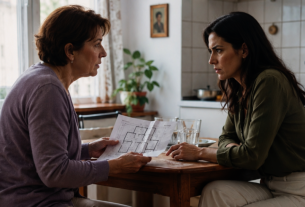
Lena stood by the window, looking at the wet asphalt. The rain blurred the line between the sidewalk and the road, turning everything into one gray mass. Her phone vibrated in her pocket — Igor. She declined the call and turned off the sound.
Three days ago, she had closed the savings account. Seven hundred and eighty thousand rubles, which they had been saving for four years. Half of the money was hers — bonuses, vacation pay she had not spent while Igor bought his mother a new television, paid for her trip to a sanatorium, and replaced the plumbing in her apartment. The other half was formally theirs too, though Lena had long stopped understanding where their family money ended and Nina Petrovna’s needs began.
“Lena, open the door!” Igor knocked on the bedroom door. “I know you’re home!”
She opened it. He was standing on the threshold with a bank printout in his hand, his face red, his tie pulled crooked.
“Did you close the account? I promised that money to Mom!” He shook the paper in front of her face. “We had an agreement!”
“An agreement?” Lena leaned against the doorframe. “Igor, we agreed to save for our apartment. Then for a car. Then for a vacation together. And what happened in the end? Your mother got a new kitchen, new windows, a trip to a sanatorium…”
“She’s alone! Her pension is tiny!”
“My mother’s pension is even smaller. And she’s alone too. And I don’t remember you ever offering to buy her anything.”
Igor clenched his jaw. She knew that gesture by heart — now he would explain how things really worked, how she didn’t understand basic things.
“Your mother lives in her own house. She has a vegetable garden. She isn’t in need. My mom lives in the city, in an old apartment. She needs help.”
“In a house without proper heating,” Lena said calmly. “Where every autumn she stuffs the cracks with jute. But that doesn’t count, right? Because she has a garden.”
“We’ve talked about this a hundred times!”
“Yes. We have. And I’ve heard the same thing a hundred times: ‘Lena, be patient,’ ‘Lena, Mom really needs it,’ ‘Lena, you understand.’”
Igor walked into the room and threw the printout onto the table.
“You had no right to close the account without my consent.”
“The account was in my name. I had every right.”
“Half the money is mine!”
“Your half has been with your mother for a long time already. In the form of new appliances, renovations, and everything else. I calculated it. Over four years, you gave her a huge amount. Now I took my share.”
He looked at her as if he were seeing her for the first time. Confusion flickered in his eyes, quickly replaced by anger.
“Where did you put the money?”
“I spent it on what I need.”
“On what?!”
“A trip. I’m going to Anapa with my mother. The day after tomorrow.”
The silence was so thick that Lena could hear the wall clock ticking in the hallway. Nina Petrovna had bought that clock — Chinese, with a loud mechanism that irritated Lena every evening.
“You’re joking,” Igor said slowly.
“No. I’m going for three weeks. I’ll rent a small house by the sea for Mom and me. She has wanted to go south in autumn, to the warm sea, for years, but she never had the money. Now she does.”
“Lena, Mom is waiting for the dacha. I promised her we’d buy a dacha! She already knows the plot, she’s already gone to see it!”
“You promised her. Not us. You.”
“We’re family!”
“Family?” Lena smiled tiredly. “Igor, when was the last time we spent a vacation together? When was the last time you asked what I wanted? Not your mother, not your relatives — me?”
He was silent. Lena went to the wardrobe, took out a bag, and began packing.
“Lena, wait. Let’s talk normally.”
“We’ve talked normally so many times. It always ended the same way: you went to your mother, complained about me, and then she called me and explained how ungrateful I was. As if I should be grateful that my money was going to her instead of us.”
“She raised me alone!”
“I know. You’ve told me that about two hundred times. And you know what? My mother raised me alone too. After my father left, she worked two jobs and went hungry so I could eat. But somehow that doesn’t give me the right to spend all our money on her.”
Igor sat down on the edge of the bed and lowered his head. When he spoke again, his voice was quieter.
“What am I supposed to tell Mom now?”
Lena froze, a folded sweater hanging from her hands.
“That’s what worries you? Not that I’m leaving. Not that I’m hurting. But what you’ll tell your mother?”
“She was counting on that money!”
“And I was counting on a husband! On him thinking about me at least sometimes. On us having our own life, instead of endlessly serving someone else’s needs!”
“Someone else’s? She’s my mother!”
“Your mother, who calls you five times a day. Who suddenly gets sick every time we plan to go somewhere. Who ‘accidentally’ comes to visit and stays for a week. And you don’t even notice what it looks like.”
“Are you jealous of my mother? That’s ridiculous.”
“No, Igor. It’s sad.”
She zipped up the bag. In the hallway, Igor’s phone rang again. Lena had no doubt it was Nina Petrovna.
“Answer it,” Lena said. “Tell her how awful I am. How I stole the money you promised her.”
Igor grabbed the phone, looked at the screen, and tossed it onto the sofa.
“No need.”
“Why? You usually always answer. At the movies, in restaurants, even at night. Remember when we stayed at a hotel on our anniversary and she called at one in the morning because her TV remote wasn’t working? And you spent half an hour explaining over the phone how to change the batteries.”
“Lena, stop.”
“No, I won’t stop! I’m tired of being second place. Tired of hearing that I’m cruel, that I don’t understand, that I have no heart. I’ve endured it for six years. Six years of smiling when your mother comes over and starts explaining how to cook properly, how to clean the apartment, how to behave with you. Six years of listening to how wonderful your ex-girlfriend was — the one who never objected to all these visits and calls.”
“Leave Olya alone.”
“Gladly. But you’re the one who keeps holding her up as an example. ‘Olya baked pies,’ ‘Olya never objected,’ ‘Olya understood how important Mom is to me.’ Do you know why Olya left? She left for the same reason I’m leaving.”
Igor raised his head. There was something like fear in his eyes.
“You’re not leaving. You’re going on vacation.”
“I don’t know,” Lena said honestly. “I really don’t know. Maybe three weeks away from you and your mother will help me understand what to do next.”
“Lena, I love you.”
“And I love you. But that isn’t enough. Because you also love your mother. And whenever you have to choose between us, you always choose her.”
She picked up her bag and walked into the hallway. Igor followed her.
“Wait. Let’s sit down and talk. We’ll find a solution.”
“Igor, I’m tired of looking for solutions. I suggested seeing a psychologist — you refused. I asked you to limit your mother’s visits — you got offended. I wanted us to go to the sea together just once — you said you couldn’t leave your mother alone for that long. Every time, I gave in. Now you give in.”
“By giving away our money?”
Lena turned and looked him in the eyes.
“It wasn’t our money, Igor. Not anymore. It was your mother’s money that just happened to still be sitting in the account. I simply took what was mine.”
Outside, the rain had stopped. Wet leaves shone under the streetlights. Lena called a taxi and went to her friend Svetka’s place.
“You left?” Svetka opened the door in pajamas, holding a glass of water.
“I left.”
“Come in. Want wine?”
“I do.”
They sat in the kitchen, and Lena talked — not for the first time, but for some reason, today everything formed one clear picture. How Igor always consulted his mother about everything. How Nina Petrovna had keys to their apartment and could come over at any moment. How money flowed to her in an endless stream.
“Do you know the scariest part?” Lena finished her second glass. “I started hating her. Truly hating her. But that’s wrong. She’s just an elderly woman who’s used to her son solving all her problems. But I hate her because, because of her, I barely have a family.”
“And Igor is a good person,” Svetka said thoughtfully. “I’ve known him since university. Kind, decent, faithful.”
“Yes. Faithful to his mother.”
“Do you think it’s over?”
Lena looked out the window. Somewhere there, in the next district, Igor was probably explaining to his mother what had happened. Nina Petrovna was shaking her head, crying, saying she had always known that Lena was not right for her son. Tomorrow she would come to him with pies, comfort him, and repeat that good women were rare nowadays, that he shouldn’t be upset.
“I don’t know,” Lena answered. “Honestly, I don’t know.”
In the morning, Igor sent a message: “I’m sorry. Let’s meet and talk.” Lena didn’t reply. The train to Anapa left at six in the evening.
At the station, she met her mother. Small, thin, with a tanned face, wearing a sweater faded from many washes.
“My daughter,” she said, pulling Lena close. “You’ve lost so much weight.”
“It’s all nerves, Mom.”
They boarded the train. When it started moving, Lena burst into tears. Her mother silently sat beside her and stroked her head, like when she was a child.
“Tell me,” she said simply.
And Lena told her. Everything, without hiding anything. How tired she was, how guilty she felt, even though she understood she had done nothing wrong. How she was afraid to be alone, but even more afraid to go back.
“Do you remember why I never remarried after your father?” her mother asked.
“You said you never met anyone.”
“Not exactly. I did meet men. Good men. But they all wanted me to be convenient. To adjust, stay silent, endure. And I was tired of enduring. After your father, who drank and raised his hand against me, I understood: better alone than like that.”
“Igor doesn’t drink or hit me.”
“I know. But he does what your father did — he doesn’t see you. He doesn’t hear you.”
“Mom, maybe I’m selfish? Maybe I really should have helped with the dacha?”
“You can help. If you’re asked, if it’s discussed, if the decision is made together. But if something is taken from you without even asking — that isn’t help.”
When they arrived, they found a small house by the sea — two rooms, a kitchen, a terrace with a view of the water. The landlady, an elderly Armenian woman, was overcharging them, but when she learned Lena had come with her mother, she softened and gave them a discount.
“A mother always brings joy into a home,” she said. “Rest, girls.”
For the first time in years, Lena felt like she could breathe easily. They walked along the shore, collected shells, cooked dinner together. Her mother told stories from Lena’s childhood that Lena had forgotten. They laughed, drank wine on the terrace, watched the sunsets.
Igor called every day. At first pleading, then offended, then almost aggressive. “You can’t just abandon everything and leave,” “I have to solve your problems here,” “Mom is very upset.” Lena listened, but did not return to the subject of coming back.
On the tenth day, he sent an audio message. He spoke for a long time, stumbling over his words. He said he had gone to a psychologist — alone, for the first time in his life. That he was beginning to understand certain things. That he had talked to his mother, and it had been a difficult conversation. That he loved Lena and was ready to change.
“What will you answer him?” her mother asked.
“Nothing yet. Let him be patient, the way I was patient.”
But two days later, Igor came himself. He secretly found out the address from Lena’s mother. He knocked on the door of the little house in the evening, when Lena and her mother were finishing tea on the terrace.
“Lena, can we talk?”
He was unshaven, rumpled, wearing a wrinkled jacket. Lena stepped outside.
“Why did you come?”
“For you. Forgive me. I should have done this sooner. I should have heard you sooner.”
“Igor…”
“Wait. Let me speak. I really went to a psychologist. Three times already. And she explained to me… or rather, helped me see what I’m doing. How I constantly put my mother’s needs above yours. How I use you, even though I never wanted to. How I turned our family into some strange structure where Mom is the main person, and you’re a secondary character.”
“You understand that now?”
“I do. And I’m ashamed. Very ashamed, Lena. I talked to Mom. I told her we wouldn’t buy the dacha. That I’m married, and my wife is the main woman in my life. That if she wants a dacha, she can save for it herself or sell something of hers. But our money is ours.”
Lena was silent. The words were right. But she had heard the right words from him before — after every fight. And then everything always went back to the way it was.
“How did she react?”
“She cried. Accused me of being heartless. Then she didn’t answer the phone for two days. And yesterday she called and apologized. She said she didn’t want to destroy our family. That she had just gotten used to relying on me and hadn’t noticed she had gone too far.”
“And you believed her?”
“I want to believe her. But the main thing is, I want you to come back. If you want, we’ll move to another city. Or I’ll tell Mom she can only come over by invitation. Or something else. You tell me — what needs to happen for you to come back?”
Lena looked at the sea. The moon drew a path across the water — wide and silver. She wanted to believe. Wanted to hope. But six years had taught her caution.
“I need time. To understand whether this is just temporary enlightenment. To see whether something has really changed.”
“How much time?”
“I don’t know. Maybe a month. Maybe three. I don’t know, Igor.”
He nodded. There was something new in his eyes — not resentment, not confusion. Fear. The fear of losing his love.
“Okay. I’ll wait. As long as you need.”
He left. Lena returned to the terrace, where her mother was pretending she hadn’t been listening.
“He came,” Lena said.
“I see. And?”
“I don’t know, Mom. He says the right things. But I’m tired of the right words.”
“Then wait for actions. Words cost nothing. Actions show everything.”
Two months passed. Lena returned to the city, but rented a small apartment separately. Igor called, they met, they talked. He really did continue going to the psychologist. He really did set boundaries with his mother — she no longer came over without an invitation, no longer called five times a day. Once, she tried to throw a tantrum, and Igor firmly told her he would not discuss it.
One day, Nina Petrovna called Lena herself. She asked to meet. They sat in a café drinking tea, and for the first time in all those years, Lena saw in her mother-in-law not an enemy, but simply an elderly woman who was afraid of loneliness.
“I didn’t want to take your husband away from you,” Nina Petrovna said. “I just didn’t understand that this was what was happening. I thought that if he needed me, it meant I wasn’t alone. It meant life wasn’t over.”
“He wouldn’t have abandoned you anyway,” Lena answered. “But there needed to be room left for me too.”
“I know that now. Forgive me, if you can.”
Lena did not answer. But something inside her trembled. Not forgiveness yet — but something like the possibility of forgiveness in the future.
In March, she and Igor went to the sea. Just the two of them. For a week. He turned off his phone, and they simply spent time together — for the first time in many years. They walked, talked, laughed. They spent time as if they were discovering each other all over again.
“I missed you,” Igor said on the last evening. “The real you. The one who laughs and isn’t afraid to tell me when I’m wrong.”
“I missed you too. This version of you — the one who hears me.”
She returned home. To their shared apartment, where she took the Chinese clock off the wall and hung up a painting she had long been trying to find a place for. Igor did not object.
“This is our home,” he said simply. “You have the right to decide what belongs where.”
And for the first time in years, Lena believed: maybe they would make it. Maybe family is not when one person matters more. Maybe it is when people hear each other. Even if, in order for that to happen, she had to travel to the other side of the country and close that very savings account.