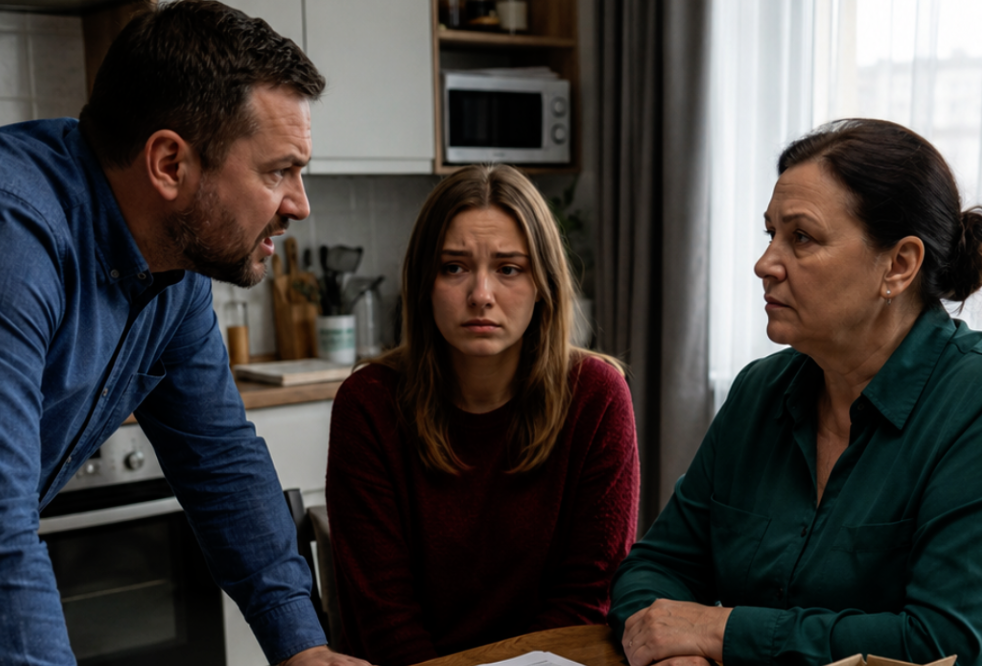
“After the divorce, the apartment is mine, Natasha. You’re an adult. You can rent something for yourself,” Sergey said, sliding a sheet of paper toward her. “No hysterics. Mom and I have already discussed everything.”
Natalya did not take the paper right away. She was not looking at the sheet, but at the plaid bag by Valentina Mikhailovna’s feet. Her mother-in-law had placed it in the kitchen so confidently, as if she had already chosen a shelf in the wardrobe and a spot by the window.
On the sheet, in large letters, it said: “Apartment — to Sergey. Furniture — to Sergey. Appliances — by agreement. Natalya — personal belongings.”
“Very generous,” Natalya said. “Will you at least leave me my slippers?”
Sergey grimaced.
“Don’t start being sarcastic. I’m explaining this to you normally. We lived here as a family. I did the repairs, paid the utilities, brought groceries. The apartment is practically shared.”
“Practically?” Natalya repeated.
“Humanly speaking,” Valentina Mikhailovna cut in. She was sitting at the table in a light coat, even though the apartment was warm. “Not everything should be measured by paperwork. Seryozha is a man. After the divorce, he needs a place to live. And you work, you have a sister. A woman manages somehow.”
Natalya shifted her gaze to her mother-in-law.
“So you’ve already decided that I’m leaving my own apartment, and you’re moving in?”
“I’m not moving in,” Valentina Mikhailovna adjusted the strap of her bag. “I’ll just stay with my son for a while. My place is being renovated, you know that. I have nowhere to go.”
“Your renovation has been going on for three years.”
“Don’t be rude to your elders,” Sergey snapped. “Mom won’t bother anyone. The small room suits her fine. Your desk can go to Kira’s place or your father’s. You’ll take your papers.”
He spoke calmly, even wearily, like a person who was not demanding someone else’s property, but simply formalizing a decision that had long ago been made. That bothered Natalya more than if he had shouted. Sergey was not asking. He was distributing.
“Sign it,” he said, placing a pen beside the paper. “I’m filing for divorce, and you move out without scandals. My nerves aren’t made of iron either.”
Natalya took the sheet, read it again, and placed it in the kitchen drawer. The same drawer where batteries, tape, and old warranty cards were kept.
“I’m not signing this.”
Sergey looked at her as if she had not refused, but had misunderstood a simple instruction.
“Natasha, you’re being stubborn for no reason. After the divorce, you’ll be nobody here.”
“Check the documents before handing out someone else’s square meters.”
She left the kitchen. Behind her, Sergey sharply pushed back his chair. Valentina Mikhailovna whispered something to him quickly and irritably, but Natalya did not turn around.
Her writing desk stood in the small room. Sergey called that room a storage room because there was no guest sofa or television in it. Natalya called it her office because it was there, late at night, that she prepared reports, took extra work, and paid for furniture while Sergey told his friends that he “carried everything alone.”
In the lower drawer lay a thick envelope. Natalya took it out, sat down at the desk, and unfolded the documents.
A deed of gift. Apartment on Sadovaya Street, 49.6 square meters. Donor — Natalya’s father. Recipient — Natalya Orlova. Date — March 14, 2018. Marriage to Sergey registered on September 21, 2019.
She had not hidden this deed. It had simply lain where it was supposed to lie: among important papers. Sergey had once heard about the gift, but it had gone in one ear and out the other. He liked the word “ours.” It conveniently covered any details.
A message from him arrived on her phone: “Don’t drag Kira into this. This is family.”
Natalya called her sister herself. Kira answered quickly, and without long introductions, Natalya told her about the conversation in the kitchen.
“Do you have the documents?” Kira asked.
“They’re in front of me.”
“Then don’t argue with them all night. Show the deed and say briefly: the apartment is not being divided, your mother-in-law is not moving in, and the keys are being returned. That’s all.”
“He won’t give back the keys just like that.”
“Then he’ll give them back not just like that, but after he understands that he was giving orders in someone else’s property.”
After the call, Natalya took a blank sheet of paper and wrote several lines by hand. No threats, no long explanations: “I do not consent to Valentina Mikhailovna living in the apartment. I ask Sergey Orlov to remove his personal belongings and return the set of keys.” She reread the note and placed it next to the deed. The words looked dry, but there was neither a request nor a justification in them.
In the morning, Sergey behaved as if the previous evening’s conversation had ended with his victory. He loudly opened the wardrobe in the hallway, pulled out his jacket, and threw it onto the ottoman.
“Mom is bringing a couple of boxes. Don’t start again. The small room is free.”
“The small room is occupied.”
“By your desk?” Sergey snorted. “Natasha, enough already. A desk isn’t a person. Mom needs a bed, not your folders.”
The doorbell rang. Sergey went to open the door with the expression of a man returning home with the owner of the apartment, not letting his mother into someone else’s property.
Valentina Mikhailovna entered the hallway first. Behind her, a delivery guy set down two boxes and a narrow suitcase. On the top box, written in black marker, were the words: “Kitchen. Valya.”
Natalya’s eyes lingered on that inscription. Sergey’s list from yesterday suddenly became physical: here was the kitchen, here were the belongings, here was someone else’s confidence that she had already been moved aside.
“Don’t put those here,” she told the delivery man.
The guy stopped.
“To the kitchen,” Valentina Mikhailovna ordered without looking at Natalya. “I’ll sort out the lower cabinet myself. Half of what’s in there is useless anyway.”
“The boxes stay by the door,” Natalya repeated. “They are not being carried into the kitchen.”
Sergey turned sharply toward her.
“Are you making a scene in front of a stranger?”
“I’m explaining that other people’s things are not being unpacked in my apartment without my consent.”
Valentina Mikhailovna took off her coat and hung it on Sergey’s hook.
“Natasha, it’s unpleasant for me to hear this. I’m your husband’s mother, not some random woman from the street.”
“In this apartment, you are a guest. And only until I ask you to leave.”
Sergey gave a short laugh.
“Are you seriously trying to play the hostess?”
Natalya went to the small room and returned with the envelope. At first, Sergey looked at her face, not at the papers. He was waiting for the usual long speech. Waiting for her to start explaining why she was offended and drown in her own explanations.
Natalya placed the deed on top of his list from yesterday.
“Read.”
“What is this?”
“The document you didn’t consider it necessary to remember when you were dividing the apartment.”
Sergey picked up the sheets. His self-confidence held for a few more seconds, then his face grew tense. He quickly scanned the lines, returned to the date, then looked at Natalya.
“A gift deed? From your father?”
“Yes.”
“But we were already together.”
“We were together. We were not married. The apartment was gifted to me on March 14, 2018. The marriage was registered on September 21, 2019.”
Valentina Mikhailovna moved closer.
“Seryozha, you said the apartment was family property.”
“I thought it was family property,” he snapped irritably.
“You didn’t think,” Natalya said. “You got used to me not arguing when you called mine ours.”
Sergey placed the deed on the table but did not take his hand off it.
“I did repairs here.”
“You replaced the faucet, put up a shelf, and chose wallpaper for the large room. That does not make you the owner. It makes you a person who lived here and used the apartment.”
In the hallway, the delivery man awkwardly shifted from one foot to the other.
“Should I leave the boxes or take them back?”
“Back,” Natalya said.
Sergey flared up.
“Don’t order my people around.”
“Then explain the new address to them yourself. Valentina Mikhailovna is not living in this apartment.”
Her mother-in-law straightened.
“Now everything is clear. So family means nothing to you. The main thing is a piece of paper.”
“The main thing is that you and Sergey already decided everything for me. You even labeled the box.”
Valentina Mikhailovna looked at the words “Kitchen. Valya” and fell silent for the first time that morning. The inscription had exposed more than all her soft phrases about repairs and clinics.
Natalya took out the second sheet.
“Here is my decision. I do not give consent for you to live here. Sergey removes his personal belongings and returns the keys.”
Sergey smirked, but the smirk came out strained.
“Are you trying to scare me with a piece of paper?”
“No. I’m leaving no room for your retellings. Yesterday, you said I had agreed to the division. Today, your mother says I almost agreed to her moving in. Now you have a text that states exactly what I said.”
The delivery man picked up the box marked “Kitchen. Valya” and carried it back out onto the landing. The suitcase followed. The hallway immediately became wider, as if someone else’s decision had been removed along with the luggage.
Sergey stood by the wall in silence. Valentina Mikhailovna was quickly typing a message to someone, but her fingers kept stumbling.
“Fine,” Sergey said at last. “The apartment is yours. But I’m taking everything inside.”
“Take what is yours: clothes, tools, computer, documents. We’ll discuss shared purchases separately and calmly. But without lists where I’m left with personal belongings in my own apartment.”
“You’re ungrateful, Natasha.”
“You’re confusing gratitude with permission to control me.”
Valentina Mikhailovna picked up her bag.
“Seryozha, let’s go. I don’t have the strength to listen to myself being erased from the family.”
Natalya did not answer. Her mother-in-law was waiting for a phrase she could later cling to: rudeness, insult, shouting. Natalya gave her only a closed door.
When they left, Natalya did not sit down to cry or start calling everyone she knew. She photographed Sergey’s list, her note, and the boxes in the hallway while the delivery man had not yet carried away the last one. Then she called Kira.
“Come over if you can. We need to pack his things so there won’t be talk later that I hid something.”
Kira arrived an hour later with two large bags and labels. She did not hug Natalya in the hallway or ask how she was holding up. She simply took off her shoes, rolled up her sleeves, and asked:
“Where do we start?”
“The hallway. His jackets, boots, tools.”
They sorted the belongings silently and carefully. Sergey occupied the apartment not through the number of things he owned, but through the manner of leaving them wherever it suited him. Fishing rods behind the wardrobe, a box of wires under the desk, tools on the top shelf where Natalya could not reach without a chair. For years, all of this had been called “men’s things for the home,” although only he used them.
Kira labeled the bags in large letters: “Sergey’s clothes,” “Sergey’s tools,” “Sergey’s documents.”
“He says I’m kicking him out,” Natalya said, folding his sweaters.
“Yesterday he wrote that you get personal belongings,” Kira replied. “You simply applied his own principle to him.”
By evening, four bags, a sports bag, and a box of tools stood in the hallway. The deed of gift was not by the door, but in the small room on the desk. Natalya had no intention of waving it around during every conversation. The document had already done its job: it had stopped someone else from taking charge.
Sergey arrived exactly at six. Without his mother. He looked over the bags and the box as if he were seeing not his belongings, but proof of his loss.
“You packed me up quickly.”
“Your things are packed carefully. Check them.”
He bent over the box, shifted the tools around, then straightened.
“I’m keeping the keys. I’m not taking everything at once.”
“No. You return the keys now.”
“Natalya, don’t go too far.”
“You tried to move your mother in here this morning. I have no reason to leave you access.”
Sergey looked toward the small room. He knew Kira was sitting there, but she did not come out or interfere. Her presence worked better than any comments: Natalya was no longer alone in the kitchen against two people who had “discussed everything.”
Sergey took out his keyring and removed two keys: one for the entrance and one for the apartment. He placed them on the cabinet.
“Happy now?”
“The mailbox key too.”
He hesitated, then removed the small key and tossed it beside the others.
“You’ve changed a lot.”
“No. You’ve just heard me refuse for the first time.”
Sergey picked up the box, then returned for the bag. At the door, he stopped.
“Mom thinks you’ll still apologize. She feels terrible because of this whole story.”
“I’m not discussing your mother. I’m discussing belongings, keys, and the divorce. You can handle everything else without me.”
He wanted to answer sharply, but instead he grabbed a bag and left. On the staircase, the box loudly hit the railing, and Sergey swore under his breath. Natalya did not close the door immediately. She waited until his footsteps faded downstairs, and only then turned the key.
Kira came out of the small room.
“Well?”
“He returned the keys.”
“Then the power is over.”
They did not celebrate. They simply cleaned the hallway, wiped the cabinet, and threw Sergey’s list into the trash. The very list where Natalya had been left with “personal belongings” in her own apartment.
Sergey picked up the rest of his things three days later. This time he came quickly and almost did not argue. He took a folder with his insurance papers, an old jacket, and a box of wires. For several minutes, he stood by the kitchen, where his mother had tried to claim the lower cabinet that morning.
“Mom is staying with a relative,” he said without looking at Natalya. “She already told everyone she was moving in with me. Now she looks stupid.”
“She looks the way a person looks when she came to live somewhere she was not invited.”
Sergey gave a crooked smirk.
“You’ve become harsh.”
“No. Precise.”
He did not argue anymore. He lifted the box, left, and quietly closed the door. No slam. No final loud phrase. No old confidence that any decision of his automatically became shared.
Natalya walked through the apartment. There were no strange bags in the hallway. There was no box labeled “Kitchen. Valya” in the kitchen. The small room was once again an office, not a place someone had assigned to her mother-in-law in advance.
She took Sergey’s folded sheet out of the drawer, unfolded it, and read: “Apartment — to Sergey. Furniture — to Sergey. Appliances — by agreement. Natalya — personal belongings.” Then she tore it into several pieces and threw it away. Not angrily, not for show. That paper simply no longer decided anything.
Natalya put the deed of gift back into the envelope and placed it in the lower drawer of the desk. Beside it, she put Sergey’s three returned keys. Separate from her own keyring.
That evening, her father called.
“How are you?” he asked.
Natalya looked at the empty hallway and the clean kitchen table.
“I’m fine. The document came in handy.”
“That’s why I told you to keep it with you.”
“It’s not only about the document, Dad. I just stopped explaining to people why they don’t get to control my home.”
Her father was silent for a moment, then calmly said:
“That’s right.”
After the call, Natalya took off her wedding ring and placed it in the box with Sergey’s small things that he had forgotten. By the door stood one last little bag for him: a charger, a belt, an old flash drive. Kira had written on it in marker: “Pick up.”
Natalya turned off the light in the hallway and went into the small room. On the desk lay her papers, her laptop, and the envelope with the deed. The armchair stood by the window exactly the way it was comfortable for her.
In the apartment on Sadovaya Street, 49.6 square meters, no one divided up the cupboards anymore without her consent.